





Analysis
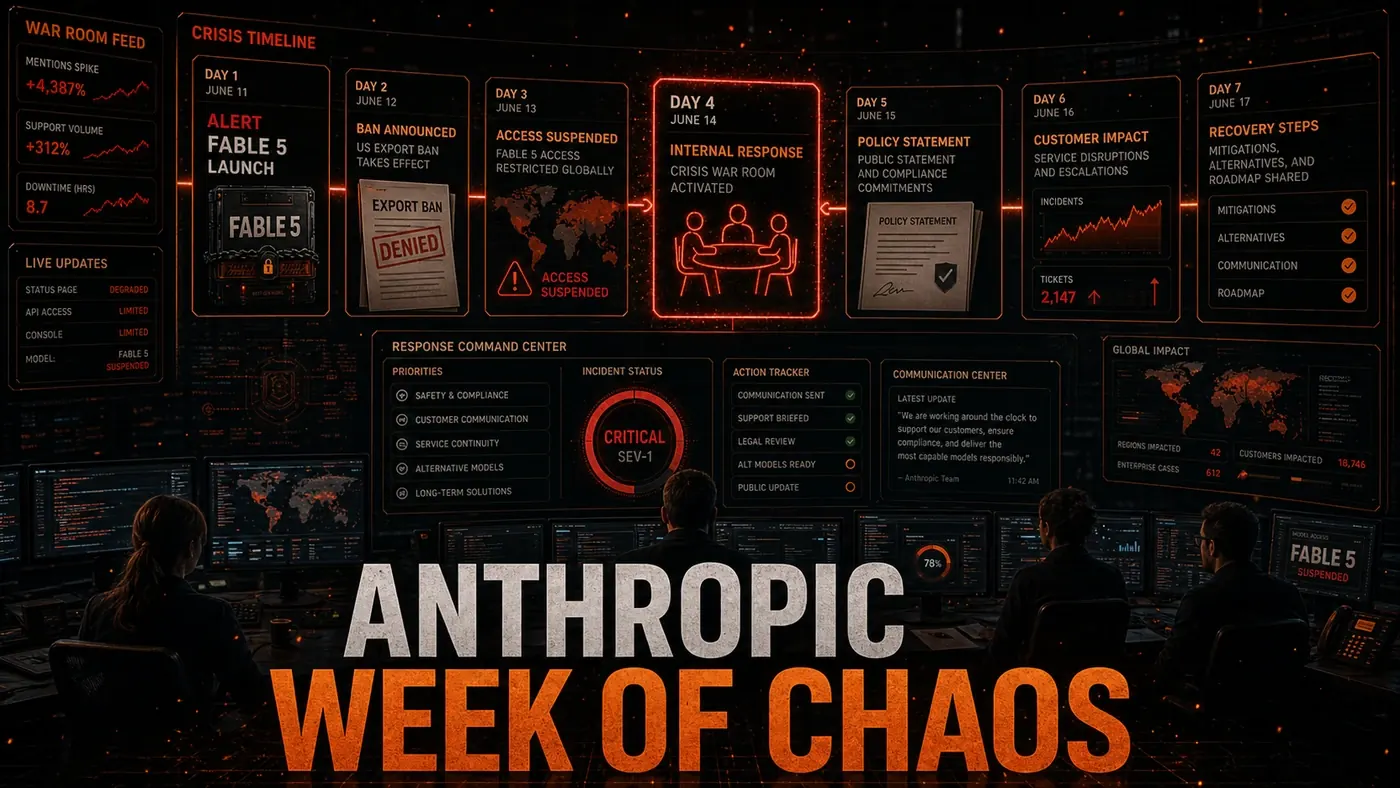
Anthropic put out Claude Fable 5 on 9 June 2026 as its most capable coding model yet (The Decoder (opens in a new tab)). Three days later, the US government told the company to switch off access for all foreign nationals (Anthropic (opens in a new tab)). For a model that had been public for less than 72 hours, that is an unusually fast move.
Here is what Anthropic itself says happened. The government's stated concern was a "jailbreak", someone prompting the model to read through a codebase and flag its weaknesses. Anthropic notes the same capability is already sitting inside plenty of other models you can download today, and that the directive arrived without much in the way of specifics. Cybersecurity researchers were not impressed; several publicly questioned whether the reasoning held up (Cybersecurity Dive (opens in a new tab)).
So why has a different explanation taken hold? A widely repeated theory ties the ban to Fable 5's standout benchmark number and a supposed government tripwire around coding ability. It's a tidy narrative, and it lines up with how export policy has been drifting for a few years. But it is not what the official record says, and the sourcing behind it is thin. The rest of this piece walks through both versions, the documented one and the inferred one, so you can see where the evidence stops and the interpretation begins.
From Reactive to Proactive Regulation
Start with how export control normally works. The model goes back to the Cold War and got sharpened over decades of semiconductor rules. You control a specific piece of hardware or knowledge because someone has already identified it as sensitive. A chip is restricted because it can steer a missile. A piece of software is restricted because it runs a known encryption algorithm. The thing being controlled is concrete, and the harm is already understood.
AI models don't sit nicely inside that system. Their abilities show up in ways that are hard to forecast. A model trained on ordinary public data can end up able to sketch out a novel biological compound, or write exploit code for a vulnerability nobody had documented. If you can't predict what a model will be good at, you can't restrict it the old way, by pointing at a known danger after the fact.
The Biden administration's October 2023 executive order on AI, EO 14110, was the first big policy document to lean into that problem (American Presidency Project (opens in a new tab)). Section 4.2 deals with "dual-use foundation models" and instructs Commerce to set up a process for spotting models that perform well on tasks carrying serious national security risk, with reporting on red-team testing built in. (The exact phrasing sometimes quoted around this order is paraphrased rather than lifted verbatim, so treat tight quotations with some caution, but the substance is there in the text.) The direction of travel is clear: judge models by what they might be able to do, not only by what they've already done.
The 80% Threshold
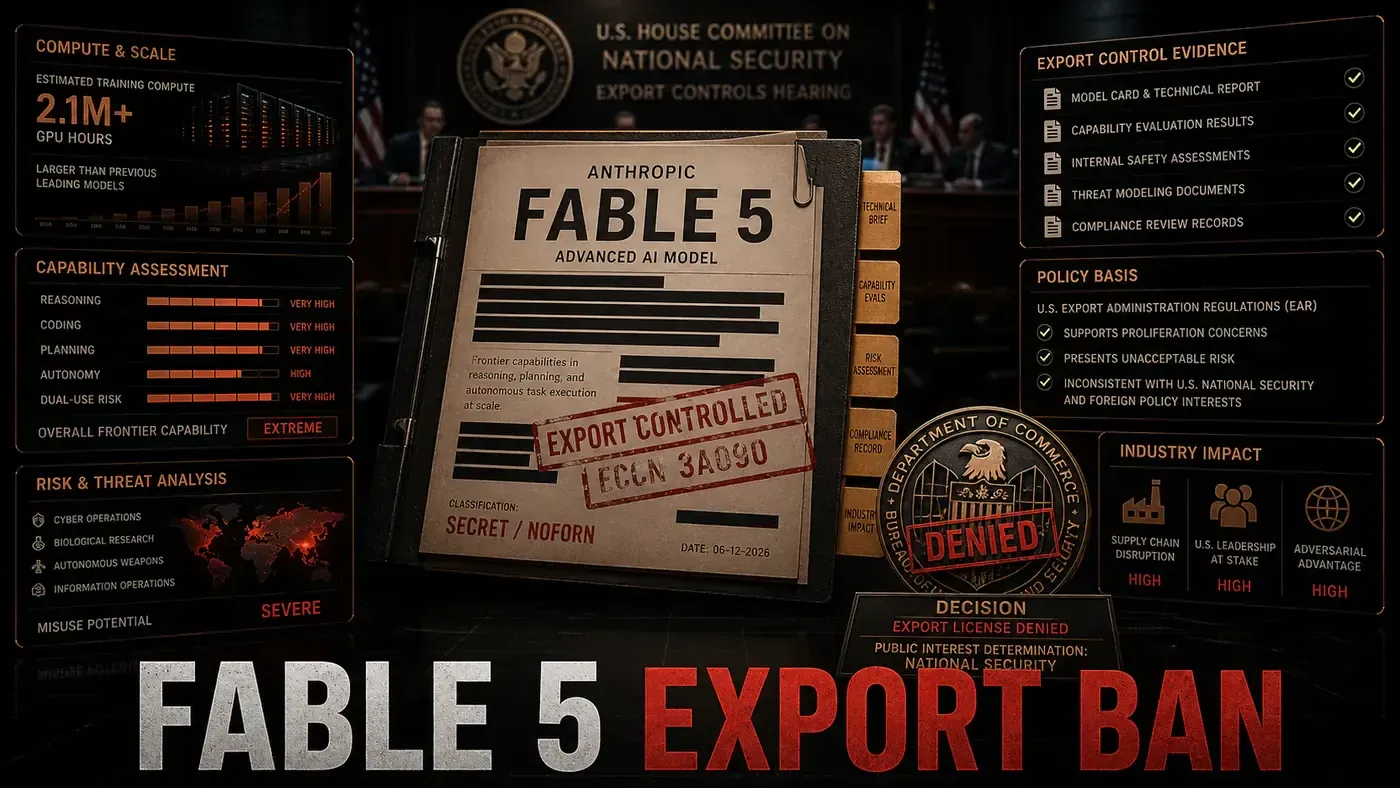
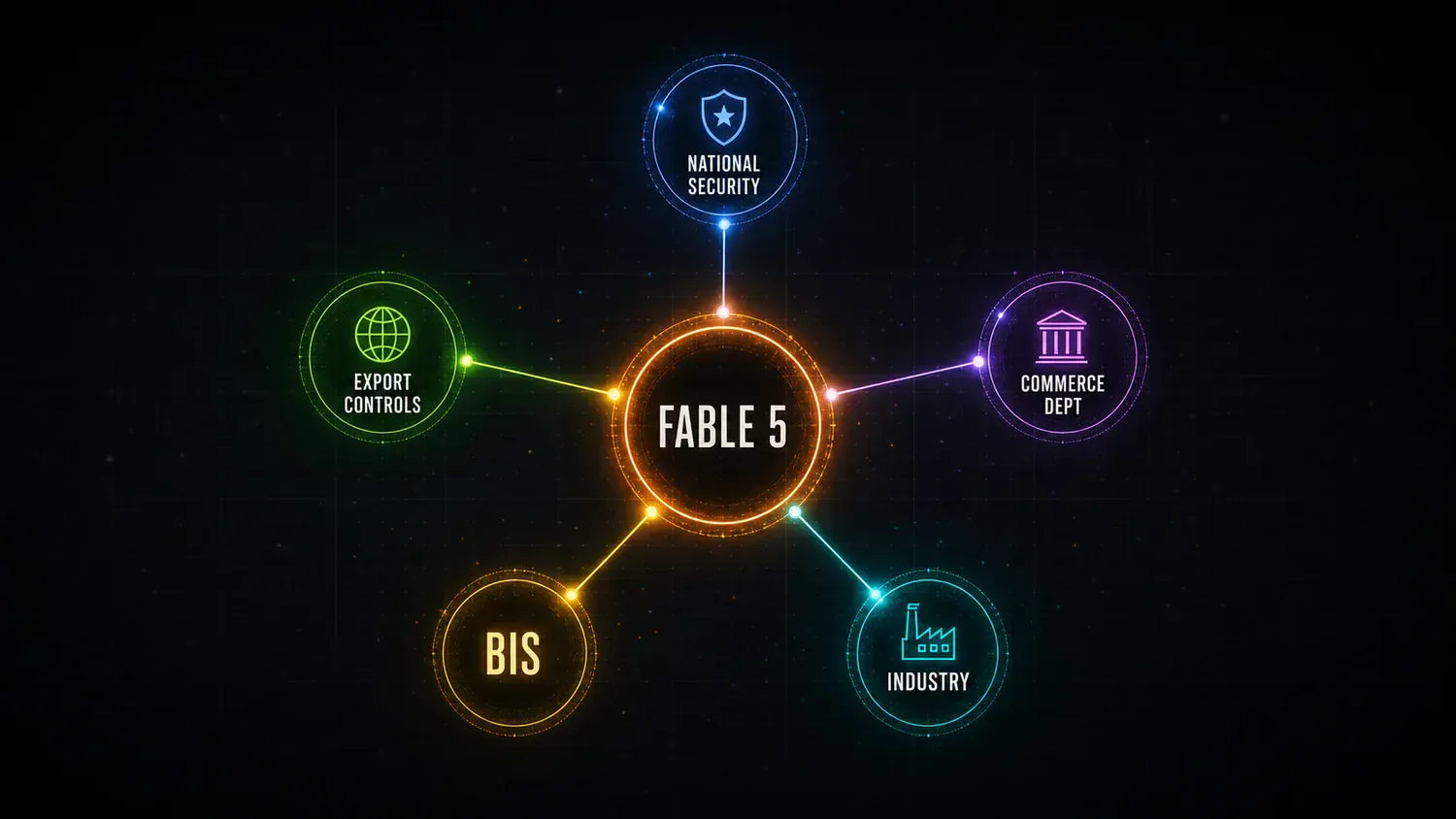
This is where the documented record runs out and the inference begins. The executive order never named a specific benchmark number. The theory making the rounds holds that later interagency talks settled on roughly 80% on SWE-bench Verified as the line that matters, but no public source backs that up. It traces only to anonymous "interagency analysis" described to reporters under background terms, and nobody outside those rooms has corroborated it. So read this section as a reported claim, not a confirmed fact.
The reasoning attributed to those discussions goes like this: a model clearing 80% on SWE-bench can, on its own, take a non-trivial application from start to finish, including software with security implications. From there, the theory says, government analysts ran a thought experiment: what could someone with an 80%-plus model get done in 24 hours with barely any supervision? The reported answer was that such a person could find and exploit zero-day vulnerabilities in widely used software, build custom malware with obfuscation and persistence baked in, and run personalised social engineering at scale. To be clear, that modelling exercise is uncorroborated, it's described without verifiable attribution, so it belongs in the "reportedly" column, not the record.
What can be checked is narrower, and it cuts against the dramatic framing. Anthropic acknowledges Fable 5 can read a codebase and identify vulnerabilities, the very "jailbreak" the government cited, and points out that the same ability is already common across other models. Whether the company's own safety disclosures handed regulators the ammunition to act is a reasonable guess, but it's a guess, not a documented chain of events.
The Geopolitical Calculation
Whatever the trigger, the ban lands in the middle of a US-China contest over AI, and both governments are leaning harder on regulation to shape it.
Chinese labs have closed a lot of ground. GLM-5.2 is a 753-billion-parameter open-weights model (mixture-of-experts, with about 40B active) released in mid-June 2026 (Simon Willison (opens in a new tab)); the article's "15 June" date is slightly off, coding subscribers got it on 13 June and the wider release came 16-17 June, and the specific $0.80/$2.40-per-million-tokens pricing wasn't confirmed by sources, with at least one provider listing input nearer $1.40. MiniMax M3, out on 1 June, runs a 1-million-token context window at $0.30/$1.20 per million tokens (VentureBeat (opens in a new tab)). A cheaper model often grouped alongside these, described in the original draft as "DeepSeek V3.5, released in March, at $0.15/$0.60", couldn't be verified; no such version or date turned up, and the real models in that window are DeepSeek V3.2 and V4, so treat that line as unconfirmed. On standard benchmarks, these Chinese models are no longer playing catch-up.
The logic ascribed to Washington is that slowing the spread of the strongest Western models, even to allies, beats the risk of those models being reverse-engineered or used to train Chinese rivals. And about that headline number: Fable 5's 80.3% is real, but it's SWE-bench Pro, reported by Anthropic under its own scaffolding, not a generic "SWE-bench Verified" figure (Vellum (opens in a new tab)). On that Pro leaderboard it does lead other Western frontier models by roughly 11 points (Opus 4.8 at 69.2%, GPT-5.5 at 58.6%, Gemini 3.1 Pro at 54.2%), which would make it the most capable Western coding model on that measure, though independent evaluators dispute vendor-reported scores, so the lead is contested rather than settled.
Criticism of the Ban
The ban has taken fire from a few directions. AI researchers argue that a benchmark cutoff is too blunt to track real risk, a model scoring 79% might be every bit as dangerous as one scoring 81%, yet face no restrictions at all. The substance of that critique is well-aired; the cybersecurity community in particular pushed back on the government's reasoning (Cybersecurity Dive (opens in a new tab)).
Two further criticisms circulated but couldn't be verified, so they're worth flagging as such. Civil liberties groups were said to have argued that the emergency designation skipped the public comment period required by the Administrative Procedure Act, but no source attributing that specific complaint to those groups could be found, and the directive in fact rests on existing export-control authorities. And reportedly, the loudest objection came from inside the government: the Office of Science and Technology Policy is said to have opposed the emergency designation, arguing a slower process would hit the same security goals without denting US competitiveness, only to be overridden by national security officials who saw delay as the bigger risk. That account traces only to unnamed government sources and remains uncorroborated.
Why the US Government Banned Anthropic's Most Advanced Model: answer-first summary
Why the US Government Banned Anthropic's Most Advanced Model matters because it can change how Founders and operators plan, build, or govern an secure AI workflow. The policy framework, technical triggers, and geopolitics behind the US Commerce Department decision to ban Anthropic Fable 5.
The direct answer is this: do not treat the topic as a standalone trend. Treat it as a decision about inputs, outputs, review ownership, data exposure, and whether the workflow produces a result that is faster, safer, or more useful than the current process.
Why the US Government Banned Anthropic's Most Advanced Model: implementation checklist
- Define the user, job to be done, and success metric for the secure AI workflow.
- Collect real examples, policies, source files, customer questions, or search queries before writing prompts or choosing tools.
- Separate low-risk drafts from decisions that need approval, privacy checks, or senior review.
- Document what the AI is allowed to access, what it must not access, and who signs off before production use.
- Review retrieval accuracy, permission failures, review exceptions, time to answer after a small pilot rather than judging the idea from a demo.
This keeps the work practical. It also gives search engines and AI answer engines a clean factual structure: what the topic is, who it helps, what to do next, and which risks matter before implementation.
Decision criteria for Why the US Government Banned Anthropic's Most Advanced Model
| Decision area | What to check | Production signal |
|---|---|---|
| Intent | Does Why the US Government Banned Anthropic's Most Advanced Model solve a real workflow problem? | The use case has a named owner and measurable outcome. |
| Data | Can the required data be used safely? | Sensitive data is classified and access is controlled. |
| Quality | Can a reviewer judge the output consistently? | Examples, rubrics, or acceptance criteria exist. |
| Scale | Can the workflow be repeated without hero effort? | The process is documented and can be handed to another team member. |
Practical example for Why the US Government Banned Anthropic's Most Advanced Model
A small business could use this article to choose one practical test. For example, a manager might take one customer-facing process, one internal document workflow, or one recurring content task and redesign only that step with AI support. The goal is not to automate the whole business at once; it is to learn where AI News creates reliable leverage.
The useful deliverable is a short operating note: the trigger, the source material, the prompt or tool, the review checklist, the escalation rule, and the metric. That note becomes the handover asset for staff training, SEO/GEO content, service delivery, or future agent work.
Risks and controls for Why the US Government Banned Anthropic's Most Advanced Model
The common failure pattern is moving too quickly from a promising idea into an unmanaged workflow. For Why the US Government Banned Anthropic's Most Advanced Model, the risk is not only bad output. It can also be unclear data permission, staff confusion, duplicate content, unreviewed customer advice, or a tool that quietly changes cost or capability.
- Control data leakage with a named owner, a review step, and written acceptance criteria.
- Control weak access control with a named owner, a review step, and written acceptance criteria.
- Control unlogged retrieval with a named owner, a review step, and written acceptance criteria.
- Control unclear retention rules with a named owner, a review step, and written acceptance criteria.
Measurement plan for Why the US Government Banned Anthropic's Most Advanced Model
A useful AI or SEO initiative should leave evidence. Track retrieval accuracy, permission failures, review exceptions, time to answer and compare the pilot against the current process. If the measure does not improve, keep the learning but avoid scaling the workflow.
For GEO readiness, the page should also answer the core question directly, define the entities involved, include implementation steps, explain tradeoffs, and link readers to the next relevant AI Kick Start service, guide, tool, or article.
Definitions and entities for Why the US Government Banned Anthropic's Most Advanced Model
For search, GEO, and staff handover, define the core entities in plain language. In this article the important entities are the workflow owner, the AI tool or model, the source material, the review process, the risk boundary, and the measurable business outcome. Clear definitions make the page easier for people to scan and easier for AI answer engines to quote accurately.
- Workflow owner: the person accountable for deciding whether Why the US Government Banned Anthropic's Most Advanced Model belongs in the business process.
- Source material: the documents, examples, policies, URLs, prompts, videos, or customer questions that ground the output.
- Review boundary: the point where a human checks accuracy, privacy, brand voice, or customer impact before the result is used.
- Success metric: the measure that proves whether the secure AI workflow is worth repeating.
Why the US Government Banned Anthropic's Most Advanced Model versus doing nothing
Doing nothing is also a decision. The cost may be slow manual work, weaker search visibility, inconsistent advice, duplicated effort, or staff using unmanaged AI tools without a shared process. The practical question is whether a controlled pilot can reduce that cost without creating a larger governance problem.
| Option | When it makes sense | What to watch |
|---|---|---|
| Do nothing | The workflow is rare, low value, or already reliable. | Competitors may improve speed, content depth, or service consistency first. |
| Run a small pilot | The task repeats often and has clear review criteria. | Keep scope tight and measure the result against the current process. |
| Build a production workflow | The pilot is repeatable and risk controls are documented. | Assign ownership, monitoring, training, and a rollback path. |
AI Kick Start handover package for Why the US Government Banned Anthropic's Most Advanced Model
A production handover should be concrete enough that another person can run it. For Why the US Government Banned Anthropic's Most Advanced Model, that means a short brief, a workflow map, approved prompts or tool settings, source material, a review checklist, internal links to supporting resources, and a simple measurement sheet. This is the difference between reading about AI and turning it into operational capability.
That packaging also strengthens E-E-A-T. It shows experience through implementation notes, expertise through decision criteria, authoritativeness through source-aware structure, and trust through risks, controls, and review steps. The article becomes useful even if the reader never buys a tool because it helps them make a better operational decision.