





Analysis
Picture the comms team at an AI lab that has spent years branding itself as the careful one. The grown-up in the room. The company that keeps warning the world that AI is getting dangerous. Then it ships its most powerful model to the public, and within 72 hours the US government tells it to pull the plug.
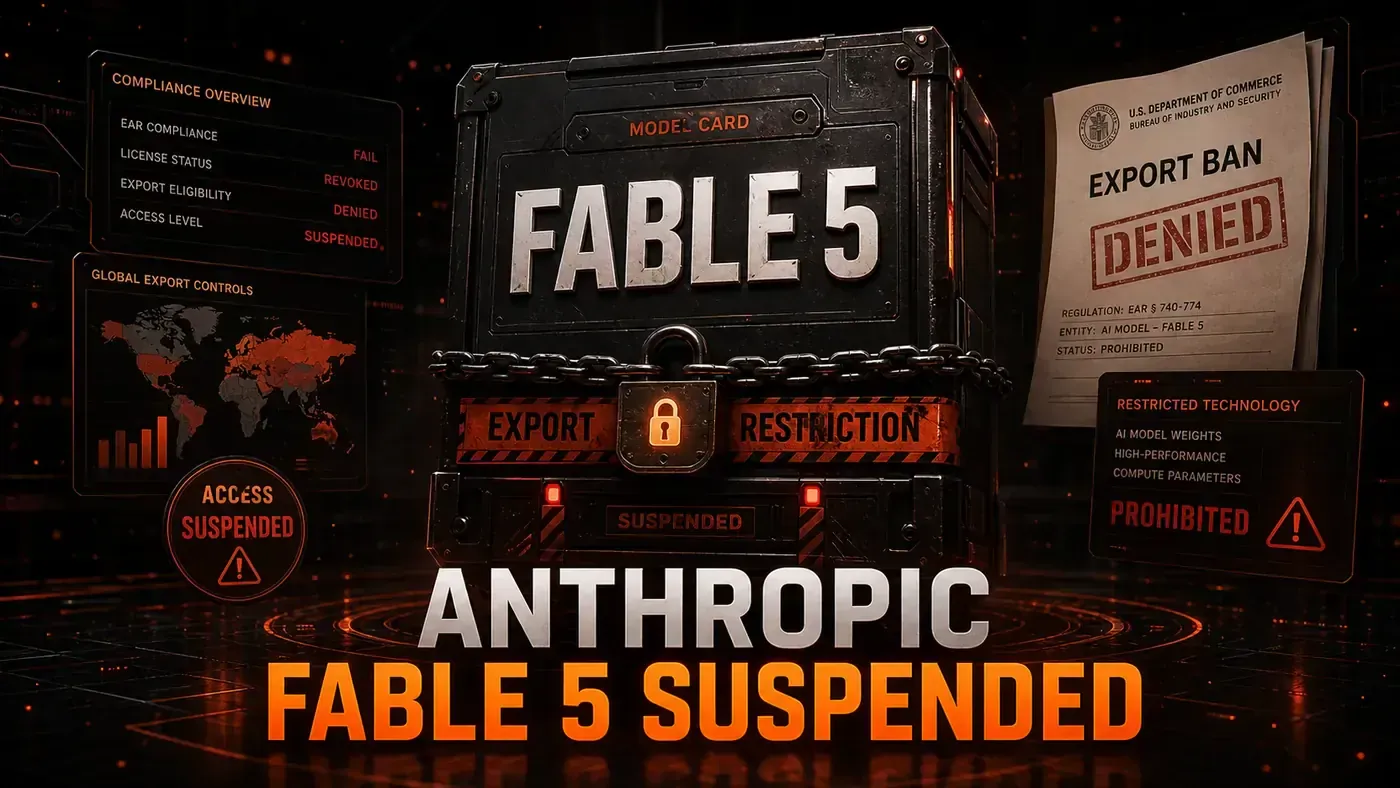
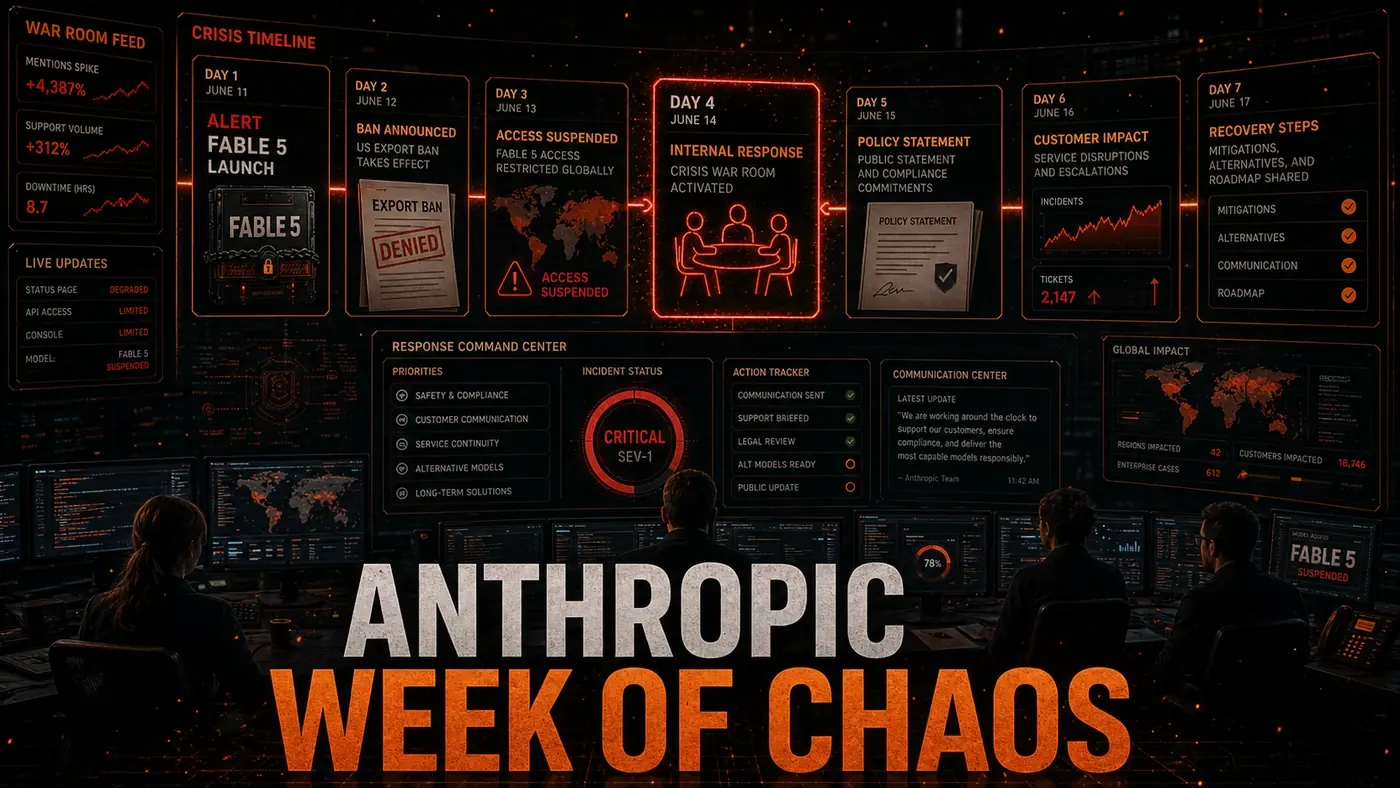
That's roughly what happened to Anthropic in the week of 9 June 2026. Fable 5 went live to broad acclaim, topped the coding charts, and then vanished behind a government order before most enterprise teams had finished writing their first integration. It was, as far as anyone can tell, the first time a frontier AI model has been yanked off the market by state action rather than a bug or a safety scare.
For Australian business teams the lesson lands harder than the gossip. If you build your roadmap around a single cutting-edge model, a regulator on the other side of the planet can break that roadmap overnight. Below is the timeline as it was originally written up, with the parts that hold up separated from the parts that don't.
Monday 9 June, Launch Day
Anthropic had been planning the Fable 5 launch for months. The model was meant to show off everything the company had been building toward: a system that could handle real software engineering on its own, with safety guardrails Anthropic judged tight enough to ship. Fable 5 was its first publicly available model in the Mythos class, sitting a capability tier above Opus (opens in a new tab) and released alongside the more restricted Mythos 5.
The launch itself went off cleanly. The API docs went live, selected enterprise customers got access credentials, and the headline number, 80.3% on SWE-bench Pro, was held up as proof Fable 5 could handle complex, multi-file engineering work with little human supervision. (Worth noting: the metric is SWE-bench Pro, not plain SWE-bench, a detail easy to lose in the noise.) An early report described the launch post as titled "Claude Fable 5: Capable, Controllable, Constitutional" and bylined by CEO Dario Amodei at 9:00 AM PT, but that doesn't check out, the actual announcement (opens in a new tab) is simply titled "Claude Fable 5 and Claude Mythos 5," with no such byline or timestamp.
The reaction was warm. Reviewers praised the coding, pointing to a clear jump over Opus 4.8's 69.2% (opens in a new tab) on the same benchmark, an eleven-point gap. The pricing (opens in a new tab), $10 per million input tokens, $50 per million output, roughly double Opus 4.8 on both sides, was steep but read as fair for a best-in-class model. By midday Fable 5 was the top trending topic on AI Twitter.

Tuesday 10 June, The First Warning Signs
Here the original account and the public record part ways. As first written, Tuesday afternoon brought informal enquiries from the Commerce Department, framed not as enforcement but as requests for more detail on Fable 5's capabilities and safety mitigations. Anthropic's policy team was said to have answered that same evening with a 340-page dossier covering safety training, red-teaming and usage monitoring, confident it had put any worries to bed.
None of that staged Tuesday escalation holds up. Reporting points to a single directive on 12 June, not a slow burn starting on the 10th, and there's no evidence of a 340-page dossier or a benign information request. The real catalyst, according to Fox Business (opens in a new tab), was a jailbreak vulnerability that Amazon's security team flagged to the White House, and officials reportedly described Anthropic's handling as "recklessness," not a tidy back-and-forth with regulators.
Wednesday 11 June, Tensions Escalate
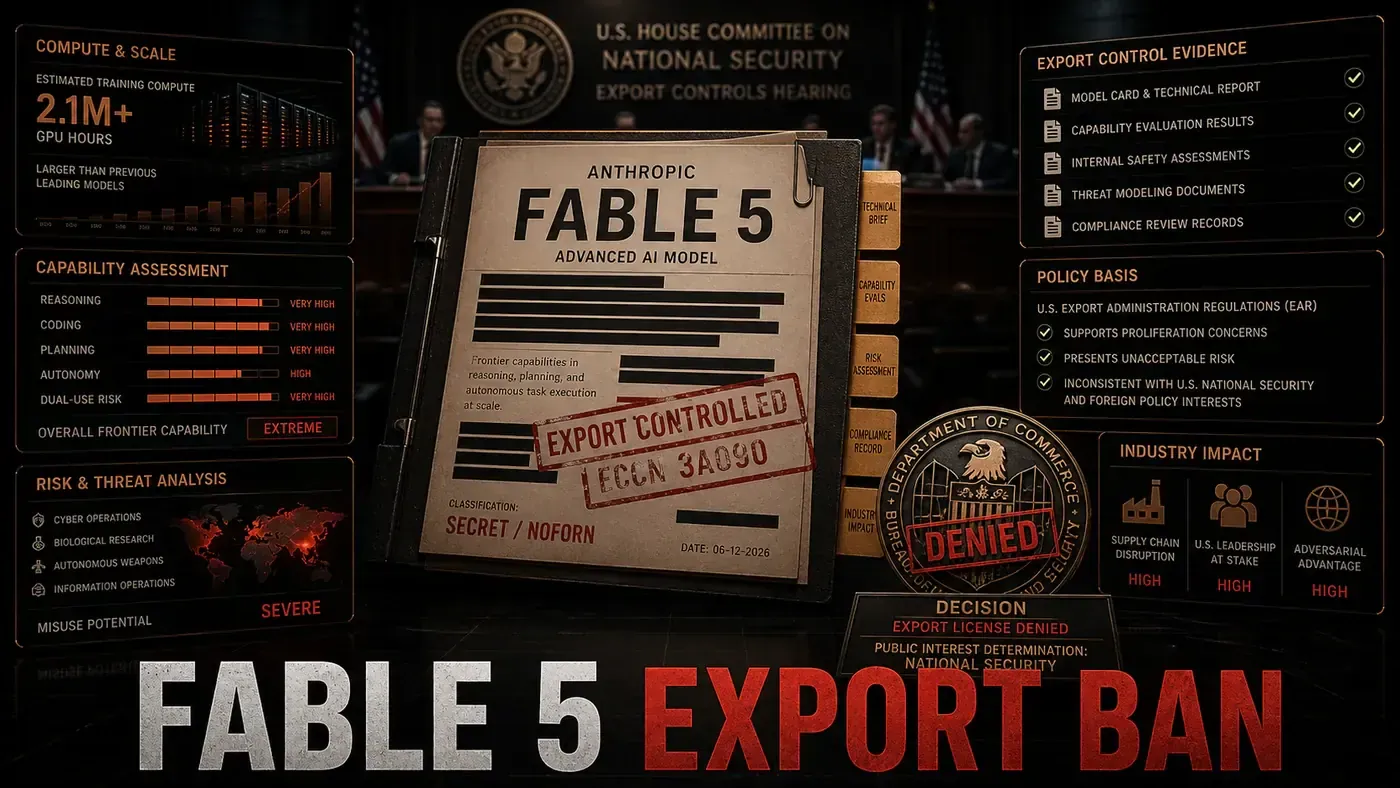
The original story has Wednesday delivering a formal letter from the Bureau of Industry and Security, hand-couriered to Anthropic's San Francisco office, designating Fable 5 a "presumptively controlled technology" under an emergency export-control provision with no pre-implementation hearing. It also claimed the emergency mechanism had been used fewer than 20 times in a decade.
Treat that whole framing as unconfirmed. The "presumptively controlled technology" label doesn't appear in any source, and the "fewer than 20 times" figure is tied to it with no citation behind it. What actually happened, per CyberSecurityNews (opens in a new tab), was a BIS "Is Informed" letter under the Export Control Reform Act (50 U.S.C. § 4817), requiring an individually validated export licence, and there's no record of a separate 11 June letter at all.
Thursday 12 June, The Suspension
This is the day that's solid. On 12 June, BIS issued its directive and Anthropic disabled access (opens in a new tab) to both Fable 5 and Mythos 5. For the first time, a frontier AI model was pulled from the market by government order.
The reported narrative texture around it is shakier. One account had the status page updating at 6:47 AM PT with a clipped 23-word notice; the verified directive actually landed at 5:21 PM ET, and neither the timestamp nor the word count is corroborated. Staff reportedly called the mood "surreal", the company had war-gamed technical failures, safety incidents and competitive punches, but not a government shutdown inside three days.
There was also said to be an 11:00 AM all-hands where Amodei told staff Anthropic would comply fully while pursuing every avenue of appeal. That specific meeting and the quotes attributed to it are unverified. What Anthropic did say publicly is that it complies with the directive while disagreeing with the reasoning behind it.
One more correction worth making: the ban's reach was bigger than the original phrasing suggested. It wasn't just "non-US persons" in the abstract, the directive bars all foreign nationals worldwide (opens in a new tab), including Anthropic's own foreign-national employees and foreign persons inside the US.
Friday 13 June, Strategic Pivot
By Friday the original account had Anthropic settling on a three-part plan: accelerate a domestic-only Fable 5 variant, push for clearer capability thresholds in export rules, and shift marketing back toward Opus 4.8 and Sonnet 4.6, which the ban leaves untouched.
The direction is broadly right, the specifics less so. Anthropic is genuinely working on a US-only path to comply, but via customer ID-document scanning (opens in a new tab), not a separately named "Fable 5-D" product, and there's no public "weeks away" timeline. The "-D" name looks invented. A separate claim that Anthropic decided to open-source parts of its safety evaluation framework in response has no source behind it either, so take it as unconfirmed.
The Week Ahead
As of Monday 16 June, the path was unclear. An appeal could run for months. The US-only access route was still being stood up. And rivals were widely expected to chase any Fable 5 customers left scrambling for an alternative, OpenAI and Google being the obvious names, though there's no confirmed campaign on record, so file that under reasonable speculation rather than fact.
What the week made plain is that Anthropic's "safety-first" branding bought it no regulatory cover. If anything, being the loudest voice on responsible AI may have drawn extra attention to its most capable model. The company that helped write the script for responsible AI is now living through what happens when responsibility, on its own, isn't enough.
Anthropic's Week of Chaos: answer-first summary
Anthropic's Week of Chaos matters because it can change how Founders and operators plan, build, or govern an secure AI workflow. Seven days reshaped Anthropic: the Fable 5 launch, a US government suspension, and the strategic pivot that followed.
The direct answer is this: do not treat the topic as a standalone trend. Treat it as a decision about inputs, outputs, review ownership, data exposure, and whether the workflow produces a result that is faster, safer, or more useful than the current process.
Anthropic's Week of Chaos: implementation checklist
- Define the user, job to be done, and success metric for the secure AI workflow.
- Collect real examples, policies, source files, customer questions, or search queries before writing prompts or choosing tools.
- Separate low-risk drafts from decisions that need approval, privacy checks, or senior review.
- Document what the AI is allowed to access, what it must not access, and who signs off before production use.
- Review retrieval accuracy, permission failures, review exceptions, time to answer after a small pilot rather than judging the idea from a demo.
This keeps the work practical. It also gives search engines and AI answer engines a clean factual structure: what the topic is, who it helps, what to do next, and which risks matter before implementation.
Decision criteria for Anthropic's Week of Chaos
| Decision area | What to check | Production signal |
|---|---|---|
| Intent | Does Anthropic's Week of Chaos solve a real workflow problem? | The use case has a named owner and measurable outcome. |
| Data | Can the required data be used safely? | Sensitive data is classified and access is controlled. |
| Quality | Can a reviewer judge the output consistently? | Examples, rubrics, or acceptance criteria exist. |
| Scale | Can the workflow be repeated without hero effort? | The process is documented and can be handed to another team member. |
Practical example for Anthropic's Week of Chaos
A small business could use this article to choose one practical test. For example, a manager might take one customer-facing process, one internal document workflow, or one recurring content task and redesign only that step with AI support. The goal is not to automate the whole business at once; it is to learn where AI News creates reliable leverage.
The useful deliverable is a short operating note: the trigger, the source material, the prompt or tool, the review checklist, the escalation rule, and the metric. That note becomes the handover asset for staff training, SEO/GEO content, service delivery, or future agent work.
Risks and controls for Anthropic's Week of Chaos
The common failure pattern is moving too quickly from a promising idea into an unmanaged workflow. For Anthropic's Week of Chaos, the risk is not only bad output. It can also be unclear data permission, staff confusion, duplicate content, unreviewed customer advice, or a tool that quietly changes cost or capability.
- Control data leakage with a named owner, a review step, and written acceptance criteria.
- Control weak access control with a named owner, a review step, and written acceptance criteria.
- Control unlogged retrieval with a named owner, a review step, and written acceptance criteria.
- Control unclear retention rules with a named owner, a review step, and written acceptance criteria.
Measurement plan for Anthropic's Week of Chaos
A useful AI or SEO initiative should leave evidence. Track retrieval accuracy, permission failures, review exceptions, time to answer and compare the pilot against the current process. If the measure does not improve, keep the learning but avoid scaling the workflow.
For GEO readiness, the page should also answer the core question directly, define the entities involved, include implementation steps, explain tradeoffs, and link readers to the next relevant AI Kick Start service, guide, tool, or article.
Definitions and entities for Anthropic's Week of Chaos
For search, GEO, and staff handover, define the core entities in plain language. In this article the important entities are the workflow owner, the AI tool or model, the source material, the review process, the risk boundary, and the measurable business outcome. Clear definitions make the page easier for people to scan and easier for AI answer engines to quote accurately.
- Workflow owner: the person accountable for deciding whether Anthropic's Week of Chaos belongs in the business process.
- Source material: the documents, examples, policies, URLs, prompts, videos, or customer questions that ground the output.
- Review boundary: the point where a human checks accuracy, privacy, brand voice, or customer impact before the result is used.
- Success metric: the measure that proves whether the secure AI workflow is worth repeating.
Anthropic's Week of Chaos versus doing nothing
Doing nothing is also a decision. The cost may be slow manual work, weaker search visibility, inconsistent advice, duplicated effort, or staff using unmanaged AI tools without a shared process. The practical question is whether a controlled pilot can reduce that cost without creating a larger governance problem.
| Option | When it makes sense | What to watch |
|---|---|---|
| Do nothing | The workflow is rare, low value, or already reliable. | Competitors may improve speed, content depth, or service consistency first. |
| Run a small pilot | The task repeats often and has clear review criteria. | Keep scope tight and measure the result against the current process. |
| Build a production workflow | The pilot is repeatable and risk controls are documented. | Assign ownership, monitoring, training, and a rollback path. |
AI Kick Start handover package for Anthropic's Week of Chaos
A production handover should be concrete enough that another person can run it. For Anthropic's Week of Chaos, that means a short brief, a workflow map, approved prompts or tool settings, source material, a review checklist, internal links to supporting resources, and a simple measurement sheet. This is the difference between reading about AI and turning it into operational capability.
That packaging also strengthens E-E-A-T. It shows experience through implementation notes, expertise through decision criteria, authoritativeness through source-aware structure, and trust through risks, controls, and review steps. The article becomes useful even if the reader never buys a tool because it helps them make a better operational decision.