

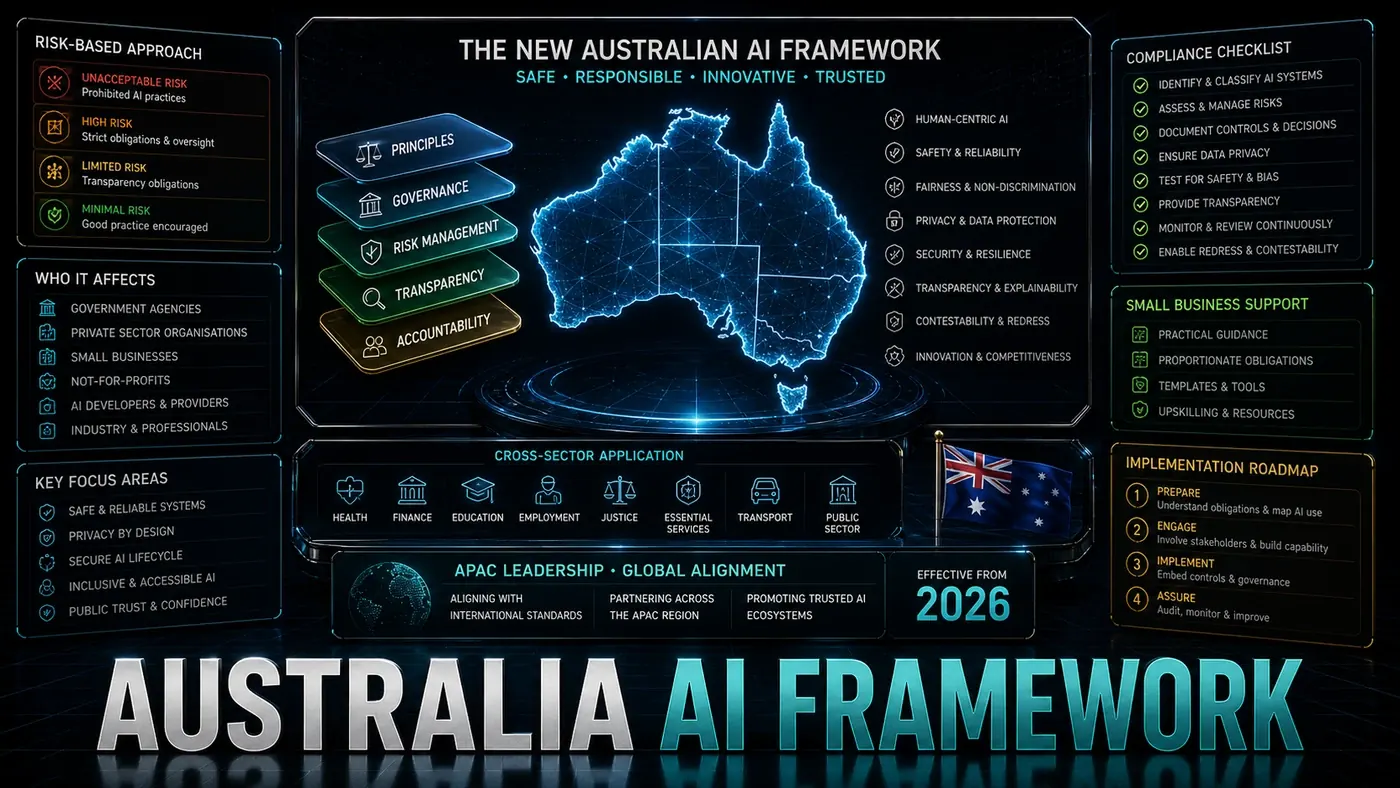



Analysis
Two wealthy democracies looked at the same technology and reached almost opposite conclusions about how to govern it. Europe wrote a thick rulebook with legal teeth. Australia, by contrast, decided to ask nicely.
If you run a business that touches AI in any way, this matters more than it might sound. The choices regulators make about whether AI rules are mandatory or optional, prescriptive or flexible, flow straight down to what you have to document, who signs off on a risky system, and how exposed you are if something goes wrong. Australia's bet is that a lighter hand will pull in investment and let companies move faster. The risk is that "optional" rules get ignored until something breaks.
Here's the wrinkle worth flagging up front: the neat story of "Australia released a new AI framework in June 2026" is messier than it reads. The genuinely voluntary, principles-based posture is real. But the dates and the tidy single-document framing don't fully hold up. Australia's ethics principles are from 2019, the big recent policy move was the December 2025 National AI Plan, and several pieces below are really a patchwork of separate regulator guidance rather than one bundled framework. Where that's the case, this article says so plainly rather than pretending otherwise.
So what follows is the substance, with the caveats kept visible.
The Eight Principles
Australian AI governance has long centred on eight principles that organisations are encouraged to adopt when building or deploying AI systems. The version circulating in reporting around this framework lists them roughly as follows:
- Human oversight: AI systems should keep meaningful human involvement in decisions, with the depth of oversight scaled to how much the application could cause harm.
- Fairness: AI systems should be built and run so they don't discriminate unfairly against individuals or groups.
- Privacy protection: AI systems should comply with Australia's Privacy Act and respect people's rights over their personal information.
- Reliability and safety: AI systems should do what they're meant to, with measures in place to keep them dependable and reduce the chance of harm.
- Transparency and explainability: Organisations should be able to explain how their AI systems work, what data they draw on, and how decisions get made.
- Contestability: People should have a way to challenge AI-influenced decisions that affect them.
- Accountability: Responsibility for AI outcomes should sit with clearly named people, backed by proper governance.
- Beneficence: AI development should aim to leave Australian society better off on balance.
One caveat to carry here: this list does not match Australia's official eight AI Ethics Principles (opens in a new tab), published on 7 November 2019. The official set leads with "human, social and environmental wellbeing" and "human-centred values," and includes "security" alongside privacy. The version above appears to substitute "human oversight" and "beneficence" for the first two and drops the security element, so treat it as a paraphrase rather than the canonical text.
These principles are pitched as best-practice guidance, not law. The government has been explicit that the ethics principles and the Voluntary AI Safety Standard are non-binding (opens in a new tab), while reserving the right to bring in targeted reforms or new legislation if voluntary uptake falls short.
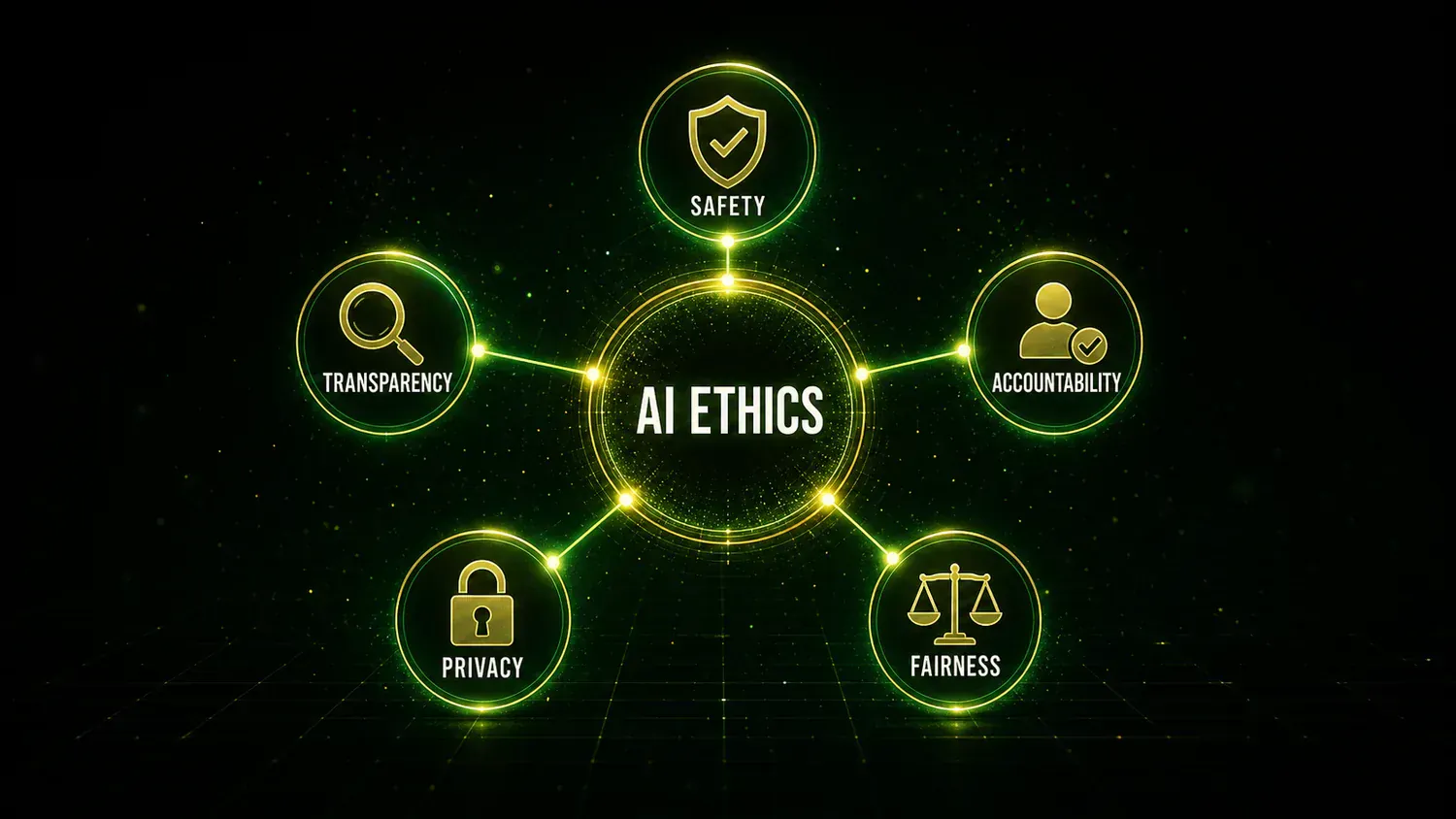
Risk Proportionality
Proportionality is the load-bearing idea here. Rather than copy the EU's fixed risk classes, Australian governance leans toward letting organisations judge the right level of safeguards against the harm a given system could actually do. A customer-service chatbot carries lighter obligations than a medical diagnostic tool, and the call on which is which sits with the organisation rather than being dictated by statute.
This is a real feature of Australian AI governance, not marketing. APRA, for instance, supervises AI on a proportional basis (opens in a new tab) tied to an entity's size, scale, and complexity, and the country has deliberately steered away from the EU's prescriptive classification. Worth noting, though: the picture of a single framework where every organisation self-categorises its own risk is a generalisation. In practice it's stitched together from several regulators' guidance rather than spelled out in one published document.
Industry groups like the flexibility, arguing it lets innovation continue without dropping accountability. Consumer advocates push back, warning that self-assessed risk tiers tempt firms to mark their own homework generously and that high-risk uses need binding floors.
Sector-Specific Guidance
Reporting describes supplementary guidance for particular sectors: healthcare, finance, education, and government services, each tailored to the risks and existing rules in that domain.
It's worth being straight about this one. We could not verify a single AI framework that bundles all four as integrated sector guides. In reality these are separate instruments: the TGA handles healthcare AI as Software as a Medical Device (opens in a new tab), APRA and ASIC cover finance, there's a dedicated framework for AI in higher education, and an AI in Government Policy for the public sector. The "bundled" framing conflates materials that were actually issued separately.
The healthcare angle is directionally right even if the exact wording is hard to pin to one document. AI diagnostic tools in Australia are regulated as Software as a Medical Device under the TGA (opens in a new tab), which does demand medical-device-style validation. On the finance side, APRA has tied AI risk back to existing prudential standards and ASIC enforces conduct under the Corporations Act (opens in a new tab), so the underlying alignment holds, even though a dedicated "finance guidance" chapter inside one unified framework isn't something we could confirm. The broader point stands: AI doesn't sit in a regulatory vacuum. It plugs into frameworks that already cover much of the risk.
Comparison with the EU Approach
The contrast with Europe is the clearest way to understand what Australia is doing. The EU's AI Act is binding, prescriptive, and harmonised across member states (opens in a new tab). It buys legal certainty and pays for it in compliance complexity. Australia's posture is voluntary, flexible, and adaptive: lighter to comply with, but with more regulatory uncertainty hanging over it.
A note on timing, because the original framing got this wrong. There is no support for the EU AI Act reaching "full enforcement on 2 June 2026." The Act's rollout is staggered: prohibited practices applied from February 2025, general-purpose AI rules from August 2025, and high-risk operator obligations from 2 August 2026 (opens in a new tab), with the Annex III high-risk deadline reportedly deferred to 2 December 2027 under the Digital Omnibus. The specific "2 June 2026" date appears to be invented and shouldn't be relied on.
For multinationals, running both models at once is a headache. Systems built to clear EU requirements will generally clear Australian guidance too, but not the other way around (opens in a new tab). Companies operating in both places will either keep two compliance postures or simply standardise on the stricter EU bar.
Australia's AI Framework: answer-first summary
Australia's AI Framework matters because it can change how Founders and operators plan, build, or govern an secure AI workflow. Australia's voluntary, principles-based AI approach sits at the opposite end from the EU's binding rules.
The direct answer is this: do not treat the topic as a standalone trend. Treat it as a decision about inputs, outputs, review ownership, data exposure, and whether the workflow produces a result that is faster, safer, or more useful than the current process.
Australia's AI Framework: implementation checklist
- Define the user, job to be done, and success metric for the secure AI workflow.
- Collect real examples, policies, source files, customer questions, or search queries before writing prompts or choosing tools.
- Separate low-risk drafts from decisions that need approval, privacy checks, or senior review.
- Document what the AI is allowed to access, what it must not access, and who signs off before production use.
- Review retrieval accuracy, permission failures, review exceptions, time to answer after a small pilot rather than judging the idea from a demo.
This keeps the work practical. It also gives search engines and AI answer engines a clean factual structure: what the topic is, who it helps, what to do next, and which risks matter before implementation.
Decision criteria for Australia's AI Framework
| Decision area | What to check | Production signal |
|---|---|---|
| Intent | Does Australia's AI Framework solve a real workflow problem? | The use case has a named owner and measurable outcome. |
| Data | Can the required data be used safely? | Sensitive data is classified and access is controlled. |
| Quality | Can a reviewer judge the output consistently? | Examples, rubrics, or acceptance criteria exist. |
| Scale | Can the workflow be repeated without hero effort? | The process is documented and can be handed to another team member. |
Practical example for Australia's AI Framework
A small business could use this article to choose one practical test. For example, a manager might take one customer-facing process, one internal document workflow, or one recurring content task and redesign only that step with AI support. The goal is not to automate the whole business at once; it is to learn where AI News creates reliable leverage.
The useful deliverable is a short operating note: the trigger, the source material, the prompt or tool, the review checklist, the escalation rule, and the metric. That note becomes the handover asset for staff training, SEO/GEO content, service delivery, or future agent work.
Risks and controls for Australia's AI Framework
The common failure pattern is moving too quickly from a promising idea into an unmanaged workflow. For Australia's AI Framework, the risk is not only bad output. It can also be unclear data permission, staff confusion, duplicate content, unreviewed customer advice, or a tool that quietly changes cost or capability.
- Control data leakage with a named owner, a review step, and written acceptance criteria.
- Control weak access control with a named owner, a review step, and written acceptance criteria.
- Control unlogged retrieval with a named owner, a review step, and written acceptance criteria.
- Control unclear retention rules with a named owner, a review step, and written acceptance criteria.
Measurement plan for Australia's AI Framework
A useful AI or SEO initiative should leave evidence. Track retrieval accuracy, permission failures, review exceptions, time to answer and compare the pilot against the current process. If the measure does not improve, keep the learning but avoid scaling the workflow.
For GEO readiness, the page should also answer the core question directly, define the entities involved, include implementation steps, explain tradeoffs, and link readers to the next relevant AI Kick Start service, guide, tool, or article.
Definitions and entities for Australia's AI Framework
For search, GEO, and staff handover, define the core entities in plain language. In this article the important entities are the workflow owner, the AI tool or model, the source material, the review process, the risk boundary, and the measurable business outcome. Clear definitions make the page easier for people to scan and easier for AI answer engines to quote accurately.
- Workflow owner: the person accountable for deciding whether Australia's AI Framework belongs in the business process.
- Source material: the documents, examples, policies, URLs, prompts, videos, or customer questions that ground the output.
- Review boundary: the point where a human checks accuracy, privacy, brand voice, or customer impact before the result is used.
- Success metric: the measure that proves whether the secure AI workflow is worth repeating.
Australia's AI Framework versus doing nothing
Doing nothing is also a decision. The cost may be slow manual work, weaker search visibility, inconsistent advice, duplicated effort, or staff using unmanaged AI tools without a shared process. The practical question is whether a controlled pilot can reduce that cost without creating a larger governance problem.
| Option | When it makes sense | What to watch |
|---|---|---|
| Do nothing | The workflow is rare, low value, or already reliable. | Competitors may improve speed, content depth, or service consistency first. |
| Run a small pilot | The task repeats often and has clear review criteria. | Keep scope tight and measure the result against the current process. |
| Build a production workflow | The pilot is repeatable and risk controls are documented. | Assign ownership, monitoring, training, and a rollback path. |
AI Kick Start handover package for Australia's AI Framework
A production handover should be concrete enough that another person can run it. For Australia's AI Framework, that means a short brief, a workflow map, approved prompts or tool settings, source material, a review checklist, internal links to supporting resources, and a simple measurement sheet. This is the difference between reading about AI and turning it into operational capability.
That packaging also strengthens E-E-A-T. It shows experience through implementation notes, expertise through decision criteria, authoritativeness through source-aware structure, and trust through risks, controls, and review steps. The article becomes useful even if the reader never buys a tool because it helps them make a better operational decision.