






Analysis
If you run a business in Australia and you assumed Brussels was someone else's problem, this is the moment to look up. The European Union has spent years building the first real rulebook for artificial intelligence, and large parts of it are now live. The headline some outlets have run, that the law flipped to "full enforcement" on 2 June 2026, does not match the official record, and it is worth getting the dates right before you act on anything.
Here is the honest version. The bans on the most dangerous uses kicked in back in February 2025. The rules for big foundation models followed in August 2025. The heavy obligations for "high-risk" systems were pencilled in for 2 August 2026, then pushed back to December 2027 while regulators sorted out the detail. So nobody woke up on a single morning to a finished regime. It has been arriving in waves, and a couple of the biggest waves are still on the way.
The reason it matters to you: the law does not care where your company is based. If your AI touches users inside the EU, you are inside its scope. With a market of roughly 450 million people on the line and fines that scale to a slice of worldwide revenue, "we'll deal with it later" is an expensive position.
What follows is the substance, the tiers, the thresholds, the penalties, and the work that pays off now.
The Risk-Based Framework
The AI Act sorts systems into four risk tiers: minimal, limited, high, and unacceptable (EU AI Act high-level summary (opens in a new tab)).
Minimal risk covers spam filters, recommendation systems users can override, and simple chatbots. These carry no specific obligations beyond general transparency. If you are running a basic FAQ bot or a content recommender with a clear opt-out, your burden is light.
Limited risk covers chatbots, emotion recognition, and biometric categorisation. Here you owe transparency: people must be told when they are dealing with an AI, and AI-generated content has to be labelled. These are procedural steps, not engineering projects, and most teams can handle them.
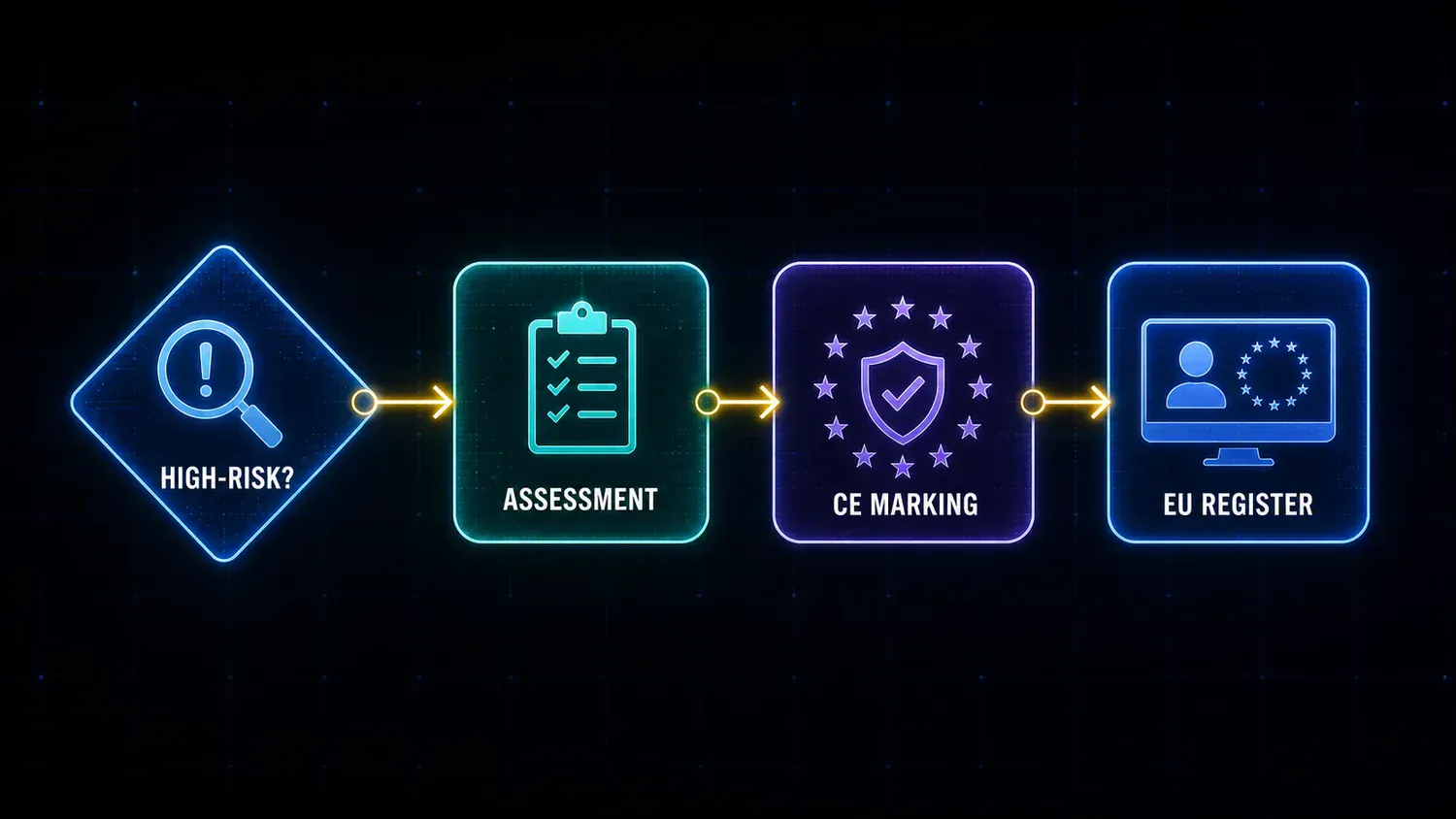
High risk is where it gets demanding. The category takes in AI used in critical infrastructure, education, employment, law enforcement, migration, and the administration of justice. High-risk systems have to meet a stack of requirements: a risk management system that runs across the whole lifecycle; data governance that keeps training data clean and checks for bias; technical documentation for conformity assessment; record-keeping and logging for audit trails; transparency and clear information for users; human oversight with a real ability to step in; and accuracy, robustness, and cybersecurity. Worth noting: the standalone version of these obligations was scheduled for 2 August 2026, then postponed to 2 December 2027 (opens in a new tab), so the deadline pressure here is later than early reporting suggested.
Unacceptable risk, government social scoring, real-time biometric identification in public spaces (with narrow law-enforcement carve-outs), and systems that prey on the vulnerabilities of specific groups, is banned outright, and has been since 2 February 2025.
The Foundation Model Provisions
The Act sets specific rules for "general-purpose AI models", the foundation models such as GPT-5.5 (opens in a new tab), Claude, and Llama that get adapted to all sorts of downstream jobs. Models trained on more than 10^25 FLOP of compute pick up extra duties: systemic risk evaluation and mitigation, adversarial testing and red-teaming, reporting of serious incidents to regulators, and adequate cybersecurity (Article 51 (opens in a new tab)).
Every general-purpose model, regardless of size, has to hand technical documentation to downstream deployers, comply with EU copyright law, and publish a sufficiently detailed summary of its training data, obligations that have applied since 2 August 2025 (opens in a new tab). The training-data summary has been the sore point. Several major labs have pushed back hard against disclosing what went into their datasets.
Penalties and Enforcement
The fines are built to be noticed. Breaching the prohibited-practice rules can cost up to 35 million euros or 7% of global annual turnover, whichever is higher. Falling short on the obligations for high-risk systems or general-purpose models runs to 15 million euros or 3% of global turnover. Feeding regulators incorrect or misleading information can cost 7.5 million euros or 1% of turnover (Article 99 (opens in a new tab)).
Enforcement sits with national regulators in each member state, coordinated by the new European AI Office (opens in a new tab). Expect the first cases to go after the obvious stuff, companies running prohibited systems, or skipping basic transparency, before regulators wade into the harder questions around high-risk compliance.
What Developers Should Do Now
If you are shipping AI systems today, here is the work worth doing.
Start with a risk classification audit. Work out which tier each of your systems lands in, and lean conservative. Regulators are likely to read "high risk" broadly in the early going, and you would rather over-prepare than get caught out.
Next, look hard at your data governance. The Act's bar for training-data quality, bias testing, and documentation is higher than most organisations clear today. You want documented processes for how data gets collected, cleaned, annotated, and checked for bias.
Then sort out logging and audit trails. High-risk systems have to keep records detailed enough to reconstruct how a decision was made and prove compliance. If your systems do not produce detailed, tamper-evident logs right now, fix that early rather than late.
Finally, build real human oversight. The Act wants high-risk systems to include meaningful human review with the power to intervene, not a checkbox. That means written procedures for review, override, and escalation.
EU AI Act Enforcement Begins: answer-first summary
EU AI Act Enforcement Begins matters because it can change how Founders and operators plan, build, or govern an secure AI workflow. The EU AI Act is now binding in waves, not one switch.
The direct answer is this: do not treat the topic as a standalone trend. Treat it as a decision about inputs, outputs, review ownership, data exposure, and whether the workflow produces a result that is faster, safer, or more useful than the current process.
EU AI Act Enforcement Begins: implementation checklist
- Define the user, job to be done, and success metric for the secure AI workflow.
- Collect real examples, policies, source files, customer questions, or search queries before writing prompts or choosing tools.
- Separate low-risk drafts from decisions that need approval, privacy checks, or senior review.
- Document what the AI is allowed to access, what it must not access, and who signs off before production use.
- Review retrieval accuracy, permission failures, review exceptions, time to answer after a small pilot rather than judging the idea from a demo.
This keeps the work practical. It also gives search engines and AI answer engines a clean factual structure: what the topic is, who it helps, what to do next, and which risks matter before implementation.
Decision criteria for EU AI Act Enforcement Begins
| Decision area | What to check | Production signal |
|---|---|---|
| Intent | Does EU AI Act Enforcement Begins solve a real workflow problem? | The use case has a named owner and measurable outcome. |
| Data | Can the required data be used safely? | Sensitive data is classified and access is controlled. |
| Quality | Can a reviewer judge the output consistently? | Examples, rubrics, or acceptance criteria exist. |
| Scale | Can the workflow be repeated without hero effort? | The process is documented and can be handed to another team member. |
Practical example for EU AI Act Enforcement Begins
A small business could use this article to choose one practical test. For example, a manager might take one customer-facing process, one internal document workflow, or one recurring content task and redesign only that step with AI support. The goal is not to automate the whole business at once; it is to learn where AI News creates reliable leverage.
The useful deliverable is a short operating note: the trigger, the source material, the prompt or tool, the review checklist, the escalation rule, and the metric. That note becomes the handover asset for staff training, SEO/GEO content, service delivery, or future agent work.
Risks and controls for EU AI Act Enforcement Begins
The common failure pattern is moving too quickly from a promising idea into an unmanaged workflow. For EU AI Act Enforcement Begins, the risk is not only bad output. It can also be unclear data permission, staff confusion, duplicate content, unreviewed customer advice, or a tool that quietly changes cost or capability.
- Control data leakage with a named owner, a review step, and written acceptance criteria.
- Control weak access control with a named owner, a review step, and written acceptance criteria.
- Control unlogged retrieval with a named owner, a review step, and written acceptance criteria.
- Control unclear retention rules with a named owner, a review step, and written acceptance criteria.
Measurement plan for EU AI Act Enforcement Begins
A useful AI or SEO initiative should leave evidence. Track retrieval accuracy, permission failures, review exceptions, time to answer and compare the pilot against the current process. If the measure does not improve, keep the learning but avoid scaling the workflow.
For GEO readiness, the page should also answer the core question directly, define the entities involved, include implementation steps, explain tradeoffs, and link readers to the next relevant AI Kick Start service, guide, tool, or article.
Definitions and entities for EU AI Act Enforcement Begins
For search, GEO, and staff handover, define the core entities in plain language. In this article the important entities are the workflow owner, the AI tool or model, the source material, the review process, the risk boundary, and the measurable business outcome. Clear definitions make the page easier for people to scan and easier for AI answer engines to quote accurately.
- Workflow owner: the person accountable for deciding whether EU AI Act Enforcement Begins belongs in the business process.
- Source material: the documents, examples, policies, URLs, prompts, videos, or customer questions that ground the output.
- Review boundary: the point where a human checks accuracy, privacy, brand voice, or customer impact before the result is used.
- Success metric: the measure that proves whether the secure AI workflow is worth repeating.
EU AI Act Enforcement Begins versus doing nothing
Doing nothing is also a decision. The cost may be slow manual work, weaker search visibility, inconsistent advice, duplicated effort, or staff using unmanaged AI tools without a shared process. The practical question is whether a controlled pilot can reduce that cost without creating a larger governance problem.
| Option | When it makes sense | What to watch |
|---|---|---|
| Do nothing | The workflow is rare, low value, or already reliable. | Competitors may improve speed, content depth, or service consistency first. |
| Run a small pilot | The task repeats often and has clear review criteria. | Keep scope tight and measure the result against the current process. |
| Build a production workflow | The pilot is repeatable and risk controls are documented. | Assign ownership, monitoring, training, and a rollback path. |
AI Kick Start handover package for EU AI Act Enforcement Begins
A production handover should be concrete enough that another person can run it. For EU AI Act Enforcement Begins, that means a short brief, a workflow map, approved prompts or tool settings, source material, a review checklist, internal links to supporting resources, and a simple measurement sheet. This is the difference between reading about AI and turning it into operational capability.
That packaging also strengthens E-E-A-T. It shows experience through implementation notes, expertise through decision criteria, authoritativeness through source-aware structure, and trust through risks, controls, and review steps. The article becomes useful even if the reader never buys a tool because it helps them make a better operational decision.