


Analysis
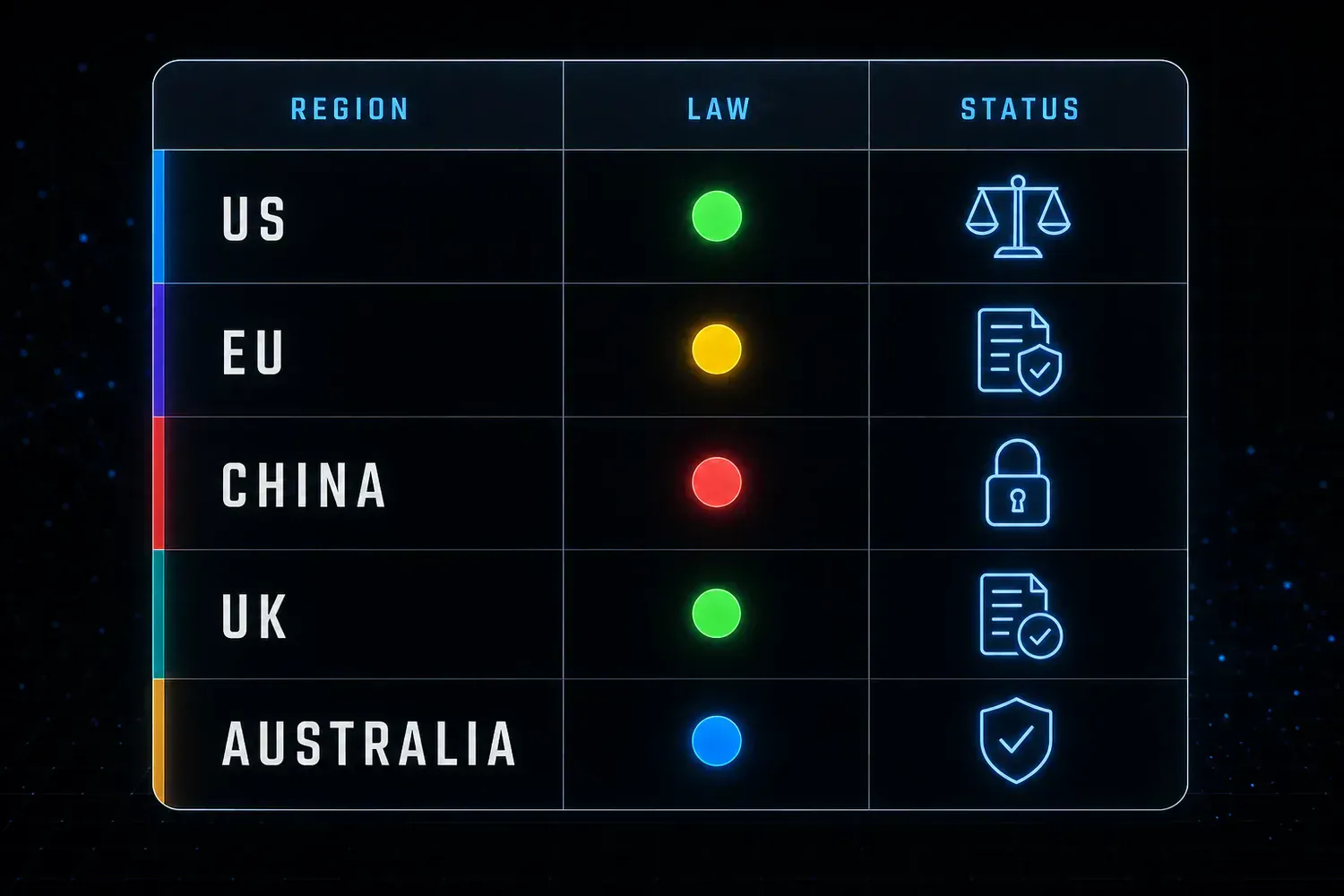
For years, AI regulation has lived mostly on paper. Governments published principles, ran consultations, and drafted bills that sat in committee. June 2026 was the month one of those threads turned into something with teeth, and it didn't look the way most people expected.
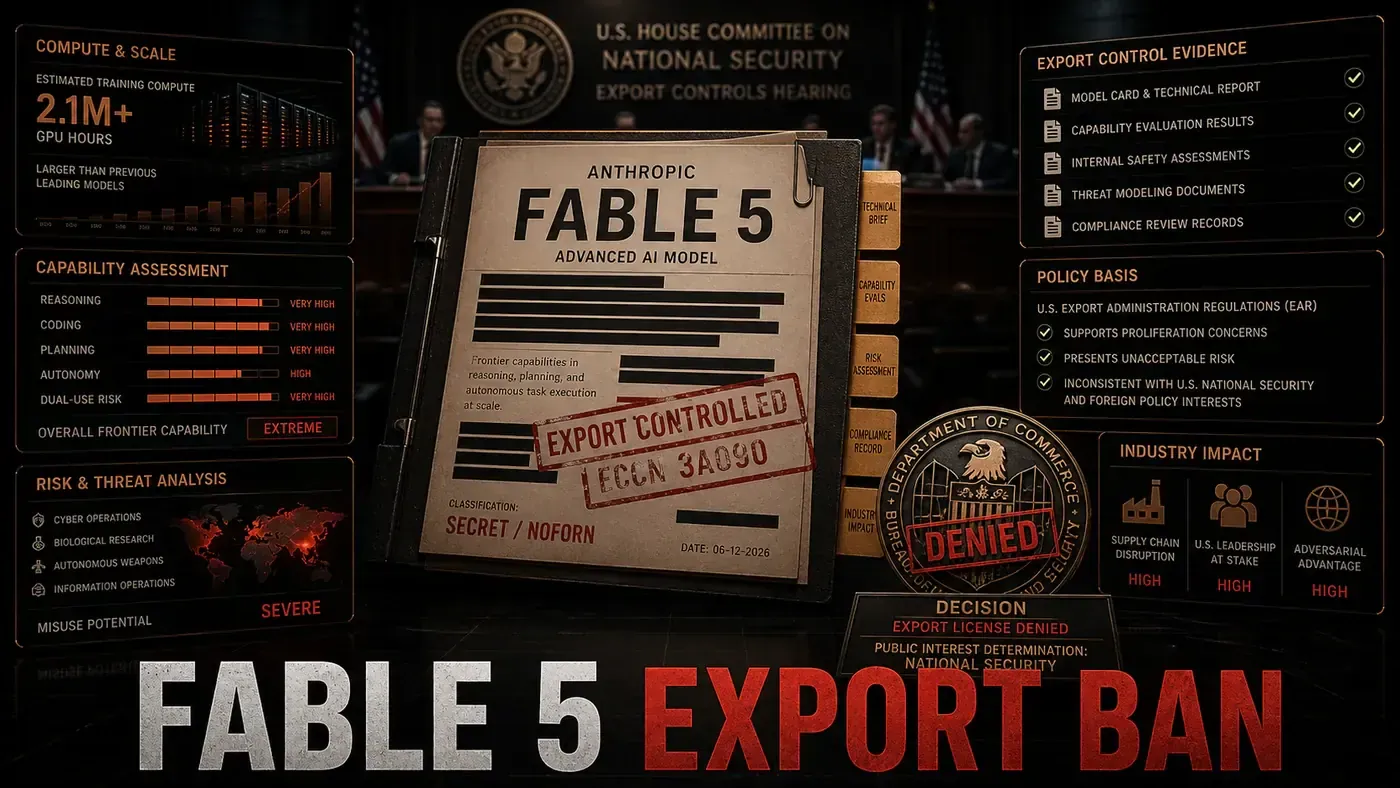
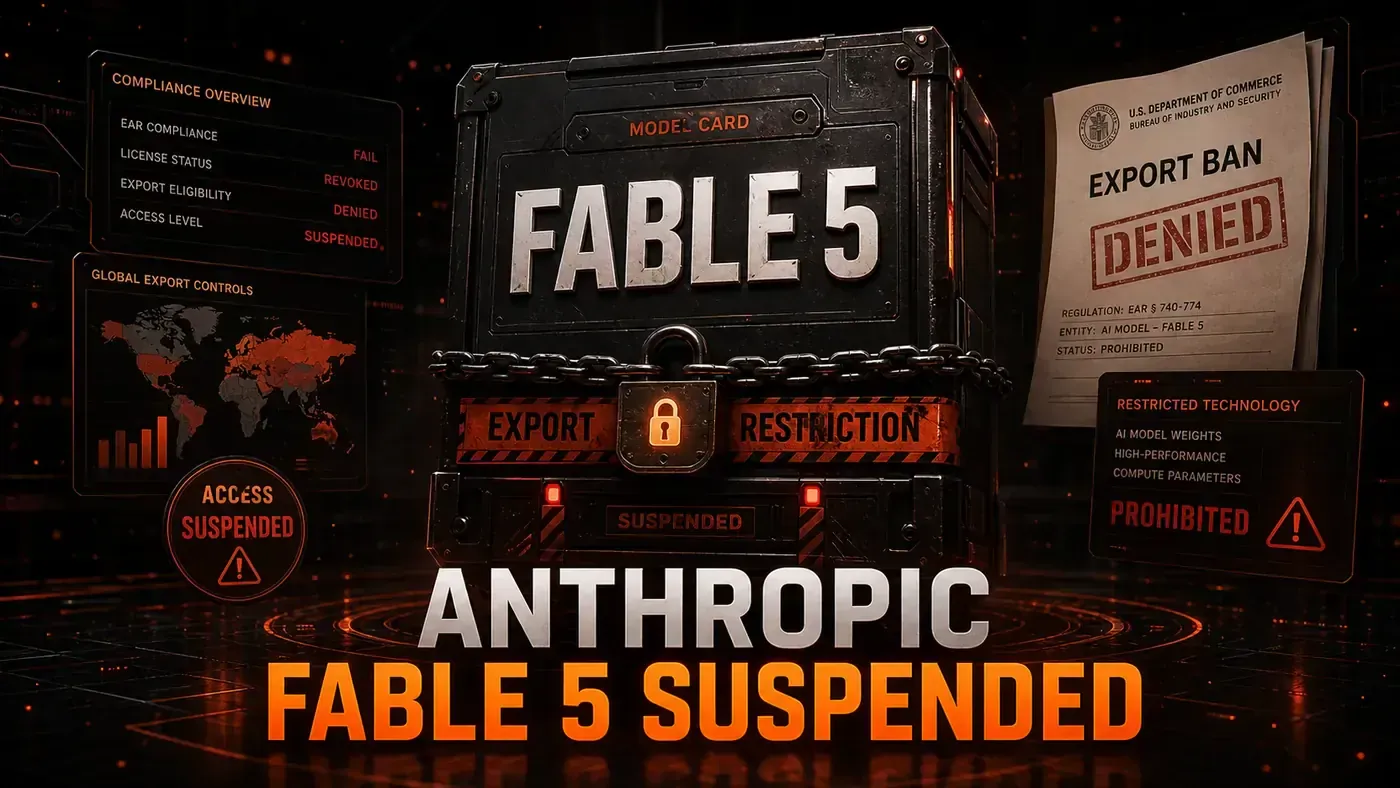
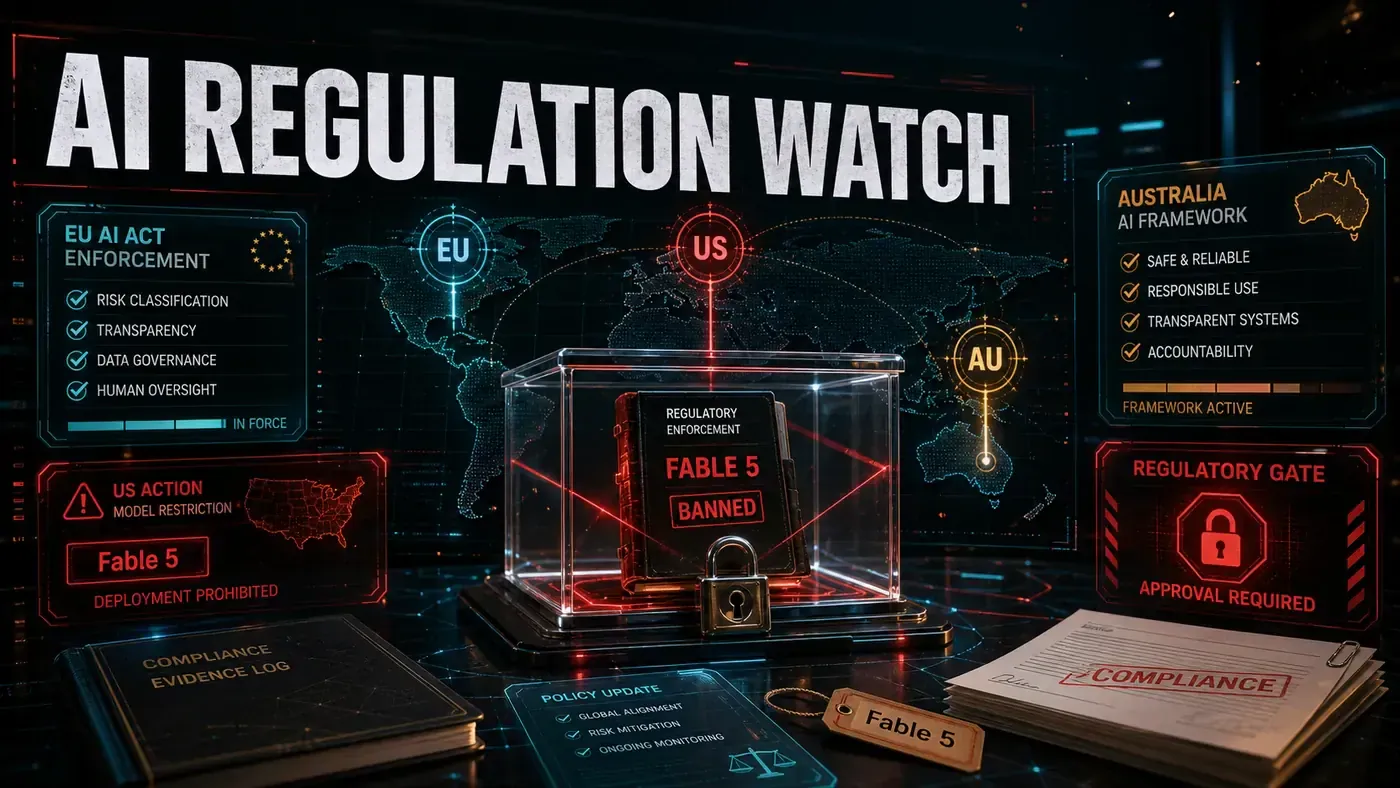
The clearest action came from Washington. On 12 June, the US Commerce Department told Anthropic it could no longer let any foreign national, anywhere, use its newest models. The result was a near-immediate global shutdown of Fable 5 and Mythos 5, both released only days earlier. It's the first time a US export rule has been pointed at a specific frontier AI model rather than at chips or hardware.
Elsewhere, the picture is messier than the headlines suggest. A lot of what circulated as "new June rules", Australia's framework, China's labelling regime, Brazil's AI law, turns out to be either older policy being re-reported or, in some cases, not yet on the books at all. For a business trying to plan, the gap between what was announced and what is actually enforceable matters more than the noise.
So below is the honest version: the US action that's confirmed, the EU duties that are real but arriving later than the buzz implies, and the regional moves that are still claims rather than law.
European Union: The AI Act Timeline
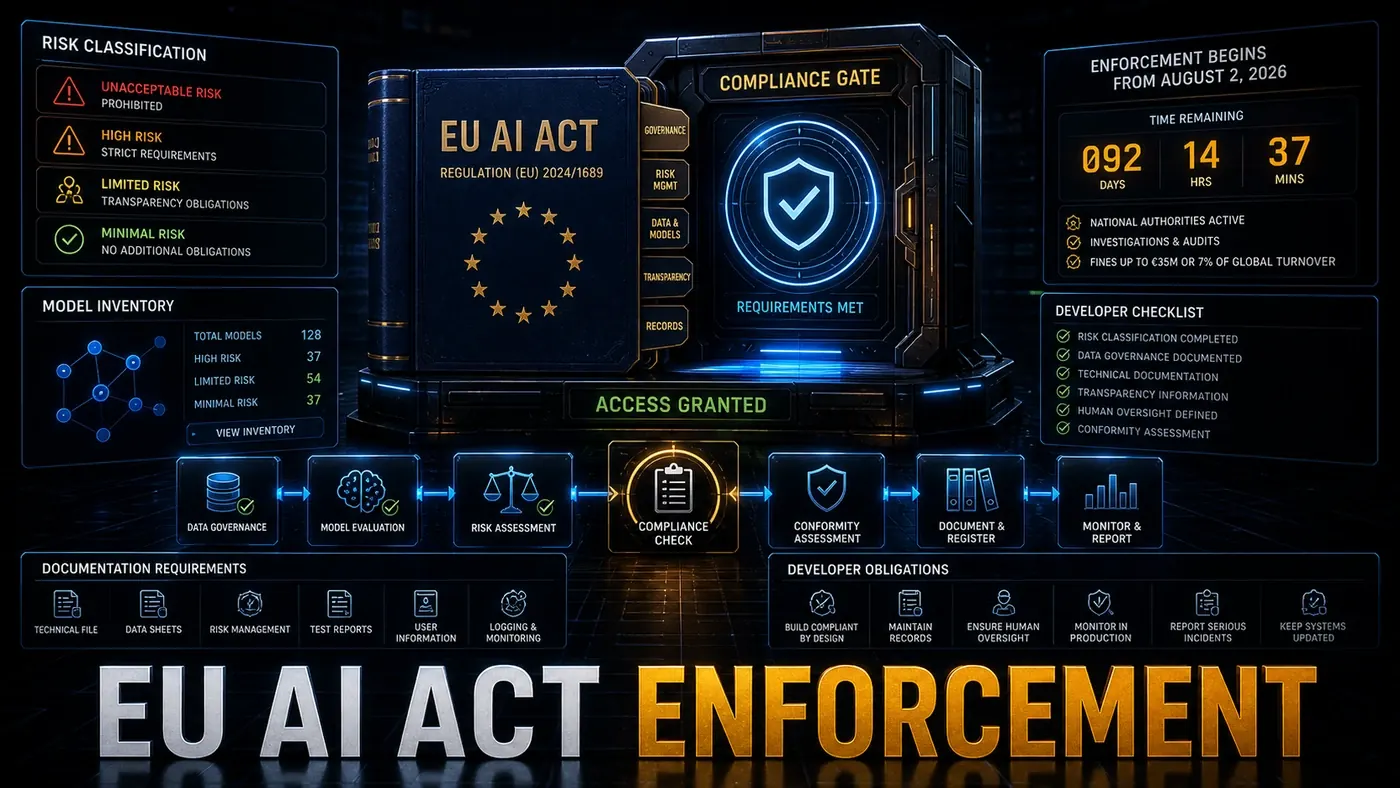
The EU AI Act is real and binding, and it remains the world's first comprehensive AI law. But the framing of a "2 June 2026 enforcement switch" doesn't match the official schedule. The Act phases in over years: prohibited practices and AI literacy rules applied from February 2025, general-purpose model rules from August 2025, and most high-risk obligations from August 2026 (EU AI Act Implementation Timeline (opens in a new tab)). There was no distinct provision that switched on in June.
What the Act actually does is sort AI systems by risk, with the heaviest duties landing on high-risk uses in healthcare, finance, education, and law enforcement.
A chunk of the transparency story is accurate, just early. Article 50 requires that systems interacting with people disclose they're artificial and that AI-generated content be labelled, with the new European AI Office coordinating across member states. Those transparency duties apply from August 2026, and a recent Digital Omnibus agreement set a content-labelling deadline of 2 December 2026 (EU AI Act Update June 2026, Covington (opens in a new tab)). General-purpose model providers have had documentation duties since August 2025. So the substance holds; the "first wave of enforcement this month" timing does not.
The compliance picture is harder to pin down. Major providers have engaged with the documentation requirements, and there have been scattered reports of some firms limiting EU availability. But the tidy snapshot of OpenAI, Google, Anthropic, and Meta all filing paperwork while smaller and open-source projects geofence EU users is unconfirmed, treat it as a plausible direction of travel, not a verified state of play.
United States: Export Controls Over Legislation
Washington skipped comprehensive legislation and went straight to a targeted strike. On 12 June 2026, Anthropic received a Commerce Department directive (issued by the Bureau of Industry and Security under the Export Administration Regulations) suspending access to its newest models by any foreign national, inside or outside the US. In practice that forced a global shutdown (Anthropic disables Fable and Mythos after US export ban, Fortune (opens in a new tab)).
Two corrections to the version that spread online. First, the order covered both Fable 5 and Mythos 5, not Fable 5 alone. Second, the reported trigger wasn't the model's raw capability, officials pointed to Anthropic's "recklessness" and a narrow jailbreak vulnerability raising national-security concerns (Export controls stem from Anthropic 'recklessness', official says, Fox Business (opens in a new tab)).
The action leaned on the Export Administration Regulations administered by BIS, under authorities tied to the Export Control Reform Act of 2018 and national security (A Kill Switch for Frontier AI, Lawfare (opens in a new tab)). The article's framing that it was issued specifically to block "weapons of mass destruction or advanced cyber weapons" reflects the general statutory category, but reporting centred the rationale on the jailbreak flaw rather than that exact clause.
For context on the model itself: Fable 5 launched on 9 June 2026, with safeguards that route some sensitive queries to Claude Opus 4.8, priced at $10 per million input tokens and $50 per million output tokens (Claude Fable 5 and Mythos 5, Anthropic (opens in a new tab)). It scored 80.3% on SWE-Bench Pro at launch, roughly 11 points ahead of the next-best model, though that figure used Anthropic's own scaffolding and is contested by some independent evaluators (Claude Fable 5 & Mythos 5 Benchmark Breakdown, Vellum (opens in a new tab)).
Worth being clear here: the idea that the 80.3% benchmark score was the regulatory trigger, setting an informal "capability threshold," is interpretation, not established fact. Reporting tied the ban to the jailbreak vulnerability, not the benchmark. So the "capability threshold" reading is best treated as an unconfirmed theory.
Congress, meanwhile, stayed put. The comprehensive AI bill introduced in early 2025 hasn't moved past committee, and the partisan split, Democrats leaning toward prescriptive rules, Republicans toward market-based approaches, shows little sign of closing before the November midterms.
There was also a real White House action in early June. On 2 June 2026, the administration issued an executive order on advanced AI innovation and security, plus NSPM-11, directing agencies to secure frontier-AI deployment, seek voluntary early access to models, and update procurement to onboard advanced AI faster (White House Executive Order on Advanced AI, Covington (opens in a new tab)). The description of it as a memo focused on "safety, transparency, and domestic sourcing" is a loose paraphrase rather than a precise account of what the order says.
Australia: The Voluntary Framework
The claim of a "12 June 2026" framework release doesn't hold up. Australia's principles-based, voluntary Guidance for AI Adoption was released by the National AI Centre in October 2025, building on the 2024 Voluntary AI Safety Standard (Australia unveils AI policy roadmap, IAPP (opens in a new tab)). The more recent developments are the National AI Plan 2025 and an AI Safety Institute slated to be operational in early 2026. So treat any "just released this month" version of this story as unsupported.
The underlying approach is genuine, and it's deliberately different from the EU's. Australia's long-standing AI Ethics Principles run to eight, human oversight, fairness, privacy protection, reliability, transparency, contestability, accountability, and beneficence, and they guide development without binding anyone legally. Industry groups generally like the light touch; consumer advocates argue it leaves too much to good intentions. The standing question is whether voluntary adoption is enough, or whether binding law eventually follows.
China: Algorithmic Governance
This one is mostly older policy in new wrapping. China's mandatory labelling regime for AI-generated content (paired with the GB 45438-2025 standard) was released in March 2025 and took effect on 1 September 2025, not issued in June 2026 (China Releases New Labeling Requirements for AI-Generated Content, Inside Privacy (opens in a new tab)). The algorithmic recommendation rules go back to 2021. The specific "security assessments for systems with more than 100,000 users" threshold isn't confirmed in the sources, so treat that detail as unverified.
The broader contrast still stands. China's regime is built around content control, labelling AI output and restricting material deemed to endanger national security or social order, where Western regimes lean toward safety and capability concerns. Western regulators tend to worry about what models can do; Chinese regulators about what models say.
Brazil: Still a Pending Bill
The article's headline claim is wrong as stated. Brazil's "Marco Legal da Inteligência Artificial" (PL 2.338/2023) was not signed into law on 18 June 2026. As of June 2026 it remained a pending bill under review in the Chamber of Deputies (AI laws and regulations in Brazil, CMS Expert Guide (opens in a new tab)). So Brazil being "the first Latin American country to pass comprehensive AI legislation" is, at this point, unconfirmed, the legislation hadn't passed.
If and when it does pass, it could matter regionally. The bill borrows the EU's risk-based structure but with lighter obligations and more emphasis on innovation, and Brazil's market of roughly 215 million people gives it real weight as a possible template for neighbours that would rather adapt than start from scratch.
Other Developments
- United Kingdom: The UK's sector-by-sector approach continued, with reports of the Financial Conduct Authority issuing guidance on AI in financial services and the Medicines and Healthcare products Regulatory Agency working on rules for AI medical devices. These are consistent with the UK's known posture but the specific June 2026 actions are unconfirmed.
- Japan: Japan's METI is reported to have updated its AI governance guidelines, positioning the country as a bridge between the EU and US blocs. This fits Japan's interoperability stance, though the specific June release wasn't confirmed.
- India: India continues to prioritise investment over regulation. Its IndiaAI Mission is funded at roughly US$1.2 billion (about Rs 10,300 crore) for compute infrastructure (IndiaAI Mission, IBEF (opens in a new tab)), though that programme was sanctioned in March 2024, not newly announced in June 2026. Comprehensive regulation still looks at least a couple of years off.
- Singapore: Singapore's AI Verify testing framework remains a regional reference point. The claim that Malaysia, Indonesia, and Vietnam formally adopted it in June 2026 is unverified; reporting suggests those countries are building their own frameworks, with an ASEAN AI Safety Network as the shared regional effort (National AI Strategy, Smart Nation Singapore (opens in a new tab)).