









Briefing
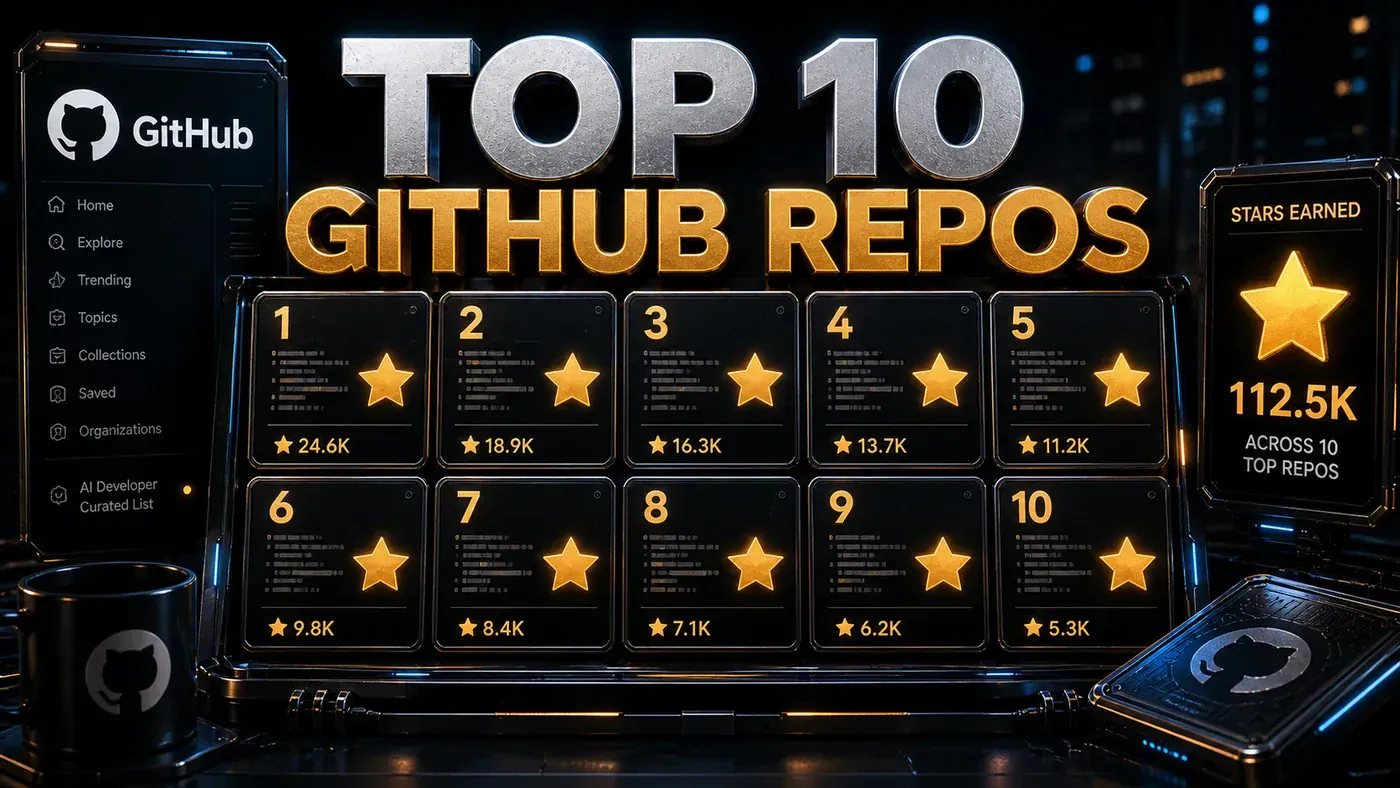
GitHub hosts thousands of AI repositories, and most of them will never matter to your work. The hard part isn't finding projects to look at. It's working out which handful are worth your attention. So we picked ten that we think every AI developer should have starred, forked, or at least bookmarked, plus a few honourable mentions worth a look.
A quick word on the numbers below: open-source projects move fast, and star counts climb every week. The figures here were accurate when the article was first compiled, but several have already crept higher. Treat them as a rough sense of scale, not a live scoreboard. Each entry links straight to the repo so you can check the current count yourself.
Why bother with a list like this at all? Because the tools a team chooses early on tend to shape how it builds for years. Pick the project with a real community and active maintainers, and you inherit thousands of other people's bug fixes and ideas. Pick the abandoned one with a slick README, and you end up maintaining it yourself. The ten below are, for the most part, in the first camp.
1. OpenClaw (345,000 stars), github.com/openclaw/openclaw
One of the most-starred AI projects on GitHub, sitting somewhere north of 345,000 stars (opens in a new tab). MIT license, Node.js, more than 100 built-in skills, and the ClawHub marketplace for adding more. Worth noting that the project's own README pitches it as a personal AI assistant you run on your own devices and reach through messaging apps like WhatsApp, Telegram, Slack and Discord, rather than a developer agent framework as such. Either way, the skills it ships for browser automation, code execution and API orchestration are solid reference implementations, and if you build with agents you should know what's in here.

2. Langflow (146,000 stars), github.com/langflow-ai/langflow
A visual agent builder with a big following at roughly 146,000 stars (opens in a new tab). It's MIT licensed (not Apache 2.0, as you'll sometimes see written). You drag and drop your way through a workflow using more than 100 components, then export the whole thing as code when you're ready. Good for prototyping fast and for poking at ideas without writing much, and it's seen real enterprise pickup.
3. Dify (136,000 stars), github.com/langgenius/dify
A full platform for building LLM apps, with around 136,000 stars (opens in a new tab). You get a RAG pipeline, prompt management, visual orchestration and one-click deployment out of the box. If you're shipping production LLM applications, Dify hands you a chunk of infrastructure you'd otherwise have to build and maintain yourself.
4. Firecrawl (130,000+ stars), github.com/mendableai/firecrawl
The web-context API that a lot of agents use to read the internet, with 130,000+ stars (opens in a new tab) (there's a hosted version (opens in a new tab) too). It takes any website and hands back clean Markdown an LLM can actually use, and the MCP server integration makes it easy to wire into an agent that needs to browse. The crawler is AGPL-3.0; the SDKs are MIT.
5. Browser-use (86,000 stars), github.com/browser-use/browser-use
Natural-language browser automation for agents, built on Playwright, with around 86,000 stars (opens in a new tab). You tell it what you want in plain English and it drives the browser, with some visual understanding of the page. It's one of the cleaner ways to give an agent real web-browsing ability, which makes it handy for research, scraping and anything that involves clicking around a site.
6. AutoGen, github.com/microsoft/autogen
Microsoft's multi-agent orchestration framework (opens in a new tab): conversational agents that can run code, with human-in-the-loop support and flexible conversation patterns, plus deep Azure integration. One caveat worth knowing before you commit: the project is now in maintenance mode, and Microsoft is pointing new users toward its newer Microsoft Agent Framework. Still a useful codebase to learn from, but check where active development has moved before you build on it.
7. Mem0 (52,000 stars), github.com/mem0ai/mem0
Memory for agents, with about 52,000 stars (opens in a new tab). It offers layered storage across short-term, long-term and episodic memory, works with any model, and aims to give agents something better than a blank slate every session. The project advertises very fast retrieval; its own published benchmarks put single-pass retrieval closer to a second than the millisecond figures sometimes quoted, so test it against your own latency budget rather than taking the marketing number at face value. If your agents keep forgetting what happened five minutes ago, this is the kind of thing that fixes it.
8. nanochat (55,000 stars), github.com/karpathy/nanochat
Andrej Karpathy's minimal LLM training stack, sitting at roughly 55,000 stars (opens in a new tab). The headline: you can train a GPT-2 class model for about $48 in compute (the README clocks it at roughly two hours on an 8xH100 node). More than that, it's one of the best ways to actually understand how transformers work. The code is small and well commented, and reading it teaches you something.
9. LocalAI (44,000 stars), github.com/mudler/LocalAI
Run models on your own hardware, no GPU required, with around 44,000 stars (opens in a new tab). It's MIT licensed and exposes an OpenAI-compatible API, so you can point existing code at a local backend without rewriting it. It handles LLMs, vision models, embeddings, diffusion and audio. If you're moving work off the cloud for cost or privacy reasons, this is a sensible foundation.
10. Hermes Agent (22,000 stars), github.com/nousresearch/hermes
Nous Research's learning agent, built around what they call dialectic memory via the Honcho system, with 40+ tools. One correction before you go looking: the repo lives at NousResearch/hermes-agent (opens in a new tab), and its star count is far higher than the 22,000 originally listed here. The pitch is an agent that actually adapts to the person using it over time, which puts it closer to the research edge than the production mainstream. Reportedly built by around 142 contributors, though we couldn't confirm that figure.
Honourable Mentions
These didn't make the top 10 but are worth a look:
- CrewAI: probably the most approachable multi-agent framework if you're starting out
- MetaGPT: multi-agent teams that take a brief and build software end to end
- OpenHuman: a desktop-first personal AI (tinyhumansai/openhuman (opens in a new tab)) with 118+ integrations and persistent local memory
- Vercel agent-browser (27,000 stars): serverless browser automation, at vercel-labs/agent-browser (opens in a new tab)
- awesome-claude-skills: the broader community has put together collections of 1,000+ skills (opens in a new tab) for Claude Code, though any single repo of that exact name tends to be smaller
How to Use This List
Star the ones that look relevant, read their docs, and run a quickstart or two. Even the projects you never adopt are worth opening, because the design choices their maintainers made will rub off on how you build. And since this space turns over fast, it's worth coming back every few months to see what's changed.
The thread running through all ten is that they're genuinely open and genuinely maintained. None of them are README-and-nothing-else projects. They're worked on in the open, depended on by a lot of people, and that's most of the reason they earned a place here.
Top 10 GitHub repos every AI developer should star: answer-first summary
Top 10 GitHub repos every AI developer should star matters because it can change how Founders and operators plan, build, or govern an AI implementation workflow. Our curated list of the most essential open-source repositories for AI developers, from agent frameworks to training stacks to deployment tools.
The direct answer is this: do not treat the topic as a standalone trend. Treat it as a decision about inputs, outputs, review ownership, data exposure, and whether the workflow produces a result that is faster, safer, or more useful than the current process.
Top 10 GitHub repos every AI developer should star: implementation checklist
- Define the user, job to be done, and success metric for the AI implementation workflow.
- Collect real examples, policies, source files, customer questions, or search queries before writing prompts or choosing tools.
- Separate low-risk drafts from decisions that need approval, privacy checks, or senior review.
- Document what the AI is allowed to access, what it must not access, and who signs off before production use.
- Review time saved, quality score, review effort, business outcome after a small pilot rather than judging the idea from a demo.
This keeps the work practical. It also gives search engines and AI answer engines a clean factual structure: what the topic is, who it helps, what to do next, and which risks matter before implementation.
Decision criteria for Top 10 GitHub repos every AI developer should star
| Decision area | What to check | Production signal |
|---|---|---|
| Intent | Does Top 10 GitHub repos every AI developer should star solve a real workflow problem? | The use case has a named owner and measurable outcome. |
| Data | Can the required data be used safely? | Sensitive data is classified and access is controlled. |
| Quality | Can a reviewer judge the output consistently? | Examples, rubrics, or acceptance criteria exist. |
| Scale | Can the workflow be repeated without hero effort? | The process is documented and can be handed to another team member. |
Practical example for Top 10 GitHub repos every AI developer should star
A small business could use this article to choose one practical test. For example, a manager might take one customer-facing process, one internal document workflow, or one recurring content task and redesign only that step with AI support. The goal is not to automate the whole business at once; it is to learn where AI News creates reliable leverage.
The useful deliverable is a short operating note: the trigger, the source material, the prompt or tool, the review checklist, the escalation rule, and the metric. That note becomes the handover asset for staff training, SEO/GEO content, service delivery, or future agent work.
Risks and controls for Top 10 GitHub repos every AI developer should star
The common failure pattern is moving too quickly from a promising idea into an unmanaged workflow. For Top 10 GitHub repos every AI developer should star, the risk is not only bad output. It can also be unclear data permission, staff confusion, duplicate content, unreviewed customer advice, or a tool that quietly changes cost or capability.
- Control unclear use case with a named owner, a review step, and written acceptance criteria.
- Control weak data quality with a named owner, a review step, and written acceptance criteria.
- Control missing governance with a named owner, a review step, and written acceptance criteria.
- Control no measurement with a named owner, a review step, and written acceptance criteria.
Measurement plan for Top 10 GitHub repos every AI developer should star
A useful AI or SEO initiative should leave evidence. Track time saved, quality score, review effort, business outcome and compare the pilot against the current process. If the measure does not improve, keep the learning but avoid scaling the workflow.
For GEO readiness, the page should also answer the core question directly, define the entities involved, include implementation steps, explain tradeoffs, and link readers to the next relevant AI Kick Start service, guide, tool, or article.
Definitions and entities for Top 10 GitHub repos every AI developer should star
For search, GEO, and staff handover, define the core entities in plain language. In this article the important entities are the workflow owner, the AI tool or model, the source material, the review process, the risk boundary, and the measurable business outcome. Clear definitions make the page easier for people to scan and easier for AI answer engines to quote accurately.
- Workflow owner: the person accountable for deciding whether Top 10 GitHub repos every AI developer should star belongs in the business process.
- Source material: the documents, examples, policies, URLs, prompts, videos, or customer questions that ground the output.
- Review boundary: the point where a human checks accuracy, privacy, brand voice, or customer impact before the result is used.
- Success metric: the measure that proves whether the AI implementation workflow is worth repeating.
Top 10 GitHub repos every AI developer should star versus doing nothing
Doing nothing is also a decision. The cost may be slow manual work, weaker search visibility, inconsistent advice, duplicated effort, or staff using unmanaged AI tools without a shared process. The practical question is whether a controlled pilot can reduce that cost without creating a larger governance problem.
| Option | When it makes sense | What to watch |
|---|---|---|
| Do nothing | The workflow is rare, low value, or already reliable. | Competitors may improve speed, content depth, or service consistency first. |
| Run a small pilot | The task repeats often and has clear review criteria. | Keep scope tight and measure the result against the current process. |
| Build a production workflow | The pilot is repeatable and risk controls are documented. | Assign ownership, monitoring, training, and a rollback path. |
AI Kick Start handover package for Top 10 GitHub repos every AI developer should star
A production handover should be concrete enough that another person can run it. For Top 10 GitHub repos every AI developer should star, that means a short brief, a workflow map, approved prompts or tool settings, source material, a review checklist, internal links to supporting resources, and a simple measurement sheet. This is the difference between reading about AI and turning it into operational capability.
That packaging also strengthens E-E-A-T. It shows experience through implementation notes, expertise through decision criteria, authoritativeness through source-aware structure, and trust through risks, controls, and review steps. The article becomes useful even if the reader never buys a tool because it helps them make a better operational decision.