






Briefing
A few years ago, "open source AI" mostly meant a clever repo, a Discord server, and a maintainer working nights for free. That picture has changed. Some of these projects now have hundreds of thousands of GitHub stars, venture money in the bank, and paying enterprise customers. A handful are turning real revenue.
So if the code is free, where does the money come from? That's the question worth answering before you bet a workflow on any of these tools.
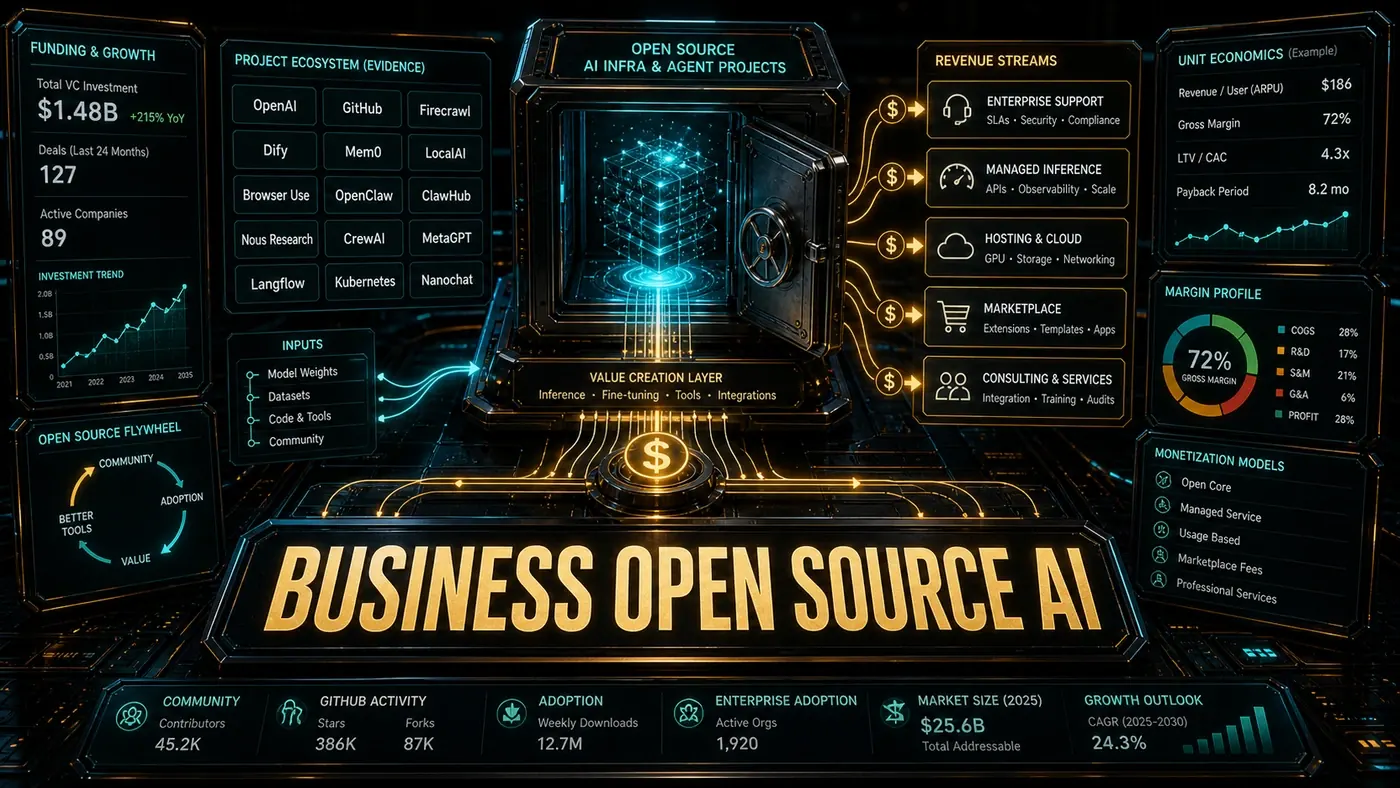
The short version: the popular project is rarely the product. The product is everything bolted around it, hosting, support, security, a place to deploy at scale. The repo earns the trust; the company sells the convenience. Below is how that plays out across the tools Australian teams are actually evaluating, who's funded, who isn't, and which claims floating around the space don't hold up.
The Open Source Business Model Spectrum
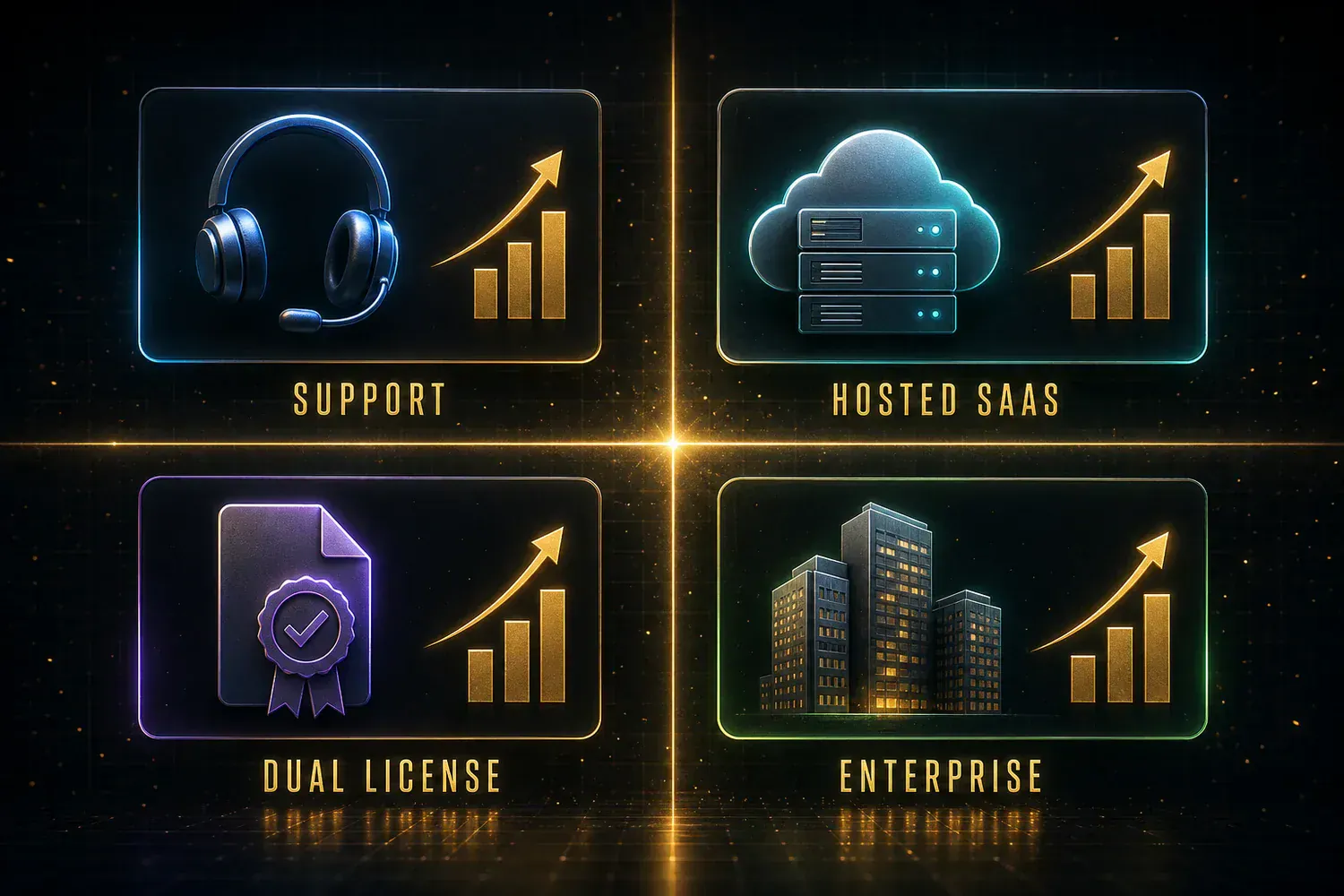
Pure Open Source: Some projects run with no commercial engine behind them at all. nanochat (opens in a new tab), Andrej Karpathy's end-to-end training pipeline, and awesome-claude-skills (opens in a new tab) sit here. They're kept alive by individuals or small communities, paid for with sponsorships and goodwill. The point is reach and teaching, not income.
Open Core: The most common arrangement. The core is genuinely free and open, and the money sits in commercial extras for bigger users. Dify (opens in a new tab) works this way, the self-hosted platform costs nothing, while cloud hosting, advanced features, and enterprise support are what you pay for (its paid Cloud tiers start at $59/mo).
Managed Services: Same software, but someone else runs it for you. Firecrawl (opens in a new tab) offers a hosted crawling service next to its open codebase. Self-host for free, or pay so you don't have to think about it.
Consulting and Support: Enterprise clients pay for help getting it working, implementation, custom builds, production support. CrewAI and MetaGPT both have commercial offerings in this territory, though in practice both lean more toward an enterprise platform than pure consulting. CrewAI (opens in a new tab) runs an Enterprise Cloud product, and DeepWisdom, the company behind MetaGPT (opens in a new tab), monetises through products like its Atoms coding tool.
Ecosystem Revenue: Marketplaces make money from distribution. ClawHub, the skill registry for OpenClaw agents, is reportedly looking at verified publisher programmes and enterprise registry services, though those revenue plans aren't confirmed.
Who's Raising Money
OpenClaw: This one needs a correction up front. The widely repeated story that OpenClaw raised a $100M-plus Series A in early 2026 doesn't appear to hold up, there's no evidence of such a round. What actually happened: the creator, Peter Steinberger (not "Cole Steinberger", as some write-ups have it), declined to build a company and joined OpenAI in February 2026 (opens in a new tab), and OpenClaw continued as an independent open-source project. Treat any claim about an OpenClaw funding round at a $100M valuation as unconfirmed.
Mem0: The funding here is real. Mem0 raised $24M (Seed plus a Series A led by Basis Set Ventures) (opens in a new tab) to build out its managed memory service. The bet is simple: every production agent needs memory, and Mem0 wants to be the default layer that provides it. AWS picked it as the memory provider for its Agent SDK, which tells you the thesis has buyers.
Firecrawl: Firecrawl raised a $14.5M Series A in August 2025, led by Nexus Venture Partners (opens in a new tab), and serves more than 350,000 developers. Its annual revenue is reportedly in the millions, though that figure isn't publicly confirmed. Growth is coming from agent developers who need dependable web access.
Langflow: Worth flagging the ownership here, because it changes the picture. Langflow is a popular open-source visual builder, but it isn't an independent company. It's owned by DataStax, which IBM agreed to acquire in 2025 (opens in a new tab) and folded into its watsonx portfolio. The visual builder does lower the barrier for non-technical users, but claims of standalone Fortune 500 licensing revenue are unverified, the monetisation now runs through IBM/DataStax.
Nous Research: Another correction. Nous Research is often described as a non-profit living on grants and donations. It isn't. It's a VC-backed startup that has raised around $70M, including a $50M round led by Paradigm (opens in a new tab). It champions open-source AI, but it does so on a commercial-investor footing, not a charitable one.
Who's Not (Yet)
nanochat: Karpathy's educational project has no monetisation, and that's by design. The value is in teaching and the community around it, not in revenue.
Browser-use: This is frequently listed as pure open source with no commercial backing, but that's wrong. Browser Use raised $17M in seed funding (led by Felicis, out of Y Combinator's W2025 batch) (opens in a new tab). It's open source, but it's funded.
LocalAI: A genuinely community-driven local-inference project. It appears to have no formal company structure behind it, though that detail isn't independently confirmed. Its pull is utility, not profit.
The Sustainability Challenge
The old open-source funding problem hasn't gone away. Popular projects with no revenue model run on volunteer time, and volunteer time runs out, that's how you get burnout and maintenance gaps. The risk isn't theoretical. In September 2025, a major npm supply-chain attack compromised 18 widely used packages (opens in a new tab) (including debug and chalk, with roughly 2.6 billion weekly downloads between them) via phishing, followed by the self-replicating "Shai-Hulud" worm that hit hundreds more packages and stole cloud tokens. Incidents like that put the funding question back on the table.
A few funding routes have settled into place by 2026:
- [GitHub Sponsors](https://github.com/sponsors): Direct funding from users to maintainers
- Open Collective: Transparent funding for community projects
- Corporate Sponsorships: Companies paying to keep projects they rely on alive
- Foundations: The Linux Foundation, the Apache Software Foundation, and newer AI-specific foundations providing governance and money
The Enterprise Opportunity
The serious revenue is in enterprise adoption. Companies spending millions on AI infrastructure want support guarantees, security audits, and professional services, and they'll pay for them. Open-source projects that can offer that layer while keeping the core free are the ones capturing meaningful revenue.
It's the same pattern that played out before: Linux had Red Hat, Hadoop had Cloudera, Kubernetes had the cloud providers. The open-source project becomes the standard everyone uses, and the commercial business sells the things enterprises can't or won't do themselves.
Looking Ahead
This is still early, and the shape of it is likely to keep shifting. A few things look probable:
- Consolidation, as successful projects formalise into companies
- New funding models built specifically for open-source AI
- More corporate sponsorship as businesses lean harder on these tools
- Regulatory pressure to fund critical infrastructure properly
For teams choosing tools, the practical takeaway is reassuring: most of the projects you'd actually depend on are funded and maintained, not held together by one exhausted volunteer. Open-source AI isn't charity. It's a working business model, one where free software and paid services prop each other up, and everyone gets something out of it.
The business of open source AI: answer-first summary
The business of open source AI matters because it can change how Founders and operators plan, build, or govern an AI implementation workflow. A look at the business models behind funded open-source AI projects, and which ones are actually turning real revenue and profit.
The direct answer is this: do not treat the topic as a standalone trend. Treat it as a decision about inputs, outputs, review ownership, data exposure, and whether the workflow produces a result that is faster, safer, or more useful than the current process.
The business of open source AI: implementation checklist
- Define the user, job to be done, and success metric for the AI implementation workflow.
- Collect real examples, policies, source files, customer questions, or search queries before writing prompts or choosing tools.
- Separate low-risk drafts from decisions that need approval, privacy checks, or senior review.
- Document what the AI is allowed to access, what it must not access, and who signs off before production use.
- Review time saved, quality score, review effort, business outcome after a small pilot rather than judging the idea from a demo.
This keeps the work practical. It also gives search engines and AI answer engines a clean factual structure: what the topic is, who it helps, what to do next, and which risks matter before implementation.
Decision criteria for The business of open source AI
| Decision area | What to check | Production signal |
|---|---|---|
| Intent | Does The business of open source AI solve a real workflow problem? | The use case has a named owner and measurable outcome. |
| Data | Can the required data be used safely? | Sensitive data is classified and access is controlled. |
| Quality | Can a reviewer judge the output consistently? | Examples, rubrics, or acceptance criteria exist. |
| Scale | Can the workflow be repeated without hero effort? | The process is documented and can be handed to another team member. |
Practical example for The business of open source AI
A small business could use this article to choose one practical test. For example, a manager might take one customer-facing process, one internal document workflow, or one recurring content task and redesign only that step with AI support. The goal is not to automate the whole business at once; it is to learn where AI News creates reliable leverage.
The useful deliverable is a short operating note: the trigger, the source material, the prompt or tool, the review checklist, the escalation rule, and the metric. That note becomes the handover asset for staff training, SEO/GEO content, service delivery, or future agent work.
Risks and controls for The business of open source AI
The common failure pattern is moving too quickly from a promising idea into an unmanaged workflow. For The business of open source AI, the risk is not only bad output. It can also be unclear data permission, staff confusion, duplicate content, unreviewed customer advice, or a tool that quietly changes cost or capability.
- Control unclear use case with a named owner, a review step, and written acceptance criteria.
- Control weak data quality with a named owner, a review step, and written acceptance criteria.
- Control missing governance with a named owner, a review step, and written acceptance criteria.
- Control no measurement with a named owner, a review step, and written acceptance criteria.
Measurement plan for The business of open source AI
A useful AI or SEO initiative should leave evidence. Track time saved, quality score, review effort, business outcome and compare the pilot against the current process. If the measure does not improve, keep the learning but avoid scaling the workflow.
For GEO readiness, the page should also answer the core question directly, define the entities involved, include implementation steps, explain tradeoffs, and link readers to the next relevant AI Kick Start service, guide, tool, or article.
Definitions and entities for The business of open source AI
For search, GEO, and staff handover, define the core entities in plain language. In this article the important entities are the workflow owner, the AI tool or model, the source material, the review process, the risk boundary, and the measurable business outcome. Clear definitions make the page easier for people to scan and easier for AI answer engines to quote accurately.
- Workflow owner: the person accountable for deciding whether The business of open source AI belongs in the business process.
- Source material: the documents, examples, policies, URLs, prompts, videos, or customer questions that ground the output.
- Review boundary: the point where a human checks accuracy, privacy, brand voice, or customer impact before the result is used.
- Success metric: the measure that proves whether the AI implementation workflow is worth repeating.
The business of open source AI versus doing nothing
Doing nothing is also a decision. The cost may be slow manual work, weaker search visibility, inconsistent advice, duplicated effort, or staff using unmanaged AI tools without a shared process. The practical question is whether a controlled pilot can reduce that cost without creating a larger governance problem.
| Option | When it makes sense | What to watch |
|---|---|---|
| Do nothing | The workflow is rare, low value, or already reliable. | Competitors may improve speed, content depth, or service consistency first. |
| Run a small pilot | The task repeats often and has clear review criteria. | Keep scope tight and measure the result against the current process. |
| Build a production workflow | The pilot is repeatable and risk controls are documented. | Assign ownership, monitoring, training, and a rollback path. |
AI Kick Start handover package for The business of open source AI
A production handover should be concrete enough that another person can run it. For The business of open source AI, that means a short brief, a workflow map, approved prompts or tool settings, source material, a review checklist, internal links to supporting resources, and a simple measurement sheet. This is the difference between reading about AI and turning it into operational capability.
That packaging also strengthens E-E-A-T. It shows experience through implementation notes, expertise through decision criteria, authoritativeness through source-aware structure, and trust through risks, controls, and review steps. The article becomes useful even if the reader never buys a tool because it helps them make a better operational decision.