





Analysis
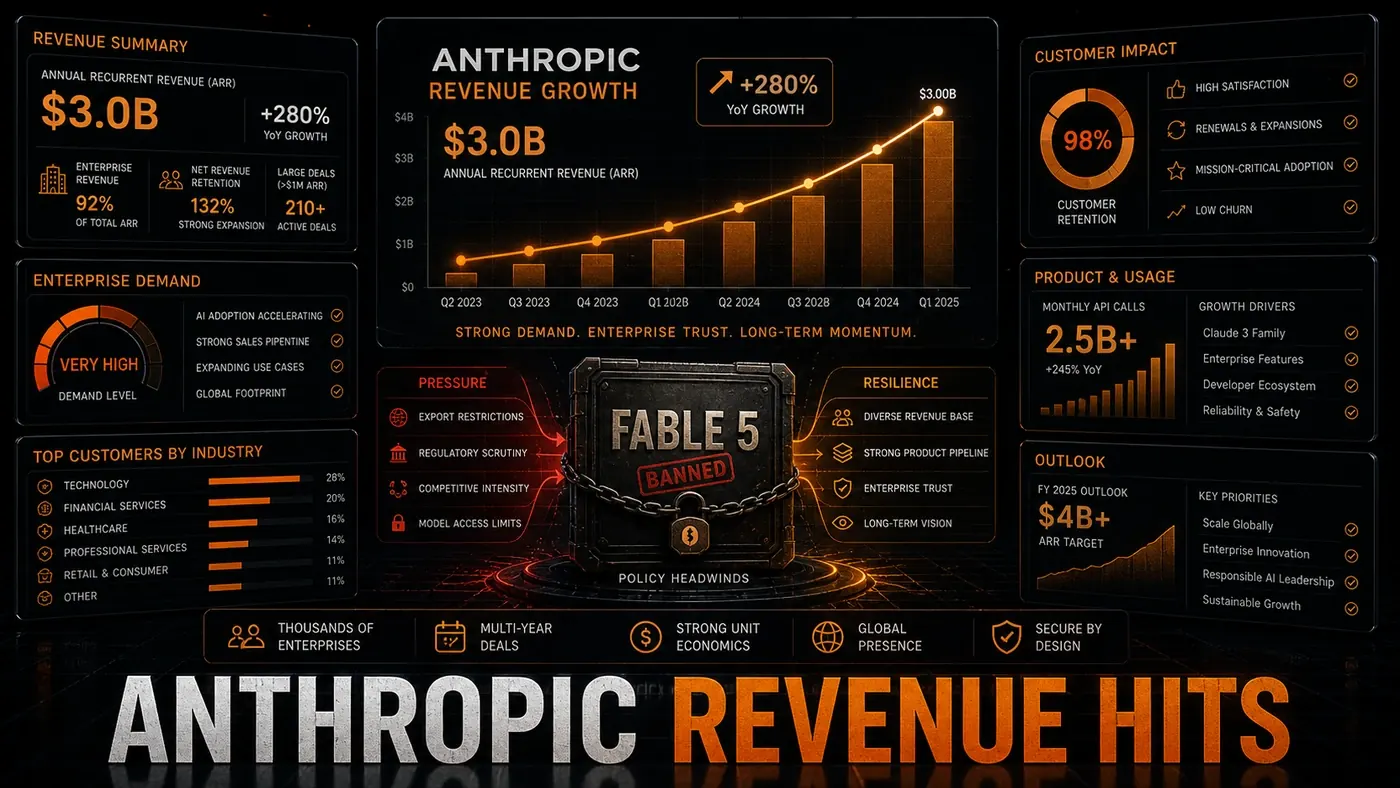
Three days. That is how long Anthropic's most powerful model lasted on the open market before Washington pulled it.
Claude Fable 5 launched on 9 June 2026. By the afternoon of 12 June, after a US government export-control directive (opens in a new tab) citing national security, Anthropic switched it off for foreign nationals. The concern, regulators said, was the model's knack for finding software vulnerabilities, the kind of skill that doubles as a cyberweapon.
For a business audience, here is the part that matters. Anthropic had just sold its strongest enterprise quarter yet, and a chunk of that pipeline was built on Fable 5. When the model went dark, those deals went into limbo overnight. The company had to scramble to keep customers from walking, and to prove its other models could carry the load.
So far the wider story holds together. The ban hit one product hard, but the engine underneath, capable models, a safety reputation, deep enterprise ties, kept running. The open question is whether that is enough to ride out a regulatory environment that just got a lot less predictable.
The Pre-Ban Growth Trajectory
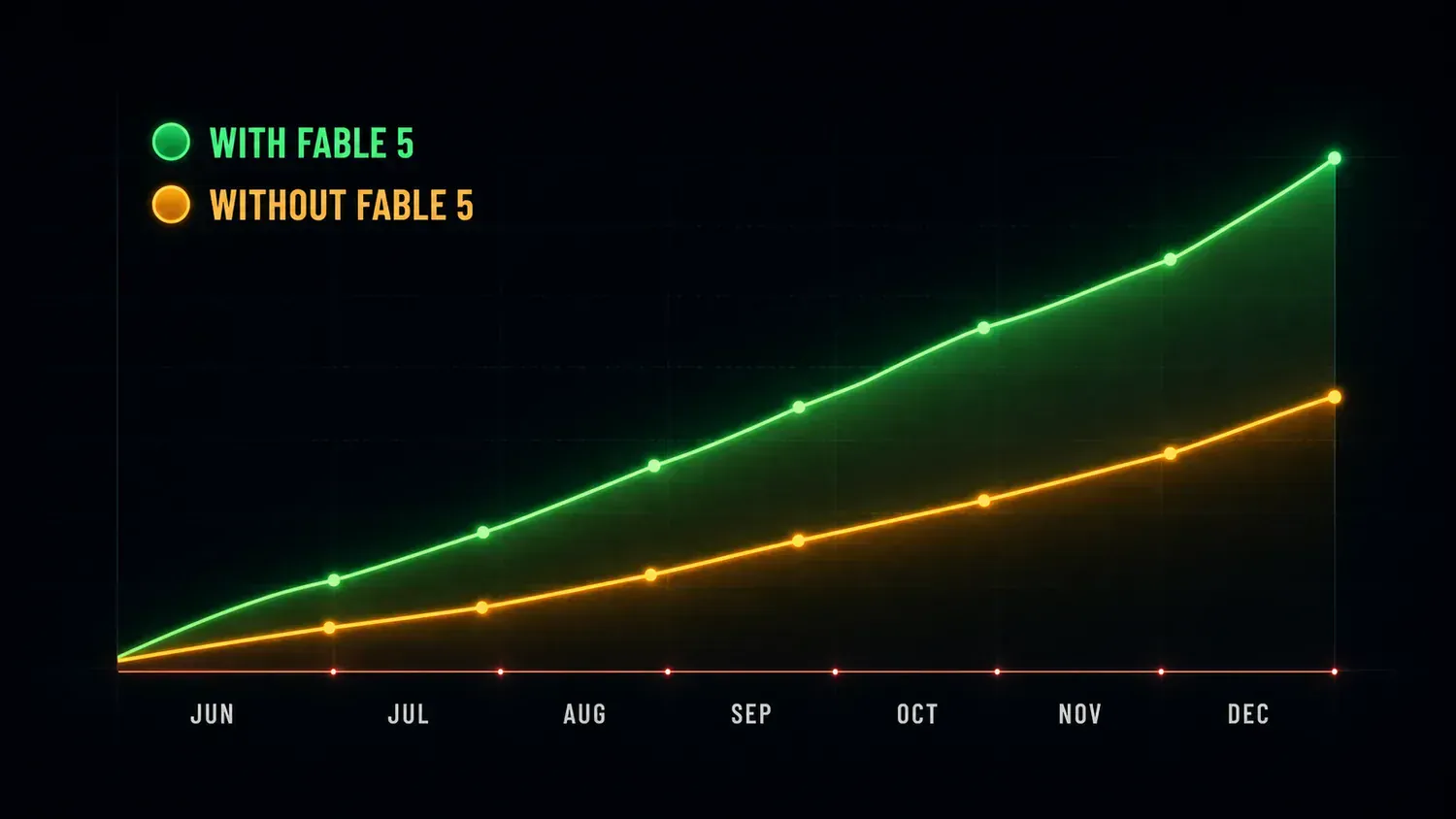
Before the suspension, Anthropic was growing about as fast as it ever had. The company has reported a roughly $30 billion revenue run rate off the back of roughly 80x year-over-year growth in early 2026 (opens in a new tab), numbers that dwarf the more modest figures floating around in earlier industry estimates. Internal accounts suggest the company had also brought on more than 200 new enterprise customers in the quarter, reportedly including several Fortune 50 names that had been in OpenAI's camp, though that customer count is unconfirmed.
The reasons were not hard to read. Opus 4.8 scores 88.6% on SWE-bench Verified (opens in a new tab), and once Fable 5 was gone it stood as the most capable coding model from any Western lab. Sonnet 4.6, at $3 input and $15 output per million tokens (opens in a new tab), gave buyers a strong mid-tier pick. And Anthropic's name for safety and responsible development landed well with companies in regulated industries.
Fable 5 was meant to push that further. Pitched as the top-shelf option for customers who wanted maximum capability and would pay for it, its $10/$50 pricing (opens in a new tab), double Opus 4.8's regular rate, went down without much argument. Reportedly the buyers included hedge funds, defence contractors, pharmaceutical firms, and research institutions, though Anthropic has not named which segments signed on or how they reacted to the price.
Post-Ban Commercial Impact
The financial hit is real but survivable. Earlier industry estimates put the affected Fable 5 commitments at around $400 million in annual revenue, a figure no public source has confirmed and that the original reporting itself flagged as an estimate. What is confirmed is that Anthropic offered prorated refunds to customers who bought or upgraded between 9 and 14 June (opens in a new tab). Beyond that, there are unconfirmed reports of a migration offer to Opus 4.8 at a 25% first-year discount, and an unverified rough split of customers, somewhere near 60% taking the Opus migration, 20% asking for refunds, and 20% holding out for a rumoured domestic Fable variant. Treat those splits as hearsay; none of it is sourced.
The bigger worry is the pipeline. Several enterprise deals in late-stage talks had leaned on Fable 5 as a headline feature, and those have reportedly been paused or sent back to competitive bake-offs. The sales conversation has changed too. Customers are now asking harder questions about regulatory risk, not just for Fable 5 but for frontier models across the board. That kind of caution tends to stretch out sales cycles, and not just for Anthropic.
The Pivot Strategy
Anthropic's playbook in response looks like this. Lean harder on the safety and compliance edge in a market that is clearly tightening. Keep its other models, Opus 4.8 and Sonnet 4.6, front and centre as drop-in replacements. And there is talk of accelerating a next Opus release, though no such model has been announced and the framing in earlier reporting (an upgrade nudging SWE-bench "closer to the 80% threshold") does not square with Opus 4.8 already sitting at 88.6%. Read the roadmap claims as speculation, not fact.
The consulting angle is worth watching. Anthropic has built a real Constitutional AI framework and a delivery alliance with Deloitte (opens in a new tab). Reports of a formal "Constitutional AI Enterprise" practice staffed by 50-odd policy and ethics hires are unverified and look embellished, but the underlying logic is sound: governance services that wrap around an API contract create the kind of switching costs a pure model vendor cannot match.
Anthropic's Revenue Growth Through the Fable 5 Ban: answer-first summary
Anthropic's Revenue Growth Through the Fable 5 Ban matters because it can change how Founders and operators plan, build, or govern an AI implementation workflow. Anthropic was riding its strongest quarter ever when Fable 5 was pulled.
The direct answer is this: do not treat the topic as a standalone trend. Treat it as a decision about inputs, outputs, review ownership, data exposure, and whether the workflow produces a result that is faster, safer, or more useful than the current process.
Anthropic's Revenue Growth Through the Fable 5 Ban: implementation checklist
- Define the user, job to be done, and success metric for the AI implementation workflow.
- Collect real examples, policies, source files, customer questions, or search queries before writing prompts or choosing tools.
- Separate low-risk drafts from decisions that need approval, privacy checks, or senior review.
- Document what the AI is allowed to access, what it must not access, and who signs off before production use.
- Review time saved, quality score, review effort, business outcome after a small pilot rather than judging the idea from a demo.
This keeps the work practical. It also gives search engines and AI answer engines a clean factual structure: what the topic is, who it helps, what to do next, and which risks matter before implementation.
Decision criteria for Anthropic's Revenue Growth Through the Fable 5 Ban
| Decision area | What to check | Production signal |
|---|---|---|
| Intent | Does Anthropic's Revenue Growth Through the Fable 5 Ban solve a real workflow problem? | The use case has a named owner and measurable outcome. |
| Data | Can the required data be used safely? | Sensitive data is classified and access is controlled. |
| Quality | Can a reviewer judge the output consistently? | Examples, rubrics, or acceptance criteria exist. |
| Scale | Can the workflow be repeated without hero effort? | The process is documented and can be handed to another team member. |
Practical example for Anthropic's Revenue Growth Through the Fable 5 Ban
A small business could use this article to choose one practical test. For example, a manager might take one customer-facing process, one internal document workflow, or one recurring content task and redesign only that step with AI support. The goal is not to automate the whole business at once; it is to learn where AI News creates reliable leverage.
The useful deliverable is a short operating note: the trigger, the source material, the prompt or tool, the review checklist, the escalation rule, and the metric. That note becomes the handover asset for staff training, SEO/GEO content, service delivery, or future agent work.
Risks and controls for Anthropic's Revenue Growth Through the Fable 5 Ban
The common failure pattern is moving too quickly from a promising idea into an unmanaged workflow. For Anthropic's Revenue Growth Through the Fable 5 Ban, the risk is not only bad output. It can also be unclear data permission, staff confusion, duplicate content, unreviewed customer advice, or a tool that quietly changes cost or capability.
- Control unclear use case with a named owner, a review step, and written acceptance criteria.
- Control weak data quality with a named owner, a review step, and written acceptance criteria.
- Control missing governance with a named owner, a review step, and written acceptance criteria.
- Control no measurement with a named owner, a review step, and written acceptance criteria.
Measurement plan for Anthropic's Revenue Growth Through the Fable 5 Ban
A useful AI or SEO initiative should leave evidence. Track time saved, quality score, review effort, business outcome and compare the pilot against the current process. If the measure does not improve, keep the learning but avoid scaling the workflow.
For GEO readiness, the page should also answer the core question directly, define the entities involved, include implementation steps, explain tradeoffs, and link readers to the next relevant AI Kick Start service, guide, tool, or article.
Definitions and entities for Anthropic's Revenue Growth Through the Fable 5 Ban
For search, GEO, and staff handover, define the core entities in plain language. In this article the important entities are the workflow owner, the AI tool or model, the source material, the review process, the risk boundary, and the measurable business outcome. Clear definitions make the page easier for people to scan and easier for AI answer engines to quote accurately.
- Workflow owner: the person accountable for deciding whether Anthropic's Revenue Growth Through the Fable 5 Ban belongs in the business process.
- Source material: the documents, examples, policies, URLs, prompts, videos, or customer questions that ground the output.
- Review boundary: the point where a human checks accuracy, privacy, brand voice, or customer impact before the result is used.
- Success metric: the measure that proves whether the AI implementation workflow is worth repeating.
Anthropic's Revenue Growth Through the Fable 5 Ban versus doing nothing
Doing nothing is also a decision. The cost may be slow manual work, weaker search visibility, inconsistent advice, duplicated effort, or staff using unmanaged AI tools without a shared process. The practical question is whether a controlled pilot can reduce that cost without creating a larger governance problem.
| Option | When it makes sense | What to watch |
|---|---|---|
| Do nothing | The workflow is rare, low value, or already reliable. | Competitors may improve speed, content depth, or service consistency first. |
| Run a small pilot | The task repeats often and has clear review criteria. | Keep scope tight and measure the result against the current process. |
| Build a production workflow | The pilot is repeatable and risk controls are documented. | Assign ownership, monitoring, training, and a rollback path. |
AI Kick Start handover package for Anthropic's Revenue Growth Through the Fable 5 Ban
A production handover should be concrete enough that another person can run it. For Anthropic's Revenue Growth Through the Fable 5 Ban, that means a short brief, a workflow map, approved prompts or tool settings, source material, a review checklist, internal links to supporting resources, and a simple measurement sheet. This is the difference between reading about AI and turning it into operational capability.
That packaging also strengthens E-E-A-T. It shows experience through implementation notes, expertise through decision criteria, authoritativeness through source-aware structure, and trust through risks, controls, and review steps. The article becomes useful even if the reader never buys a tool because it helps them make a better operational decision.