





Analysis
If you've tried to buy serious AI compute this year, you already know the punchline: there isn't enough of it, and money alone won't fix that. The most expensive chip NVIDIA has ever shipped is also the one you can't get your hands on, and the wait is measured in seasons, not weeks.
That's the strange shape of the current AI boom. Everyone talks about smarter models and better data, but the thing actually rationing progress is a manufacturing step most people have never heard of, happening in a handful of buildings in Taiwan. When a cloud provider quotes you a 9-to-12-month lead time on Blackwell hardware, that's the bottleneck talking.
For an Australian business team, this matters even if you never touch a GPU directly. It's why your AI vendor's prices keep drifting up, why "we're capacity-constrained" has become a standard line, and why the gap between the labs that can scale and the ones that can't is widening. Here's what's behind it, and when it might let up.
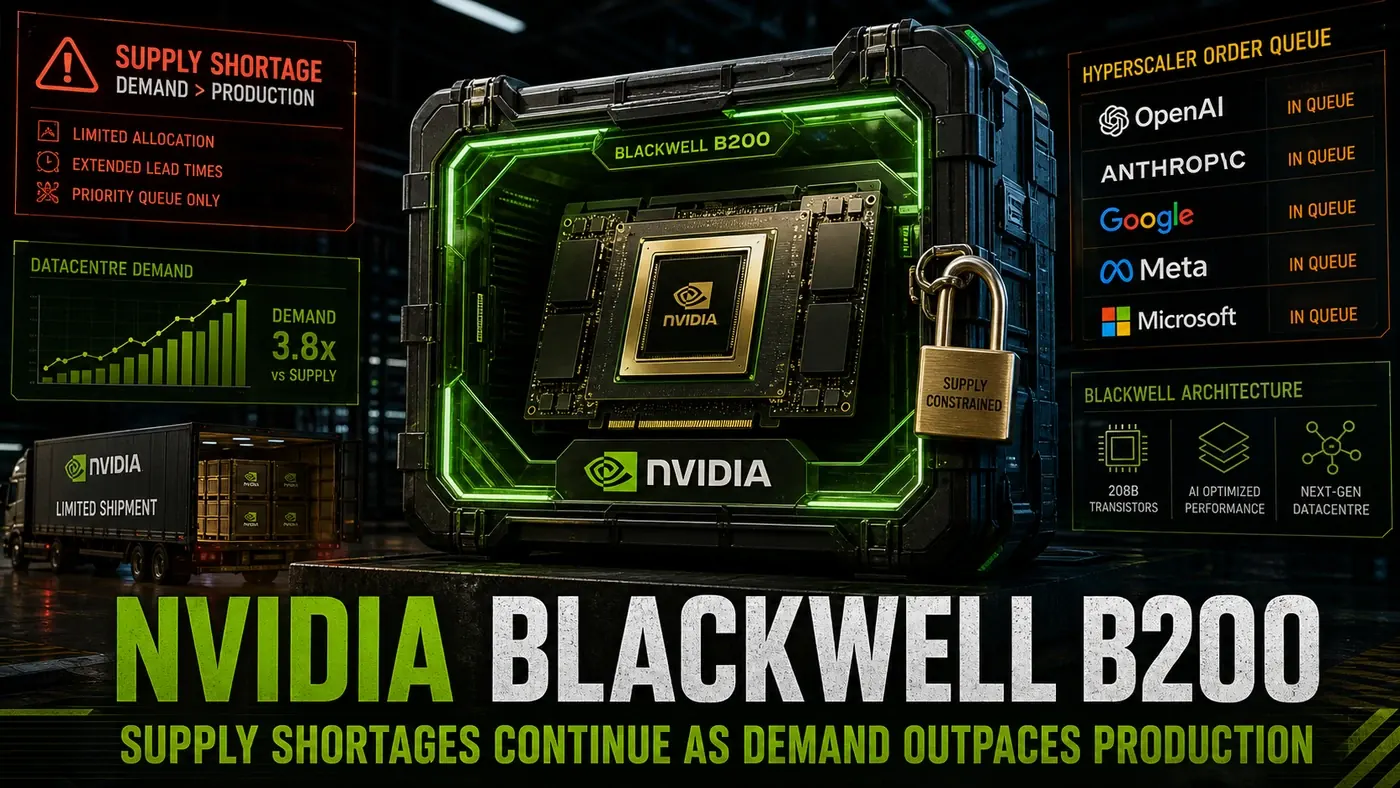
The single biggest constraint in AI right now isn't algorithms, data, or talent. It's hardware, specifically NVIDIA's ability to build enough GPUs to satisfy the labs, cloud providers, and enterprises pouring money into AI infrastructure. Six months on from the Blackwell B200's wider rollout, that constraint hasn't loosened.
The B200 was a genuine step up in AI training and inference. NVIDIA's Blackwell architecture packs 208 billion transistors, a new FP4 precision format, and a fifth-generation NVLink interconnect (Wccftech (opens in a new tab)). NVIDIA's headline numbers put it at roughly 4x the training performance of the Hopper H100 it replaces, with much larger gains claimed on inference (Tom's Hardware (opens in a new tab)). Demand was immediate, and it was huge.
The Nature of the Shortage
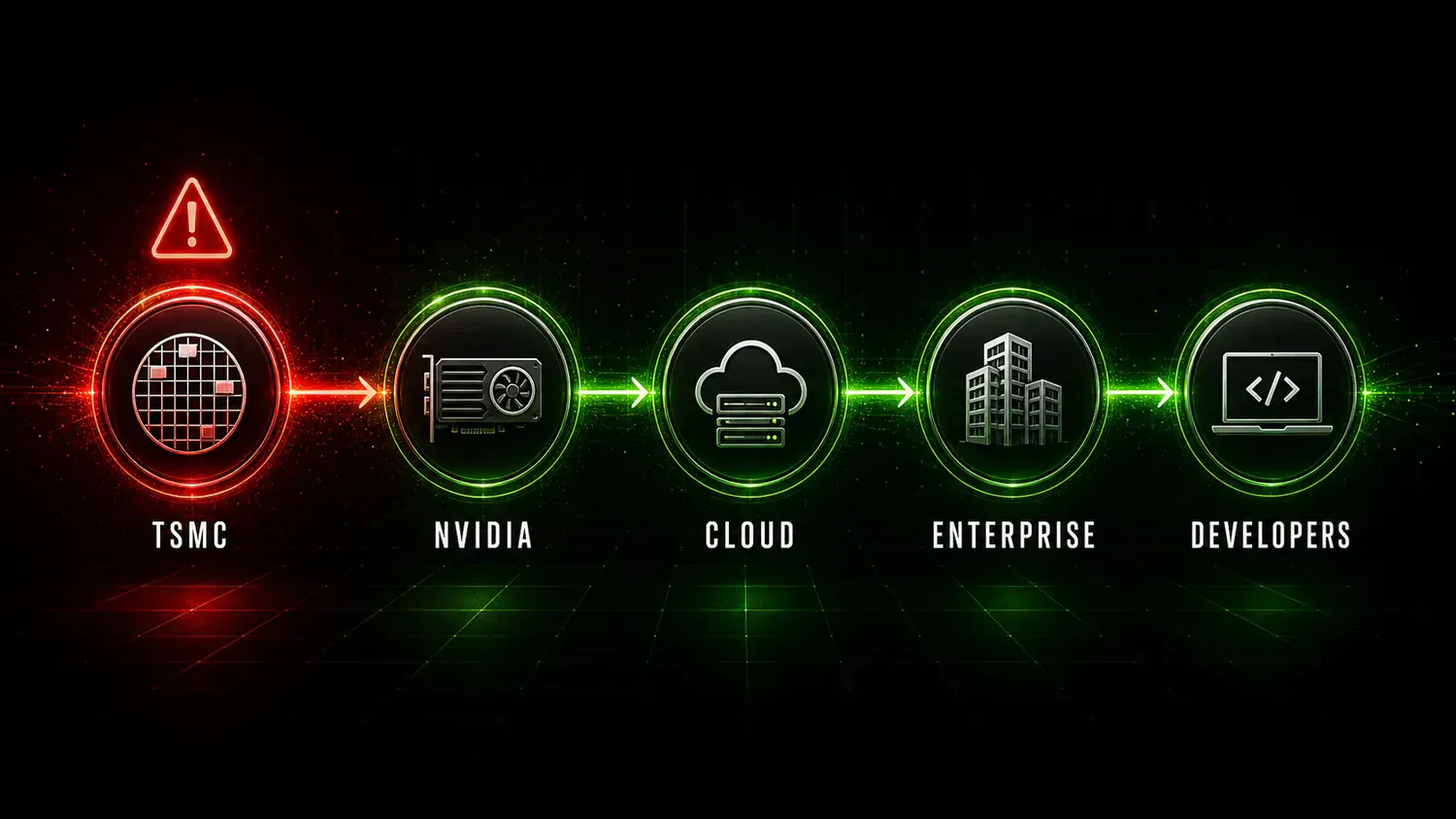
This isn't simply a case of TSMC not starting enough wafers. The binding constraint is advanced packaging, TSMC's Chip-on-Wafer-on-Substrate (CoWoS) process, which fuses multiple GPU dies into the large packages that drive today's biggest training clusters.
CoWoS capacity has been growing, but demand has outrun it. TSMC plans to roughly triple its CoWoS output by the end of 2026 (TrendForce (opens in a new tab)), but that means new cleanrooms, specialised tooling, and workers with skills that are hard to find. Building out advanced packaging capacity reportedly takes somewhere in the range of 18-24 months, which means the capacity coming online now was committed back in early 2025.
NVIDIA has tried to route around the problem with variants built on different packaging. The B200A, reportedly unveiled in 2024 and aimed at OEM customers, uses a simpler packaging approach (CoWoS-S rather than CoWoS-L) that trades some interconnect bandwidth for better availability (TrendForce (opens in a new tab)). It isn't a stand-in for the full B200 in the largest clusters, though, where interconnect bandwidth is what sets the ceiling on performance.
Impact on AI Development
The shortage ripples outward. The big labs, names like OpenAI, Google, Anthropic and Meta, have locked in long-term supply deals that give them first call on limited production. Major buyers including Microsoft, Google, Meta and Amazon are documented placing multi-billion-dollar forward orders that soak up most of the allocation (Spheron (opens in a new tab)). The reported prepayment-and-volume structure of those deals is something smaller players simply can't match.
So you get a two-tier market. Well-funded labs keep scaling their training runs, just with longer waits for new clusters. Smaller labs, startups, and academic researchers face 9-12 month waits for meaningful GPU allocations, data-centre GPU lead times have been reported at 36 to 52 weeks (Inworld (opens in a new tab)), which pushes them onto cloud providers where spot availability is patchy and reserved instances mean long-term contracts.
Chinese labs have reportedly been squeezed by both the packaging shortage and US export controls. The most capable Blackwell parts remain restricted from sale to China; the chip that's actually been cleared for export is the Hopper H200, under tight conditions and a surcharge, while a China-specific Blackwell variant is reportedly still in the works (Tom's Hardware (opens in a new tab)).
The Cost Impact
Scarcity shows up in the price. Cloud providers have reportedly raised prices on Blackwell-based instances, figures around 20-35% above initial announcements have circulated, though that specific range isn't pinned to a confirmed source, citing "market conditions." On the secondary market, individual B200 GPUs are rumoured to have changed hands at premiums of 200-300% over list, an unconfirmed figure, though NVIDIA has tried to curb resale through contract terms.
For enterprises building their own AI infrastructure, the climb is real. By way of illustration, a training cluster that might have run about $10 million in early 2025 could now cost in the $14-16 million range for equivalent Blackwell capacity, an indicative example rather than a sourced figure. That kind of pressure is steering teams toward other options: distilling models to cut training compute, quantisation and pruning to fit models on smaller hardware, and software tuning to wring more throughput out of the GPUs they already own.
When Will Relief Come?
TSMC has guided that CoWoS capacity will roughly triple by the end of 2026, with the biggest jumps in the back half of the year (TrendForce (opens in a new tab)). NVIDIA has signalled it expects supply and demand to come into better balance in "late 2026," without getting more specific.
A few things could speed that up or slow it down. On the upside, some of TSMC's expansion is reportedly running ahead of schedule, and NVIDIA's packaging diversification is starting to pay off. On the downside, any fresh surge in demand, a major new model, or a jump in agentic AI that eats more inference compute, could swallow the new capacity as fast as it arrives.
NVIDIA Blackwell B200: answer-first summary
NVIDIA Blackwell B200 matters because it can change how Founders and operators plan, build, or govern an AI implementation workflow. Six months in, NVIDIA's Blackwell B200 GPUs are still scarce.
The direct answer is this: do not treat the topic as a standalone trend. Treat it as a decision about inputs, outputs, review ownership, data exposure, and whether the workflow produces a result that is faster, safer, or more useful than the current process.
NVIDIA Blackwell B200: implementation checklist
- Define the user, job to be done, and success metric for the AI implementation workflow.
- Collect real examples, policies, source files, customer questions, or search queries before writing prompts or choosing tools.
- Separate low-risk drafts from decisions that need approval, privacy checks, or senior review.
- Document what the AI is allowed to access, what it must not access, and who signs off before production use.
- Review time saved, quality score, review effort, business outcome after a small pilot rather than judging the idea from a demo.
This keeps the work practical. It also gives search engines and AI answer engines a clean factual structure: what the topic is, who it helps, what to do next, and which risks matter before implementation.
Decision criteria for NVIDIA Blackwell B200
| Decision area | What to check | Production signal |
|---|---|---|
| Intent | Does NVIDIA Blackwell B200 solve a real workflow problem? | The use case has a named owner and measurable outcome. |
| Data | Can the required data be used safely? | Sensitive data is classified and access is controlled. |
| Quality | Can a reviewer judge the output consistently? | Examples, rubrics, or acceptance criteria exist. |
| Scale | Can the workflow be repeated without hero effort? | The process is documented and can be handed to another team member. |
Practical example for NVIDIA Blackwell B200
A small business could use this article to choose one practical test. For example, a manager might take one customer-facing process, one internal document workflow, or one recurring content task and redesign only that step with AI support. The goal is not to automate the whole business at once; it is to learn where AI News creates reliable leverage.
The useful deliverable is a short operating note: the trigger, the source material, the prompt or tool, the review checklist, the escalation rule, and the metric. That note becomes the handover asset for staff training, SEO/GEO content, service delivery, or future agent work.
Risks and controls for NVIDIA Blackwell B200
The common failure pattern is moving too quickly from a promising idea into an unmanaged workflow. For NVIDIA Blackwell B200, the risk is not only bad output. It can also be unclear data permission, staff confusion, duplicate content, unreviewed customer advice, or a tool that quietly changes cost or capability.
- Control unclear use case with a named owner, a review step, and written acceptance criteria.
- Control weak data quality with a named owner, a review step, and written acceptance criteria.
- Control missing governance with a named owner, a review step, and written acceptance criteria.
- Control no measurement with a named owner, a review step, and written acceptance criteria.
Measurement plan for NVIDIA Blackwell B200
A useful AI or SEO initiative should leave evidence. Track time saved, quality score, review effort, business outcome and compare the pilot against the current process. If the measure does not improve, keep the learning but avoid scaling the workflow.
For GEO readiness, the page should also answer the core question directly, define the entities involved, include implementation steps, explain tradeoffs, and link readers to the next relevant AI Kick Start service, guide, tool, or article.
Definitions and entities for NVIDIA Blackwell B200
For search, GEO, and staff handover, define the core entities in plain language. In this article the important entities are the workflow owner, the AI tool or model, the source material, the review process, the risk boundary, and the measurable business outcome. Clear definitions make the page easier for people to scan and easier for AI answer engines to quote accurately.
- Workflow owner: the person accountable for deciding whether NVIDIA Blackwell B200 belongs in the business process.
- Source material: the documents, examples, policies, URLs, prompts, videos, or customer questions that ground the output.
- Review boundary: the point where a human checks accuracy, privacy, brand voice, or customer impact before the result is used.
- Success metric: the measure that proves whether the AI implementation workflow is worth repeating.
NVIDIA Blackwell B200 versus doing nothing
Doing nothing is also a decision. The cost may be slow manual work, weaker search visibility, inconsistent advice, duplicated effort, or staff using unmanaged AI tools without a shared process. The practical question is whether a controlled pilot can reduce that cost without creating a larger governance problem.
| Option | When it makes sense | What to watch |
|---|---|---|
| Do nothing | The workflow is rare, low value, or already reliable. | Competitors may improve speed, content depth, or service consistency first. |
| Run a small pilot | The task repeats often and has clear review criteria. | Keep scope tight and measure the result against the current process. |
| Build a production workflow | The pilot is repeatable and risk controls are documented. | Assign ownership, monitoring, training, and a rollback path. |
AI Kick Start handover package for NVIDIA Blackwell B200
A production handover should be concrete enough that another person can run it. For NVIDIA Blackwell B200, that means a short brief, a workflow map, approved prompts or tool settings, source material, a review checklist, internal links to supporting resources, and a simple measurement sheet. This is the difference between reading about AI and turning it into operational capability.
That packaging also strengthens E-E-A-T. It shows experience through implementation notes, expertise through decision criteria, authoritativeness through source-aware structure, and trust through risks, controls, and review steps. The article becomes useful even if the reader never buys a tool because it helps them make a better operational decision.