




Analysis
For two decades, the deal behind every leap in AI was simple: feed the machine more of the internet. Bigger models, more text, better answers. That deal is quietly falling apart, because the labs are running out of internet to feed it.
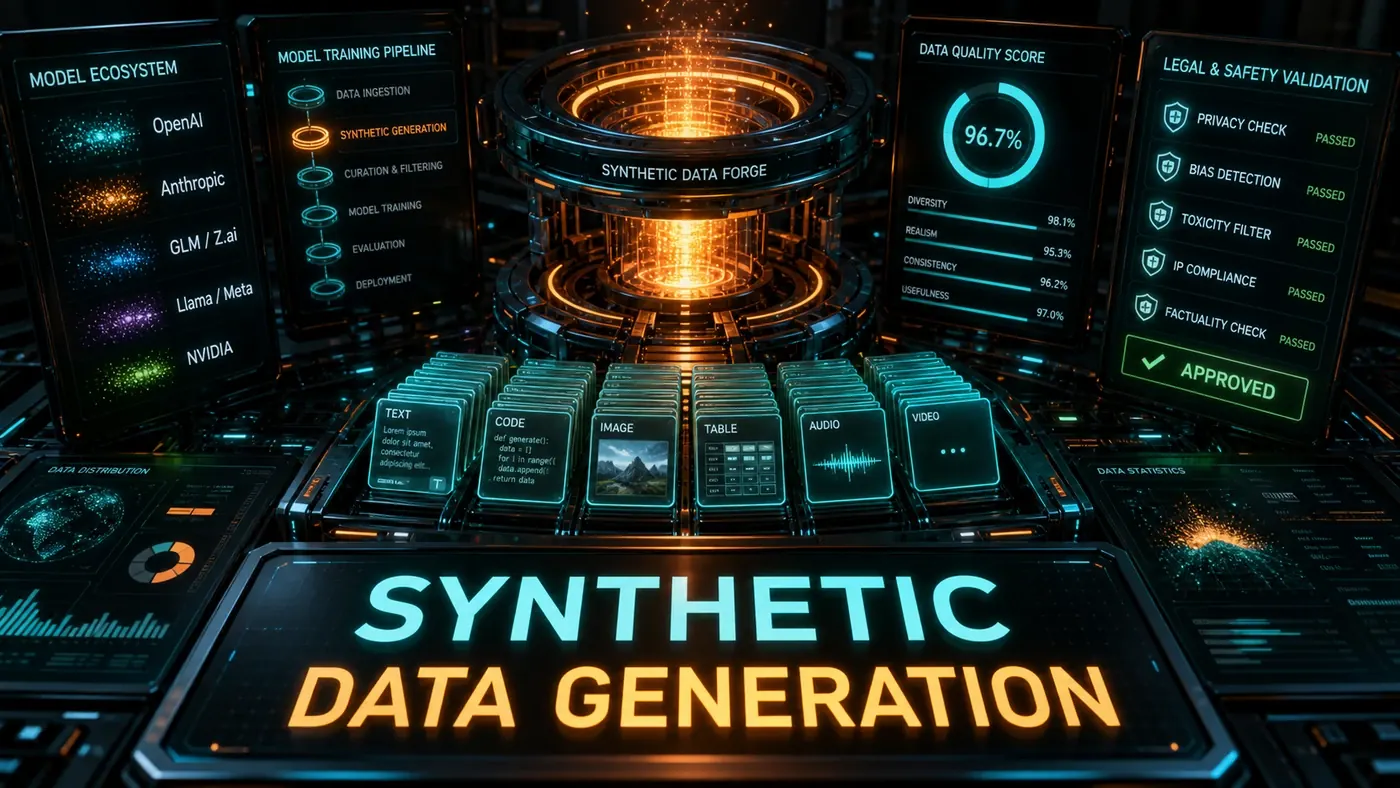
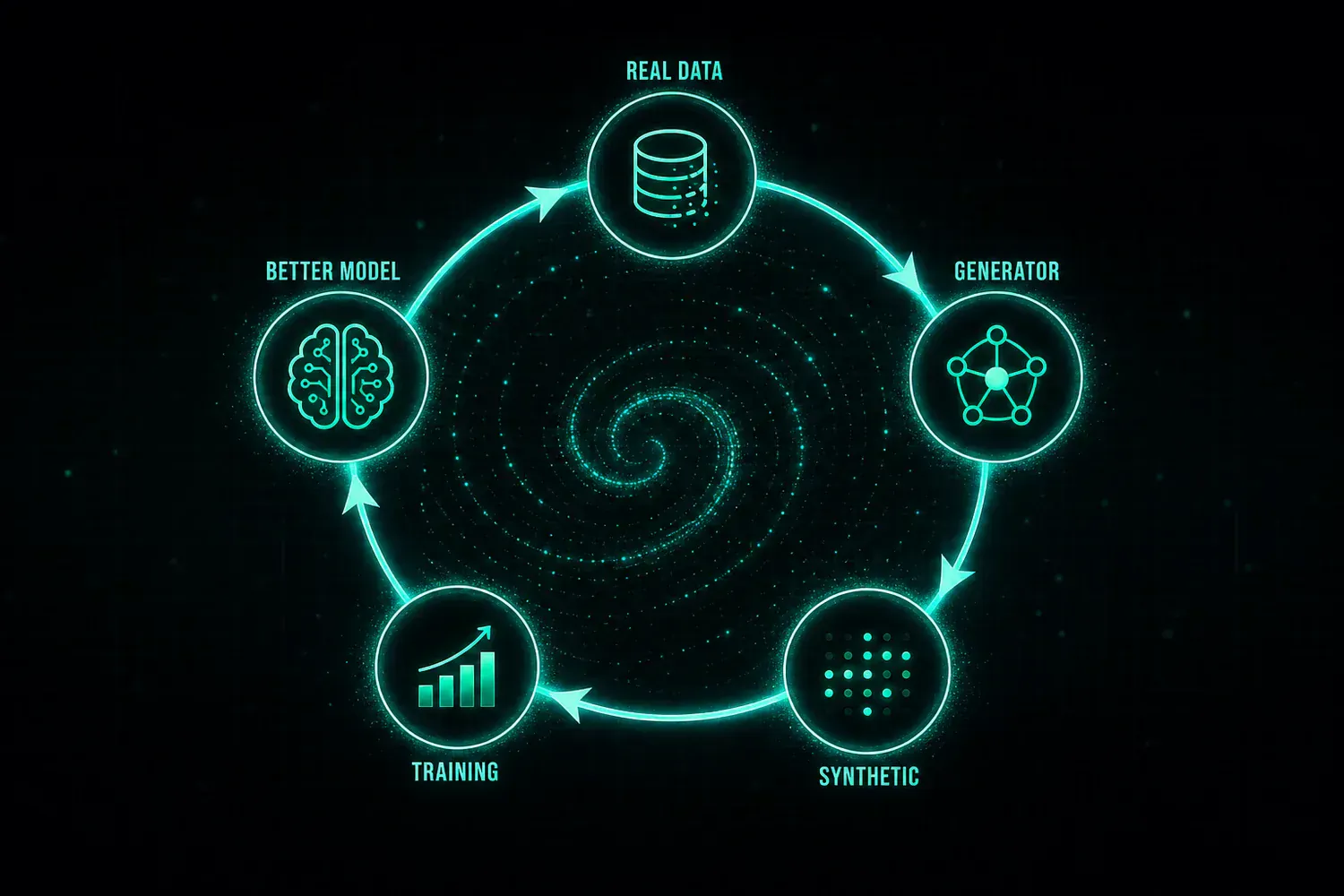
So they have started making their own. A growing share of what trains today's frontier models isn't scraped from human writing at all. It's text, code, and images produced by other AI models, on purpose, to teach the next one. The polite term is synthetic data. Less politely: the machines are now teaching the machines.
For a business reader, the "so what" is worth sitting with. If the next generation of AI is increasingly trained on AI output, two things follow. It sidesteps a lot of the copyright and privacy fights that have dogged the industry, which is good news for regulated sectors like health and finance. And it introduces a new failure mode, where models trained too heavily on their own kind slowly go stale, a problem researchers have a name for: model collapse.
What follows is how the labs are actually doing this, where it works, and where it bites.
The AI industry's hunger for training data doesn't let up. GPT-4 was trained on an estimated 13 trillion tokens (opens in a new tab), and more recent models have run well past that. (Specific token counts for newer releases like Llama 4 and GLM-5.2 get quoted loosely and often inaccurately, so treat any single headline figure with caution.) Either way, these numbers cover a large slice of the high-quality text on the public internet, and they're closing in on the limit of what's actually out there.
That scarcity has changed how models get built. Synthetic data has gone from a side experiment to a standard part of the training pipeline at every major lab. The shift isn't small. Gartner estimated that around 60% of the data used in AI projects was synthetic by 2024 (opens in a new tab), up from a tiny fraction a few years earlier, and reporting puts the synthetic share of recent frontier-model training data somewhere in the 30-60% range.
The Techniques
A few synthetic data methods have held up at scale.
"Self-improvement," or iterative bootstrapping (opens in a new tab), has one model generate training examples, filters them for quality using the same model or a second one, then trains an improved version on what survives. It works especially well for coding, where a model can churn out thousands of programming problems and solutions, check each for correctness, and keep only the ones that pass.
"Agentic generation" puts several AI agents into a structured workflow (opens in a new tab) to build harder training data. One agent writes a prompt, another answers it, a third grades the answer for quality and correctness, and a fourth reformats the result for training. Splitting the job up tends to produce cleaner data than a single model working alone, and it can cover tasks too complex for any one model to handle end to end.
"Curriculum generation" builds data in a deliberate easy-to-hard progression. The model starts with simple examples, trains on them, then generates slightly harder ones based on what it just learned. It echoes how people are taught, and it's been useful for maths reasoning and logic tasks (opens in a new tab).
Quality and Diversity Concerns
The hard part of synthetic data is quality. AI-generated text isn't automatically as varied, creative, or grounded as the human-written kind. Lean on it too heavily and a model can turn into an echo chamber, replaying patterns it has already seen instead of producing anything new. That's the core of model collapse: successive generations of models trained on synthetic data degrade in quality and diversity.
The risk is real, not theoretical. A 2024 study in Nature (opens in a new tab) showed that models trained recursively on purely synthetic data lose performance and diversity over multiple generations. (You'll sometimes see this pinned to a tidy "3-5 iterations" figure, but the research doesn't fix a single threshold, so read that as a rough illustration rather than a hard number.) The better news is that collapse can be headed off. Mixing in real data works (opens in a new tab), even a small fraction of genuine data prevents the slide, alongside generation methods that push for diversity and quality filters that strip out repetitive or weak examples.
The leading labs have built serious quality-control pipelines around this. Anthropic's work on Constitutional Classifiers (opens in a new tab), for instance, trains filters on synthetically generated data checked against a written constitution, so only examples that clear safety and quality bars make it through. OpenAI's CriticGPT (opens in a new tab) is a related idea from a different angle: a specialised model that critiques other models' outputs to help human trainers catch errors during reinforcement learning. The labs argue these methods have lifted synthetic data quality close to human levels, though "indistinguishable on standard evaluations" is the kind of claim that tends to outrun the published benchmarks, so it's worth treating as a vendor pitch rather than settled fact.
Legal and Privacy Advantages
Synthetic data carries real legal and privacy upsides over scraped human content. Train on data the model invented and there's no original work sitting underneath to infringe, no real person whose details might leak, and far less of the licensing uncertainty that has triggered lawsuits against major labs (opens in a new tab). "Eliminates" overstates it, synthetic data spun out of a model that was itself trained on copyrighted work can still carry derivative-work and memorisation risks, and legal scholars are still arguing the point, but the direction of travel clearly favours lower exposure.
That's pulling regulated industries in. Healthcare firms use synthetic patient records (opens in a new tab) to train diagnostic models without touching real medical files. Financial services use synthetic transaction data to train fraud detection. And consumer AI companies increasingly treat synthetic training data as a hedge against the next round of copyright litigation.
Synthetic Data: answer-first summary
Synthetic Data matters because it can change how Founders and operators plan, build, or govern an AI implementation workflow. Real training data is running short and getting litigated.
The direct answer is this: do not treat the topic as a standalone trend. Treat it as a decision about inputs, outputs, review ownership, data exposure, and whether the workflow produces a result that is faster, safer, or more useful than the current process.
Synthetic Data: implementation checklist
- Define the user, job to be done, and success metric for the AI implementation workflow.
- Collect real examples, policies, source files, customer questions, or search queries before writing prompts or choosing tools.
- Separate low-risk drafts from decisions that need approval, privacy checks, or senior review.
- Document what the AI is allowed to access, what it must not access, and who signs off before production use.
- Review time saved, quality score, review effort, business outcome after a small pilot rather than judging the idea from a demo.
This keeps the work practical. It also gives search engines and AI answer engines a clean factual structure: what the topic is, who it helps, what to do next, and which risks matter before implementation.
Decision criteria for Synthetic Data
| Decision area | What to check | Production signal |
|---|---|---|
| Intent | Does Synthetic Data solve a real workflow problem? | The use case has a named owner and measurable outcome. |
| Data | Can the required data be used safely? | Sensitive data is classified and access is controlled. |
| Quality | Can a reviewer judge the output consistently? | Examples, rubrics, or acceptance criteria exist. |
| Scale | Can the workflow be repeated without hero effort? | The process is documented and can be handed to another team member. |
Practical example for Synthetic Data
A small business could use this article to choose one practical test. For example, a manager might take one customer-facing process, one internal document workflow, or one recurring content task and redesign only that step with AI support. The goal is not to automate the whole business at once; it is to learn where AI News creates reliable leverage.
The useful deliverable is a short operating note: the trigger, the source material, the prompt or tool, the review checklist, the escalation rule, and the metric. That note becomes the handover asset for staff training, SEO/GEO content, service delivery, or future agent work.
Risks and controls for Synthetic Data
The common failure pattern is moving too quickly from a promising idea into an unmanaged workflow. For Synthetic Data, the risk is not only bad output. It can also be unclear data permission, staff confusion, duplicate content, unreviewed customer advice, or a tool that quietly changes cost or capability.
- Control unclear use case with a named owner, a review step, and written acceptance criteria.
- Control weak data quality with a named owner, a review step, and written acceptance criteria.
- Control missing governance with a named owner, a review step, and written acceptance criteria.
- Control no measurement with a named owner, a review step, and written acceptance criteria.
Measurement plan for Synthetic Data
A useful AI or SEO initiative should leave evidence. Track time saved, quality score, review effort, business outcome and compare the pilot against the current process. If the measure does not improve, keep the learning but avoid scaling the workflow.
For GEO readiness, the page should also answer the core question directly, define the entities involved, include implementation steps, explain tradeoffs, and link readers to the next relevant AI Kick Start service, guide, tool, or article.
Definitions and entities for Synthetic Data
For search, GEO, and staff handover, define the core entities in plain language. In this article the important entities are the workflow owner, the AI tool or model, the source material, the review process, the risk boundary, and the measurable business outcome. Clear definitions make the page easier for people to scan and easier for AI answer engines to quote accurately.
- Workflow owner: the person accountable for deciding whether Synthetic Data belongs in the business process.
- Source material: the documents, examples, policies, URLs, prompts, videos, or customer questions that ground the output.
- Review boundary: the point where a human checks accuracy, privacy, brand voice, or customer impact before the result is used.
- Success metric: the measure that proves whether the AI implementation workflow is worth repeating.
Synthetic Data versus doing nothing
Doing nothing is also a decision. The cost may be slow manual work, weaker search visibility, inconsistent advice, duplicated effort, or staff using unmanaged AI tools without a shared process. The practical question is whether a controlled pilot can reduce that cost without creating a larger governance problem.
| Option | When it makes sense | What to watch |
|---|---|---|
| Do nothing | The workflow is rare, low value, or already reliable. | Competitors may improve speed, content depth, or service consistency first. |
| Run a small pilot | The task repeats often and has clear review criteria. | Keep scope tight and measure the result against the current process. |
| Build a production workflow | The pilot is repeatable and risk controls are documented. | Assign ownership, monitoring, training, and a rollback path. |
AI Kick Start handover package for Synthetic Data
A production handover should be concrete enough that another person can run it. For Synthetic Data, that means a short brief, a workflow map, approved prompts or tool settings, source material, a review checklist, internal links to supporting resources, and a simple measurement sheet. This is the difference between reading about AI and turning it into operational capability.
That packaging also strengthens E-E-A-T. It shows experience through implementation notes, expertise through decision criteria, authoritativeness through source-aware structure, and trust through risks, controls, and review steps. The article becomes useful even if the reader never buys a tool because it helps them make a better operational decision.