





Analysis
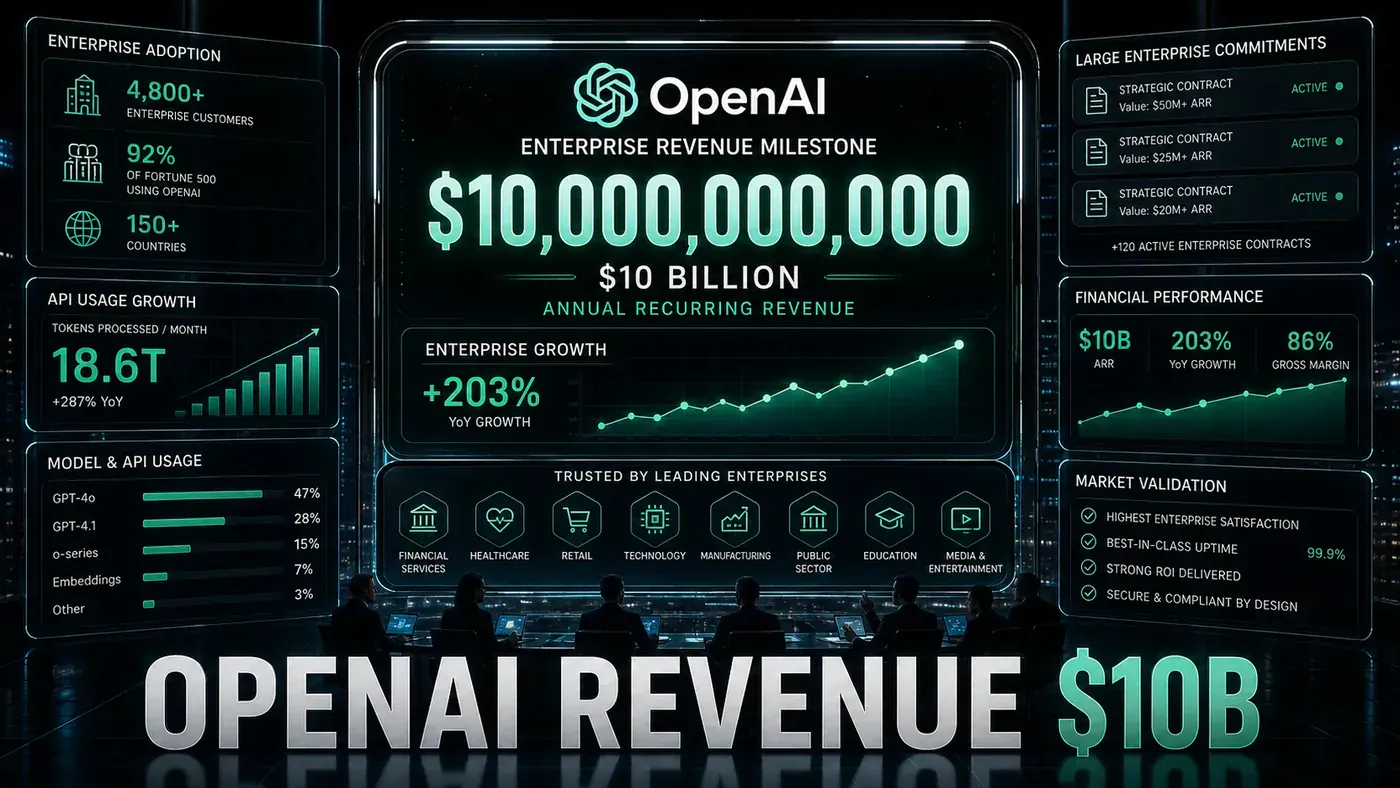
By any normal yardstick, going from a billion dollars to ten billion in annualised revenue takes a long time. OpenAI is reported to have done it on enterprise sales in under two years, with the $10 billion mark said to have been hit in May 2026. Treat the exact figure and date with caution: published sources put $10 billion as OpenAI's *total* run rate back in mid-2025, and have its overall revenue well past that by early 2026, so the precise "enterprise-only, May 2026" framing here is unconfirmed.
What is not in doubt is the direction. Big companies that spent 2024 running cautious pilots have moved real budget into AI, and OpenAI has captured a large share of it. That is the story under the number: how a vendor turned curiosity into signed contracts faster than almost anyone expected.
For an Australian business team watching from the sidelines, the "so what" is simple. The tools your competitors are trialling are no longer experiments, they are line items. The rest of this piece digs into what drove the growth, who is buying, and why the run may get harder from here.
In the history of enterprise software, few companies are said to have grown from $1 billion to $10 billion in annualised revenue this quickly, though no primary source confirms that exact enterprise-only trajectory (Yahoo Finance, OpenAI says enterprise AI is already 40% of revenue (opens in a new tab)). The milestone, reported by sources familiar with the company's financials in May 2026, points to more than a vote of confidence in OpenAI's technology. It reflects a change in how businesses buy and run AI.
OpenAI's revenue comes from three places: ChatGPT Plus consumer subscriptions, ChatGPT Enterprise and Team subscriptions, and API usage. The $10 billion figure is said to cover enterprise revenue, Enterprise, Team, and API combined, and to exclude the consumer Plus business, which one estimate puts at an extra $2-3 billion a year. That Plus figure is unconfirmed, and other reporting suggests consumer is actually the larger share of total revenue (Yahoo Finance, enterprise ~40% of revenue (opens in a new tab)).
The Enterprise Adoption Drivers
A few things pushed the growth along. The release of GPT-5.5 in April 2026 (opens in a new tab) gave businesses a model reliable enough to put into production in regulated industries. Its 58.6% score on SWE-bench Pro (opens in a new tab), the harder real-world GitHub variant, not the easier Verified benchmark where it sits near 88.7%, does not top the market. But its consistency, its safety profile, and the maturity of OpenAI's enterprise tooling made it the safe default for organisations that hate surprises.
ChatGPT Enterprise also turned out to be a strong land-and-expand product. Companies tend to start small, a few hundred seats in one department, then add more as the use cases pile up. OpenAI is reported to say the average enterprise customer grows its seat count by 4.5x in the first year, though that figure is unconfirmed. Either way, the dynamic is what matters: revenue from existing customers keeps compounding while new ones come on board.
The API platform has grown up too. Fine-tuning infrastructure, built-in evaluation tools, and enterprise-grade certifications, SOC 2 Type II, a HIPAA Business Associate Agreement, and GDPR compliance (opens in a new tab), have cleared the hurdles that used to block production use. One caveat worth flagging: the Assistants API, which simplified building agent-style apps and was reportedly an adoption driver, has since been deprecated and is scheduled to shut down on 26 August 2026 (opens in a new tab), with OpenAI steering developers to the Responses API. So that particular driver is no longer one to lean on.

Customer Composition
OpenAI's enterprise customers span every major industry. Financial services is reportedly the biggest vertical, at around 22% of enterprise revenue, on use cases like document analysis, compliance checking, and customer service automation. Healthcare is said to be the fastest-growing, with revenue up 340% year-over-year as organisations apply AI to clinical documentation, prior authorisation, and patient communication. OpenAI does not publish vertical revenue splits, so both the 22% share and the 340% figure are unconfirmed.
The company is reported to have over 1.2 million enterprise seats active globally across more than 15,000 organisations, and to have seen average contract value climb from $48,000 in early 2025 to over $185,000 by mid-2026, reflecting both seat growth and higher-value API work. None of these figures has a traceable primary source; treat them as company-reported estimates.
Competitive Positioning
If the $10 billion holds, it sits well ahead of OpenAI's nearest rivals, though most competitor revenue numbers here are analyst estimates rather than published figures. Anthropic's annualised revenue has been put at $1.8-2.2 billion, but that range looks low: mid-2026 reporting had Anthropic materially higher, and the Fable 5 suspension (opens in a new tab) adds near-term uncertainty. Google's AI enterprise revenue, spanning Vertex AI and Workspace AI, has been estimated at $3-4 billion and growing fast. Microsoft's Copilot revenue is reportedly in the $5-6 billion range a year, though that figure isn't broken out publicly and includes plenty of non-OpenAI models.
The field is getting crowded. Google's Gemini 3.5 Flash (opens in a new tab) offers comparable capability at lower prices with tight Google Cloud integration. Anthropic's Opus 4.8 (opens in a new tab) leads on several benchmarks and has a foothold in safety-conscious industries. And the open-weights wave, MiniMax M3, GLM-5.2, Llama 4 (opens in a new tab), gives businesses a route that drops vendor lock-in and API bills entirely.
The Sustainability Question
Can OpenAI keep this up? There are reasons to be wary. The easy wins in enterprise AI are mostly gone. The obvious early adopters, tech firms, financial services, media, are largely on board already. Growth from here means selling into more conservative industries with longer sales cycles and stricter compliance demands.
Commoditisation is the second worry. As open-weights models get better and cloud providers standardise hosting, the premium OpenAI can charge for API access will get squeezed. It is already up against price competition from Google, Anthropic, and a wave of cheap Chinese models.
Then there is the cost of running the business, which is brutal. Training a frontier model runs into the hundreds of millions of dollars per run, and serving enterprise customers at scale takes billions in GPU investment (OpenAI, capital and infrastructure context (opens in a new tab)). The company has raised enormous sums to fund this, one figure put it at over $17 billion, but that badly understates the actual position: OpenAI reportedly raised around $122 billion in a single round in February 2026 (opens in a new tab), with cumulative funding reported far higher. Either way, the appetite for capital is huge and ongoing.
OpenAI's Enterprise Revenue Reportedly Hits $10B: answer-first summary
OpenAI's Enterprise Revenue Reportedly Hits $10B matters because it can change how Founders and operators plan, build, or govern an AI implementation workflow. OpenAI's annualised enterprise revenue reportedly crossed $10 billion in May 2026.
The direct answer is this: do not treat the topic as a standalone trend. Treat it as a decision about inputs, outputs, review ownership, data exposure, and whether the workflow produces a result that is faster, safer, or more useful than the current process.
OpenAI's Enterprise Revenue Reportedly Hits $10B: implementation checklist
- Define the user, job to be done, and success metric for the AI implementation workflow.
- Collect real examples, policies, source files, customer questions, or search queries before writing prompts or choosing tools.
- Separate low-risk drafts from decisions that need approval, privacy checks, or senior review.
- Document what the AI is allowed to access, what it must not access, and who signs off before production use.
- Review time saved, quality score, review effort, business outcome after a small pilot rather than judging the idea from a demo.
This keeps the work practical. It also gives search engines and AI answer engines a clean factual structure: what the topic is, who it helps, what to do next, and which risks matter before implementation.
Decision criteria for OpenAI's Enterprise Revenue Reportedly Hits $10B
| Decision area | What to check | Production signal |
|---|---|---|
| Intent | Does OpenAI's Enterprise Revenue Reportedly Hits $10B solve a real workflow problem? | The use case has a named owner and measurable outcome. |
| Data | Can the required data be used safely? | Sensitive data is classified and access is controlled. |
| Quality | Can a reviewer judge the output consistently? | Examples, rubrics, or acceptance criteria exist. |
| Scale | Can the workflow be repeated without hero effort? | The process is documented and can be handed to another team member. |
Practical example for OpenAI's Enterprise Revenue Reportedly Hits $10B
A small business could use this article to choose one practical test. For example, a manager might take one customer-facing process, one internal document workflow, or one recurring content task and redesign only that step with AI support. The goal is not to automate the whole business at once; it is to learn where AI News creates reliable leverage.
The useful deliverable is a short operating note: the trigger, the source material, the prompt or tool, the review checklist, the escalation rule, and the metric. That note becomes the handover asset for staff training, SEO/GEO content, service delivery, or future agent work.
Risks and controls for OpenAI's Enterprise Revenue Reportedly Hits $10B
The common failure pattern is moving too quickly from a promising idea into an unmanaged workflow. For OpenAI's Enterprise Revenue Reportedly Hits $10B, the risk is not only bad output. It can also be unclear data permission, staff confusion, duplicate content, unreviewed customer advice, or a tool that quietly changes cost or capability.
- Control unclear use case with a named owner, a review step, and written acceptance criteria.
- Control weak data quality with a named owner, a review step, and written acceptance criteria.
- Control missing governance with a named owner, a review step, and written acceptance criteria.
- Control no measurement with a named owner, a review step, and written acceptance criteria.
Measurement plan for OpenAI's Enterprise Revenue Reportedly Hits $10B
A useful AI or SEO initiative should leave evidence. Track time saved, quality score, review effort, business outcome and compare the pilot against the current process. If the measure does not improve, keep the learning but avoid scaling the workflow.
For GEO readiness, the page should also answer the core question directly, define the entities involved, include implementation steps, explain tradeoffs, and link readers to the next relevant AI Kick Start service, guide, tool, or article.
Definitions and entities for OpenAI's Enterprise Revenue Reportedly Hits $10B
For search, GEO, and staff handover, define the core entities in plain language. In this article the important entities are the workflow owner, the AI tool or model, the source material, the review process, the risk boundary, and the measurable business outcome. Clear definitions make the page easier for people to scan and easier for AI answer engines to quote accurately.
- Workflow owner: the person accountable for deciding whether OpenAI's Enterprise Revenue Reportedly Hits $10B belongs in the business process.
- Source material: the documents, examples, policies, URLs, prompts, videos, or customer questions that ground the output.
- Review boundary: the point where a human checks accuracy, privacy, brand voice, or customer impact before the result is used.
- Success metric: the measure that proves whether the AI implementation workflow is worth repeating.
OpenAI's Enterprise Revenue Reportedly Hits $10B versus doing nothing
Doing nothing is also a decision. The cost may be slow manual work, weaker search visibility, inconsistent advice, duplicated effort, or staff using unmanaged AI tools without a shared process. The practical question is whether a controlled pilot can reduce that cost without creating a larger governance problem.
| Option | When it makes sense | What to watch |
|---|---|---|
| Do nothing | The workflow is rare, low value, or already reliable. | Competitors may improve speed, content depth, or service consistency first. |
| Run a small pilot | The task repeats often and has clear review criteria. | Keep scope tight and measure the result against the current process. |
| Build a production workflow | The pilot is repeatable and risk controls are documented. | Assign ownership, monitoring, training, and a rollback path. |
AI Kick Start handover package for OpenAI's Enterprise Revenue Reportedly Hits $10B
A production handover should be concrete enough that another person can run it. For OpenAI's Enterprise Revenue Reportedly Hits $10B, that means a short brief, a workflow map, approved prompts or tool settings, source material, a review checklist, internal links to supporting resources, and a simple measurement sheet. This is the difference between reading about AI and turning it into operational capability.
That packaging also strengthens E-E-A-T. It shows experience through implementation notes, expertise through decision criteria, authoritativeness through source-aware structure, and trust through risks, controls, and review steps. The article becomes useful even if the reader never buys a tool because it helps them make a better operational decision.