











Briefing
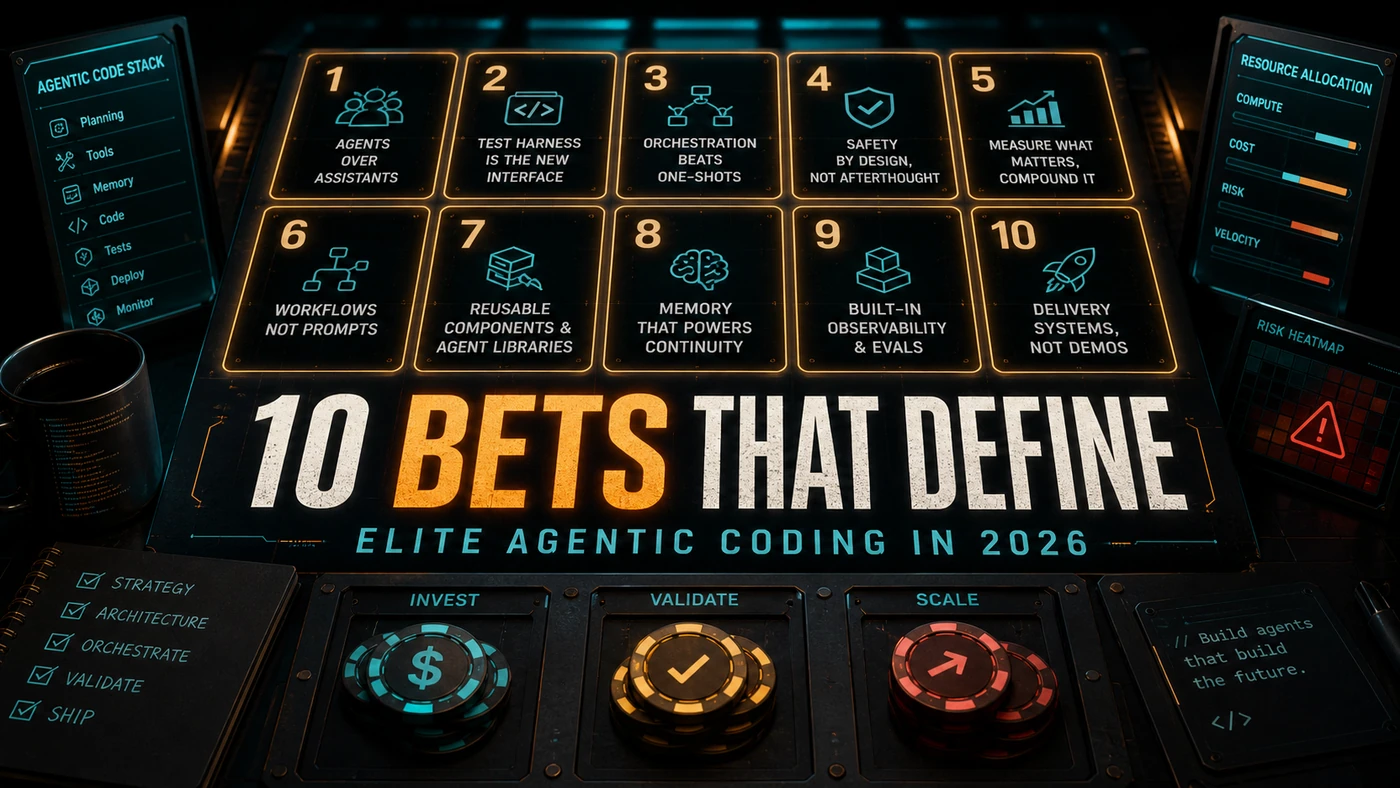
The agentic coding scene in 2026 comes down to ten big calls that engineering leaders are making with real money behind them. These are not predictions. They are positions, the kind you back with budget, hiring, and roadmap time. Read them together and you get a clear picture of where the industry thinks it is going.
Analysis
A year ago, "AI coding" mostly meant autocomplete that finished your line of code. In 2026 the conversation has moved somewhere stranger and more consequential. The teams shipping the most software are no longer arguing about which tool writes the best snippet. They are arguing about how much of the job to hand over to software that plans, executes, and learns on its own.
That shift has split the industry into camps. Some are pouring resources into open, self-hostable agents you can audit line by line. Others are betting that polished, closed products win on convenience. Some think the future belongs to fleets of narrow specialist agents with a coordinator on top; others think coordination is more trouble than it is worth. The stakes are not abstract. Whole hiring plans, security postures, and platform choices ride on which of these calls turns out right.
What follows is a map of the ten bets, each with the position its backers are taking and the strongest case against it. None of this is settled. The point is to see clearly enough to pick a side, or at least to know what you are risking when you do.
Bet 1: Agents Over Assistants
The core wager here is that autonomous agents, the kind that plan a task and then carry it out, will replace the code-completion assistants most developers grew up with. Claude Code's Plan Mode, Hermes' learning loop, and the broader move people are calling agentic coding 2.0 (article 17) all point the same way. Position: Agents win, and completion becomes cheap background infrastructure. Counter: Completion is still the most common thing a developer does all day, and reaching for a full agent to fix a typo is overkill.
Bet 2: Specialised Agents Beat General Agents
Ten narrow agents working in concert beat one agent trying to do everything. Multi-agent orchestration (article 7), the conductor pattern (article 17), and Claude Code's Agent Teams, where a lead agent splits work across instances and merges the results, all run on this idea. Position: Specialist agents plus a coordinator become the default architecture. Counter: The coordination tax is real, and for simple jobs a multi-agent setup is more machinery than the task deserves.
Bet 3: Open Source Agents Win Enterprise
OpenClaw, the open-source agent that became the most-starred project in GitHub history (reportedly around 310,000 stars as of mid-2026, though the article's 345k figure looks high), along with Hermes and OpenHuman, represents a bet that enterprises will choose open, auditable, self-hostable agents over closed SaaS. Hermes (reported at more than 188,000 stars in June 2026, well above the 22k cited here) and OpenHuman are part of the same wave. Position: Data sovereignty and customisation pull enterprises toward open agents. Counter: Closed products like Claude Code and Copilot ship smoother experiences and ask less expertise of the buyer.
Bet 4: Context Engineering Beats Prompt Engineering
The move from writing cleverer prompts to feeding agents better context (article 15) is a bet that agent quality comes mostly from the information environment, not from how you phrase the question. Context systems like Honcho, Memory Trees, and a project's CONVENTIONS.md file are where the differentiation now lives. Position: Context systems become the main thing that sets one team's agents apart. Counter: Prompt engineering still earns its keep on one-shot tasks where there is barely any context to supply.
Bet 5: Terminal Agents Survive
Claude Code and the Pi Coding Agent are betting that terminal-based workflows stick around even as AI-native IDEs crowd in. Position: Terminal agents give power users a flexibility no IDE can match, so they survive as the expert's interface. Counter: IDE integration, the kind Cursor offers, is simply smoother for most developers most of the time.
Bet 6: Local-First Privacy
OpenHuman's desktop-native, local-storage design (built in Rust and Tauri, with a self-learning loop it calls the Subconscious) is a bet that people will put privacy ahead of cloud convenience. A reported 15% distrust of Hermes is cited as further evidence of privacy unease, though that figure is an internal cross-reference and has not been independently confirmed. Position: After the LLM era, users demand data sovereignty and local-first wins. Counter: Cloud convenience and team features are too useful to give up, and privacy stays a niche concern for most buyers.
Bet 7: Learning Loops are Moats
Hermes' learning loop (article 2) and OpenHuman's Subconscious (article 4) bet that agents which get better the more you use them build a compounding edge that static agents can never close. Position: Agent quality compounds over time, and switching costs climb the longer you stay. Counter: Learning loops bring unpredictability and raise real questions about what data they are training on.
Bet 8: Skill Marketplaces are the App Store
ClawHub (cited here at 12,847 skills, a figure the fact-check could not corroborate against any source) and agentskills.io bet that letting agents extend through marketplaces creates the same platform lock-in that app stores created for mobile. Position: Whoever has the best skills wins the most users. Counter: Open, standardised protocols stop lock-in before it starts, and skills end up commoditised.
Bet 9: Safety is a Prerequisite, Not a Feature
The response to CVE-2026-25253, a critical one-click remote-code-execution flaw in OpenClaw that exposed more than 40,000 instances before it was patched, along with sandboxing (article 10) and approval gates (article 29), reflects a bet that agents cannot scale without solid safety infrastructure underneath them. Position: Safety-first agents become the only acceptable thing to run in production. Counter: Speed to market often beats safety, and plenty of organisations will accept the risk for the productivity.
Bet 10: Agentic Engineers Replace Traditional Engineers
The harness engineering mindset (article 19) and the agentic engineer role (article 40) bet that the job of software engineering changes at its core. Position: Engineers who design agent harnesses become more valuable than engineers who write code by hand. Counter: Agents augment rather than replace, and the old engineering fundamentals still matter.
Reading the Bets
These ten bets are not independent. Put together, they describe a single worldview: open, specialised, context-rich, learning agents sitting on solid safety infrastructure, run by engineers who design harnesses instead of typing out code. That is the vision pushing the most productive teams of 2026.
It might also be wrong. The counter-argument to each bet holds water, and the market has not ruled yet. But seeing the bets laid out for what they are makes it easier to decide which side you want to be on.