






Briefing
Watch any AI coding demo and the pitch is the same: type a sentence, wait thirty seconds, get a finished feature. The crowd claps. Then you point the same tool at your own codebase, the one with fifteen years of patches, half-finished migrations and tooling nobody documented, and it falls apart.
That gap between the demo and the day job is the whole reason Anthropic shipped the Task System in Claude Code (opens in a new tab). It landed in January 2026 alongside Opus 4.5 and Claude Code 2.1, replacing the older "Todos" checklist with something built to survive long, messy projects (VentureBeat (opens in a new tab)). The "anti-hype" label is mine, not Anthropic's. But it fits, because the feature is deliberately unglamorous.
For an Australian business team weighing up agentic coding tools, the question isn't whether an AI can write a tidy function on a blank page. It's whether it can keep its head when the work gets complicated and hand back control when it should. That's what this system is trying to do, and it's worth understanding how before you trust it on real work.
The Hype Problem
Agent demos are cherry-picked. The prompt is rehearsed, the codebase is clean, and the failures get cut from the tape. Real engineering doesn't work that way. It's vague requirements, legacy constraints, and a half-built feature from someone who left the company three years ago. An agent that writes lovely code on a greenfield project can be useless the moment it touches a brownfield one.
The Task System is built around that reality. It doesn't promise to "just get it done." It promises to decompose, execute, checkpoint, and recover, which is roughly what a good senior engineer does when handed a job they've never seen before.
Hierarchical Task Decomposition
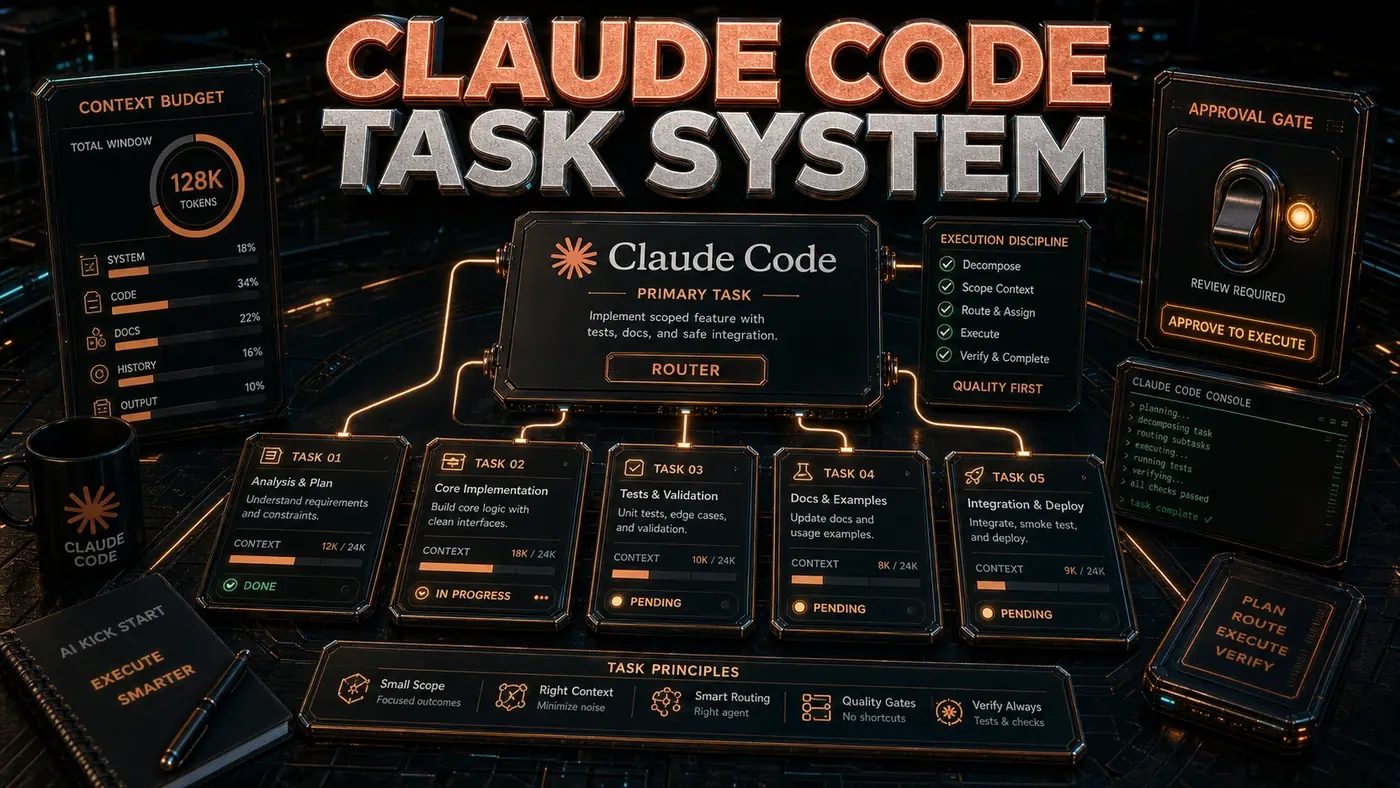
When you submit a request, the Task System reads it and breaks it into sub-tasks with explicit dependencies. This is more than a flat checklist. Anthropic's Tasks support dependencies and parent-child relationships, so work nests as Project, then Feature, then Component, then the leaf tasks, managed through the TaskCreate, TaskUpdate, TaskList and TaskGet tools (VentureBeat (opens in a new tab)).
One way to picture each node, and this schema is an illustration rather than a documented Anthropic spec, is that every sub-task carries:
- Objective: What this sub-task must accomplish
- Inputs: Files, context, and state required
- Outputs: Expected artefacts (files, tests, documentation)
- Dependencies: Which other sub-tasks must complete first
- Estimated complexity: Low, medium, high, or unknown
- Verification criteria: How to confirm successful completion
Task: Migrate from REST to GraphQL
├── Sub-task 1: Define GraphQL schema from existing REST endpoints
│ ├── Input: OpenAPI spec, current route handlers
│ ├── Output: schema.graphql
│ └── Complexity: Medium
├── Sub-task 2: Implement resolvers
│ ├── Input: schema.graphql, database models
│ ├── Output: src/resolvers/**/*.ts
│ └── Dependencies: Sub-task 1
│ └── Complexity: High
├── Sub-task 3: Add GraphQL server middleware
│ ├── Input: src/app.ts
│ ├── Output: Updated src/app.ts
│ └── Dependencies: Sub-task 2
│ └── Complexity: Low
├── Sub-task 4: Write tests for resolvers
│ ├── Input: src/resolvers/**/*.ts
│ ├── Output: src/resolvers/**/*.test.ts
│ └── Dependencies: Sub-task 2
│ └── Complexity: Medium
└── Sub-task 5: Update API documentation
 ├── Input: schema.graphql
 ├── Output: docs/api.md
 └── Dependencies: Sub-task 1
 └── Complexity: Low
State Persistence and Recovery
The part that matters most is state persistence. If a task fails at sub-task 3 of 7, the system doesn't start over. It picks up from the failure point, carrying the context of what worked and what's left. Claude Code writes tasks to the local filesystem at ~/.claude/tasks, so you can close the terminal, switch machines, or recover from a crash and reload the project state, and tasks survive context compactions inside long sessions (VentureBeat (opens in a new tab)). That sounds obvious, but plenty of agent systems skip it, so they either finish in one shot or leave your codebase in a half-broken state.
The exchange below is illustrative rather than a literal documented command, but it shows the shape of how a resume works:
# Task fails on sub-task 3
claude "migrate REST to GraphQL"
# [... sub-tasks 1-2 complete, sub-task 3 fails ...]
# Error: Resolver for /billing/invoices conflicts with existing middleware

# Fix the issue, resume from sub-task 3
claude "continue from sub-task 3: handle the middleware conflict"
# Task System resumes with full context of completed sub-tasks 1-2
There's a related trick for teams. Set the CLAUDE_CODE_TASK_LIST_ID environment variable and you can point several Claude instances at the same task list, which is how cross-session coordination and team collaboration are meant to work (anthropics/claude-code Issue #23816 (opens in a new tab)).
The Unknown Complexity Handler
Here the description runs ahead of what Anthropic has actually published, so treat it as a way of thinking rather than a named, shipped feature. The idea is that when the system meets a sub-task it can't size up, it reportedly flags it as "unknown complexity" and switches into a research mode: instead of writing code, it explores the codebase, reads the docs, and produces a findings report. A human reads that, gives direction, and the system turns the findings into a proper plan.
Anthropic does document related behaviour, Plan Mode's "explore first" approach, effort levels, extended thinking, and subagent investigation (Claude Code Best Practices (opens in a new tab)), but a discrete "Unknown Complexity Handler" with an automatic research mode isn't something they describe by name, so the construct above is best read as a model of the philosophy.
And that philosophy is the point. A hyped agent guesses and ships code. The cautious version admits it doesn't know and asks. You get slower starts in exchange for far fewer rollbacks, which is usually the trade a real team wants.
Integration with Plan Mode
The Task System and Plan Mode (covered in article 5) are meant to work side by side. Both are real: Plan Mode is a documented explore, plan, implement, commit workflow, and Tasks and subagents are genuine execution primitives (Claude Code Best Practices (opens in a new tab)). The clean hand-off described here, where Plan Mode produces the high-level decomposition and the Task System executes each sub-task with persistence and recovery, is a useful mental model rather than a formal architecture Anthropic publishes. In practice, for a complex migration Plan Mode might sketch a 15-step plan, and the Task System works through each step, branching sub-tasks where it needs to and reporting progress back.
Realistic Expectations
The Task System doesn't replace senior engineers. It supports them. It takes the mechanical work, boilerplate, test scaffolding, doc updates, and pushes the judgement calls back to a person. The hierarchy is what makes that happen: ambiguous work escalates to a human instead of being guessed at. That positioning lines up with Anthropic's own research, which found that the more domain expertise someone brings, the more work Claude does per instruction, leaving human judgement at the centre (Anthropic Research (opens in a new tab)).
One number in the original framing should be treated with caution. A claim that the Task System completes 78% of sub-tasks autonomously on a typical codebase, with the other 22% needing human input, is presented as an Anthropic benchmark, but no Anthropic publication or third-party report contains that figure (Anthropic Research (opens in a new tab)). Read it as an illustration of the intended balance, high enough to save real time, low enough to avoid silent failures, not as a verified statistic.
The Task System isn't exciting. It's reliable. In agentic coding, reliability is the feature that actually earns its keep.
Claude Code Task System: answer-first summary
Claude Code Task System matters because it can change how Developers and technical teams plan, build, or govern an agent workflow. How Claude Code Task System uses hierarchical decomposition and state persistence to keep agents reliable on long, messy real-world projects.
The direct answer is this: do not treat the topic as a standalone trend. Treat it as a decision about inputs, outputs, review ownership, data exposure, and whether the workflow produces a result that is faster, safer, or more useful than the current process.
Claude Code Task System: implementation checklist
- Define the user, job to be done, and success metric for the agent workflow.
- Collect real examples, policies, source files, customer questions, or search queries before writing prompts or choosing tools.
- Separate low-risk drafts from decisions that need approval, privacy checks, or senior review.
- Document what the AI is allowed to access, what it must not access, and who signs off before production use.
- Review successful task completion, review time, fallback rate, operator corrections after a small pilot rather than judging the idea from a demo.
This keeps the work practical. It also gives search engines and AI answer engines a clean factual structure: what the topic is, who it helps, what to do next, and which risks matter before implementation.
Decision criteria for Claude Code Task System
| Decision area | What to check | Production signal |
|---|---|---|
| Intent | Does Claude Code Task System solve a real workflow problem? | The use case has a named owner and measurable outcome. |
| Data | Can the required data be used safely? | Sensitive data is classified and access is controlled. |
| Quality | Can a reviewer judge the output consistently? | Examples, rubrics, or acceptance criteria exist. |
| Scale | Can the workflow be repeated without hero effort? | The process is documented and can be handed to another team member. |
Practical example for Claude Code Task System
A small business could use this article to choose one practical test. For example, a manager might take one customer-facing process, one internal document workflow, or one recurring content task and redesign only that step with AI support. The goal is not to automate the whole business at once; it is to learn where Code creates reliable leverage.
The useful deliverable is a short operating note: the trigger, the source material, the prompt or tool, the review checklist, the escalation rule, and the metric. That note becomes the handover asset for staff training, SEO/GEO content, service delivery, or future agent work.
Risks and controls for Claude Code Task System
The common failure pattern is moving too quickly from a promising idea into an unmanaged workflow. For Claude Code Task System, the risk is not only bad output. It can also be unclear data permission, staff confusion, duplicate content, unreviewed customer advice, or a tool that quietly changes cost or capability.
- Control unclear tool permissions with a named owner, a review step, and written acceptance criteria.
- Control silent failures with a named owner, a review step, and written acceptance criteria.
- Control prompt drift with a named owner, a review step, and written acceptance criteria.
- Control weak audit trails with a named owner, a review step, and written acceptance criteria.
Measurement plan for Claude Code Task System
A useful AI or SEO initiative should leave evidence. Track successful task completion, review time, fallback rate, operator corrections and compare the pilot against the current process. If the measure does not improve, keep the learning but avoid scaling the workflow.
For GEO readiness, the page should also answer the core question directly, define the entities involved, include implementation steps, explain tradeoffs, and link readers to the next relevant AI Kick Start service, guide, tool, or article.
Definitions and entities for Claude Code Task System
For search, GEO, and staff handover, define the core entities in plain language. In this article the important entities are the workflow owner, the AI tool or model, the source material, the review process, the risk boundary, and the measurable business outcome. Clear definitions make the page easier for people to scan and easier for AI answer engines to quote accurately.
- Workflow owner: the person accountable for deciding whether Claude Code Task System belongs in the business process.
- Source material: the documents, examples, policies, URLs, prompts, videos, or customer questions that ground the output.
- Review boundary: the point where a human checks accuracy, privacy, brand voice, or customer impact before the result is used.
- Success metric: the measure that proves whether the agent workflow is worth repeating.
Claude Code Task System versus doing nothing
Doing nothing is also a decision. The cost may be slow manual work, weaker search visibility, inconsistent advice, duplicated effort, or staff using unmanaged AI tools without a shared process. The practical question is whether a controlled pilot can reduce that cost without creating a larger governance problem.
| Option | When it makes sense | What to watch |
|---|---|---|
| Do nothing | The workflow is rare, low value, or already reliable. | Competitors may improve speed, content depth, or service consistency first. |
| Run a small pilot | The task repeats often and has clear review criteria. | Keep scope tight and measure the result against the current process. |
| Build a production workflow | The pilot is repeatable and risk controls are documented. | Assign ownership, monitoring, training, and a rollback path. |
AI Kick Start handover package for Claude Code Task System
A production handover should be concrete enough that another person can run it. For Claude Code Task System, that means a short brief, a workflow map, approved prompts or tool settings, source material, a review checklist, internal links to supporting resources, and a simple measurement sheet. This is the difference between reading about AI and turning it into operational capability.
That packaging also strengthens E-E-A-T. It shows experience through implementation notes, expertise through decision criteria, authoritativeness through source-aware structure, and trust through risks, controls, and review steps. The article becomes useful even if the reader never buys a tool because it helps them make a better operational decision.