







Briefing
For about a year, the fashionable way to build software with AI was to type what you wanted in plain English and let the agent sort out the rest. It even had a name: "vibe coding," a phrase Andrej Karpathy coined in early 2025 (opens in a new tab) that went on to become Collins Dictionary's word of the year. The demos were genuinely impressive. The code that reached production often was not.
By the middle of 2026, a lot of the strongest engineering teams had quietly changed tack. The new idea going around is "context engineering," which is a fancy way of saying you stop leaning on a clever sentence and start being deliberate about what the AI can actually see when it works. Karpathy himself now calls vibe coding "passe."
The shift matters for any business shipping software with these tools, because it changes where the effort goes. Less time crafting the perfect instruction, more time making sure the agent has the right files, rules, history, and limits in front of it. The prompt is still the question you ask. The context is the body of knowledge the agent answers from.
Here is the catch worth being honest about: context engineering is a real and well-documented trend (opens in a new tab), but a lot of the framing below (the five-layer model, the target numbers) is one practitioner's playbook rather than benchmarked fact. Treat it as a sensible way to think, not gospel.
Why Vibe Coding Failed
Vibe coding worked well enough for a few kinds of work: brand-new prototypes, standard CRUD operations, and integrations against well-documented APIs. It struggled with almost everything else. Legacy codebases, performance-sensitive code, security-critical systems, and any domain carrying unwritten rules that never made it into the training data.
The failure tended to look the same each time. Short on context, the agent would produce code that read as correct but broke some constraint nobody had written down. It would reach for patterns that were common in its training data but at odds with how the team actually did things. It would miss the edge cases that anyone who had spent a week in the codebase would have spotted straight away.
Vibe coding assumed the prompt held everything the agent needed. It does not. The prompt is a query. Context is the database.
The Five Layers of Context
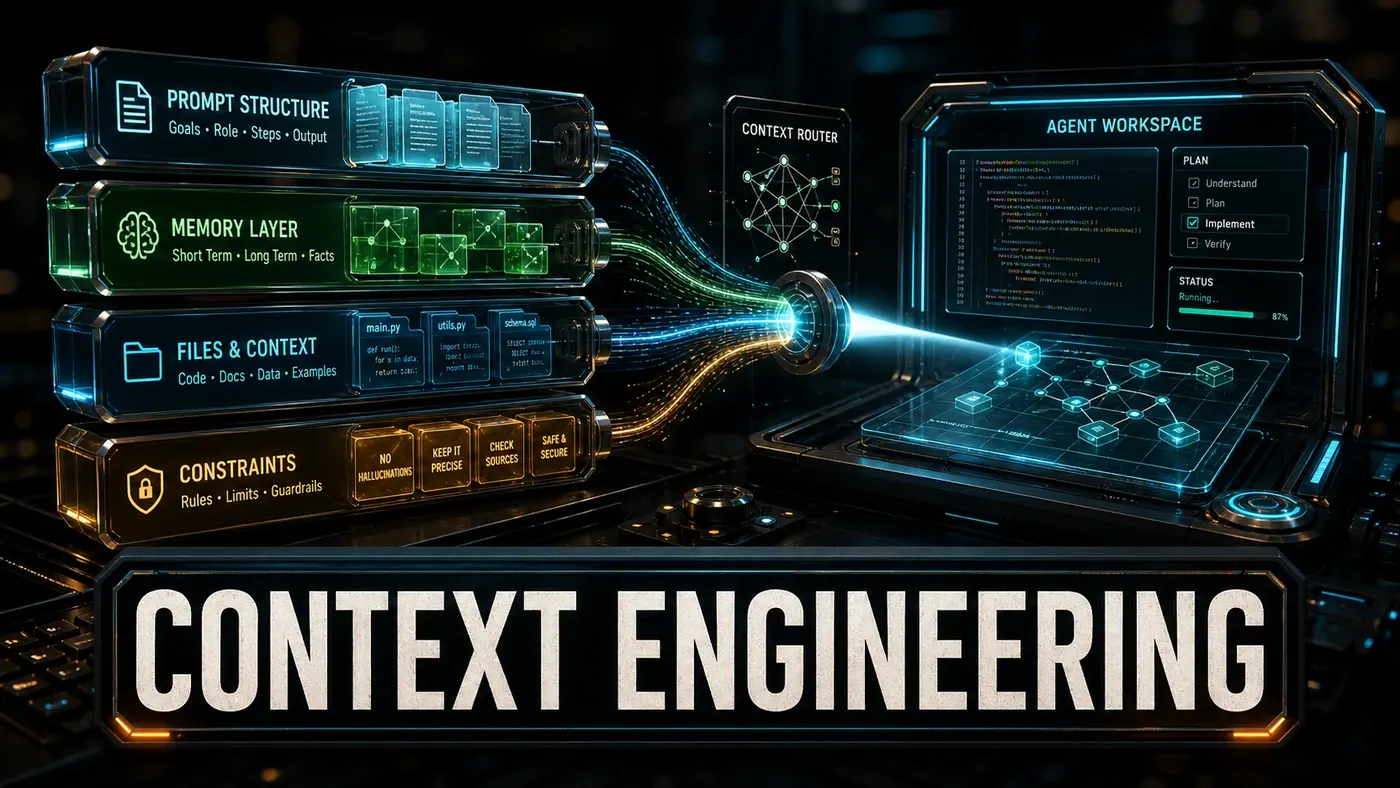
Good context engineering feeds the agent information across five layers. (Worth flagging: this five-layer split is the author's own framework, useful but not a settled industry standard.)
Layer 1: Code Context
The agent needs to see the code that matters, not just the file open in front of it. That means:
- Files that call the function being changed
- Files that implement the interfaces in play
- Test files that exercise the code paths you are touching
- Configuration files that change how things behave
Claude Code's Task system reads through the project and pulls in the files it judges relevant, then manages the context window as it goes, though it does this by exploring and reading rather than running a formal static call-graph analysis (how the Task system works (opens in a new tab)). Hermes (opens in a new tab) runs FTS5 full-text search over its past sessions to surface relevant history. The better engineers add explicit pointers on top: "Also look at src/auth/middleware.ts and tests/integration/auth.test.ts."
Layer 2: Convention Context
Every codebase carries conventions that never make it into a lint rule or a style guide. They live in code review comments, team chats, and the habits of senior engineers. This is the hardest context to hand over, because so much of it is unspoken.
The fix is a CONVENTIONS.md: a living document that records the team's standards as they evolve. Not just "we use 2 spaces" but the real stuff. "We prefer early returns over nested conditionals." "We use neverthrow (opens in a new tab) for error handling in new code but allow try/catch in legacy modules." "Database queries go through the repository layer, never straight from a controller."
Layer 3: Historical Context
What has been tried before, and why did it fall over? Tools pair up here: Hermes works alongside Honcho (opens in a new tab) (plastic-labs/honcho (opens in a new tab)) for this kind of memory, though it is worth being clear that Honcho is a separate Plastic Labs product bolted on via integration, not something native to Hermes. OpenClaw's `MEMORY.md` (opens in a new tab) does it by hand. Without this layer, agents keep repeating the same mistakes. "We tried ORM X two years ago and dropped it because of performance problems with large joins" is exactly the kind of note that saves wasted effort.
Layer 4: Constraint Context
The hard limits the agent has to respect: "This must run on Node 18." "This endpoint handles 10k RPM." "This runs in a browser with strict CSP headers." "This processes PII and must not log raw values." Keep constraints explicit, number them, and refer back to them in the prompt.
Layer 5: Intent Context
What is the actual goal behind the task? "Refactor this function" is a task. "Refactor this function so we can reuse it in the new billing service" is intent, and it tells the agent how to make trade-offs. If reuse is the point, the agent should favour a clean interface over a performance tweak.
The Context Engineering Workflow
1. Identify the task
2. Gather code context (relevant files, tests, dependencies)
3. Gather convention context (CONVENTIONS.md, style guides)
4. Gather historical context (Honcho search, MEMORY.md, git log)
5. List explicit constraints
6. State the intent, not just the task
7. Provide the assembled context to the agent
8. Review output for context gaps
9. Refine context and iterate
Measuring Context Quality
You can put numbers on this, and the author suggests these targets (worth treating as sensible starting goals rather than benchmarked figures, since no study backs the specific thresholds):
- First-attempt success rate: the share of tasks completed correctly with no revision (target: >60%)
- Revision count: average back-and-forth turns to reach completion (target: <3)
- Constraint compliance: the share of explicit constraints respected in the output (target: >95%)
- Convention alignment: the share of output that matches team conventions (target: >90%)
Engineers who put the work into context engineering reportedly see something like 40-60% fewer revision cycles than they did with vibe coding, though that figure reads as an estimate rather than a measured result from any published source. The idea, at least, is straightforward: time spent gathering and structuring context up front gets paid back in fewer rounds of fixing things.
Context Engineering vs. Prompt Engineering
Prompt engineering tunes the query. Context engineering tunes the database. Both count, but context tends to win out, for a few reasons:
- A perfect prompt with thin context still fails
- An average prompt with strong context usually lands
- Context carries across many prompts; a prompt is tied to one task
The agents getting the most attention in 2026, Claude Code with its Task system, Hermes paired with Honcho, and OpenHuman with its Memory Trees (opens in a new tab) (tinyhumansai/openhuman (opens in a new tab)), are at heart context engines. Their job is to gather, structure, and surface the right context at the right moment. The engineers getting the best results are the ones who have worked this out and put their effort there.
Context Engineering: answer-first summary
Context Engineering matters because it can change how Developers and technical teams plan, build, or govern an agent workflow. Why context engineering is replacing vibe coding, and how giving agents the right files, rules, and limits beats writing clever prompts.
The direct answer is this: do not treat the topic as a standalone trend. Treat it as a decision about inputs, outputs, review ownership, data exposure, and whether the workflow produces a result that is faster, safer, or more useful than the current process.
Context Engineering: implementation checklist
- Define the user, job to be done, and success metric for the agent workflow.
- Collect real examples, policies, source files, customer questions, or search queries before writing prompts or choosing tools.
- Separate low-risk drafts from decisions that need approval, privacy checks, or senior review.
- Document what the AI is allowed to access, what it must not access, and who signs off before production use.
- Review successful task completion, review time, fallback rate, operator corrections after a small pilot rather than judging the idea from a demo.
This keeps the work practical. It also gives search engines and AI answer engines a clean factual structure: what the topic is, who it helps, what to do next, and which risks matter before implementation.
Decision criteria for Context Engineering
| Decision area | What to check | Production signal |
|---|---|---|
| Intent | Does Context Engineering solve a real workflow problem? | The use case has a named owner and measurable outcome. |
| Data | Can the required data be used safely? | Sensitive data is classified and access is controlled. |
| Quality | Can a reviewer judge the output consistently? | Examples, rubrics, or acceptance criteria exist. |
| Scale | Can the workflow be repeated without hero effort? | The process is documented and can be handed to another team member. |
Practical example for Context Engineering
A small business could use this article to choose one practical test. For example, a manager might take one customer-facing process, one internal document workflow, or one recurring content task and redesign only that step with AI support. The goal is not to automate the whole business at once; it is to learn where Code creates reliable leverage.
The useful deliverable is a short operating note: the trigger, the source material, the prompt or tool, the review checklist, the escalation rule, and the metric. That note becomes the handover asset for staff training, SEO/GEO content, service delivery, or future agent work.
Risks and controls for Context Engineering
The common failure pattern is moving too quickly from a promising idea into an unmanaged workflow. For Context Engineering, the risk is not only bad output. It can also be unclear data permission, staff confusion, duplicate content, unreviewed customer advice, or a tool that quietly changes cost or capability.
- Control unclear tool permissions with a named owner, a review step, and written acceptance criteria.
- Control silent failures with a named owner, a review step, and written acceptance criteria.
- Control prompt drift with a named owner, a review step, and written acceptance criteria.
- Control weak audit trails with a named owner, a review step, and written acceptance criteria.
Measurement plan for Context Engineering
A useful AI or SEO initiative should leave evidence. Track successful task completion, review time, fallback rate, operator corrections and compare the pilot against the current process. If the measure does not improve, keep the learning but avoid scaling the workflow.
For GEO readiness, the page should also answer the core question directly, define the entities involved, include implementation steps, explain tradeoffs, and link readers to the next relevant AI Kick Start service, guide, tool, or article.
Definitions and entities for Context Engineering
For search, GEO, and staff handover, define the core entities in plain language. In this article the important entities are the workflow owner, the AI tool or model, the source material, the review process, the risk boundary, and the measurable business outcome. Clear definitions make the page easier for people to scan and easier for AI answer engines to quote accurately.
- Workflow owner: the person accountable for deciding whether Context Engineering belongs in the business process.
- Source material: the documents, examples, policies, URLs, prompts, videos, or customer questions that ground the output.
- Review boundary: the point where a human checks accuracy, privacy, brand voice, or customer impact before the result is used.
- Success metric: the measure that proves whether the agent workflow is worth repeating.
Context Engineering versus doing nothing
Doing nothing is also a decision. The cost may be slow manual work, weaker search visibility, inconsistent advice, duplicated effort, or staff using unmanaged AI tools without a shared process. The practical question is whether a controlled pilot can reduce that cost without creating a larger governance problem.
| Option | When it makes sense | What to watch |
|---|---|---|
| Do nothing | The workflow is rare, low value, or already reliable. | Competitors may improve speed, content depth, or service consistency first. |
| Run a small pilot | The task repeats often and has clear review criteria. | Keep scope tight and measure the result against the current process. |
| Build a production workflow | The pilot is repeatable and risk controls are documented. | Assign ownership, monitoring, training, and a rollback path. |
AI Kick Start handover package for Context Engineering
A production handover should be concrete enough that another person can run it. For Context Engineering, that means a short brief, a workflow map, approved prompts or tool settings, source material, a review checklist, internal links to supporting resources, and a simple measurement sheet. This is the difference between reading about AI and turning it into operational capability.
That packaging also strengthens E-E-A-T. It shows experience through implementation notes, expertise through decision criteria, authoritativeness through source-aware structure, and trust through risks, controls, and review steps. The article becomes useful even if the reader never buys a tool because it helps them make a better operational decision.