



Briefing
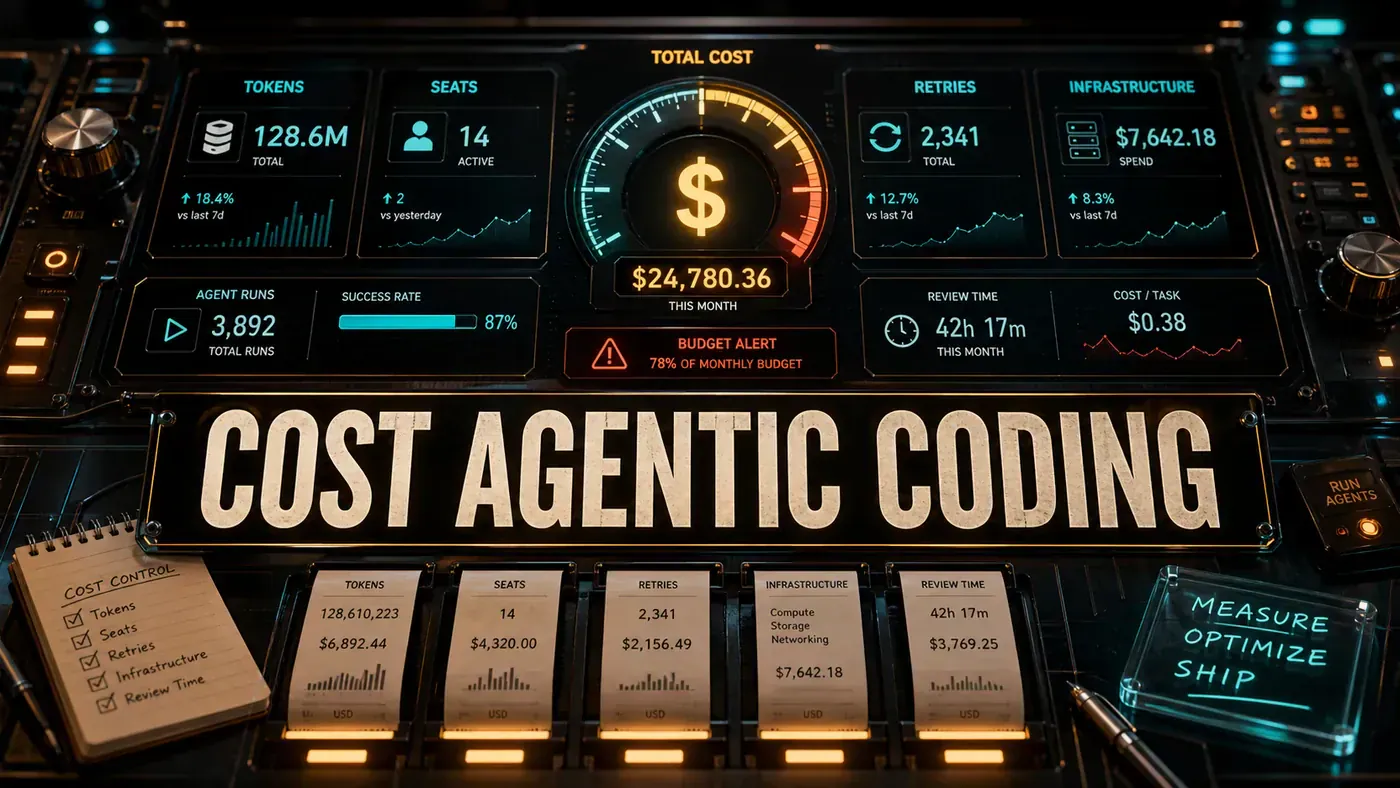
Agentic coding is not free. Tokens cost money, compute costs money, and the engineer time spent babysitting agents costs money too. This piece pulls apart what it actually costs to run agents in production, as of June 2026.
Here is the part most vendors skip over. When a team first switches on an AI coding agent, the bill they expect (the API charges) is rarely the bill that hurts. The visible cost is the model usage. The cost that quietly eats your month is the senior engineer who spends two afternoons writing system prompts, then another reviewing what the agent shipped. None of that shows up on an invoice, which is exactly why it catches people out.
A quick warning before the numbers. Model pricing in this space moves fast, and a few of the figures below come from product pages and third-party write-ups rather than locked, official rate cards. Where the published price differs from what we could confirm, I have flagged it inline. Treat the dollar amounts as a planning starting point, not a quote.
With that out of the way, here is where the money actually goes.
Cost Categories
Agent costs land in four buckets.
1. Model API Costs
This is the most visible cost, and the one that swings the most. It comes down to which model you pick, how many tokens you burn, and which provider you go through:
| Model | Provider | Input/1M tokens | Output/1M tokens |
|---|---|---|---|
| Opus 4.8 | Anthropic | $15.00 | $75.00 |
| Sonnet 4.8 | Anthropic | $3.00 | $15.00 |
| Haiku 4.8 | Anthropic | $0.25 | $1.25 |
| GPT-4.1 | OpenAI | $2.50 | $10.00 |
| GPT-4.1-mini | OpenAI | $0.15 | $0.60 |
| Hermes 3 | Nous Portal | $1.00 | $3.00 |
| Via OpenRouter | Various | $0.10-15.00 | $0.50-75.00 |
A few of those rows need a correction. The Opus 4.8 figure above ($15/$75) looks to be an older Opus-era price. Current sources put Claude Opus 4.8 at roughly $5 input / $25 output per 1M tokens (opens in a new tab), with a faster mode around $10/$50. That matters, because every per-task and total-cost figure further down this article is built on the higher number, so read the Opus-based dollar amounts as roughly three times what you would actually pay at the current rate.
The Sonnet 4.8 price of $3 input / $15 output is accurate (opens in a new tab). Haiku is murkier: the $0.25/$1.25 rate matches an earlier Haiku generation, and the current published Haiku tier is referenced as Haiku 4.5 at about $1/$5 (opens in a new tab), so treat the "Haiku 4.8" line as unconfirmed.
The OpenAI rows have the same issue. GPT-4.1 currently runs closer to $2 input / $8 output (opens in a new tab), not $2.50/$10. And the $0.15/$0.60 line labelled GPT-4.1-mini actually matches GPT-4.1 Nano pricing (opens in a new tab); the Mini tier sits nearer $0.40/$1.60. The full OpenAI rate card (opens in a new tab) is the place to confirm before you budget.
Hermes 3 sits inside the Nous Portal subscription (opens in a new tab), which is a real product bundling 300-plus models, though the specific $1/$3 per-million-token rate is not confirmed on the official pricing page and should be read as indicative. The OpenRouter range is a broad illustration of how wide the aggregator's pricing band (opens in a new tab) gets, not a single quotable price.
So what does a real task cost? A genuinely complex coding job (Plan Mode, several files, sub-agents) chews through somewhere around 50K-200K input tokens and 20K-80K output tokens on Opus 4.8. At the article's original Opus price that works out to $1.50-$12.00 per task. At the corrected $5/$25 rate, it is closer to a third of that. These token volumes are a working estimate from typical usage, not a measured benchmark, so your mileage will vary with how much context you load.
Run the same task on Sonnet 4.8 and you are looking at $0.30-$2.40. Hand the routine parts to a Haiku sub-agent and it drops again, to $0.05-$0.50.
2. Infrastructure Costs
| Setup | Monthly Cost | Notes |
|---|---|---|
| Hermes on VPS (2 vCPU/4GB) | ~$5 | Hetzner, DigitalOcean |
| OpenClaw self-hosted | $0 | Runs on existing infrastructure |
| OpenClaw managed (DigitalOcean) | $24 | Includes support |
| OpenHuman subscription | ~$20 | Multi-model routing included |
| Claude Code team | $100 | Per team, not per user |
| Cursor Pro | $20 | Per user |
| GitHub Copilot Business | $19 | Per user |
A note on a few of these. Hermes Agent is free and open-source (opens in a new tab), so your only cost is inference plus a small box to run it on, and a 2 vCPU/4GB VPS on Hetzner or DigitalOcean really does land around $5/month. OpenClaw's self-hosted core is open-source too (opens in a new tab), so the software itself is genuinely $0; you bring your own API key. DigitalOcean does offer a one-click OpenClaw deploy (opens in a new tab), and the total runs roughly $5-45/month depending on the droplet, so the "$24 including support" line is plausible but not an official managed-plan price. The OpenHuman (opens in a new tab) product is real and open-source, but the ~$20/month subscription tier with multi-model routing was not confirmed on an official pricing page, so treat that figure as reported rather than fixed.
One correction worth flagging: the "Claude Code team" row reads $100 per team, but the actual pricing is $100 per seat per month on the annual Premium plan (opens in a new tab) (or $125 monthly), with a five-seat minimum. That is per user, not a flat rate for the whole team, which changes the maths a lot for a five-person crew. Cursor Pro at $20/user (opens in a new tab) and GitHub Copilot Business at $19/user (opens in a new tab) both check out.
3. Engineer Time
This is the hidden cost, and usually the big one. Setting agents up, writing the system prompts, keeping the harness running, and reviewing what the agent produces all eat hours:
| Activity | Time (initial) | Time (ongoing/month) |
|---|---|---|
| Initial setup | 4-16 hours | - |
| Prompt engineering | 4-8 hours | 2-4 hours |
| Harness maintenance | 2-4 hours | 4-8 hours |
| Output review | 30-50% of agent output time | 20-30% after calibration |
| Debugging agent failures | 2-6 hours | 1-3 hours |
Put a senior engineer's rate at $150/hour and the first month of that work runs $2,100-$5,100, settling to $1,050-$2,550/month after that. Worth saying plainly: these are modelled estimates, not figures pulled from a published study, so use them to sanity-check your own numbers rather than as gospel.
4. Error and Rework Costs
Agents get things wrong. When they do, the bill includes:
- Rollback time: undoing bad changes, 15-60 minutes per incident
- Debug time: tracking down the root cause, anywhere from 30 minutes to 4 hours
- Opportunity cost: the higher-value work that did not get done
- Production incidents: the nightmare case, possibly hours of downtime
A well-set-up agent keeps its rollback rate under 5%. A badly set-up one can blow past 20%. Both of those rates are author estimates rather than published benchmarks, but the gap between a good harness and a sloppy one is real, and it is where a lot of the unhappy surprises come from.
Total Cost of Ownership: Example
Take a 5-person engineering team running the 3-agent stack (the one covered in article 12 of this series):
| Category | Monthly Cost |
|---|---|
| Model API (mixed usage) | $200-$500 |
| Hermes VPS | $5 |
| OpenClaw managed | $24 |
| OpenHuman (5 subscriptions) | $100 |
| Engineer time (harness maint) | $1,500 |
| Error/rework (5% rollback) | $300 |
| Total | $2,129-$2,429 |
Now the same team with no agents at all:
| Category | Monthly Cost |
|---|---|
| Engineer time (manual work) | +40% more |
| Context switching overhead | Immeasurable but real |
| Knowledge transfer time | Higher |
| Total (imputed) | $3,500-$4,500 |
That nets out to roughly $1,000-$2,500/month saved for a five-person team, with the return turning positive somewhere in month 2-3 once the team is past the learning curve. Two caveats. First, these are the author's projections, not externally measured results. Second, they lean on the model prices above, so if you redo the API line at the corrected Opus rate the savings get better, not worse. And remember the Claude Code seat pricing correction: if you are paying per seat rather than a flat $100, your subscription line is higher than the table shows.
Cost Optimisation Strategies
- Use the right model for each task: Haiku for the simple stuff, Sonnet for standard work, Opus only when the architecture is genuinely hard
- Cache context: Hermes' FTS5 session search (opens in a new tab) recalls past conversations so you are not reloading the same context every time
- Batch related tasks: one big context load is cheaper than a string of small ones
- Watch your output format: asking for full file rewrites burns far more tokens than asking for diffs
- Lean on prompt caching: Anthropic's prompt caching can cut cached input costs by up to ~90%, and Claude Code uses it (it is context caching, to be precise, not a guaranteed identical-response cache)
- Monitor usage: set budgets and alerts, because token costs can spike without warning
Agentic coding costs real money. Done properly, though, it costs less than the alternative of not doing it.
The Cost of Agentic Coding: answer-first summary
The Cost of Agentic Coding matters because it can change how Developers and technical teams plan, build, or govern an agent workflow. Agentic coding is not free.
The direct answer is this: do not treat the topic as a standalone trend. Treat it as a decision about inputs, outputs, review ownership, data exposure, and whether the workflow produces a result that is faster, safer, or more useful than the current process.
The Cost of Agentic Coding: implementation checklist
- Define the user, job to be done, and success metric for the agent workflow.
- Collect real examples, policies, source files, customer questions, or search queries before writing prompts or choosing tools.
- Separate low-risk drafts from decisions that need approval, privacy checks, or senior review.
- Document what the AI is allowed to access, what it must not access, and who signs off before production use.
- Review successful task completion, review time, fallback rate, operator corrections after a small pilot rather than judging the idea from a demo.
This keeps the work practical. It also gives search engines and AI answer engines a clean factual structure: what the topic is, who it helps, what to do next, and which risks matter before implementation.
Decision criteria for The Cost of Agentic Coding
| Decision area | What to check | Production signal |
|---|---|---|
| Intent | Does The Cost of Agentic Coding solve a real workflow problem? | The use case has a named owner and measurable outcome. |
| Data | Can the required data be used safely? | Sensitive data is classified and access is controlled. |
| Quality | Can a reviewer judge the output consistently? | Examples, rubrics, or acceptance criteria exist. |
| Scale | Can the workflow be repeated without hero effort? | The process is documented and can be handed to another team member. |
Practical example for The Cost of Agentic Coding
A small business could use this article to choose one practical test. For example, a manager might take one customer-facing process, one internal document workflow, or one recurring content task and redesign only that step with AI support. The goal is not to automate the whole business at once; it is to learn where Code creates reliable leverage.
The useful deliverable is a short operating note: the trigger, the source material, the prompt or tool, the review checklist, the escalation rule, and the metric. That note becomes the handover asset for staff training, SEO/GEO content, service delivery, or future agent work.
Risks and controls for The Cost of Agentic Coding
The common failure pattern is moving too quickly from a promising idea into an unmanaged workflow. For The Cost of Agentic Coding, the risk is not only bad output. It can also be unclear data permission, staff confusion, duplicate content, unreviewed customer advice, or a tool that quietly changes cost or capability.
- Control unclear tool permissions with a named owner, a review step, and written acceptance criteria.
- Control silent failures with a named owner, a review step, and written acceptance criteria.
- Control prompt drift with a named owner, a review step, and written acceptance criteria.
- Control weak audit trails with a named owner, a review step, and written acceptance criteria.
Measurement plan for The Cost of Agentic Coding
A useful AI or SEO initiative should leave evidence. Track successful task completion, review time, fallback rate, operator corrections and compare the pilot against the current process. If the measure does not improve, keep the learning but avoid scaling the workflow.
For GEO readiness, the page should also answer the core question directly, define the entities involved, include implementation steps, explain tradeoffs, and link readers to the next relevant AI Kick Start service, guide, tool, or article.
Definitions and entities for The Cost of Agentic Coding
For search, GEO, and staff handover, define the core entities in plain language. In this article the important entities are the workflow owner, the AI tool or model, the source material, the review process, the risk boundary, and the measurable business outcome. Clear definitions make the page easier for people to scan and easier for AI answer engines to quote accurately.
- Workflow owner: the person accountable for deciding whether The Cost of Agentic Coding belongs in the business process.
- Source material: the documents, examples, policies, URLs, prompts, videos, or customer questions that ground the output.
- Review boundary: the point where a human checks accuracy, privacy, brand voice, or customer impact before the result is used.
- Success metric: the measure that proves whether the agent workflow is worth repeating.
The Cost of Agentic Coding versus doing nothing
Doing nothing is also a decision. The cost may be slow manual work, weaker search visibility, inconsistent advice, duplicated effort, or staff using unmanaged AI tools without a shared process. The practical question is whether a controlled pilot can reduce that cost without creating a larger governance problem.
| Option | When it makes sense | What to watch |
|---|---|---|
| Do nothing | The workflow is rare, low value, or already reliable. | Competitors may improve speed, content depth, or service consistency first. |
| Run a small pilot | The task repeats often and has clear review criteria. | Keep scope tight and measure the result against the current process. |
| Build a production workflow | The pilot is repeatable and risk controls are documented. | Assign ownership, monitoring, training, and a rollback path. |
AI Kick Start handover package for The Cost of Agentic Coding
A production handover should be concrete enough that another person can run it. For The Cost of Agentic Coding, that means a short brief, a workflow map, approved prompts or tool settings, source material, a review checklist, internal links to supporting resources, and a simple measurement sheet. This is the difference between reading about AI and turning it into operational capability.
That packaging also strengthens E-E-A-T. It shows experience through implementation notes, expertise through decision criteria, authoritativeness through source-aware structure, and trust through risks, controls, and review steps. The article becomes useful even if the reader never buys a tool because it helps them make a better operational decision.