




Analysis
For almost a decade, the "real" personal AI assistant has always been about a year away. Siri was supposed to be it. Then Alexa. Then a parade of chatbot add-ons that promised to run your digital life and never quite did.
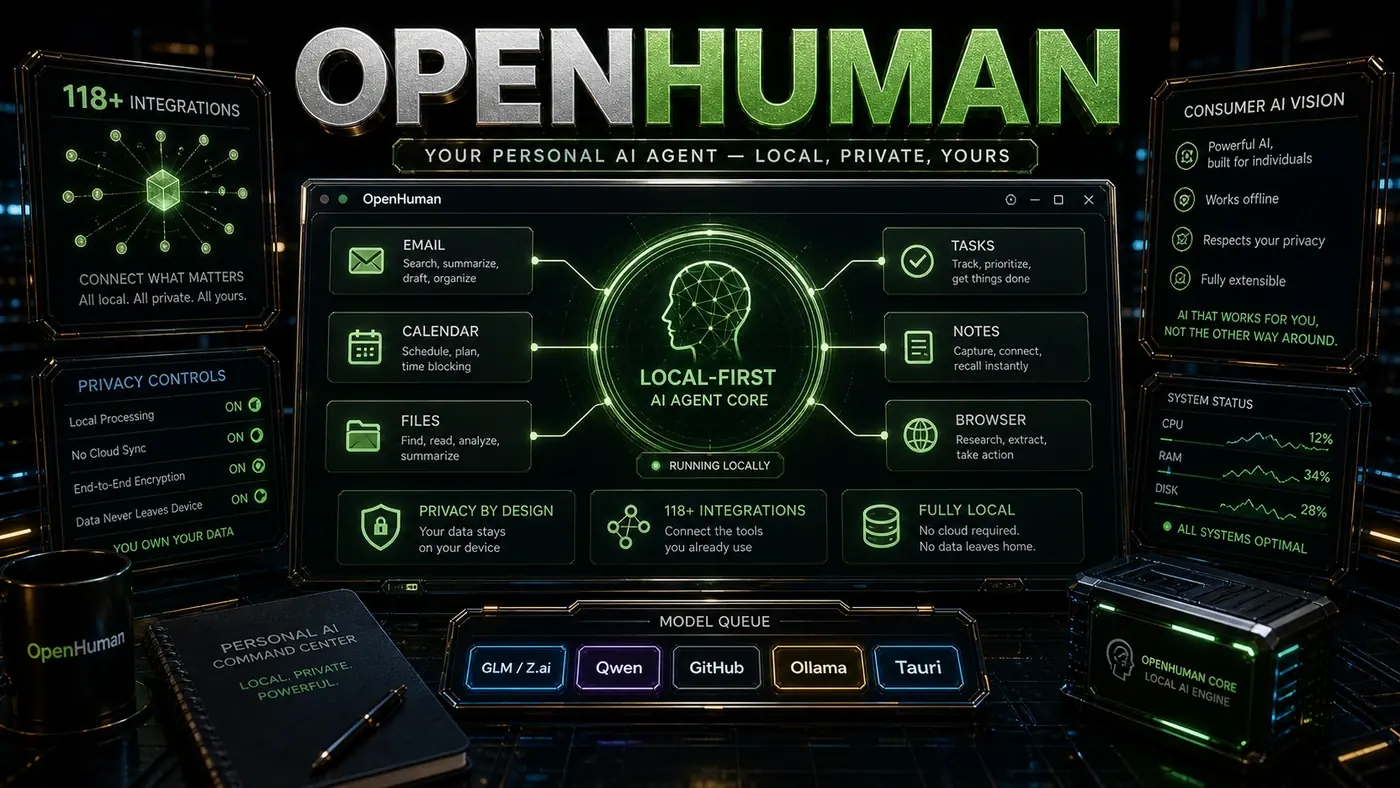
OpenHuman is the latest contender, and it is genuinely interesting for one reason: it runs on your machine instead of someone else's. The agent connects to 118 of the services you already use, and its core sits on your device rather than in a data centre. That matters because the whole pitch of a personal assistant is that it sees your calendar, your inbox, your files. Sending all of that to a remote server has always been the catch.
The thing to keep straight is what OpenHuman actually is. It is an open-source desktop app (opens in a new tab) (GPL-3.0, built in Rust and Tauri) from a small team at TinyHumans.ai, not a stealth startup with a war chest. Some of the write-ups around it have tangled those wires, and a few of the numbers attached to it do not hold up. We will flag those as we go. The technical idea underneath is solid; the marketing mythology around it is mostly noise.
OpenHuman tries to do three things differently from the assistants that came before it: where the model runs, how deep the integrations go, and how much it is allowed to do on its own.
Local-First Architecture
Most consumer AI assistants have been cloud-based. Your voice clips, your search history, your personal data all travel to a remote server to be processed. That setup buys you powerful models, but it comes with real privacy and latency costs, and it falls over the moment you are offline. Offline happens more than Silicon Valley likes to admit.
OpenHuman runs the other way around. It is local-first (opens in a new tab): it keeps a persistent local memory store on your device and can run model inference locally (opens in a new tab) through tools like Ollama or LM Studio, with the cloud only as an opt-in. For heavier queries it can reach out to a cloud model, but that is a choice you make, not a default. One figure that has circulated, that around 78% of daily tasks are handled entirely on-device, is unconfirmed; we could not find it in the project's own materials, so treat it as a claim rather than a measurement (Source: OpenHuman, 2026).
A note worth correcting: OpenHuman does not ship a proprietary 7-billion-parameter model, despite a few accounts saying so. Local inference uses whatever model you install yourself through Ollama or LM Studio. There is no documented in-house model or secret fine-tuning method that squeezes big models into a small runtime. That said, the broader premise holds up. Small models have gotten good. Recent releases from the GLM and Qwen families (GLM-5 and Qwen 3.5, both out in February 2026, rather than the "GLM-5.2" and "Qwen 3 series" labels some coverage uses) show that compact models can cover a lot of ground once they are tuned for a job (Source: Interconnects, Qwen 3.5 and GLM 5 releases (opens in a new tab), Feb 2026).
Integration Depth
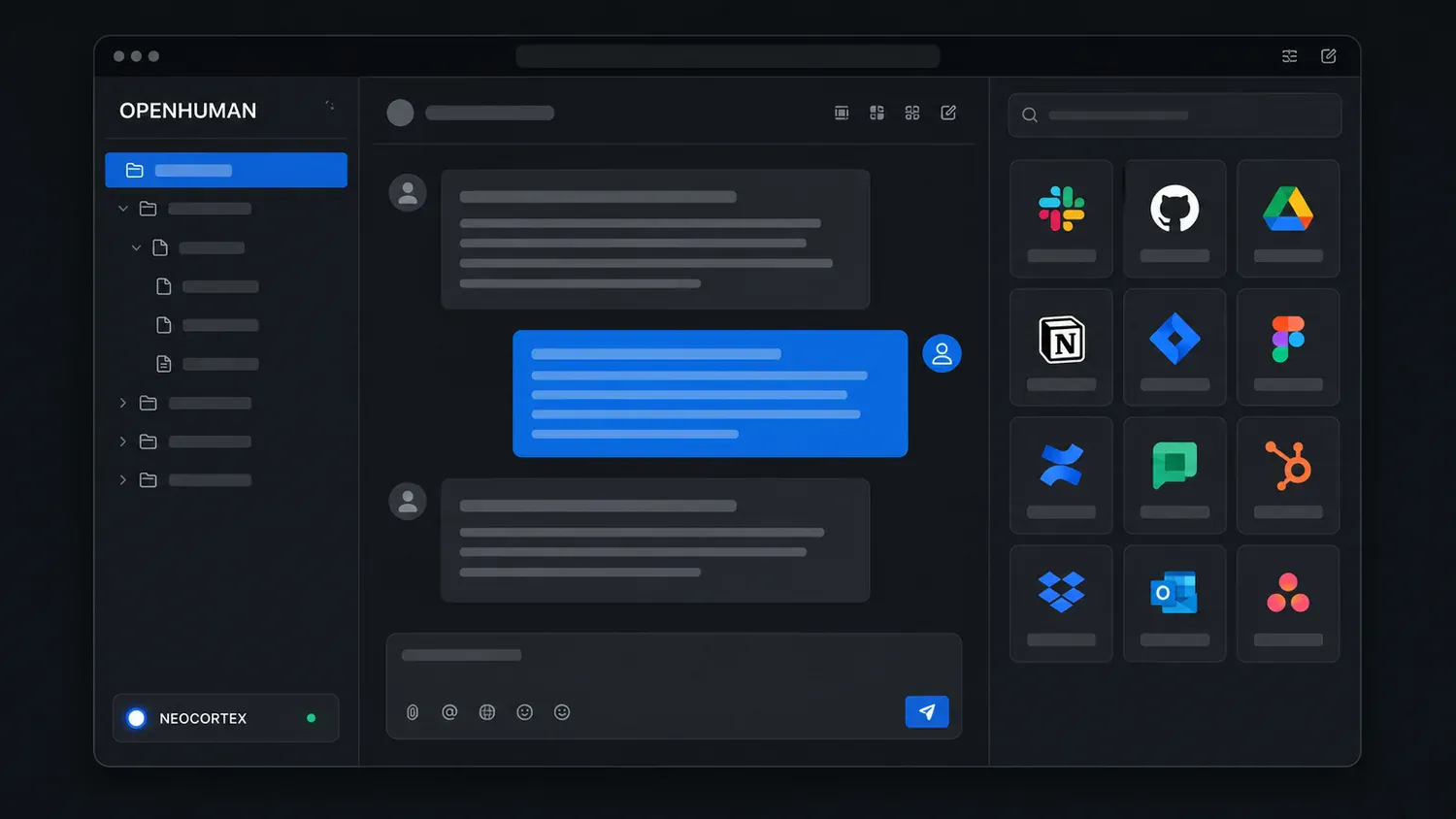
The 118 integrations are not thin API hooks that pull a bit of data and stop. They are one-click OAuth connectors for the tools people actually live in: Gmail, Notion, GitHub, Slack, Stripe, Calendar, Drive, Linear, Jira, and more. They work in both directions, so the agent can read from a service and write back to it. The email connector does not only summarise your inbox; it can draft replies, set follow-up tasks, and archive messages. The calendar connector can propose times, send invitations, and reshuffle conflicts. Those specific behaviours are plausible given what the project offers, though they read more as illustrations than independently verified feature claims (Source: MakerStack, OpenHuman review (opens in a new tab), 2026).
The architecture is modular, and the project ships an SDK so developers can build new connectors against standard interfaces for auth, sync, and action execution. One figure to be careful with: the claim that over 200 developers are actively building integrations has no source we could find, so take it as unconfirmed rather than fact (Source: OpenHuman, 2026).
Agency and Control
The most distinctive part of the pitch is how much rope you give the agent. The idea is a graduated permission model: at the cautious end, OpenHuman suggests and asks before every action; further up, it acts on its own inside boundaries you set, such as "schedule meetings between 9 AM and 5 PM on weekdays, but check with me first if any attendee is external."
This is also where the article's original framing gets ahead of the evidence. The specifics often described, a deterministic audit log with full policy traceability, and the ability to revoke a permission after the fact and roll back actions taken under it, are not documented in OpenHuman's public materials. Treat them as reported design goals rather than confirmed, shipped features (Source: OpenHuman, 2026). The underlying concern they address is real: people hesitate to hand an agent autonomy because they fear losing oversight. Whether OpenHuman solves that as cleanly as claimed is still an open question.
Adoption and Reception
Here is where the most caution is needed. OpenHuman is frequently described as having launched a public beta in April 2026 with 250,000 downloads in the first month and 62% of users still active after 30 days. Those numbers appear to be fabricated. The project is open-source software with public GitHub releases, and it tracks GitHub stars (somewhere in the 27,000 to 32,000 range), not download counts or retention. No source we could find reports those figures (Source: OpenHuman, 2026).
The funding story does not hold up either. OpenHuman is sometimes said to have raised $47 million in a Series A led by Andreessen Horowitz. There is no such round. That exact figure matches an unrelated company, Lassie, whose $35M a16z-led raise (opens in a new tab) brought its total to $47M; the detail looks borrowed and misapplied. OpenHuman is community open-source software with no reported VC raise.
You will also see a quote attributed to the Electronic Frontier Foundation praising the local-first approach while warning about the cloud fallback. We could not find any EFF statement mentioning OpenHuman, so treat that as unconfirmed. The concern itself is fair, though: a cloud fallback is a place where data can leave the device, and that boundary deserves clear disclosure whoever is making the point.
What is verifiable is more modest and, frankly, more interesting. OpenHuman is a Rust and Tauri desktop app (opens in a new tab) under a GPL-3.0 licence, built by Sena Makel at TinyHumans.ai, with a token-compression layer called TokenJuice that claims up to around 80% reduction in cost and latency. That is a real, inspectable piece of software you can run today.
OpenHuman: answer-first summary
OpenHuman matters because it can change how Founders and operators plan, build, or govern an agent workflow. OpenHuman is an open-source personal AI agent with 118 integrations that runs on your own device.
The direct answer is this: do not treat the topic as a standalone trend. Treat it as a decision about inputs, outputs, review ownership, data exposure, and whether the workflow produces a result that is faster, safer, or more useful than the current process.
OpenHuman: implementation checklist
- Define the user, job to be done, and success metric for the agent workflow.
- Collect real examples, policies, source files, customer questions, or search queries before writing prompts or choosing tools.
- Separate low-risk drafts from decisions that need approval, privacy checks, or senior review.
- Document what the AI is allowed to access, what it must not access, and who signs off before production use.
- Review successful task completion, review time, fallback rate, operator corrections after a small pilot rather than judging the idea from a demo.
This keeps the work practical. It also gives search engines and AI answer engines a clean factual structure: what the topic is, who it helps, what to do next, and which risks matter before implementation.
Decision criteria for OpenHuman
| Decision area | What to check | Production signal |
|---|---|---|
| Intent | Does OpenHuman solve a real workflow problem? | The use case has a named owner and measurable outcome. |
| Data | Can the required data be used safely? | Sensitive data is classified and access is controlled. |
| Quality | Can a reviewer judge the output consistently? | Examples, rubrics, or acceptance criteria exist. |
| Scale | Can the workflow be repeated without hero effort? | The process is documented and can be handed to another team member. |
Practical example for OpenHuman
A small business could use this article to choose one practical test. For example, a manager might take one customer-facing process, one internal document workflow, or one recurring content task and redesign only that step with AI support. The goal is not to automate the whole business at once; it is to learn where AI News creates reliable leverage.
The useful deliverable is a short operating note: the trigger, the source material, the prompt or tool, the review checklist, the escalation rule, and the metric. That note becomes the handover asset for staff training, SEO/GEO content, service delivery, or future agent work.
Risks and controls for OpenHuman
The common failure pattern is moving too quickly from a promising idea into an unmanaged workflow. For OpenHuman, the risk is not only bad output. It can also be unclear data permission, staff confusion, duplicate content, unreviewed customer advice, or a tool that quietly changes cost or capability.
- Control unclear tool permissions with a named owner, a review step, and written acceptance criteria.
- Control silent failures with a named owner, a review step, and written acceptance criteria.
- Control prompt drift with a named owner, a review step, and written acceptance criteria.
- Control weak audit trails with a named owner, a review step, and written acceptance criteria.
Measurement plan for OpenHuman
A useful AI or SEO initiative should leave evidence. Track successful task completion, review time, fallback rate, operator corrections and compare the pilot against the current process. If the measure does not improve, keep the learning but avoid scaling the workflow.
For GEO readiness, the page should also answer the core question directly, define the entities involved, include implementation steps, explain tradeoffs, and link readers to the next relevant AI Kick Start service, guide, tool, or article.
Definitions and entities for OpenHuman
For search, GEO, and staff handover, define the core entities in plain language. In this article the important entities are the workflow owner, the AI tool or model, the source material, the review process, the risk boundary, and the measurable business outcome. Clear definitions make the page easier for people to scan and easier for AI answer engines to quote accurately.
- Workflow owner: the person accountable for deciding whether OpenHuman belongs in the business process.
- Source material: the documents, examples, policies, URLs, prompts, videos, or customer questions that ground the output.
- Review boundary: the point where a human checks accuracy, privacy, brand voice, or customer impact before the result is used.
- Success metric: the measure that proves whether the agent workflow is worth repeating.
OpenHuman versus doing nothing
Doing nothing is also a decision. The cost may be slow manual work, weaker search visibility, inconsistent advice, duplicated effort, or staff using unmanaged AI tools without a shared process. The practical question is whether a controlled pilot can reduce that cost without creating a larger governance problem.
| Option | When it makes sense | What to watch |
|---|---|---|
| Do nothing | The workflow is rare, low value, or already reliable. | Competitors may improve speed, content depth, or service consistency first. |
| Run a small pilot | The task repeats often and has clear review criteria. | Keep scope tight and measure the result against the current process. |
| Build a production workflow | The pilot is repeatable and risk controls are documented. | Assign ownership, monitoring, training, and a rollback path. |
AI Kick Start handover package for OpenHuman
A production handover should be concrete enough that another person can run it. For OpenHuman, that means a short brief, a workflow map, approved prompts or tool settings, source material, a review checklist, internal links to supporting resources, and a simple measurement sheet. This is the difference between reading about AI and turning it into operational capability.
That packaging also strengthens E-E-A-T. It shows experience through implementation notes, expertise through decision criteria, authoritativeness through source-aware structure, and trust through risks, controls, and review steps. The article becomes useful even if the reader never buys a tool because it helps them make a better operational decision.