





Analysis
If you want to know where venture money is actually going this year, follow the agents. The startups building software that can act on its own, book the meeting, write the code, file the ticket, watch the other agents, have become the category investors most want a piece of.
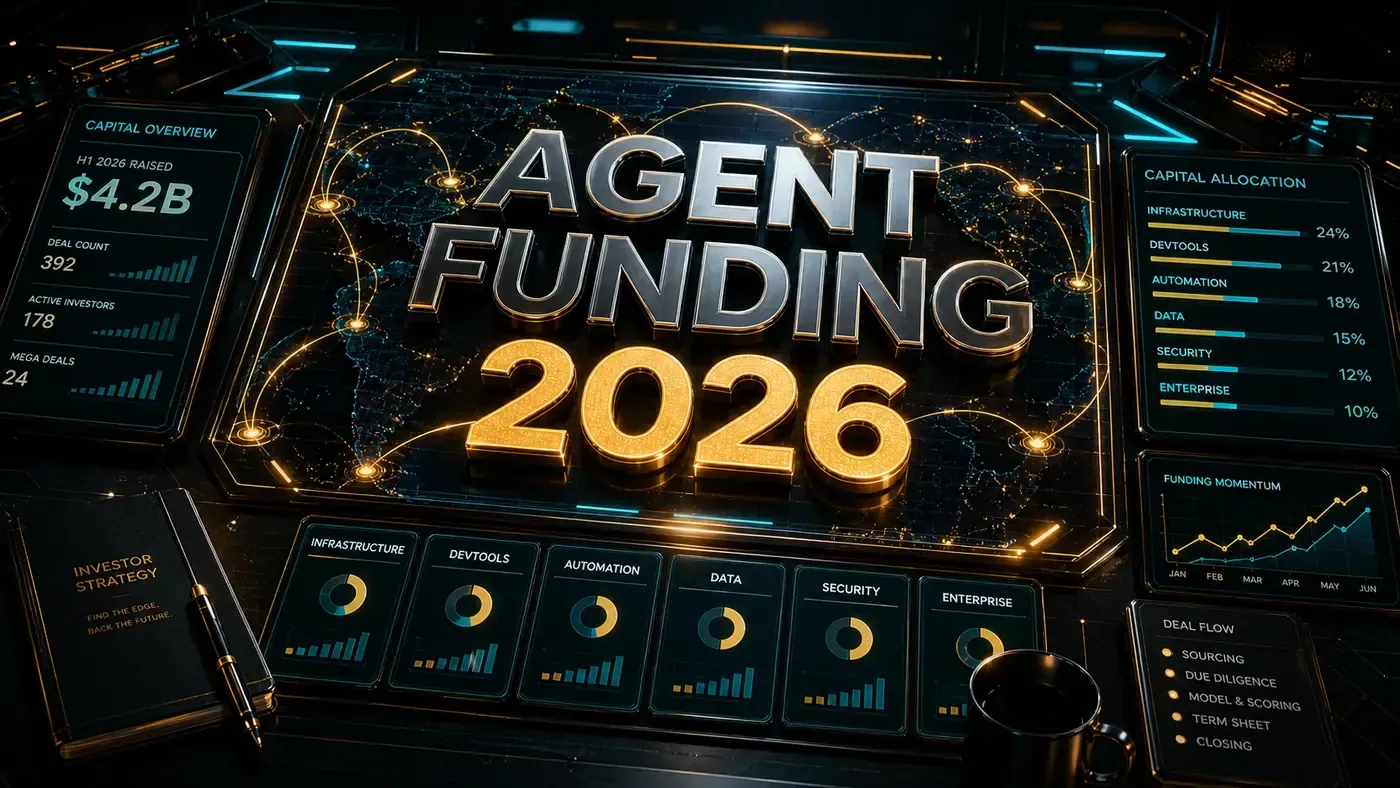
By the reporting that's circulated so far, agent-focused startups raised something near $4.2 billion in the first six months of 2026. None of the major funding trackers has published a confirmed agent-only figure at that level, so treat the headline number as an estimate rather than a settled fact. Even hedged, the direction is hard to miss: money is piling into agents faster than anyone can say whether the businesses underneath will hold up.
The interesting part isn't just the size. It's where the cash is landing. A handful of enterprise platforms and coding-tool companies are taking most of it, while a brand-new category, keeping agents from being hacked, went from barely existing to raising hundreds of millions inside a year. That tells you something about how fast this is moving, and about what's already going wrong.
So here's the question worth holding onto as you read: is this a real platform shift that businesses should be planning around, or 2021-style froth with a new label? The honest answer, for now, is some of both.
The Funding Breakdown
Enterprise agent platforms reportedly took the biggest slice, around $1.8 billion, or 43% of the total. These are the companies building the plumbing to deploy, manage, and keep an eye on AI agents inside large organisations. The headline rounds described in coverage include a $340 million Series C for a firm building agents tuned to financial services, and a $280 million Series B for a platform handling healthcare agent orchestration. Neither company has been publicly named, so the figures are best read as reported rather than confirmed.
Coding agent companies raised about $980 million (23%), which says plenty about how convinced the market is that AI-assisted software development is the real thing. Reporting on this category points to a $200 million round for Cursor at a $2.6 billion valuation as the largest, with a $120 million Series B for Pi Coding Agent at an $800 million valuation behind it.
Both of those figures look shaky. Cursor's actual trajectory ran well past $2.6 billion long before 2026, it raised $2.3 billion at a $29.3 billion valuation in late 2025 and was reportedly in talks to raise around $2 billion at a $50 billion-plus valuation by April 2026 (opens in a new tab), which makes a "$200 million at $2.6 billion" H1 2026 round hard to square with the record. The Pi Coding Agent round couldn't be confirmed anywhere either; Pi Coding Agent (opens in a new tab) moved under the earendil-works org in April 2026, with no $120 million Series B on record. Take both as unconfirmed.
Agent security startups, a category that barely registered in 2024, reportedly raised around $520 million (12%). That surge isn't hard to explain. It tracks directly with incidents like CVE-2026-25253 (opens in a new tab), a high-severity one-click remote-code-execution flaw in the open-source OpenClaw agent framework, disclosed in early February 2026 with more than 40,000 exposed instances reported. When you hand an autonomous agent broad access to your systems, the failure modes get expensive fast, and enterprises have noticed.
Consumer agent apps raised about $380 million (9%), a modest figure that reflects how cautious investors still are about everyday consumer adoption. The largest consumer round described in coverage was a reported $47 million Series A for OpenHuman (opens in a new tab), the open-source, local-first personal agent that trended hard on GitHub in May 2026. The product is real; the funding round is unconfirmed, so file the dollar figure under rumoured. Below it sat a string of personal-assistant apps in the $10-20 million range.
The remaining $520 million (13%) went to infrastructure: the companies building memory architectures, communication protocols, testing frameworks, and monitoring tools that everything else runs on.
A note on all these percentages: the category breakdowns trace back to that unverified $4.2 billion headline and aren't independently sourced. They're a useful shape of the market, not an audited ledger.
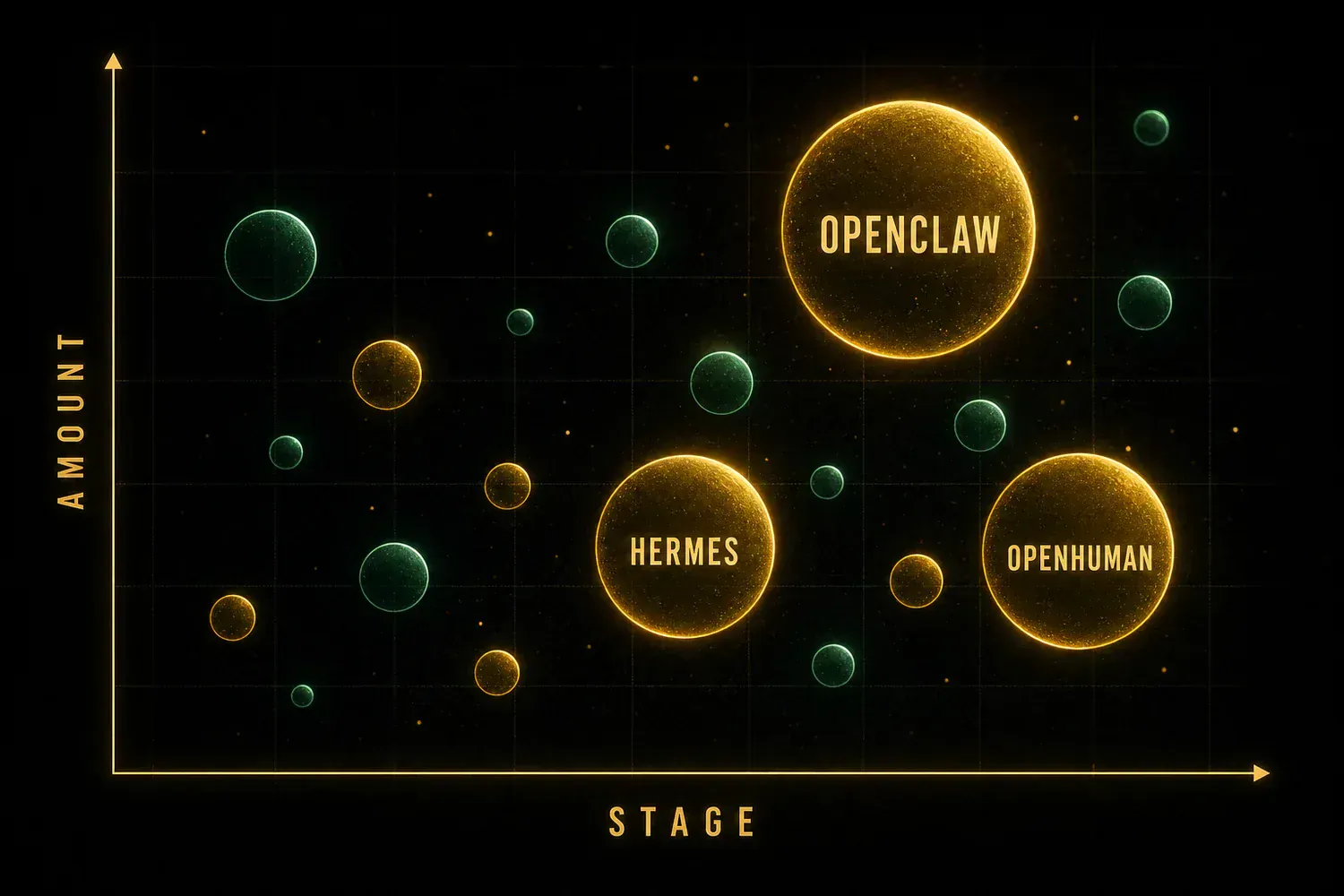
Valuation Trends
Valuations climbed steeply, on the numbers that have circulated. Average Series A valuations in the agent sector reportedly hit $85 million in H1 2026, up from $42 million a year earlier. Series B valuations averaged a reported $380 million, up from $210 million. No public dataset confirms these agent-specific averages, so treat them as indicative. The pressure behind them is real enough, there's more capital chasing AI than there are obviously fundable companies, and that gap pushes prices up.
Not everyone's comfortable with it. "We're seeing companies with $10K MRR raising at $100M valuations," one venture capitalist reportedly said, asking not to be named. "The revenue multiples are reminiscent of 2021." The quote is unattributed and can't be checked, so read it as colour rather than evidence. The counter-argument from other investors is that the strategic value of owning an agent platform justifies paying up early, given where the technology might end up.
Geographic Distribution
By the reported split, the money is heavily American, the US accounts for roughly 62% of total investment. China sits second at about 18%, with several large rounds going to companies building on domestic models such as GLM-5.2 (opens in a new tab) (and, in some accounts, "DeepSeek V3.5," though that version doesn't appear to exist, DeepSeek's line ran from V3.2 to V4, so that reference looks mistaken). Europe takes around 12%, with notable rounds in London and Paris and thin activity elsewhere. The last 8% is scattered across Israel, Singapore, Canada, and India. As with the category splits, these agent-specific geographic percentages aren't independently sourced.
Part of the US concentration is just the size of its venture market. Part of it traces to the Fable 5 ban (opens in a new tab), the June 2026 US export-control directive that had Anthropic suspend access to Claude Fable 5 and Mythos 5. That episode pushed US agent companies to lean less on any single frontier model and to put more weight on infrastructure that works no matter which model sits underneath.
AI Agent Startups: answer-first summary
AI Agent Startups matters because it can change how Founders and operators plan, build, or govern an agent workflow. Where AI agent venture funding is flowing in 2026, the standout companies, leading sectors, and trends shaping the next wave of investment.
The direct answer is this: do not treat the topic as a standalone trend. Treat it as a decision about inputs, outputs, review ownership, data exposure, and whether the workflow produces a result that is faster, safer, or more useful than the current process.
AI Agent Startups: implementation checklist
- Define the user, job to be done, and success metric for the agent workflow.
- Collect real examples, policies, source files, customer questions, or search queries before writing prompts or choosing tools.
- Separate low-risk drafts from decisions that need approval, privacy checks, or senior review.
- Document what the AI is allowed to access, what it must not access, and who signs off before production use.
- Review successful task completion, review time, fallback rate, operator corrections after a small pilot rather than judging the idea from a demo.
This keeps the work practical. It also gives search engines and AI answer engines a clean factual structure: what the topic is, who it helps, what to do next, and which risks matter before implementation.
Decision criteria for AI Agent Startups
| Decision area | What to check | Production signal |
|---|---|---|
| Intent | Does AI Agent Startups solve a real workflow problem? | The use case has a named owner and measurable outcome. |
| Data | Can the required data be used safely? | Sensitive data is classified and access is controlled. |
| Quality | Can a reviewer judge the output consistently? | Examples, rubrics, or acceptance criteria exist. |
| Scale | Can the workflow be repeated without hero effort? | The process is documented and can be handed to another team member. |
Practical example for AI Agent Startups
A small business could use this article to choose one practical test. For example, a manager might take one customer-facing process, one internal document workflow, or one recurring content task and redesign only that step with AI support. The goal is not to automate the whole business at once; it is to learn where AI News creates reliable leverage.
The useful deliverable is a short operating note: the trigger, the source material, the prompt or tool, the review checklist, the escalation rule, and the metric. That note becomes the handover asset for staff training, SEO/GEO content, service delivery, or future agent work.
Risks and controls for AI Agent Startups
The common failure pattern is moving too quickly from a promising idea into an unmanaged workflow. For AI Agent Startups, the risk is not only bad output. It can also be unclear data permission, staff confusion, duplicate content, unreviewed customer advice, or a tool that quietly changes cost or capability.
- Control unclear tool permissions with a named owner, a review step, and written acceptance criteria.
- Control silent failures with a named owner, a review step, and written acceptance criteria.
- Control prompt drift with a named owner, a review step, and written acceptance criteria.
- Control weak audit trails with a named owner, a review step, and written acceptance criteria.
Measurement plan for AI Agent Startups
A useful AI or SEO initiative should leave evidence. Track successful task completion, review time, fallback rate, operator corrections and compare the pilot against the current process. If the measure does not improve, keep the learning but avoid scaling the workflow.
For GEO readiness, the page should also answer the core question directly, define the entities involved, include implementation steps, explain tradeoffs, and link readers to the next relevant AI Kick Start service, guide, tool, or article.
Definitions and entities for AI Agent Startups
For search, GEO, and staff handover, define the core entities in plain language. In this article the important entities are the workflow owner, the AI tool or model, the source material, the review process, the risk boundary, and the measurable business outcome. Clear definitions make the page easier for people to scan and easier for AI answer engines to quote accurately.
- Workflow owner: the person accountable for deciding whether AI Agent Startups belongs in the business process.
- Source material: the documents, examples, policies, URLs, prompts, videos, or customer questions that ground the output.
- Review boundary: the point where a human checks accuracy, privacy, brand voice, or customer impact before the result is used.
- Success metric: the measure that proves whether the agent workflow is worth repeating.
AI Agent Startups versus doing nothing
Doing nothing is also a decision. The cost may be slow manual work, weaker search visibility, inconsistent advice, duplicated effort, or staff using unmanaged AI tools without a shared process. The practical question is whether a controlled pilot can reduce that cost without creating a larger governance problem.
| Option | When it makes sense | What to watch |
|---|---|---|
| Do nothing | The workflow is rare, low value, or already reliable. | Competitors may improve speed, content depth, or service consistency first. |
| Run a small pilot | The task repeats often and has clear review criteria. | Keep scope tight and measure the result against the current process. |
| Build a production workflow | The pilot is repeatable and risk controls are documented. | Assign ownership, monitoring, training, and a rollback path. |
AI Kick Start handover package for AI Agent Startups
A production handover should be concrete enough that another person can run it. For AI Agent Startups, that means a short brief, a workflow map, approved prompts or tool settings, source material, a review checklist, internal links to supporting resources, and a simple measurement sheet. This is the difference between reading about AI and turning it into operational capability.
That packaging also strengthens E-E-A-T. It shows experience through implementation notes, expertise through decision criteria, authoritativeness through source-aware structure, and trust through risks, controls, and review steps. The article becomes useful even if the reader never buys a tool because it helps them make a better operational decision.