






Briefing
Two years ago, if you wanted to build an AI agent, you had a few half-finished projects to choose from and a lot of guesswork. That has changed. By the middle of 2026, a developer starting fresh has hundreds of open-source options across frameworks, browser tools, memory layers, deployment runners and security scanners. The problem is no longer "is there a tool for this" but "which of the forty tools for this should I actually use".
That shift matters for any business team weighing whether to build on AI rather than just buy a subscription. The pieces are now mature enough to assemble into real internal systems, and most of them are free and open-licensed. The catch is that the landscape moves fast, the star counts and feature lists go stale within weeks, and a few of the loudest projects are louder than they are useful.
This is a map of where things stand. I've grouped the tools by what they actually do, kept the numbers the source material reported, and flagged where those numbers have already drifted. Treat the figures as a snapshot, not gospel, and click through to the repos before you commit.
Frameworks: The Foundation Layer
A framework is the scaffolding you build agent behaviour on top of. Here are the ones worth knowing.
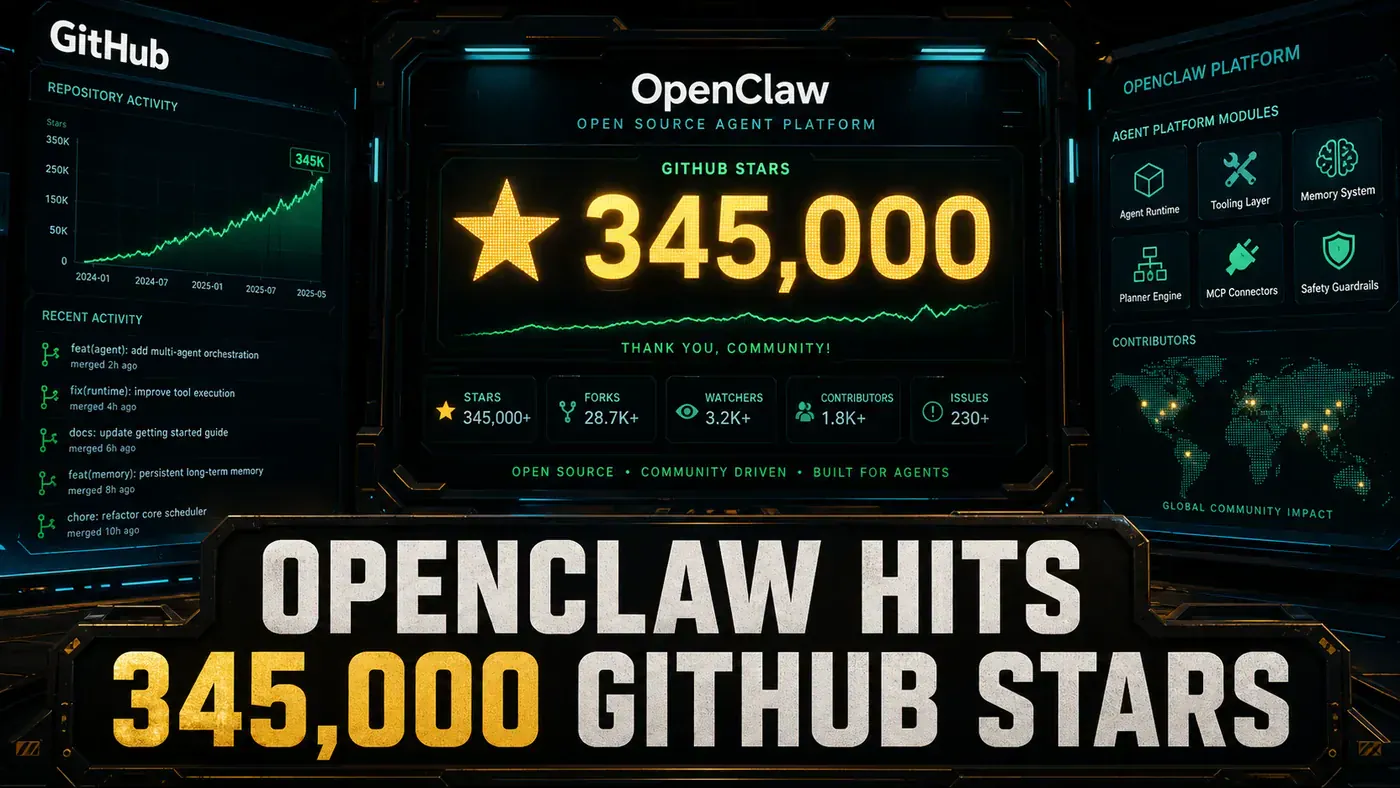
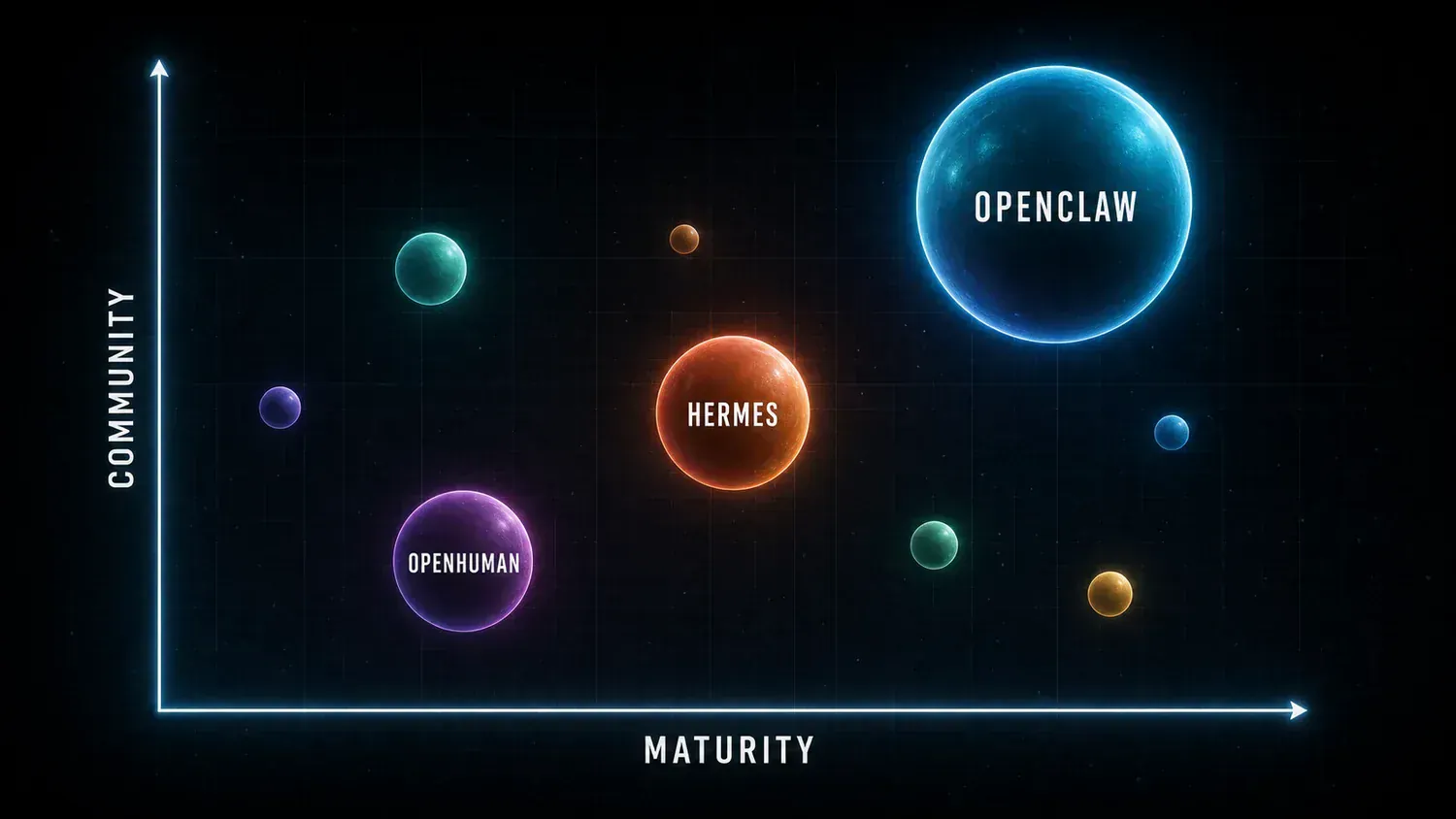
OpenClaw (345,000 stars), The leading skills-based framework. It runs on Node.js under an MIT license (opens in a new tab), ships with 100+ built-in skills (opens in a new tab), and has its own ClawHub marketplace (opens in a new tab) for community skills. Pick it if you work in JavaScript and want broad capability out of the box. Two caveats on the headline number: the live repo is closer to 379,000 stars now, and the "100+ skills" figure comes from the project's own marketing rather than an independent count (ClawHub itself hosts thousands of community-contributed skills).
Hermes Agent (reportedly 22,000 stars), Nous Research's learning agent (opens in a new tab). Python, MIT license, Honcho memory, 40+ tools, and a built-in learning loop. Good for Python developers building a personal assistant that improves over time. Be careful with the star count here: the article's 22,000 figure looks badly out of date, the live repo shows roughly 197,000 stars, nearly nine times higher. The 142-contributors figure couldn't be confirmed either.
AutoGen, Microsoft's multi-agent orchestration framework (opens in a new tab). Python, conversational agents, code execution, human-in-the-loop. The obvious choice for enterprise teams already living in the Microsoft stack.
CrewAI, The friendliest way into multi-agent work. Python, role-based agents, a clean API (opens in a new tab). Start here if multi-agent systems are new to you.
MetaGPT, Multi-agent software development teams in Python, coordinated through standard operating procedures. Built for code generation and software engineering tasks.
Visual Builders: No-Code and Low-Code
Langflow (146,000 stars), Drag-and-drop agent construction (opens in a new tab) with 100+ components, and it exports to Python so you're not trapped in the GUI. Good for fast prototyping and for non-technical people who need to ship something. The star count is close to current sources (~147k, 148k); the component count is plausible but not independently confirmed.
Dify (136,000 stars), A full LLM app platform (opens in a new tab) with visual orchestration, RAG, evaluation and deployment baked in. The better pick when you're heading to production rather than just trying ideas.
Web and Browser Tools
Firecrawl (130,000+ stars), A web context API (opens in a new tab) that turns any website into clean Markdown. It's a top-100 GitHub repo globally, and the live count (~135k) backs up the figure.
Browser-use (reportedly 86,000 stars), Natural-language browser automation (opens in a new tab), for agents that need to click around real websites. The actual star count looks higher than 86,000, one 2026 source puts it past 97,000, so read that number as a floor.
Vercel agent-browser (reportedly 27,000 stars), Serverless browser automation (opens in a new tab) for the Vercel ecosystem, written in Rust and built to run in Vercel Sandbox. The live repo is nearer 36,000 stars, so again the article's figure understates it.
Memory Systems
Mem0 (reportedly 52,000 stars), Standalone memory persistence (opens in a new tab) with multi-layer storage. Model-agnostic, and the vendor claims sub-50ms retrieval. The star count is roughly right (a 2026 source says ~48,000), but treat the retrieval-speed claim as a marketing figure, not a benchmark.
Honcho, A dialectic memory system (opens in a new tab) used by Hermes Agent. It tracks how an agent's knowledge changes over time and flags contradictions as they appear.
Local and Edge Deployment
LocalAI (44,000 stars), An OpenAI-compatible API for local models (opens in a new tab). It runs on CPU with no GPU required and supports a broad family of models. The live count (~47k) is close to the figure quoted.
Ollama, A developer-friendly local model runner (opens in a new tab). The CLI experience is the best in this category and it's well tuned for Mac.
Training and Education
nanochat (reportedly 55,000 stars), Karpathy's minimal LLM training stack (opens in a new tab). You can train a GPT-2-class model for about $48, which makes it the best hands-on way to learn how these models actually get built. Two notes: the live repo is closer to 42,900 stars (below the 55,000 quoted), and the project usually frames its headline cost as roughly $100, the $48 figure is the documented GPT-2-capability run (about two hours on 8x H100).
Security and Trust
Bumblebee (Perplexity), A supply-chain security scanner (opens in a new tab) for AI projects, open-sourced by Perplexity in May 2026 (opens in a new tab). It's a read-only scanner written in Go (Apache 2.0) that covers npm, PyPI, MCP configs, editor extensions and browser extensions, among others.
Developer Tools
awesome-claude-skills, 1,000+ production-ready skills for Claude Code (opens in a new tab), community-curated. Worth knowing this is a family of repos rather than one canonical list; the largest collection cited carries 1,200+ skills, and "quality-tested" is the maintainers' own framing.
LobeHub, A multi-agent chat UI (opens in a new tab) with deep customisation and plugin support.
Pi Coding Agent, A Claude Code competitor (opens in a new tab) (by Mario Zechner) with a minimalist take on agent-assisted development.
transitions.dev, Copy-paste CSS transitions (opens in a new tab) for AI-generated UI, packaged as an installable agent skill. The article says 12 transitions; the current project (opens in a new tab) actually lists eighteen, so that count is out of date.
developer-roadmap, Community-driven learning paths for AI and software development.
Emerging Areas
Agent Marketplaces: ClawHub for OpenClaw, Langflow's component library, and early standards for trading skills between projects.
Agent Standards: MCP (Model Context Protocol) (opens in a new tab) is gaining ground as a universal tool interface.
Agent Safety: CVE databases, security audits and responsible-disclosure practices are starting to take shape around agents.
Agent Observability: Logging, monitoring and debugging tools built specifically for agent behaviour.
How to Choose
What you should reach for depends on what you're building:
- JavaScript developers: OpenClaw + Browser-use + Firecrawl
- Python developers: Hermes + CrewAI + Mem0
- Enterprise: AutoGen + Dify + LocalAI
- No-code: Langflow + Dify
- Education: nanochat + developer-roadmap
- Security-conscious: OpenClaw + LocalAI + Bumblebee
(One note: the source list named "OpenHuman" in that last row, but no project by that name exists in this category. It reads as a typo for OpenClaw, the framework named earlier, so I've used that here.)
The Bigger Picture
The thing that stands out about this landscape is how grown-up it has become. These aren't experimental toys anymore. They're production tools, used by real companies, and the star counts and contributor numbers point to genuine adoption rather than hype, even where the exact figures drift from week to week.
The ecosystem is also settling on shared standards. MCP is becoming the common tool interface, Mem0-style memory patterns are spreading across frameworks, and OpenAI API compatibility is now the default rather than a feature. That convergence makes it easier to mix tools together and harder to get locked into one vendor.
If you're a developer stepping into this space, the timing is good. The tools work, the docs are solid, and the communities will help you. Pick a framework, run the quickstart, and start building.
Open source AI agents: answer-first summary
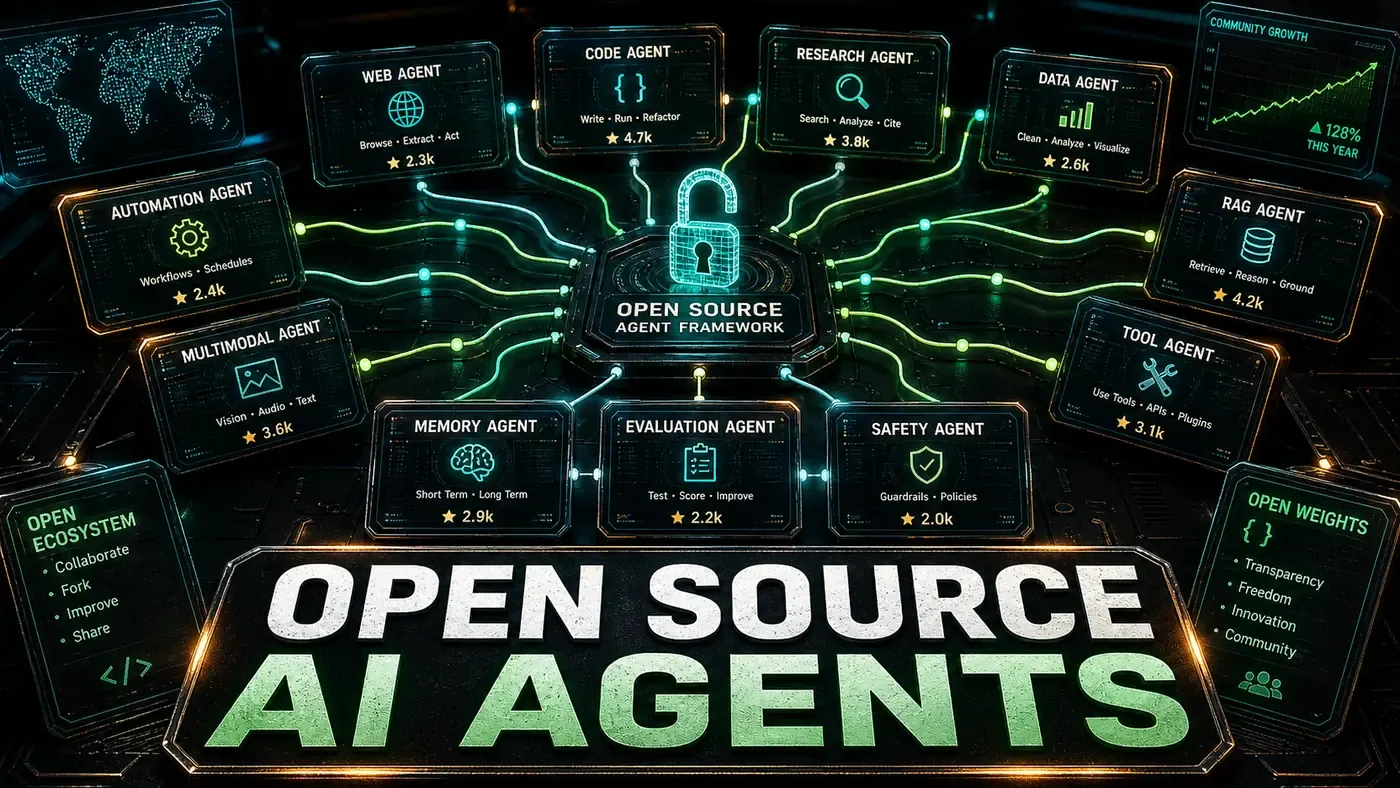
Open source AI agents matters because it can change how Founders and operators plan, build, or govern an agent workflow. A working map of the open-source AI agent ecosystem in 2026: the frameworks, tools, deployment platforms, and memory systems, and how they fit together.
The direct answer is this: do not treat the topic as a standalone trend. Treat it as a decision about inputs, outputs, review ownership, data exposure, and whether the workflow produces a result that is faster, safer, or more useful than the current process.
Open source AI agents: implementation checklist
- Define the user, job to be done, and success metric for the agent workflow.
- Collect real examples, policies, source files, customer questions, or search queries before writing prompts or choosing tools.
- Separate low-risk drafts from decisions that need approval, privacy checks, or senior review.
- Document what the AI is allowed to access, what it must not access, and who signs off before production use.
- Review successful task completion, review time, fallback rate, operator corrections after a small pilot rather than judging the idea from a demo.
This keeps the work practical. It also gives search engines and AI answer engines a clean factual structure: what the topic is, who it helps, what to do next, and which risks matter before implementation.
Decision criteria for Open source AI agents
| Decision area | What to check | Production signal |
|---|---|---|
| Intent | Does Open source AI agents solve a real workflow problem? | The use case has a named owner and measurable outcome. |
| Data | Can the required data be used safely? | Sensitive data is classified and access is controlled. |
| Quality | Can a reviewer judge the output consistently? | Examples, rubrics, or acceptance criteria exist. |
| Scale | Can the workflow be repeated without hero effort? | The process is documented and can be handed to another team member. |
Practical example for Open source AI agents
A small business could use this article to choose one practical test. For example, a manager might take one customer-facing process, one internal document workflow, or one recurring content task and redesign only that step with AI support. The goal is not to automate the whole business at once; it is to learn where AI News creates reliable leverage.
The useful deliverable is a short operating note: the trigger, the source material, the prompt or tool, the review checklist, the escalation rule, and the metric. That note becomes the handover asset for staff training, SEO/GEO content, service delivery, or future agent work.
Risks and controls for Open source AI agents
The common failure pattern is moving too quickly from a promising idea into an unmanaged workflow. For Open source AI agents, the risk is not only bad output. It can also be unclear data permission, staff confusion, duplicate content, unreviewed customer advice, or a tool that quietly changes cost or capability.
- Control unclear tool permissions with a named owner, a review step, and written acceptance criteria.
- Control silent failures with a named owner, a review step, and written acceptance criteria.
- Control prompt drift with a named owner, a review step, and written acceptance criteria.
- Control weak audit trails with a named owner, a review step, and written acceptance criteria.
Measurement plan for Open source AI agents
A useful AI or SEO initiative should leave evidence. Track successful task completion, review time, fallback rate, operator corrections and compare the pilot against the current process. If the measure does not improve, keep the learning but avoid scaling the workflow.
For GEO readiness, the page should also answer the core question directly, define the entities involved, include implementation steps, explain tradeoffs, and link readers to the next relevant AI Kick Start service, guide, tool, or article.
Definitions and entities for Open source AI agents
For search, GEO, and staff handover, define the core entities in plain language. In this article the important entities are the workflow owner, the AI tool or model, the source material, the review process, the risk boundary, and the measurable business outcome. Clear definitions make the page easier for people to scan and easier for AI answer engines to quote accurately.
- Workflow owner: the person accountable for deciding whether Open source AI agents belongs in the business process.
- Source material: the documents, examples, policies, URLs, prompts, videos, or customer questions that ground the output.
- Review boundary: the point where a human checks accuracy, privacy, brand voice, or customer impact before the result is used.
- Success metric: the measure that proves whether the agent workflow is worth repeating.
Open source AI agents versus doing nothing
Doing nothing is also a decision. The cost may be slow manual work, weaker search visibility, inconsistent advice, duplicated effort, or staff using unmanaged AI tools without a shared process. The practical question is whether a controlled pilot can reduce that cost without creating a larger governance problem.
| Option | When it makes sense | What to watch |
|---|---|---|
| Do nothing | The workflow is rare, low value, or already reliable. | Competitors may improve speed, content depth, or service consistency first. |
| Run a small pilot | The task repeats often and has clear review criteria. | Keep scope tight and measure the result against the current process. |
| Build a production workflow | The pilot is repeatable and risk controls are documented. | Assign ownership, monitoring, training, and a rollback path. |
AI Kick Start handover package for Open source AI agents
A production handover should be concrete enough that another person can run it. For Open source AI agents, that means a short brief, a workflow map, approved prompts or tool settings, source material, a review checklist, internal links to supporting resources, and a simple measurement sheet. This is the difference between reading about AI and turning it into operational capability.
That packaging also strengthens E-E-A-T. It shows experience through implementation notes, expertise through decision criteria, authoritativeness through source-aware structure, and trust through risks, controls, and review steps. The article becomes useful even if the reader never buys a tool because it helps them make a better operational decision.