




Briefing
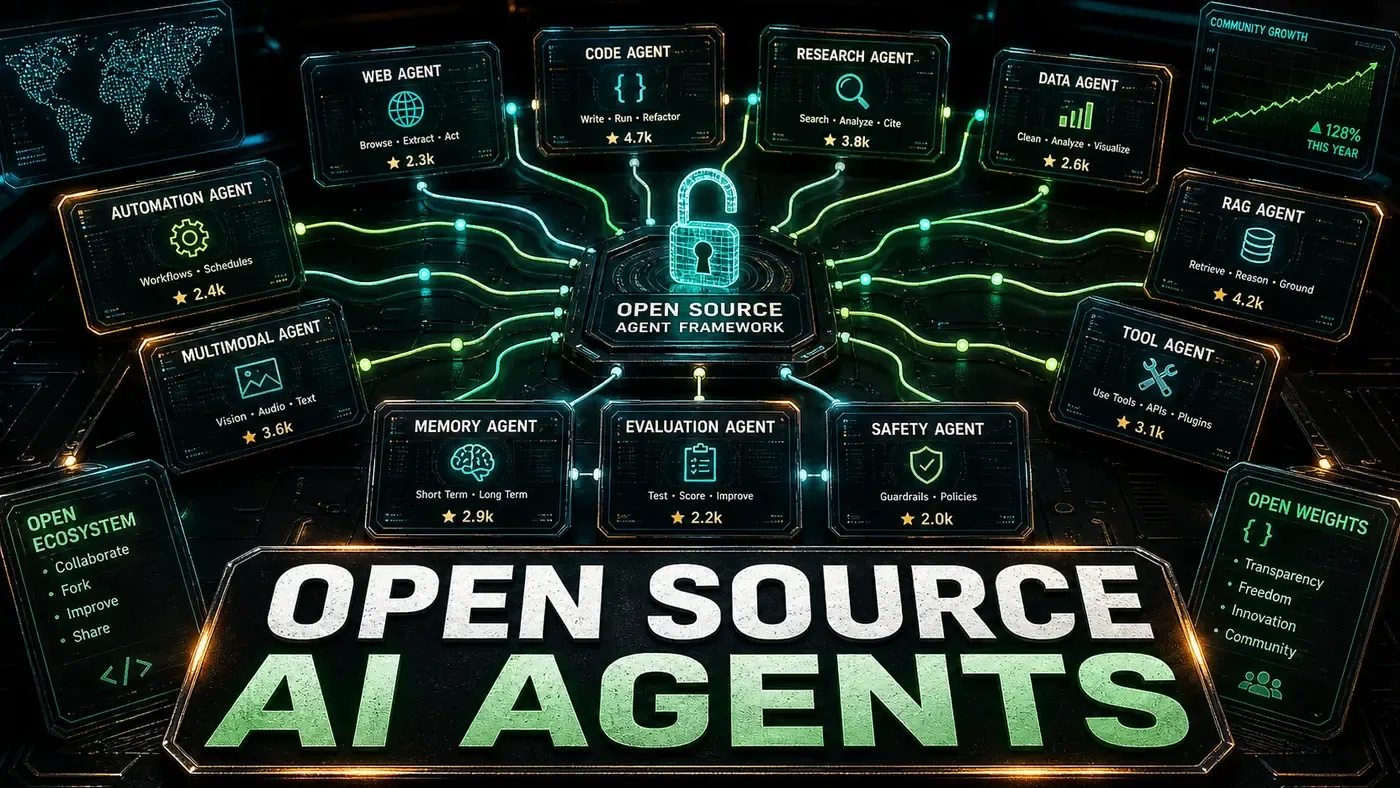
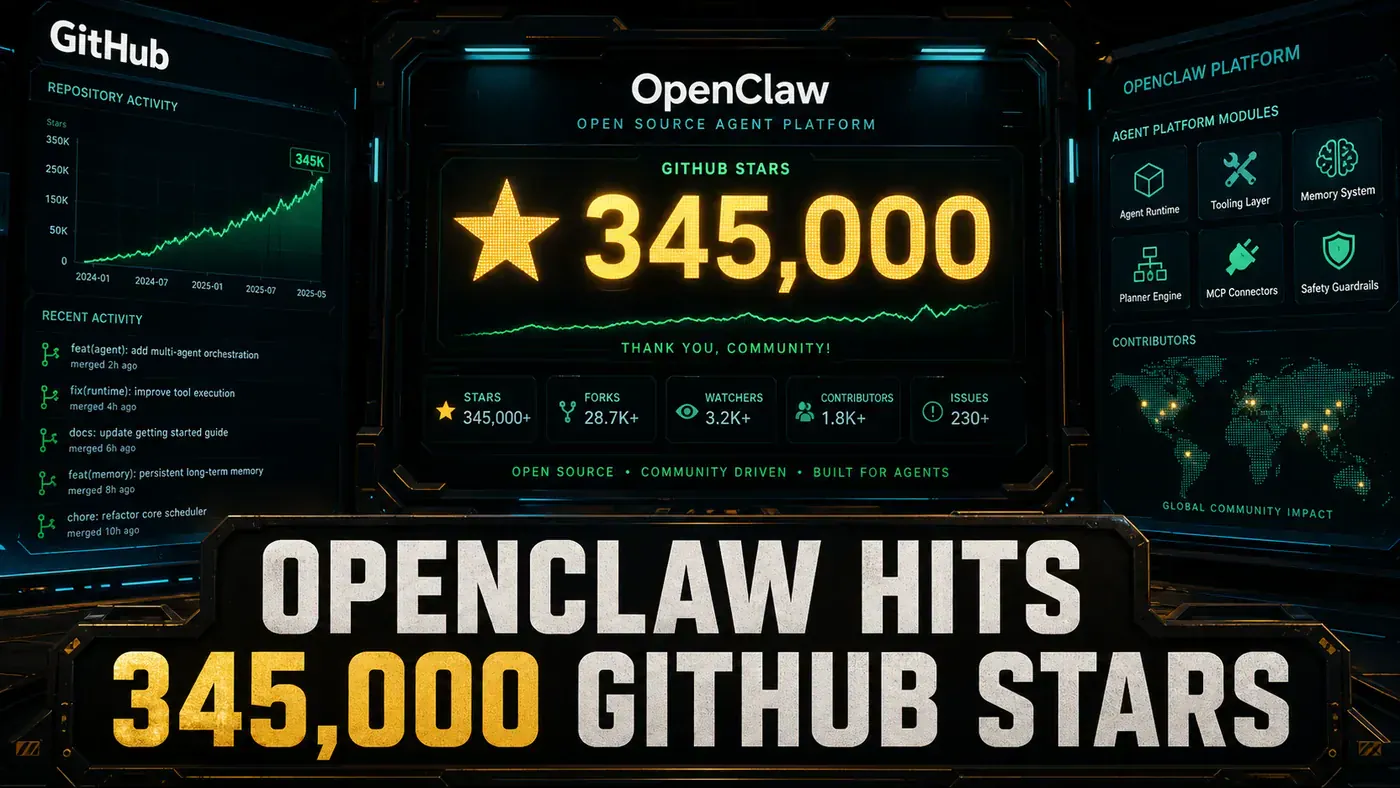
The open-source AI agent world is moving quickly. Projects like OpenClaw (opens in a new tab), reportedly sitting at around 345,000 GitHub stars, keep new frameworks shipping almost every week (OpenClaw passed 250,000 stars in early March 2026 (opens in a new tab), surpassing React, with figures since rising further). Mid-2026 already looks nothing like the same point a year ago. Here's where things are heading, and what it means if you run a business that's starting to lean on these tools.
A year ago, "AI agent" mostly meant a chatbot with a few extra tricks. Now it means software that books the meeting, scrapes the data, writes the first draft, and hands the result to a second agent for checking. The interesting part isn't any single model. It's the plumbing being built around them, out in the open, by people you've never heard of, for free.
That matters for Australian teams because the foundations are being poured right now. The tools your competitors run in 2027 are mostly being written today, in public repositories anyone can read. You don't need to predict the winners. You need to know which patterns are sticking, so you don't bet on the wrong thing.
Below are the shifts worth watching, the honest caveats, and the parts that are still guesswork dressed up as certainty.
Trend 1: Multi-Agent as Default
One agent doing everything is on its way out. The projects worth watching, MetaGPT, CrewAI and AutoGen, are all built around several agents working together rather than one trying to do the lot (all three are recognised multi-agent frameworks (opens in a new tab)). The direction is teams of narrow specialists, not a single jack-of-all-trades.
You can already see agent organisations forming: groups of agents with set roles, who reports to whom, and rules for how they hand work between each other. These aren't just code patterns. They're org charts for AI labour.
Trend 2: MCP as the Universal Interface
The Model Context Protocol (MCP) is fast becoming the common way agents talk to tools. Firecrawl's MCP server (opens in a new tab) is reportedly one of the most popular, and the approach is spreading. The author expects that within 12 months most major tools will ship an MCP server and most frameworks will support MCP clients, though that timeline is a prediction rather than a settled fact.
If it plays out, the knock-on effects are real:
- Tool interoperability: any MCP tool works with any MCP agent
- Specialised agents: agents can be built around a tool rather than locked to one framework
- Market dynamics: tool quality starts to matter more than framework lock-in
Trend 3: Agent Marketplaces Mature
ClawHub (opens in a new tab), OpenClaw's skill registry, is the most developed agent marketplace going, running like npm for AI skills with thousands of contributed entries. It isn't the only one. Langflow's component marketplace, CrewAI's tool registry, and several independents are all growing.
What comes next:
- Quality scoring: reputation systems that push the good skills to the top
- Monetisation: paid skills and tools with revenue sharing
- Verification: third parties checking skills for safety and quality
- Cross-platform: skills that run across more than one framework
Trend 4: Memory Becomes Infrastructure
Mem0 (opens in a new tab) (around 52,000 stars) and Honcho (opens in a new tab) are making the case that memory is a base layer, not a bolt-on feature. Where it's heading:
- Memory standards: shared protocols so agent memory can talk across systems
- Memory as a service: hosted memory with proper SLAs
- Cross-agent memory: memory shared between different agents serving the same person
- User-controlled memory: screens where people can see, edit and delete what their agent remembers about them
Trend 5: Local-First AI
OpenHuman (reported at 7,800 stars in an early snapshot, though later figures put it well above 20,000 after it topped GitHub Trending in May 2026 (opens in a new tab)), LocalAI (opens in a new tab) (44,000 stars), and Ollama are the face of a growing local-first push. Privacy worries, cost, and the need for low latency all feed demand for AI that runs on your own hardware.
Where it's going:
- Better local models: quantisation and architecture work make on-device models more capable
- Hybrid architectures: sensitive work stays local, the heavy lifting goes to the cloud
- Edge AI: models running on phones, laptops and IoT devices
- AI-native OS: operating systems with AI baked in at every level
Trend 6: Visual Development Matures
Langflow (opens in a new tab) (146,000 stars) and Dify (opens in a new tab) (136,000 stars) show that drag-and-drop building has a real place in AI work. The next wave:
- Visual debugging: watch what your agent is doing as it does it
- Collaborative editing: several developers building the same flow at once
- Version control for flows: Git with visual diffs
- Testing frameworks: unit and integration tests for visual flows
Trend 7: Safety Becomes Standard
The CVE-2026-25253 incident (opens in a new tab), a one-click remote-code-execution hole in OpenClaw disclosed in February 2026, points to a more grown-up attitude to safety. (Reports of a safety project named "Bumblebee" tied to this shift could not be confirmed and may not exist.) The shifts worth noting:
- Security audits: standard practice for major projects
- Supply chain scanning: every CI pipeline checks its dependencies
- Capability boundaries: permission systems that work the same way across tools
- Red teaming: community-run security testing events
Trend 8: Education Democratises
nanochat (opens in a new tab) (reported at around 55,000 stars, though some sources put it lower) and developer-roadmap are part of a wider opening-up of AI education:
- Accessible training: around $48 to train a GPT-2 class model (opens in a new tab)
- Community learning: open curricula and peer learning
- Practical skills: learning by building rather than just reading
- Certification: professional credentials for open-source AI skills
The Convergence Vision
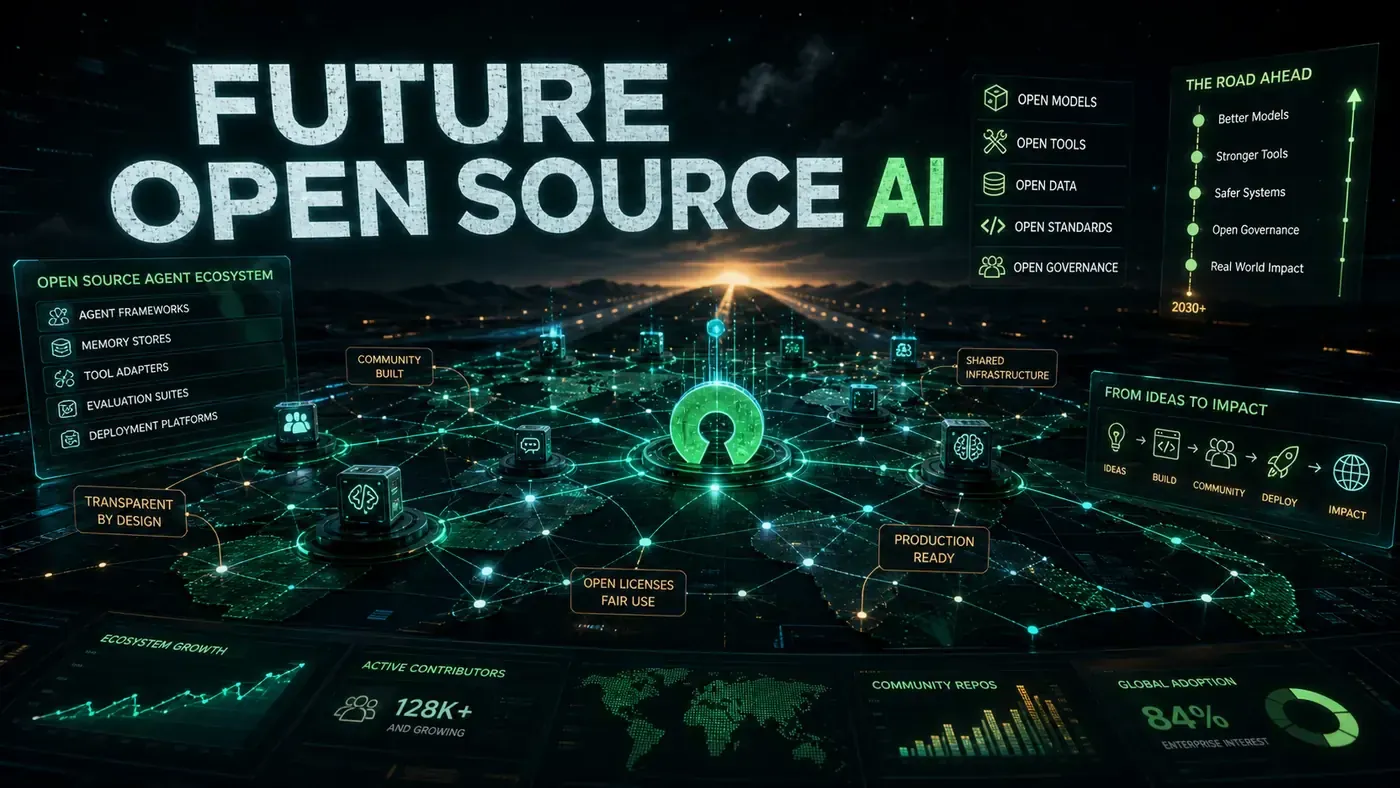
The author's most optimistic call is convergence. Today's scatter of separate frameworks, memory systems, tool integrations and deployment platforms could settle around shared standards. This is framed as a vision for where things might go, not a description of where they are.
The picture:
- One skill format: skills that run across OpenClaw, Langflow and CrewAI
- One memory protocol: Mem0 and Honcho speaking the same language
- One tool interface: MCP everywhere
- One deployment target: run it local, in the cloud, or at the edge
This isn't about flattening everything into one thing. It's about pieces that fit together. Niche tools will always exist; the goal is that they cooperate instead of fighting.
Challenges Ahead
It won't all go smoothly. The hard questions:
- Sustainability: how do open-source projects keep going without revenue?
- Governance: who decides when a project that affects millions changes course?
- Safety: how do you stop misuse as the tools get more capable?
- Concentration: do a handful of projects take over, or does the variety hold?
- Regulation: how will governments handle open-source AI?
The Bottom Line
Open-source AI agents are shifting from experiments to something businesses actually depend on. The star counts, contributor numbers and enterprise uptake all read the same way: this is becoming the foundation the next round of software gets built on.
For anyone building, the takeaway is plain. Get to know these tools now. The agents of 2027 will sit on top of what's being written today. And it's all open source, so nothing's stopping you from looking under the hood this week.
The future of open source AI agents: answer-first summary
The future of open source AI agents matters because it can change how Founders and operators plan, build, or govern an agent workflow. From multi-agent orchestration to agent marketplaces to AI-native operating systems, we explore where open-source AI agents are headed in 2026 and beyond.
The direct answer is this: do not treat the topic as a standalone trend. Treat it as a decision about inputs, outputs, review ownership, data exposure, and whether the workflow produces a result that is faster, safer, or more useful than the current process.
The future of open source AI agents: implementation checklist
- Define the user, job to be done, and success metric for the agent workflow.
- Collect real examples, policies, source files, customer questions, or search queries before writing prompts or choosing tools.
- Separate low-risk drafts from decisions that need approval, privacy checks, or senior review.
- Document what the AI is allowed to access, what it must not access, and who signs off before production use.
- Review successful task completion, review time, fallback rate, operator corrections after a small pilot rather than judging the idea from a demo.
This keeps the work practical. It also gives search engines and AI answer engines a clean factual structure: what the topic is, who it helps, what to do next, and which risks matter before implementation.
Decision criteria for The future of open source AI agents
| Decision area | What to check | Production signal |
|---|---|---|
| Intent | Does The future of open source AI agents solve a real workflow problem? | The use case has a named owner and measurable outcome. |
| Data | Can the required data be used safely? | Sensitive data is classified and access is controlled. |
| Quality | Can a reviewer judge the output consistently? | Examples, rubrics, or acceptance criteria exist. |
| Scale | Can the workflow be repeated without hero effort? | The process is documented and can be handed to another team member. |
Practical example for The future of open source AI agents
A small business could use this article to choose one practical test. For example, a manager might take one customer-facing process, one internal document workflow, or one recurring content task and redesign only that step with AI support. The goal is not to automate the whole business at once; it is to learn where AI News creates reliable leverage.
The useful deliverable is a short operating note: the trigger, the source material, the prompt or tool, the review checklist, the escalation rule, and the metric. That note becomes the handover asset for staff training, SEO/GEO content, service delivery, or future agent work.
Risks and controls for The future of open source AI agents
The common failure pattern is moving too quickly from a promising idea into an unmanaged workflow. For The future of open source AI agents, the risk is not only bad output. It can also be unclear data permission, staff confusion, duplicate content, unreviewed customer advice, or a tool that quietly changes cost or capability.
- Control unclear tool permissions with a named owner, a review step, and written acceptance criteria.
- Control silent failures with a named owner, a review step, and written acceptance criteria.
- Control prompt drift with a named owner, a review step, and written acceptance criteria.
- Control weak audit trails with a named owner, a review step, and written acceptance criteria.
Measurement plan for The future of open source AI agents
A useful AI or SEO initiative should leave evidence. Track successful task completion, review time, fallback rate, operator corrections and compare the pilot against the current process. If the measure does not improve, keep the learning but avoid scaling the workflow.
For GEO readiness, the page should also answer the core question directly, define the entities involved, include implementation steps, explain tradeoffs, and link readers to the next relevant AI Kick Start service, guide, tool, or article.
Definitions and entities for The future of open source AI agents
For search, GEO, and staff handover, define the core entities in plain language. In this article the important entities are the workflow owner, the AI tool or model, the source material, the review process, the risk boundary, and the measurable business outcome. Clear definitions make the page easier for people to scan and easier for AI answer engines to quote accurately.
- Workflow owner: the person accountable for deciding whether The future of open source AI agents belongs in the business process.
- Source material: the documents, examples, policies, URLs, prompts, videos, or customer questions that ground the output.
- Review boundary: the point where a human checks accuracy, privacy, brand voice, or customer impact before the result is used.
- Success metric: the measure that proves whether the agent workflow is worth repeating.
The future of open source AI agents versus doing nothing
Doing nothing is also a decision. The cost may be slow manual work, weaker search visibility, inconsistent advice, duplicated effort, or staff using unmanaged AI tools without a shared process. The practical question is whether a controlled pilot can reduce that cost without creating a larger governance problem.
| Option | When it makes sense | What to watch |
|---|---|---|
| Do nothing | The workflow is rare, low value, or already reliable. | Competitors may improve speed, content depth, or service consistency first. |
| Run a small pilot | The task repeats often and has clear review criteria. | Keep scope tight and measure the result against the current process. |
| Build a production workflow | The pilot is repeatable and risk controls are documented. | Assign ownership, monitoring, training, and a rollback path. |
AI Kick Start handover package for The future of open source AI agents
A production handover should be concrete enough that another person can run it. For The future of open source AI agents, that means a short brief, a workflow map, approved prompts or tool settings, source material, a review checklist, internal links to supporting resources, and a simple measurement sheet. This is the difference between reading about AI and turning it into operational capability.
That packaging also strengthens E-E-A-T. It shows experience through implementation notes, expertise through decision criteria, authoritativeness through source-aware structure, and trust through risks, controls, and review steps. The article becomes useful even if the reader never buys a tool because it helps them make a better operational decision.