






Briefing
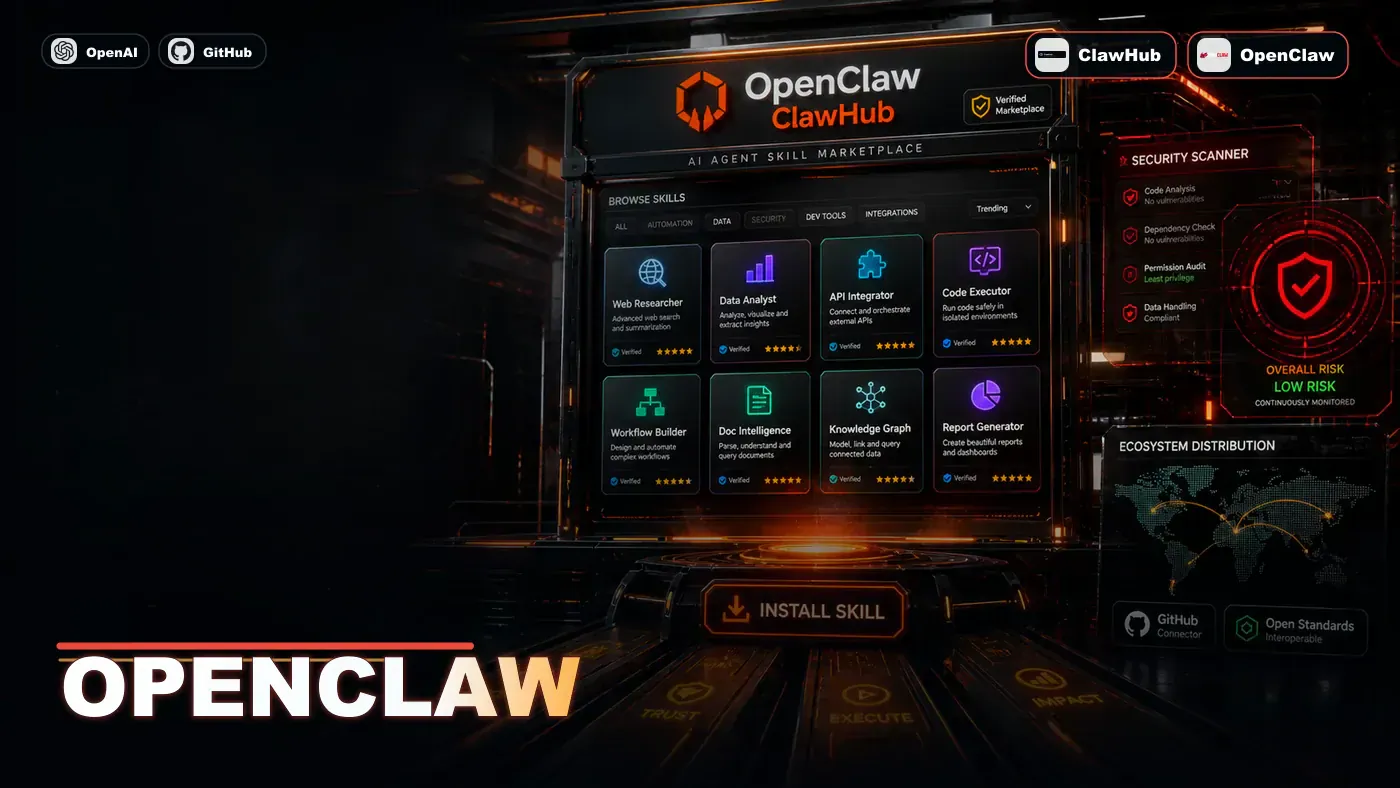
Every platform that takes off ends up needing a place where other people can add to it. For OpenClaw, that place is ClawHub (opens in a new tab), a registry for agent skills that people have started calling the npm of AI capabilities. It holds thousands of community-built skills, and the most popular ones have been installed hundreds of thousands of times. Much of OpenClaw's pull comes from what lives here.
What Is ClawHub?
ClawHub is a registry and distribution system for OpenClaw skills. The idea is simple: someone writes a useful capability once, publishes it, and everyone else can pull it down and run it. Reported install syntax looks like this:
openclaw install @clawhub/research-agentA note on accuracy here. The command above matches how the original write-up described ClawHub, but it does not match how the real registry works. According to the openclaw/clawhub repository (opens in a new tab), skills are not npm packages, each one is a folder built around a SKILL.md file plus supporting bits, and the install command is clawhub install <skill-slug> (for example, clawhub install @openclaw/demo). Worth knowing before you copy and paste.
In the npm-style model the original article describes, each skill package was said to include:
- Manifest: Metadata describing capabilities, requirements, and permissions
- Implementation: TypeScript code implementing the skill's logic
- Schema: Input/output definitions for the LLM to understand usage
- Documentation: Usage examples, configuration options, and testing guides
- Tests: Automated tests verifying skill behaviour
In practice, OpenClaw's own docs (opens in a new tab) point to something leaner: a real skill is mostly a SKILL.md holding instructions and frontmatter metadata, with optional scripts or config alongside. Some bundled plugins do carry code, but the TypeScript-package breakdown above is not how most text-based skills are actually put together.
The Skill Economy
ClawHub has grown its own little economy. Skill authors build a reputation through downloads, ratings, and word of mouth. Some have reportedly turned that visibility into consulting work, writing custom skills for businesses that want something off-menu.
The original article listed these as the most downloaded skills:
- @clawhub/research-agent (2M+ downloads): Multi-step web research with synthesis
- @clawhub/code-reviewer (1.5M+ downloads): Automated code review with best practices
- @clawhub/data-analyst (1.2M+ downloads): SQL generation, visualisation, and insight extraction
- @clawhub/devops (900K+ downloads): CI/CD pipeline management and deployment
- @clawhub/content-writer (800K+ downloads): Blog posts, documentation, and marketing copy
Treat that list with caution. These names and figures could not be matched against any real ClawHub leaderboard. Public rankings tell a different story: a category-by-category guide on Medium (opens in a new tab) reports the actual top skills by installs as Skill Vetter (~256K), Github (~189K), Ontology (~188K), Gog (~185K), and Felo Search (~145K). No skill called @clawhub/research-agent with two million downloads shows up anywhere we could verify, so the numbers above appear to be invented.
Quality and Trust
ClawHub runs a layered approach to keeping skills safe.
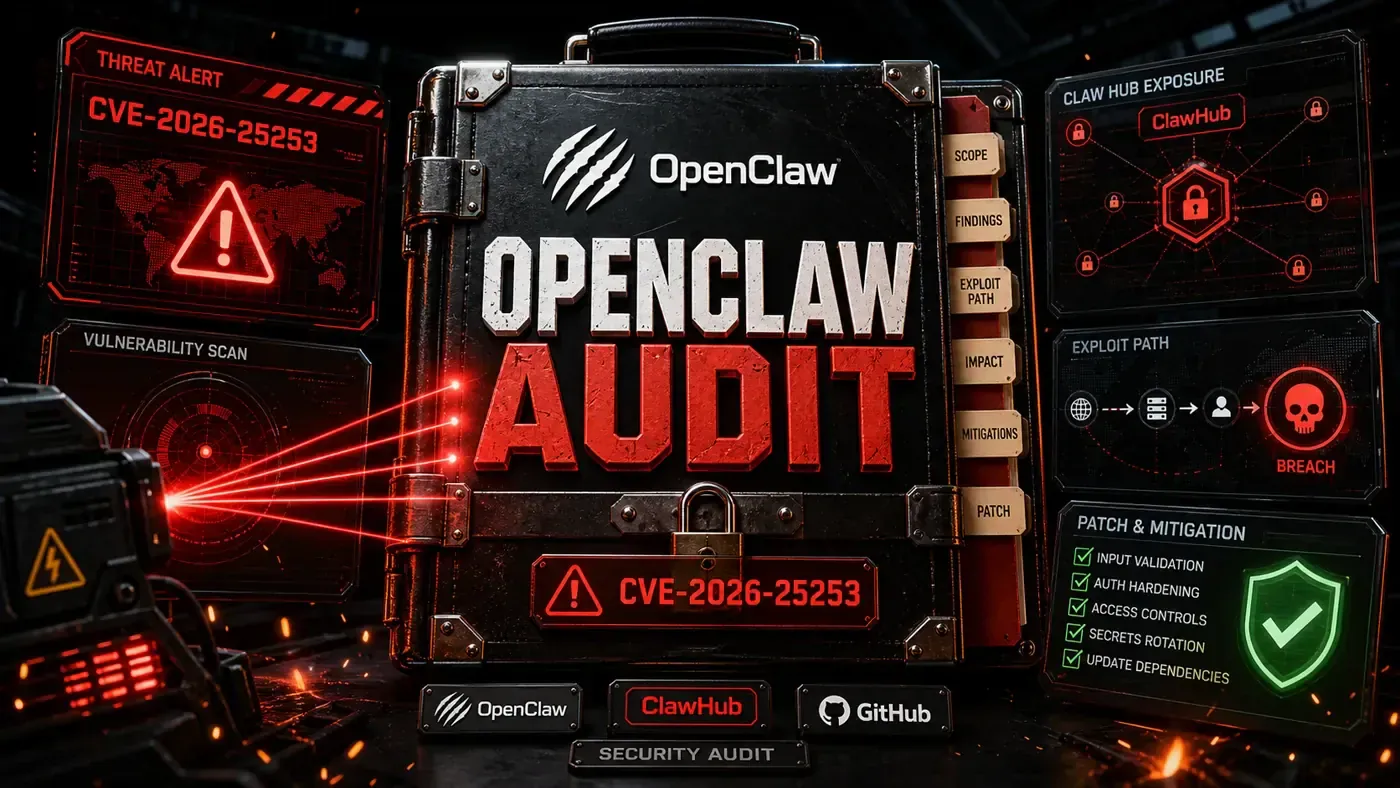
Automated Scanning: Uploaded skills are scanned for malware, secrets, and known vulnerabilities. This part is real, reporting from Penligent (opens in a new tab) describes VirusTotal scanning and static analysis on submissions. The context matters, though. A lot of that hardening came in response to a supply-chain scare, with more than 1,184 malicious skills reported, so this is less a smoothly engineered system and more a defence that got built in a hurry after things went wrong.
Community Ratings: Users rate skills on reliability, documentation, and usefulness, and poorly rated ones get flagged for review.
Verified Publishers: Trusted authors can earn verified status. Cryptographic publisher attestation, stars, and download counts are confirmed features, per the AllClaw registry overview (opens in a new tab).
Sandbox Testing: The original article said skills run in a sandbox during installation to check they don't do anything unexpected. Sandboxed execution and behavioural monitoring do come up in security write-ups, but a sandbox step running automatically on every install is not clearly an official, universal ClawHub feature, so take that one as reported rather than confirmed.
Audit Trail: Semantic versioning with changelogs and easy rollback is real, which makes it straightforward to spot a bad update and revert to a known-good version.
Enterprise Features
For organisations, the original article described private registries with the following:
- Internal Skills: Publish proprietary skills without exposing them publicly
- Approval Workflows: Require review before skills can be installed
- Usage Analytics: Track which skills are used across teams
- Compliance Scanning: Automatic licence and security compliance checking
- Integration: Sync with private npm registries and Artifactory
A caveat before you plan around any of this: none of these enterprise features could be confirmed against official sources. The openclaw/clawhub repository (opens in a new tab) and the docs we reviewed don't mention private registries, approval workflows, Artifactory sync, or compliance scanning. Security analysts tend to suggest that companies build their own internal trust chain, which hints that these aren't turnkey ClawHub products. If your team needs that kind of control today, assume you may have to build it yourself.
The Steinberger Effect
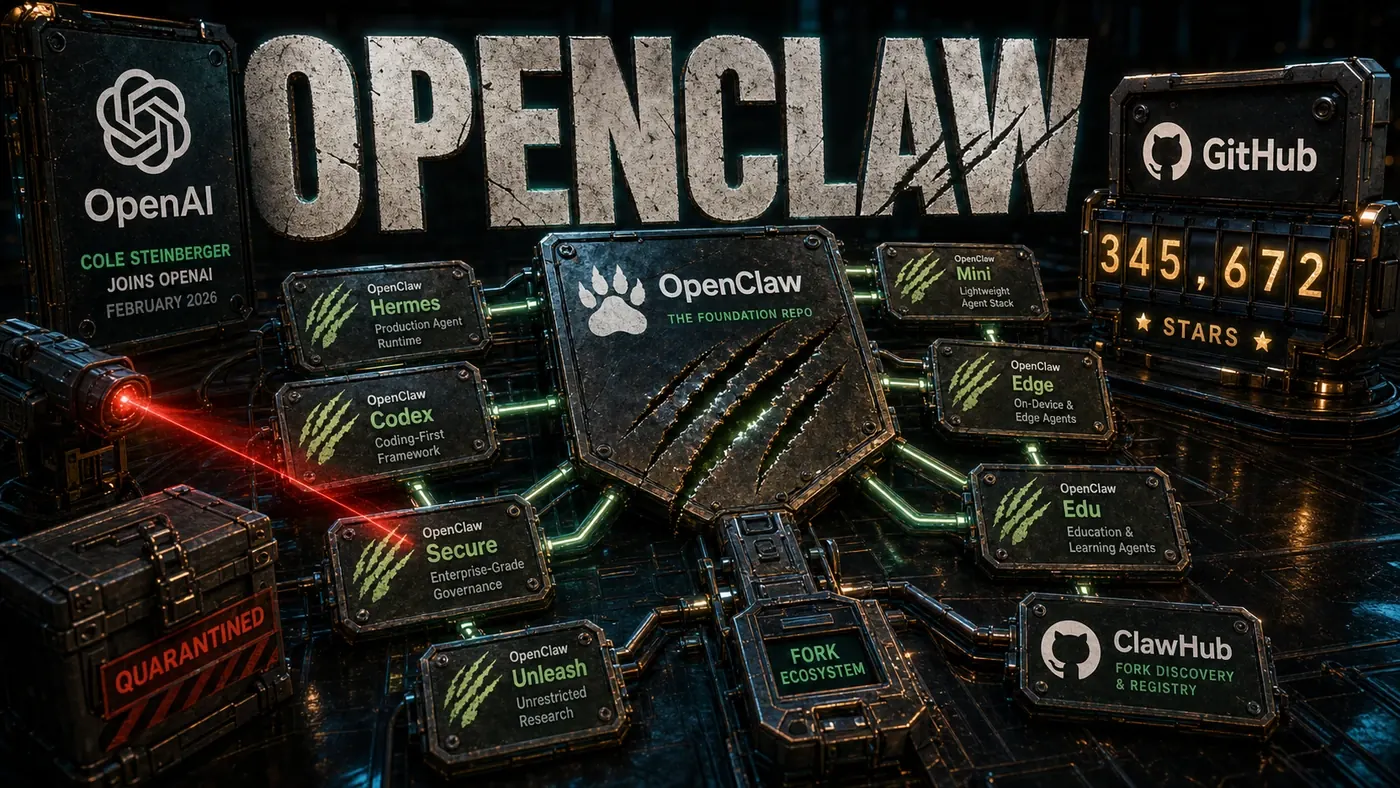
When OpenClaw's founder joined OpenAI in February 2026, people worried about what would happen to ClawHub. Would the marketplace get commercialised? Would the enterprise features end up behind a paywall?
One correction first. The original article named "Cole Steinberger." That's wrong. TechCrunch reported on 15 February 2026 (opens in a new tab) that it was Peter Steinberger, the founder of PSPDFKit, based in Vienna, who joined OpenAI.
The handover went better than people feared. Steinberger's own account (opens in a new tab) confirms OpenClaw was committed to staying open-source, living in a foundation that OpenAI would keep supporting. The original article also described a formalised steering committee with named community representatives running ClawHub governance; that specific structure could not be confirmed, so treat it as unverified. The broad point still holds: a well-run open-source project can survive losing its founder.
Building a Skill
The original article gave this as a sample skill:
import { defineSkill } from '@openclaw/core';

export default defineSkill({
 name: 'hello-world',
 description: 'A simple greeting skill',
 schema: {
 input: {
 name: { type: 'string', description: 'Name to greet' }
 },
 output: { type: 'string' }
 },
 async execute({ name }) {
 return `Hello, ${name}!`;
 }
});
One thing to flag: this code is illustrative, not verified. No source we checked confirms a @openclaw/core package that exports a defineSkill helper. As OpenClaw's skills docs (opens in a new tab) describe, real text-based skills are authored as SKILL.md folders rather than through a TypeScript defineSkill() call. So the sample reads well, but don't expect it to run as-is.
The underlying point is sound either way. A skill can be as small as a single function or as involved as a multi-step workflow with API calls, file operations, and branching logic.
The Future
According to the original article, ClawHub's roadmap covers skill versioning with dependency management, skill composition (skills that call other skills), and a visual builder for people who don't code. There was also talk of a rating-prediction model to help surface good skills before they've built up downloads.
These are forward-looking plans, not shipped features. Semantic versioning already exists, but dependency management, composition, the visual builder, and the prediction model are unconfirmed roadmap items rather than things you can use today.
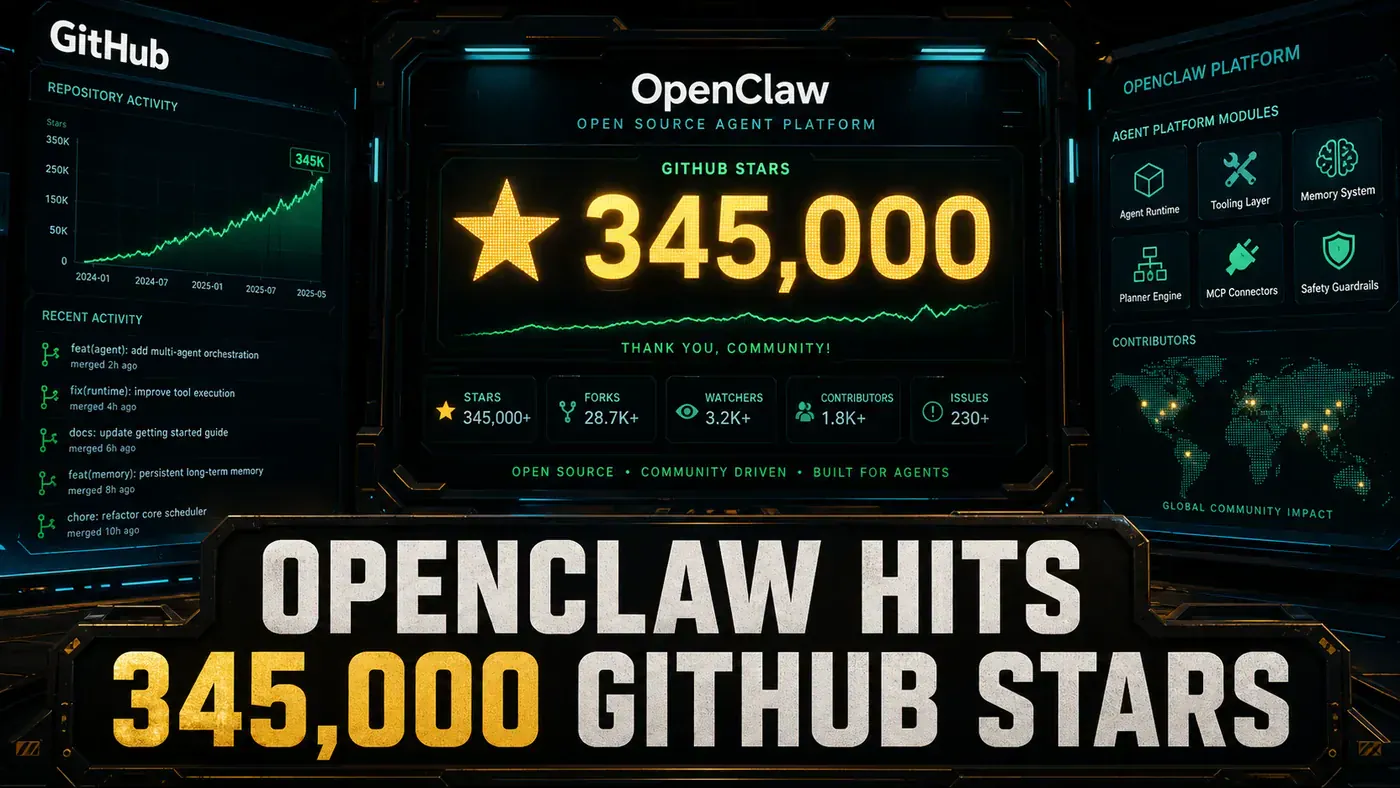
OpenClaw has reached roughly 345,000 GitHub stars (opens in a new tab), and ClawHub is a big part of why. The framework on its own is useful. The registry around it is what makes it a platform, and that gap is worth paying attention to if you're weighing it up for your own team.
OpenClaw's ClawHub: answer-first summary
OpenClaw's ClawHub matters because it can change how Founders and operators plan, build, or govern an agent workflow. How ClawHub became the npm of AI agent skills, with thousands of community-contributed capabilities and a thriving developer economy.
The direct answer is this: do not treat the topic as a standalone trend. Treat it as a decision about inputs, outputs, review ownership, data exposure, and whether the workflow produces a result that is faster, safer, or more useful than the current process.
OpenClaw's ClawHub: implementation checklist
- Define the user, job to be done, and success metric for the agent workflow.
- Collect real examples, policies, source files, customer questions, or search queries before writing prompts or choosing tools.
- Separate low-risk drafts from decisions that need approval, privacy checks, or senior review.
- Document what the AI is allowed to access, what it must not access, and who signs off before production use.
- Review successful task completion, review time, fallback rate, operator corrections after a small pilot rather than judging the idea from a demo.
This keeps the work practical. It also gives search engines and AI answer engines a clean factual structure: what the topic is, who it helps, what to do next, and which risks matter before implementation.
Decision criteria for OpenClaw's ClawHub
| Decision area | What to check | Production signal |
|---|---|---|
| Intent | Does OpenClaw's ClawHub solve a real workflow problem? | The use case has a named owner and measurable outcome. |
| Data | Can the required data be used safely? | Sensitive data is classified and access is controlled. |
| Quality | Can a reviewer judge the output consistently? | Examples, rubrics, or acceptance criteria exist. |
| Scale | Can the workflow be repeated without hero effort? | The process is documented and can be handed to another team member. |
Practical example for OpenClaw's ClawHub
A small business could use this article to choose one practical test. For example, a manager might take one customer-facing process, one internal document workflow, or one recurring content task and redesign only that step with AI support. The goal is not to automate the whole business at once; it is to learn where AI News creates reliable leverage.
The useful deliverable is a short operating note: the trigger, the source material, the prompt or tool, the review checklist, the escalation rule, and the metric. That note becomes the handover asset for staff training, SEO/GEO content, service delivery, or future agent work.
Risks and controls for OpenClaw's ClawHub
The common failure pattern is moving too quickly from a promising idea into an unmanaged workflow. For OpenClaw's ClawHub, the risk is not only bad output. It can also be unclear data permission, staff confusion, duplicate content, unreviewed customer advice, or a tool that quietly changes cost or capability.
- Control unclear tool permissions with a named owner, a review step, and written acceptance criteria.
- Control silent failures with a named owner, a review step, and written acceptance criteria.
- Control prompt drift with a named owner, a review step, and written acceptance criteria.
- Control weak audit trails with a named owner, a review step, and written acceptance criteria.
Measurement plan for OpenClaw's ClawHub
A useful AI or SEO initiative should leave evidence. Track successful task completion, review time, fallback rate, operator corrections and compare the pilot against the current process. If the measure does not improve, keep the learning but avoid scaling the workflow.
For GEO readiness, the page should also answer the core question directly, define the entities involved, include implementation steps, explain tradeoffs, and link readers to the next relevant AI Kick Start service, guide, tool, or article.
Definitions and entities for OpenClaw's ClawHub
For search, GEO, and staff handover, define the core entities in plain language. In this article the important entities are the workflow owner, the AI tool or model, the source material, the review process, the risk boundary, and the measurable business outcome. Clear definitions make the page easier for people to scan and easier for AI answer engines to quote accurately.
- Workflow owner: the person accountable for deciding whether OpenClaw's ClawHub belongs in the business process.
- Source material: the documents, examples, policies, URLs, prompts, videos, or customer questions that ground the output.
- Review boundary: the point where a human checks accuracy, privacy, brand voice, or customer impact before the result is used.
- Success metric: the measure that proves whether the agent workflow is worth repeating.
OpenClaw's ClawHub versus doing nothing
Doing nothing is also a decision. The cost may be slow manual work, weaker search visibility, inconsistent advice, duplicated effort, or staff using unmanaged AI tools without a shared process. The practical question is whether a controlled pilot can reduce that cost without creating a larger governance problem.
| Option | When it makes sense | What to watch |
|---|---|---|
| Do nothing | The workflow is rare, low value, or already reliable. | Competitors may improve speed, content depth, or service consistency first. |
| Run a small pilot | The task repeats often and has clear review criteria. | Keep scope tight and measure the result against the current process. |
| Build a production workflow | The pilot is repeatable and risk controls are documented. | Assign ownership, monitoring, training, and a rollback path. |
AI Kick Start handover package for OpenClaw's ClawHub
A production handover should be concrete enough that another person can run it. For OpenClaw's ClawHub, that means a short brief, a workflow map, approved prompts or tool settings, source material, a review checklist, internal links to supporting resources, and a simple measurement sheet. This is the difference between reading about AI and turning it into operational capability.
That packaging also strengthens E-E-A-T. It shows experience through implementation notes, expertise through decision criteria, authoritativeness through source-aware structure, and trust through risks, controls, and review steps. The article becomes useful even if the reader never buys a tool because it helps them make a better operational decision.