
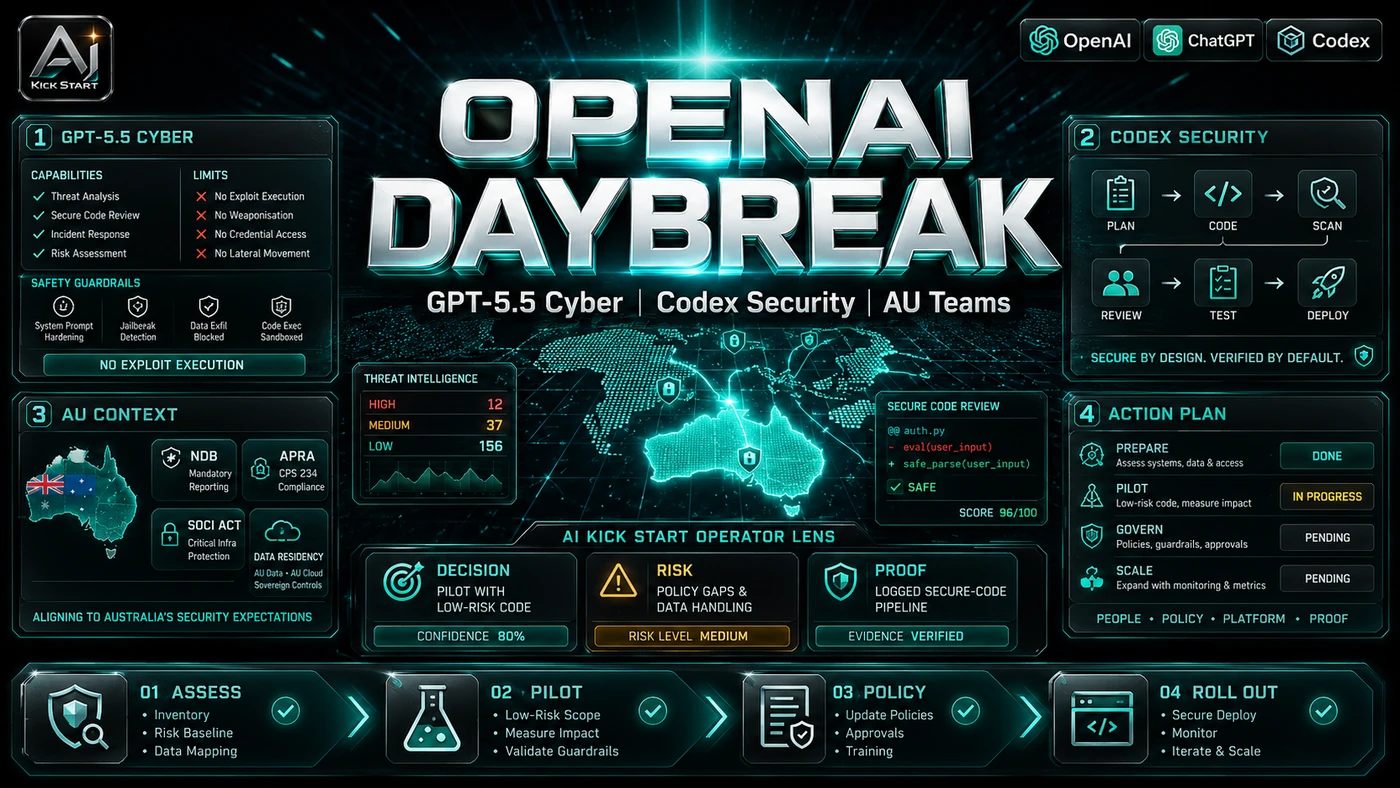


Introduction: Why This One Belongs on the Watchlist
OpenAI's June 2026 Daybreak announcement moves the conversation from "AI can find bugs" to "AI can find, validate and help patch bugs inside your existing workflow." The reason it matters for AI Kick Start readers is practical: this is not just another launch to admire from a distance. It changes how founders, operators, and technical teams should think about AI Implementation & Security work over the next few months. The source transcript repeatedly centres on Codex Security, GPT‑5.5‑Cyber and Trusted Access for Cyber, with the video framing the topic as a practical workflow rather than a detached product announcement. That is the useful lens. The video is worth treating as implementation intelligence: what should be tested, what should be ignored for now, and what should become part of a repeatable operating system. For Australian small businesses and technical teams, the right question is not "is this impressive?" The right question is "where does this reduce friction without creating a larger governance, security, or maintenance problem?"
What the Video Actually Shows
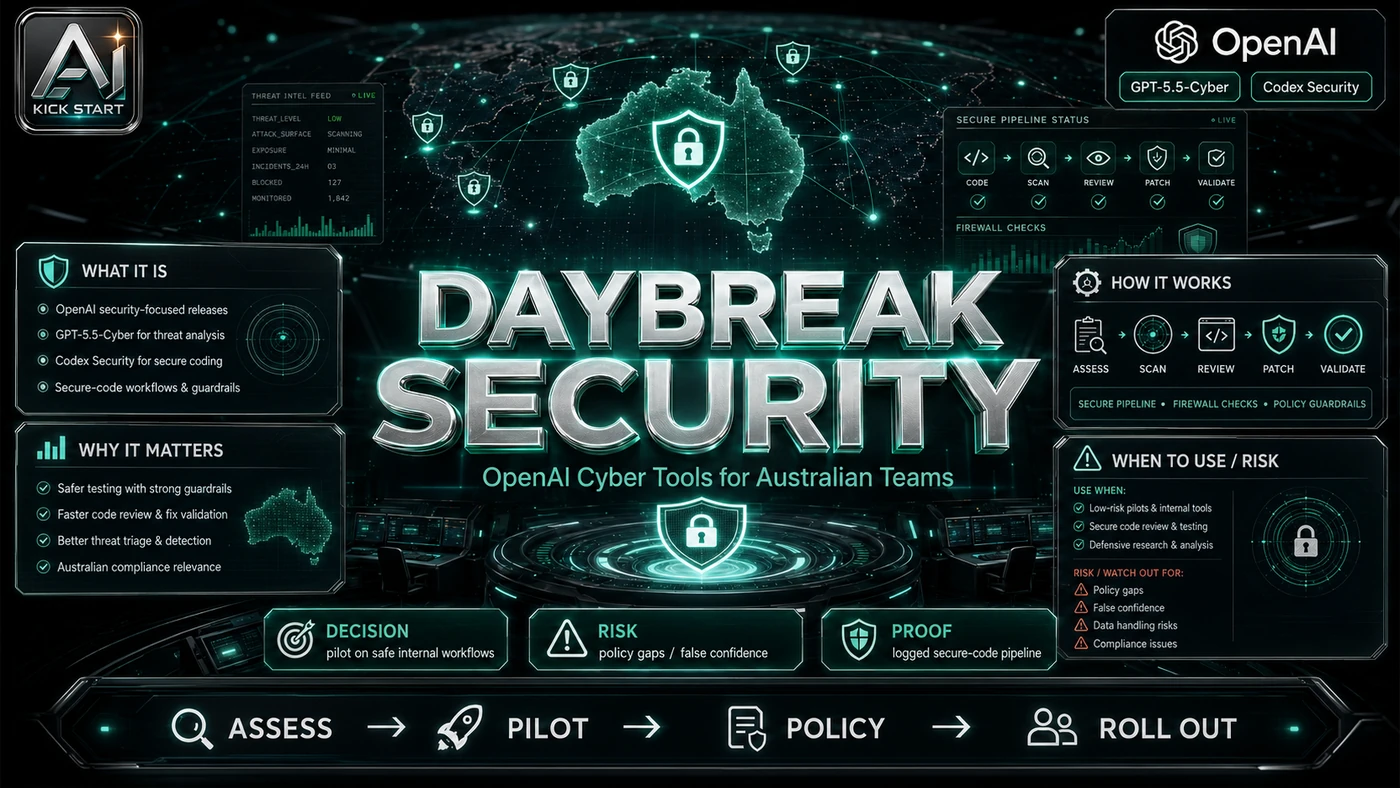
The core pattern is simple: discover vulnerabilities, validate that they are real and reachable, generate a patch, export the finding into existing tooling, and keep a human as the final approval gate. The BoxminingAI/Superbash video (host Ron) walks through Codex Security, GPT‑5.5‑Cyber for verified defenders, the Cyber Partner Program and Patch the Planet with Trail of Bits. In practice, that means the update sits inside a broader shift from isolated AI prompts to managed systems. A tool, model, or method only becomes valuable when it has clear inputs, a measurable output, a review path, and a way to repeat the result next week. The video's most useful signal is the workflow shape. The moving parts can be summarised as: Findings engine Validation loop Patch generator Export and review That is the level at which teams should evaluate it. A demo can be entertaining, but a workflow must survive messy source files, staff handoff, data boundaries, and real deadlines.
The Implementation Pattern
The first implementation lesson is to narrow the scope. Start with one codebase, one vulnerability class and one release cycle. Broad adoption is usually where AI systems fail first because nobody knows which decision the tool is allowed to make and which decision still belongs to a human. The second lesson is to create a test harness. Every AI-generated patch needs a reproduction case and a regression test before it is trusted. A useful harness does not have to be complicated. It can be a short brief, a fixed sample dataset, a few expected outputs, and one person responsible for judging whether the result is good enough. The third lesson is to capture the process. Document how the scan is run, how findings are triaged, how patches are produced, and how merge approval is granted. When the process is documented, it can become a reusable skill, checklist, prompt pack, repo pattern, or operating procedure. When it is not documented, the team is back to improvising in chat.
Research Update: What To Correct
This update adds a current-source pass rather than treating the original video summary as enough. The important corrections are the product surface, plan or pricing constraints, and what should be verified before a team depends on the workflow. The claim that "Mythos hacked the NSA's entire database" is an oversimplification: the reported exercise involved assumed initial access inside a controlled environment, not a live breach. The 30M commits, 30K codebases, 70K reviewer-marked fixes and 500K automatically determined fixes refer to Codex Security's research preview since March 2026, not GPT‑5.5‑Cyber alone. GPT‑5.5‑Cyber's 85.6% on CyberGym beats Mythos 5's 83.8% and GPT‑5.5's 81.8%, but CyberGym measures known vulnerabilities in controlled environments and other results are self-reported. Access is gated through Trusted Access for Cyber; for most teams, the entry point is GPT‑5.5 with Trusted Access plus Codex Security. Patch the Planet is a maintainer-consultation model, not a public bug-bounty fire hose.
Practical Setup and How-To
The useful next step is a controlled pilot with a named owner, fixed inputs, a measurable output, and a review point. Use the sequence below as the first implementation path before expanding the workflow. Start with what you can access: experiment with GPT‑5.5 and Codex through ChatGPT Plus/Pro or the API, while Codex Security and GPT‑5.5‑Cyber require a sales conversation. Request Daybreak or Trusted Access for Cyber, explaining your authorised defensive work and review process. Integrate defensively: run Codex Security against a non-production branch or read-only mirror, export SARIF results into your existing scanner workflow, and compare findings against Snyk, Semgrep, CodeQL or whatever you already run. Build the review gate before the automation: decide who validates a patch, writes the regression test, approves merge and owns disclosure for upstream findings. Document the prompt and scaffold, not just the patch.
Pricing, Access, and Comparison Notes
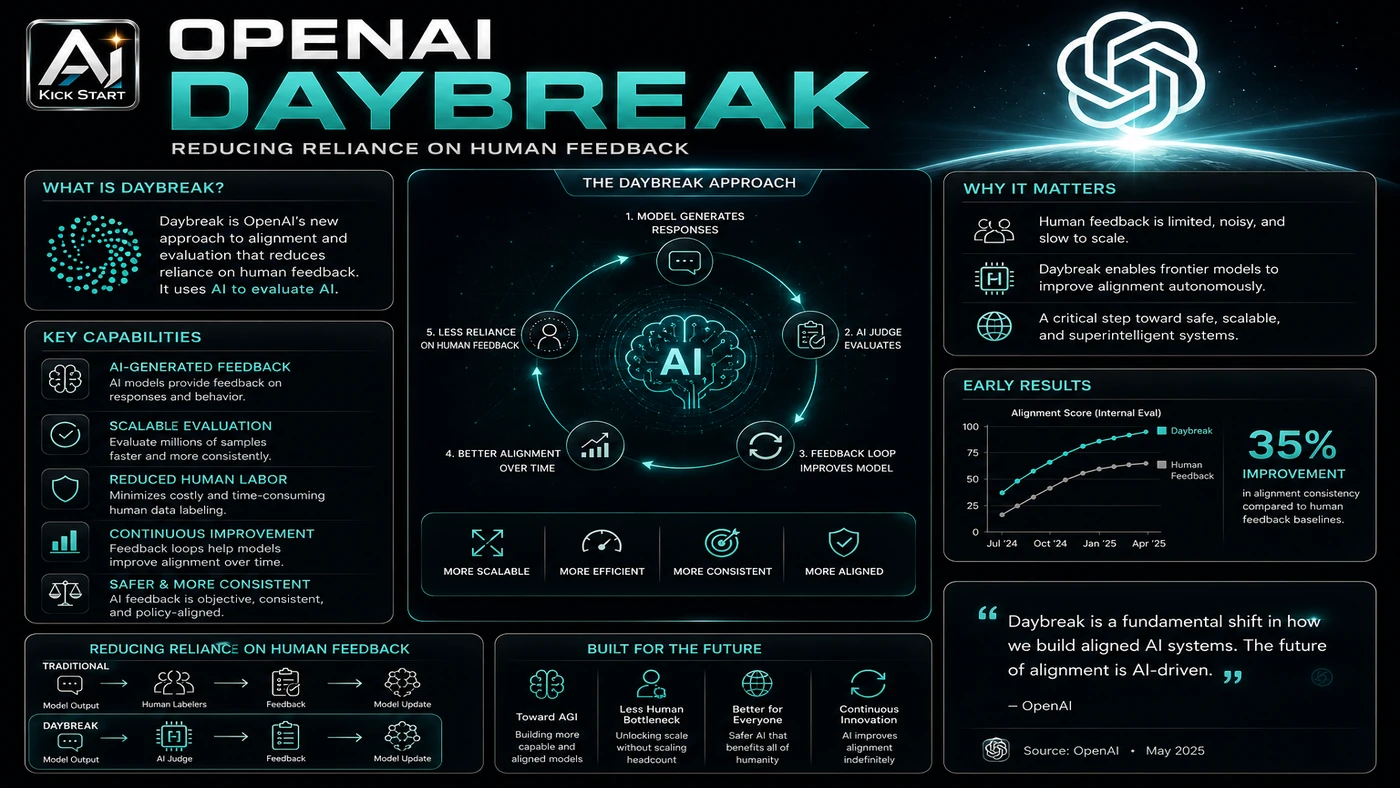
Pricing and access should be checked at implementation time because AI products change quickly. The safer decision is to compare the tool against the job-to-be-done, not against launch hype. OpenAI has not published public pricing for Daybreak, Codex Security or GPT‑5.5‑Cyber; access is via sales consultation and the Trusted Access for Cyber verification process. ChatGPT Plus ($20/month) and Pro ($100–$200/month) include Codex for general coding assistance, but this is not the Codex Security plugin. OpenAI API pricing as of mid-2026 is roughly $5/$30 per million tokens for GPT‑5.5 and $1.75/$14 for GPT‑5.3‑Codex. Anthropic's Mythos, Fable and Project Glasswing remain comparators, but as of late June 2026 the models remain offline under US export-control pressures. SAST/DAST scanners such as Snyk, Semgrep, CodeQL, Dependabot, Trivy and OWASP ZAP remain the workhorses; treat Daybreak as a layer above them, not a replacement. Access Plan, preview status, region, account type, admin controls, and rate limits. Cost Subscription, credits, API tokens, retries, hardware, review time, and support burden. Fit Workflow reliability, data handling, output quality, observability, and human approval needs.
Implementation Notes for Teams
For AI Kick Start readers, this is the production filter: keep the first rollout narrow, make the evidence visible, and do not let the tool cross a business boundary until the review model is clear. Run a narrow pilot: pick one codebase, one vulnerability class and one release cycle, then measure time from finding to merged patch, false-positive rate, and reviewer load. Keep a test harness: every AI-generated patch needs a reproduction case and a regression test; if the model cannot produce or pass both, it does not ship. Scope access tightly: use read-only permissions until you understand the tool's behaviour, and avoid giving any autonomous agent write access to production repositories or secrets. Add a disclosure policy before scanning upstream dependencies and train reviewers before scaling.
Screenshot and Visual Guidance
The second inline image for this article should make the implementation concrete: a Codex Security scan view showing severity-ranked findings, affected code locations, validation evidence, a generated patch pane and a human approval step, with SARIF/CodeQL export paths visible. OpenAI's announcement includes screenshots of Codex Security scans across a codebase, subset, or commit, with SARIF and CodeQL export. If the team is documenting a real rollout, capture setup screens, before/after outputs, permission settings, cost meters, and review evidence rather than decorative screenshots.
Where It Fits for Real Teams
For founders, the opportunity is speed with evidence. This kind of workflow can reduce the time between idea and first useful output, but it should still produce artefacts that a customer, manager, or developer can inspect. For operators, the value is consistency. If the same task is done slightly differently every time, AI can either make the inconsistency worse or help standardise the path. The difference is whether the workflow has rules, examples, and review checkpoints. For technical teams, the value is leverage. A strong setup lets agents, models, or creative systems take on repeatable work while engineers keep control over architecture, security, deployment, and final judgement. Daybreak fits security teams with mature vulnerability management, organisations with large dependency trees and teams already in the OpenAI/Codex ecosystem. It is a poor fit for teams lacking reviewer bandwidth or hoping for a cheap, self-serve security magic wand. The practical fit is strongest when the task has clear source material, a known output format, and a low-cost way to verify quality. It is weaker when the task is vague, politically sensitive, legally risky, or dependent on facts that cannot be checked.
Trade-offs and Risks
The main risk is dual-use capability. The same model that helps defenders patch can, in principle, help attackers find and exploit. That risk can be managed, but only if it is named before the workflow becomes normal. A second risk is false positives and reviewer fatigue. Trail of Bits explicitly notes that frontier models produce a high volume of false positives, and without a human filter you will drown maintainers and engineers in noise. AI systems often look better in a screen recording than they feel inside a production workflow. The test is whether the result is repeatable when the source material changes, the operator changes, and the deadline is real. A third risk is vendor lock-in, access uncertainty and patch quality. Pricing is opaque, access is discretionary, policy is shifting, and a patch that passes a test in isolation can still break semantics, performance or downstream consumers. This is why AI Kick Start generally recommends a staged rollout: sandbox first, internal use second, customer-facing deployment last. A fourth risk is governance inconsistency: the uneven treatment of GPT‑5.5‑Cyber versus Mythos/Fable is a live policy question, not a basis for procurement.
The Next Sensible Test
The next sensible test is a small controlled implementation. Pick one workflow, one owner, one expected output, and one acceptance check. Run it twice. If the second run is easier than the first, the pattern is worth keeping. Do not judge the workflow by the best possible demo. Judge it by the worst acceptable production case. The right experiment is a controlled comparison: take a recent CVE or a known vulnerable dependency in a non-production codebase, run your existing SAST/dependency scanner, run Codex Security or a GPT‑5.5‑based harness, and compare time-to-validated-patch, false-positive rate and reviewer effort. Do not measure benchmark scores. Measure whether a realistic fix lands safely in your workflow. Ask: what happens when the source file is incomplete, the tool is unavailable, the output is wrong, or a staff member needs to explain the result to a customer? If those answers are clear, this belongs in the roadmap. If they are not, it belongs in the lab until the operating model catches up.