







Briefing
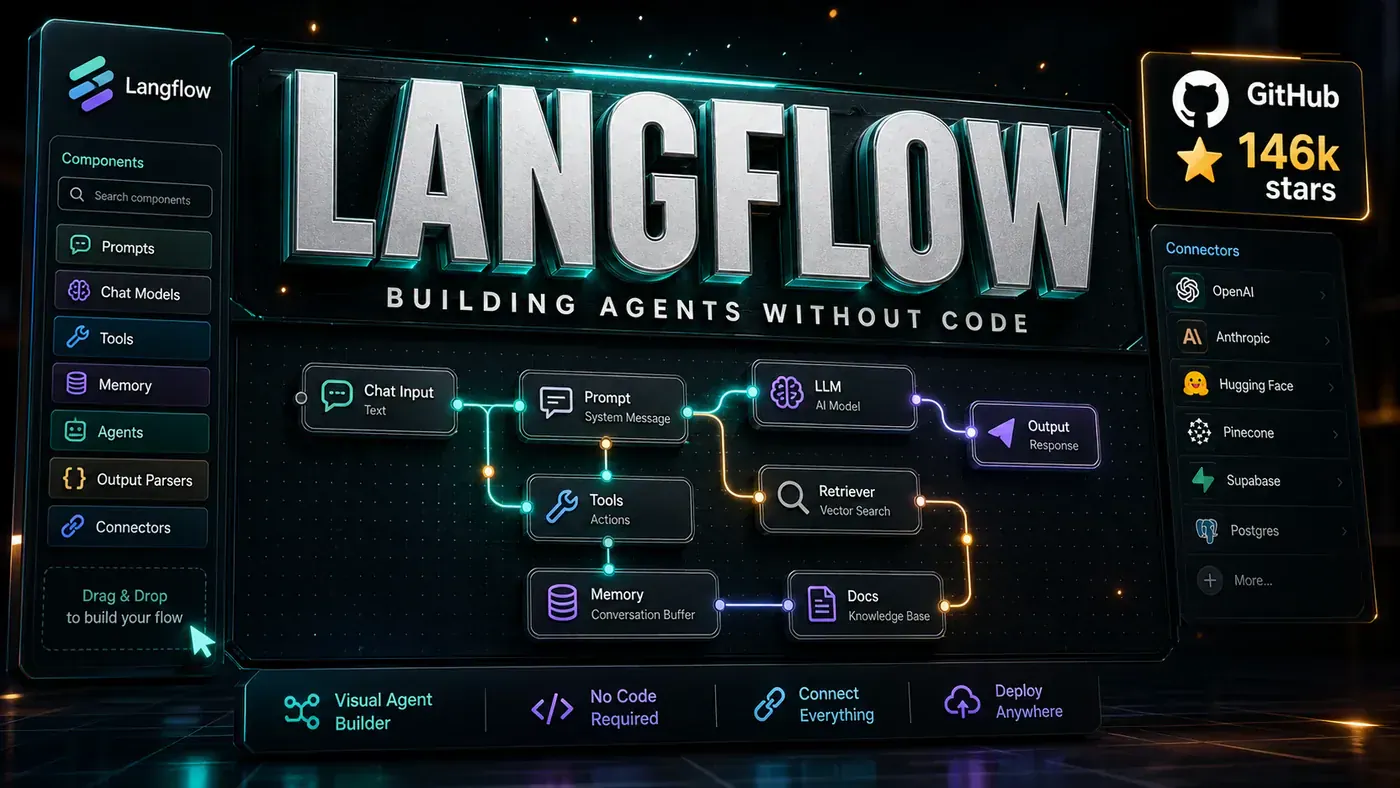
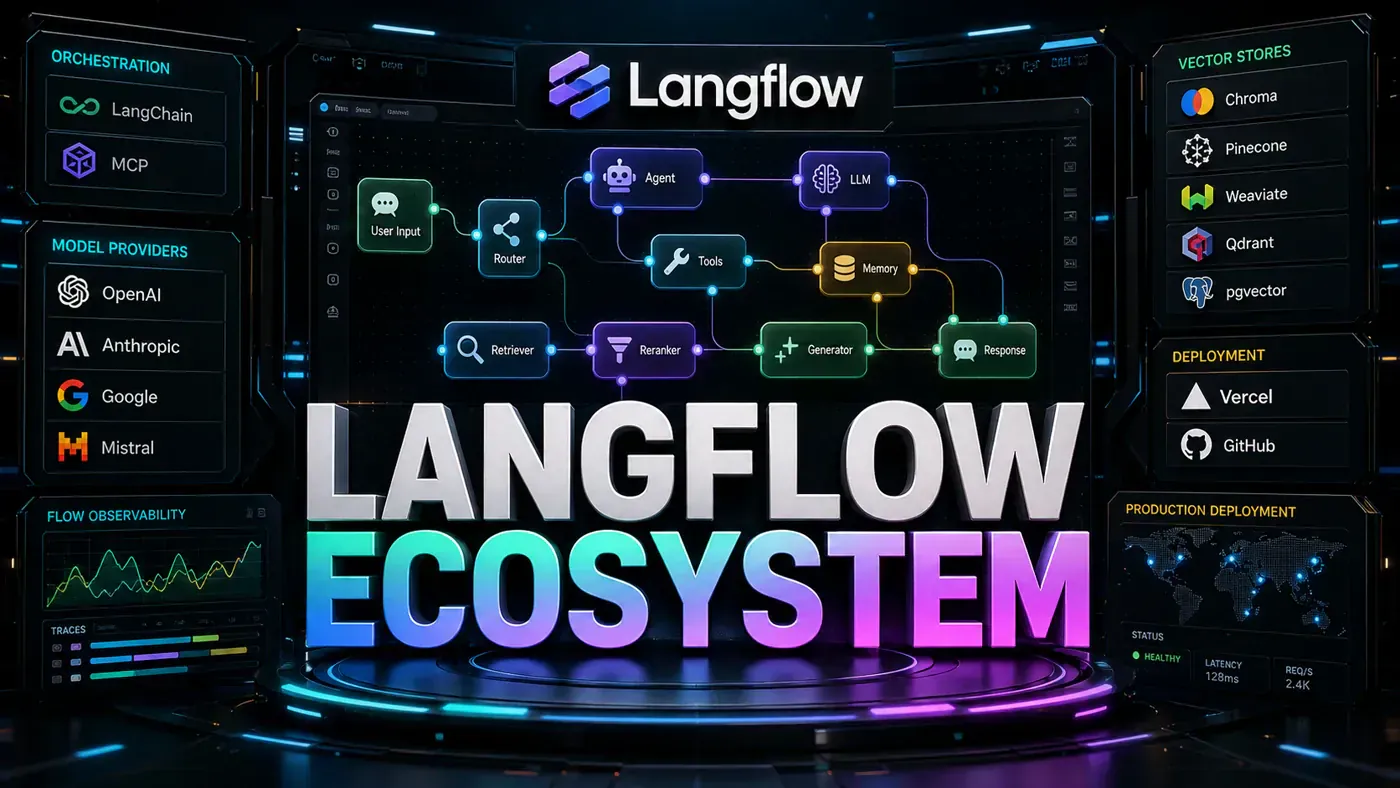
Langflow (opens in a new tab) has collected somewhere around 146,000 GitHub stars, putting it among the most-starred open-source projects in the AI agent space (its repo now reads closer to 150,000). But the star count is the least interesting thing about it. What's actually grown up around the project is the story worth telling: a library of drag-and-drop components, a busy community of people swapping flows, and a steady creep into corporate IT departments.
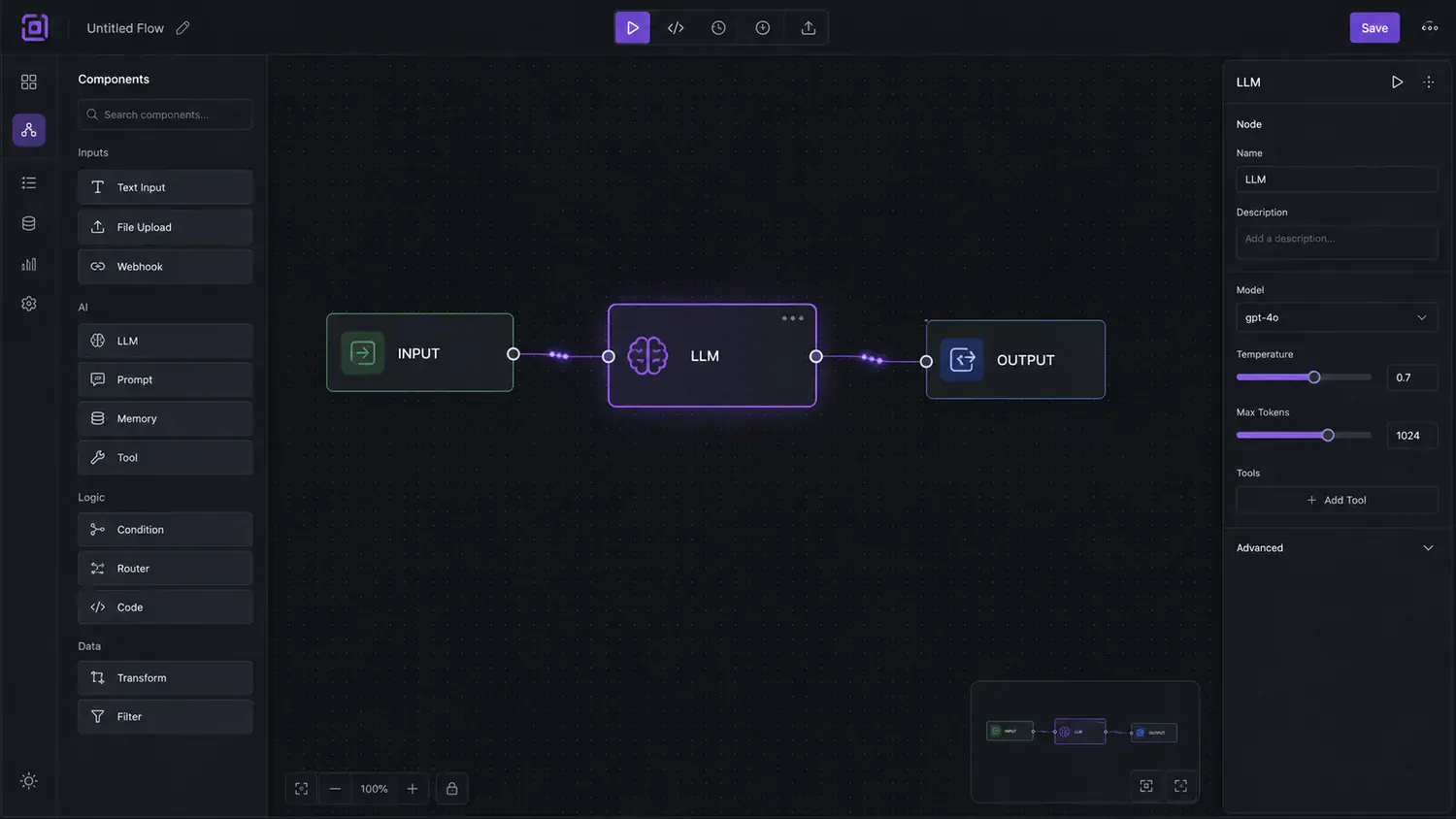
The pitch is simple enough that a business analyst can grasp it in a sentence. Instead of writing Python to wire up an AI agent, you drag boxes onto a screen and draw lines between them. The picture you end up with is the agent. For teams that want to test an idea without booking a developer for two weeks, that changes the maths.
Below is how the pieces fit together, what holds up under scrutiny, and where the marketing gets ahead of the facts. A few of the numbers that get thrown around about Langflow are hard to confirm, so I've flagged those rather than repeat them as gospel.
The Core: Visual Building
The thing Langflow is built around is a visual, node-based editor (opens in a new tab) for building agent workflows. You drag components onto a canvas and connect them with edges. What you get is a flowchart that runs as a working agent.
A few things follow from that:
- Accessibility: People who don't code can still build agents
- Rapid prototyping: An idea can be a working agent inside a few minutes
- Collaboration: A visual flow is easier to talk through and review than a wall of code
- Documentation: The flow is the documentation
The Component Marketplace
Langflow ships with hundreds of built-in components, and the ecosystem goes well past what's in the box:
Official Components: Maintained by the Langflow team. Solid, documented, and guaranteed to keep working. Covers the major LLM providers, database connectors, and the common tools.
Community Components: Submitted by users, checked by moderators. This is where the niche stuff lives, odd integrations, experiments, tools built for one industry.
Enterprise Components: Proprietary pieces shared inside a single company. Usually internal API connectors and custom business logic.
Third-Party Marketplaces: Independent sites that curate and hand out Langflow components, some of them charging for the good ones.
Key Integration Partners
A lot of Langflow's pull comes from how deep its integrations run:
LangChain: Langflow is built on LangChain, which hands it the LangChain ecosystem. In practice most LangChain components show up as visual nodes, though newer Langflow versions have moved toward native and MCP-based components, so the "everything from LangChain just works" line is more aspiration than guarantee.
LangSmith: Observability and debugging for flows running in production. Trace what executed, watch performance, and find the slow spots.
Vector Databases: Native support for Pinecone, Weaviate, Chroma, pgvector, Qdrant (opens in a new tab) and more.
LLM Providers: OpenAI, Anthropic, Google, Cohere, Mistral (opens in a new tab), and a long list of others reachable through LiteLLM.
Cloud Platforms: One-click deployment to AWS, GCP, Azure, and Vercel.
Enterprise Adoption
The visual approach has landed especially well inside larger companies:
Citizen Developers: Business analysts and domain experts build agents without waiting on engineering. IT sets the guardrails; the business builds inside them.
Rapid POCs: Proof-of-concepts that used to eat weeks now take days. A visual flow is quicker to assemble and easier to put in front of a stakeholder.
Documentation and Compliance: A visual flow doubles as an audit trail. A compliance team can see what an agent does without reading a line of code.
Training: New hires read a visual flow faster than they read code, so the time it takes to get someone building agents drops.
The Community
Langflow's community is one of the more active in the agent world:
- Discord: A reportedly large server, figures of 50,000+ members get cited, though the live count isn't publicly verifiable, where people share flows, ask questions, and help each other out
- YouTube: Hundreds of tutorials from community creators
- Templates: Shared flow templates for the common jobs
- Hackathons: Regular events that throw off new flows and new components
- Enterprise User Group: Quarterly meetings where enterprise users compare notes
Education and Resources
The wider ecosystem comes with a fair amount of learning material:
- Documentation: Thorough docs (opens in a new tab) with examples and API references
- Academy: Structured courses, beginner to advanced (the formal "Academy" offering isn't independently confirmed)
- Cookbook: Copy-paste recipes for the patterns you hit often
- Blog: Regular posts on new features, practices, and community work
- Certification: A professional certification programme is mentioned, though it couldn't be independently verified as currently running
By The Numbers
- ~146,000 GitHub stars, among the most popular visual agent builders, with the repo (opens in a new tab) now reading closer to 150,000
- 500+ components in the ecosystem (an advertised figure, not independently confirmed)
- 50,000+ Discord members (cited but unverifiable)
- 10,000+ shared flows in the community gallery (unconfirmed)
- Fortune 500 adoption across several industries (reported; no public customer list located)
- MIT License, fully open source (note: Langflow is MIT-licensed, not Apache 2.0 as is sometimes claimed)
The Roadmap
A quick correction is in order here, because the older framing of an "upcoming v1.0" is out of date. Langflow is well past v1.0, the latest release is 1.10.0, out 9 June 2026 (opens in a new tab), following 1.8 in March and 1.9 in April. Features that have been floated for future releases include faster flow execution, real-time collaboration, Git-based version control, a testing framework, a mobile app for monitoring flows, and a second-generation marketplace. Treat those as direction-of-travel rather than confirmed shipping dates; none are tied to a documented "v1.0" the way older write-ups suggest.
Why It Works
Langflow's success is mostly about meeting people where they are. Not everyone writes Python. Not everyone wants to. A visual interface that still produces real, deployable code works for the non-technical user and for the developer who just wants to move quickly.
The star count points at a real gap in the market, and for now Langflow is filling it more convincingly than the alternatives.
The Langflow ecosystem: answer-first summary
The Langflow ecosystem matters because it can change how Founders and operators plan, build, or govern an agent workflow. How Langflow's 146k stars power an ecosystem of visual agent development that's transforming how teams build AI applications.
The direct answer is this: do not treat the topic as a standalone trend. Treat it as a decision about inputs, outputs, review ownership, data exposure, and whether the workflow produces a result that is faster, safer, or more useful than the current process.
The Langflow ecosystem: implementation checklist
- Define the user, job to be done, and success metric for the agent workflow.
- Collect real examples, policies, source files, customer questions, or search queries before writing prompts or choosing tools.
- Separate low-risk drafts from decisions that need approval, privacy checks, or senior review.
- Document what the AI is allowed to access, what it must not access, and who signs off before production use.
- Review successful task completion, review time, fallback rate, operator corrections after a small pilot rather than judging the idea from a demo.
This keeps the work practical. It also gives search engines and AI answer engines a clean factual structure: what the topic is, who it helps, what to do next, and which risks matter before implementation.
Decision criteria for The Langflow ecosystem
| Decision area | What to check | Production signal |
|---|---|---|
| Intent | Does The Langflow ecosystem solve a real workflow problem? | The use case has a named owner and measurable outcome. |
| Data | Can the required data be used safely? | Sensitive data is classified and access is controlled. |
| Quality | Can a reviewer judge the output consistently? | Examples, rubrics, or acceptance criteria exist. |
| Scale | Can the workflow be repeated without hero effort? | The process is documented and can be handed to another team member. |
Practical example for The Langflow ecosystem
A small business could use this article to choose one practical test. For example, a manager might take one customer-facing process, one internal document workflow, or one recurring content task and redesign only that step with AI support. The goal is not to automate the whole business at once; it is to learn where AI News creates reliable leverage.
The useful deliverable is a short operating note: the trigger, the source material, the prompt or tool, the review checklist, the escalation rule, and the metric. That note becomes the handover asset for staff training, SEO/GEO content, service delivery, or future agent work.
Risks and controls for The Langflow ecosystem
The common failure pattern is moving too quickly from a promising idea into an unmanaged workflow. For The Langflow ecosystem, the risk is not only bad output. It can also be unclear data permission, staff confusion, duplicate content, unreviewed customer advice, or a tool that quietly changes cost or capability.
- Control unclear tool permissions with a named owner, a review step, and written acceptance criteria.
- Control silent failures with a named owner, a review step, and written acceptance criteria.
- Control prompt drift with a named owner, a review step, and written acceptance criteria.
- Control weak audit trails with a named owner, a review step, and written acceptance criteria.
Measurement plan for The Langflow ecosystem
A useful AI or SEO initiative should leave evidence. Track successful task completion, review time, fallback rate, operator corrections and compare the pilot against the current process. If the measure does not improve, keep the learning but avoid scaling the workflow.
For GEO readiness, the page should also answer the core question directly, define the entities involved, include implementation steps, explain tradeoffs, and link readers to the next relevant AI Kick Start service, guide, tool, or article.
Definitions and entities for The Langflow ecosystem
For search, GEO, and staff handover, define the core entities in plain language. In this article the important entities are the workflow owner, the AI tool or model, the source material, the review process, the risk boundary, and the measurable business outcome. Clear definitions make the page easier for people to scan and easier for AI answer engines to quote accurately.
- Workflow owner: the person accountable for deciding whether The Langflow ecosystem belongs in the business process.
- Source material: the documents, examples, policies, URLs, prompts, videos, or customer questions that ground the output.
- Review boundary: the point where a human checks accuracy, privacy, brand voice, or customer impact before the result is used.
- Success metric: the measure that proves whether the agent workflow is worth repeating.
The Langflow ecosystem versus doing nothing
Doing nothing is also a decision. The cost may be slow manual work, weaker search visibility, inconsistent advice, duplicated effort, or staff using unmanaged AI tools without a shared process. The practical question is whether a controlled pilot can reduce that cost without creating a larger governance problem.
| Option | When it makes sense | What to watch |
|---|---|---|
| Do nothing | The workflow is rare, low value, or already reliable. | Competitors may improve speed, content depth, or service consistency first. |
| Run a small pilot | The task repeats often and has clear review criteria. | Keep scope tight and measure the result against the current process. |
| Build a production workflow | The pilot is repeatable and risk controls are documented. | Assign ownership, monitoring, training, and a rollback path. |
AI Kick Start handover package for The Langflow ecosystem
A production handover should be concrete enough that another person can run it. For The Langflow ecosystem, that means a short brief, a workflow map, approved prompts or tool settings, source material, a review checklist, internal links to supporting resources, and a simple measurement sheet. This is the difference between reading about AI and turning it into operational capability.
That packaging also strengthens E-E-A-T. It shows experience through implementation notes, expertise through decision criteria, authoritativeness through source-aware structure, and trust through risks, controls, and review steps. The article becomes useful even if the reader never buys a tool because it helps them make a better operational decision.