





Briefing
The dream behind agentic coding is simple to state and hard to deliver: an agent that takes a prompt and ships working software, with nobody touching the keyboard in between. Not a clever autocomplete. A system that builds, checks, and deploys. As of June 2026, we are closer to that than most people realise, and still further away than the marketing suggests. This article walks through exactly where the line sits.
What We Can Do Today
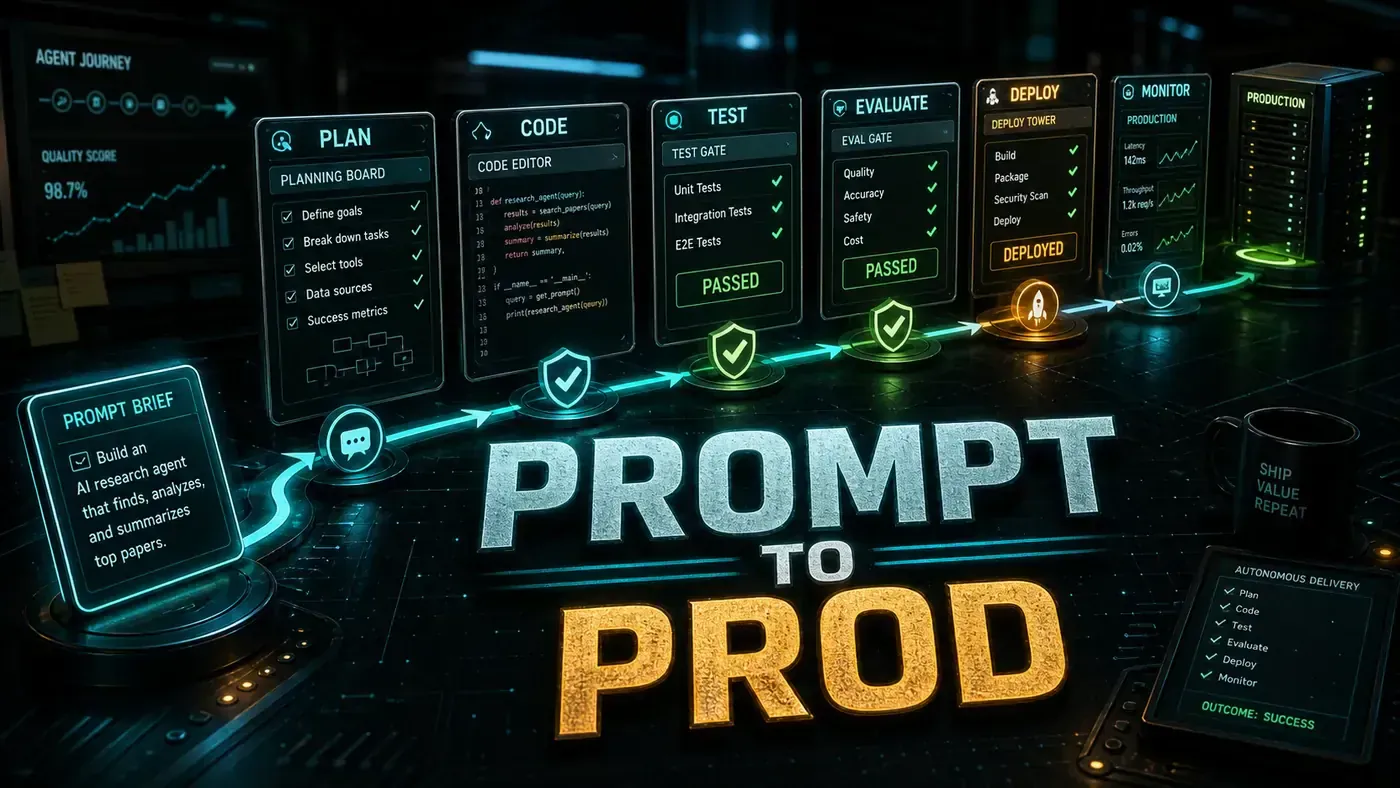
A strong autonomous pipeline in June 2026 looks like this:
[Prompt] -> [Plan Mode] -> [Sub-agent Execution] -> [Verification] -> [Approval Gate] -> [Deploy]Claude Code's Dynamic Workflows (opens in a new tab) running on Opus 4.8 (opens in a new tab) can handle the first four stages for well-scoped work. Give it a prompt like 'Add a billing history endpoint that returns paginated invoices with filters for date range and status', and the agent can:
- Plan: Break the job into schema design, route implementation, controller logic, repository queries, tests, and documentation. Name the dependencies and the risks.
- Execute: Spin up specialist sub-agents for each piece. The API agent designs the endpoint. The database agent writes migrations. The test agent generates coverage.
- Verify: Run compilation, linting, type checking, and the full test suite. Security scan with
npm audit. Check for breaking changes.
- Gate: Hand you a summary: 8 files changed, 4 tests added, 0 breaking changes, estimated review time 5 minutes. Then wait for a human to approve.
- Deploy: Once approved, create a branch, commit in conventional commit format, push, and open a pull request. Teams with enough trust auto-merge when every check passes.
By the author's own estimate, this pipeline handles roughly 60-70% of routine feature work on established codebases. That is not a benchmark figure, but it is genuinely useful in practice.
What We Cannot Do Yet
The other 30-40%, on the author's reckoning, still leans on human judgment that agents cannot stand in for:
Architectural decisions: 'Should we use a message queue or a direct API call?' turns on taste, team context, and non-functional requirements that an agent cannot fully model.
Novel problems: Agents are strong on patterns they have seen before. Genuinely new problems call for creative thinking that current models tend to fumble.
Cross-system coordination: Changes that span several services, teams, or organisations need negotiation and sign-off. An agent cannot run those conversations.
Production incidents: Under time pressure, with symptoms that do not point anywhere clean, a human reads the situation better than agentic reasoning does. Let an agent assist on incidents, but do not let it lead.
Stakeholder communication: Explaining trade-offs to a product manager, winning buy-in for a breaking change, managing expectations. That work is human at the core.
The Trust Gradient
Autonomy is a slider, not a switch:
| Level | Description | Current State |
|---|---|---|
| L0: Assisted | Agent suggests, human decides | Fully available (Copilot (opens in a new tab)) |
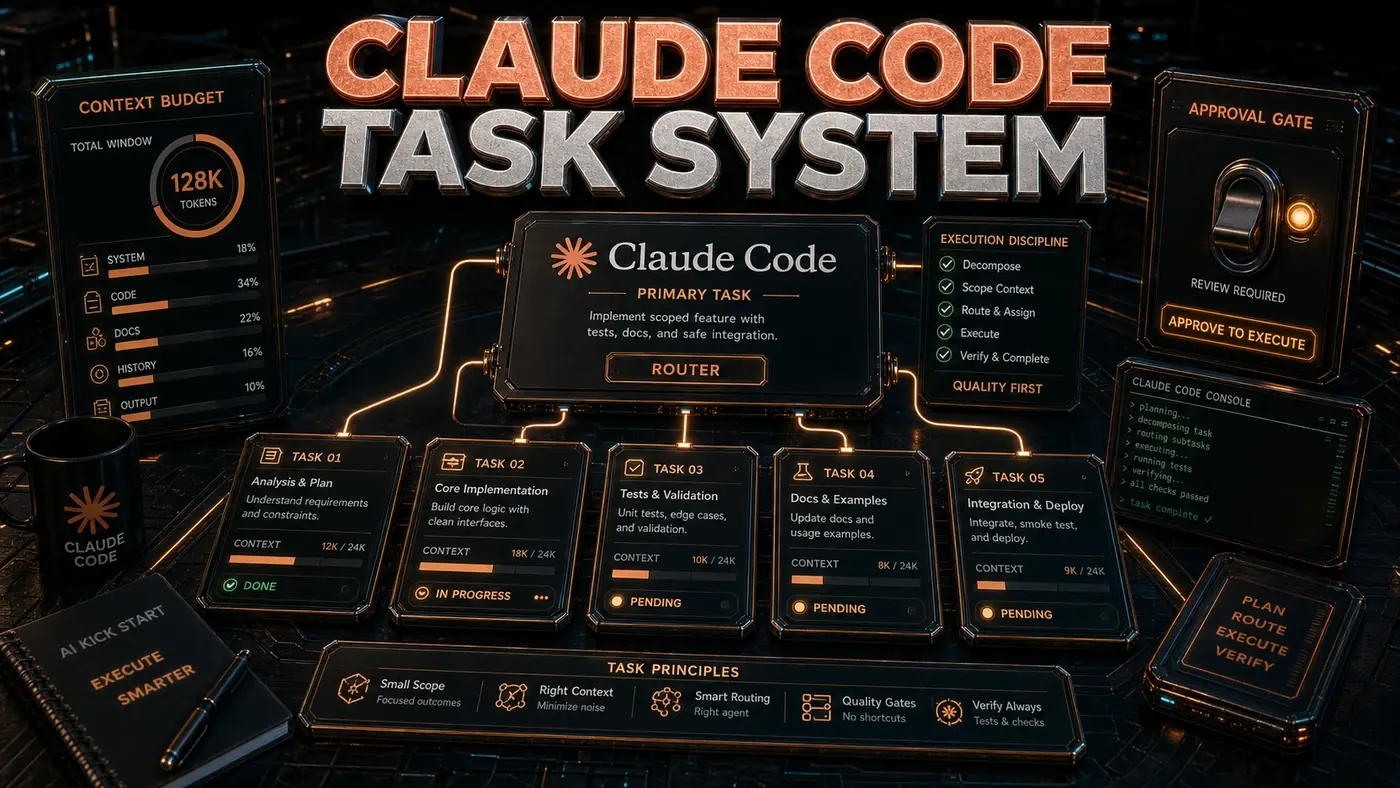
| L1: Delegated | Agent executes routine tasks, human verifies | Production-ready (Claude Code Task System (opens in a new tab)) |
| L2: Supervised | Agent works independently, human monitors | Available for scoped tasks (Hermes learning loop (opens in a new tab)) |
| L3: Autonomous | Agent plans, executes, and deploys; human reviews exceptions | Experimental |
| L4: Fully autonomous | No human in the loop | Reportedly out of reach with current models |
Most teams belong at L1-L2. L3 asks for high trust, a mature harness, and a tightly scoped problem domain.
Building Toward L3 Autonomy
Teams pushing for more autonomy should put their money into:
- Harness maturity: The failure-resistant harness from article 37, with every gate and constraint in place.
- Verification pipelines: Testing thorough enough that human review becomes a formality rather than a safety net.
- Rollback infrastructure: One-command rollback, feature flags, and blue-green deployments.
- Monitoring: Real-time alerting on agent-deployed changes, with anomaly detection that fires on its own.
- Gradual expansion: Start with documentation and tests. Move to isolated features. Then shared utilities. Core business logic comes last.
- Human review sampling: At L3, humans check a sample of agent changes instead of every one. The sample rate follows the quality you actually measure.
The Safety Ceiling
The thing holding back full autonomy is not model capability. It is safety. An agent that is 99% correct will break production 1% of the time. For most organisations, that is not a risk worth running.
The fix is not smarter models, though those help. It is better harnesses. The argument goes like this: a robust enough harness, with sandboxing, verification gates, rollback, and monitoring, could in principle make a 99% correct agent safer than a 99.9% correct human, because the agent never skips the harness. That is a claim about design, not a measured result, but it points at where the work needs to go.
End-to-end autonomy is on its way. The author's bet is that it arrives through better harnesses rather than better models. The teams putting safety infrastructure in place now are the ones most likely to use that autonomy first.
End-to-End Autonomous Agents: answer-first summary
End-to-End Autonomous Agents matters because it can change how Developers and technical teams plan, build, or govern an agent workflow. The holy grail of agentic coding: an agent that takes a prompt, plans, writes the code, runs the tests and deploys.
The direct answer is this: do not treat the topic as a standalone trend. Treat it as a decision about inputs, outputs, review ownership, data exposure, and whether the workflow produces a result that is faster, safer, or more useful than the current process.
End-to-End Autonomous Agents: implementation checklist
- Define the user, job to be done, and success metric for the agent workflow.
- Collect real examples, policies, source files, customer questions, or search queries before writing prompts or choosing tools.
- Separate low-risk drafts from decisions that need approval, privacy checks, or senior review.
- Document what the AI is allowed to access, what it must not access, and who signs off before production use.
- Review successful task completion, review time, fallback rate, operator corrections after a small pilot rather than judging the idea from a demo.
This keeps the work practical. It also gives search engines and AI answer engines a clean factual structure: what the topic is, who it helps, what to do next, and which risks matter before implementation.
Decision criteria for End-to-End Autonomous Agents
| Decision area | What to check | Production signal |
|---|---|---|
| Intent | Does End-to-End Autonomous Agents solve a real workflow problem? | The use case has a named owner and measurable outcome. |
| Data | Can the required data be used safely? | Sensitive data is classified and access is controlled. |
| Quality | Can a reviewer judge the output consistently? | Examples, rubrics, or acceptance criteria exist. |
| Scale | Can the workflow be repeated without hero effort? | The process is documented and can be handed to another team member. |
Practical example for End-to-End Autonomous Agents
A small business could use this article to choose one practical test. For example, a manager might take one customer-facing process, one internal document workflow, or one recurring content task and redesign only that step with AI support. The goal is not to automate the whole business at once; it is to learn where Code creates reliable leverage.
The useful deliverable is a short operating note: the trigger, the source material, the prompt or tool, the review checklist, the escalation rule, and the metric. That note becomes the handover asset for staff training, SEO/GEO content, service delivery, or future agent work.
Risks and controls for End-to-End Autonomous Agents
The common failure pattern is moving too quickly from a promising idea into an unmanaged workflow. For End-to-End Autonomous Agents, the risk is not only bad output. It can also be unclear data permission, staff confusion, duplicate content, unreviewed customer advice, or a tool that quietly changes cost or capability.
- Control unclear tool permissions with a named owner, a review step, and written acceptance criteria.
- Control silent failures with a named owner, a review step, and written acceptance criteria.
- Control prompt drift with a named owner, a review step, and written acceptance criteria.
- Control weak audit trails with a named owner, a review step, and written acceptance criteria.
Measurement plan for End-to-End Autonomous Agents
A useful AI or SEO initiative should leave evidence. Track successful task completion, review time, fallback rate, operator corrections and compare the pilot against the current process. If the measure does not improve, keep the learning but avoid scaling the workflow.
For GEO readiness, the page should also answer the core question directly, define the entities involved, include implementation steps, explain tradeoffs, and link readers to the next relevant AI Kick Start service, guide, tool, or article.
Definitions and entities for End-to-End Autonomous Agents
For search, GEO, and staff handover, define the core entities in plain language. In this article the important entities are the workflow owner, the AI tool or model, the source material, the review process, the risk boundary, and the measurable business outcome. Clear definitions make the page easier for people to scan and easier for AI answer engines to quote accurately.
- Workflow owner: the person accountable for deciding whether End-to-End Autonomous Agents belongs in the business process.
- Source material: the documents, examples, policies, URLs, prompts, videos, or customer questions that ground the output.
- Review boundary: the point where a human checks accuracy, privacy, brand voice, or customer impact before the result is used.
- Success metric: the measure that proves whether the agent workflow is worth repeating.
End-to-End Autonomous Agents versus doing nothing
Doing nothing is also a decision. The cost may be slow manual work, weaker search visibility, inconsistent advice, duplicated effort, or staff using unmanaged AI tools without a shared process. The practical question is whether a controlled pilot can reduce that cost without creating a larger governance problem.
| Option | When it makes sense | What to watch |
|---|---|---|
| Do nothing | The workflow is rare, low value, or already reliable. | Competitors may improve speed, content depth, or service consistency first. |
| Run a small pilot | The task repeats often and has clear review criteria. | Keep scope tight and measure the result against the current process. |
| Build a production workflow | The pilot is repeatable and risk controls are documented. | Assign ownership, monitoring, training, and a rollback path. |
AI Kick Start handover package for End-to-End Autonomous Agents
A production handover should be concrete enough that another person can run it. For End-to-End Autonomous Agents, that means a short brief, a workflow map, approved prompts or tool settings, source material, a review checklist, internal links to supporting resources, and a simple measurement sheet. This is the difference between reading about AI and turning it into operational capability.
That packaging also strengthens E-E-A-T. It shows experience through implementation notes, expertise through decision criteria, authoritativeness through source-aware structure, and trust through risks, controls, and review steps. The article becomes useful even if the reader never buys a tool because it helps them make a better operational decision.