



Analysis
On 9 June 2026, Anthropic put out two models at once. One of them got all the attention. The other was easy to miss.
Claude Fable 5 was the headline: Anthropic's most capable widely released model, built for heavy reasoning and long agentic tasks (Anthropic (opens in a new tab)). Claude Mythos 5 arrived next to it with far less noise, available only to approved partners. Three days later, on roughly 12 June, the US Commerce Department issued an export directive and Anthropic pulled both models worldwide (National Law Review (opens in a new tab)).
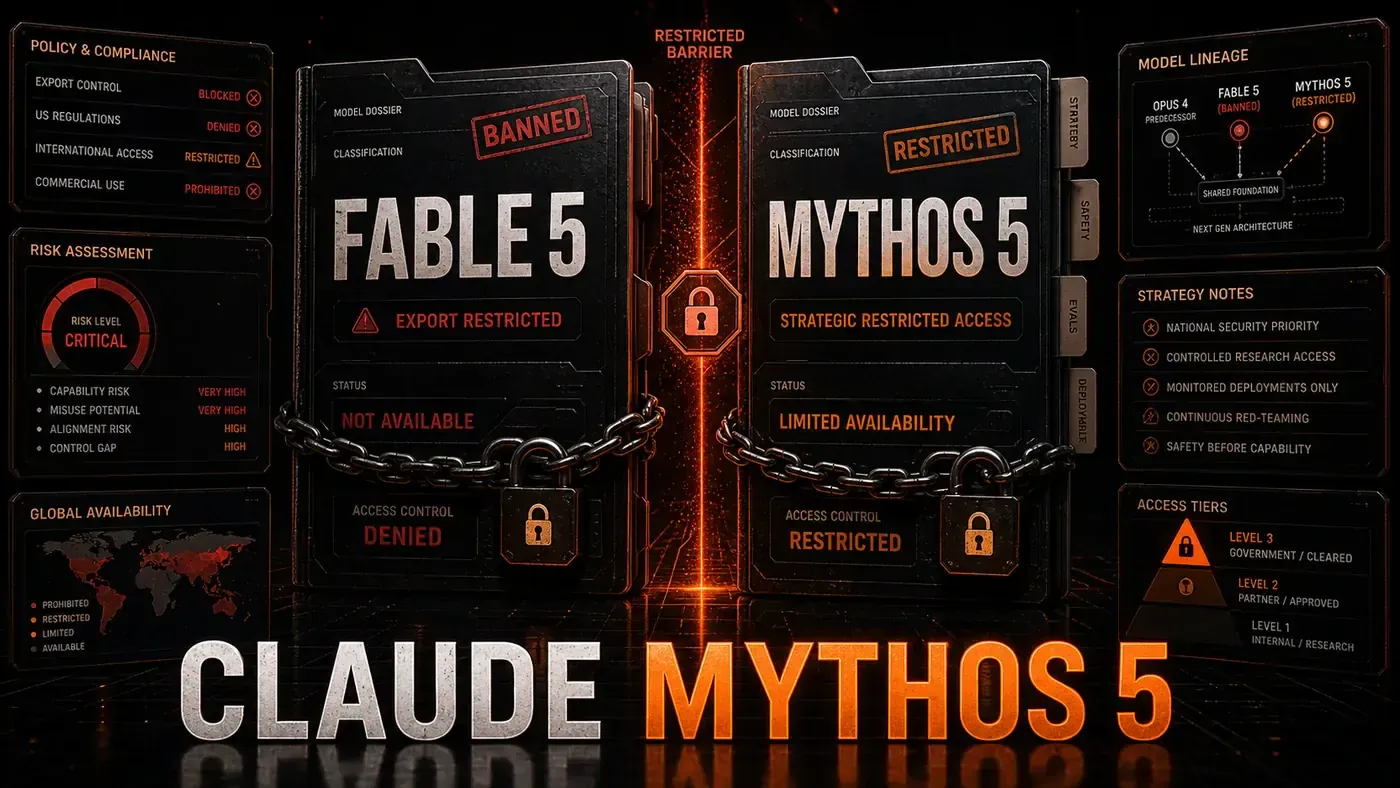
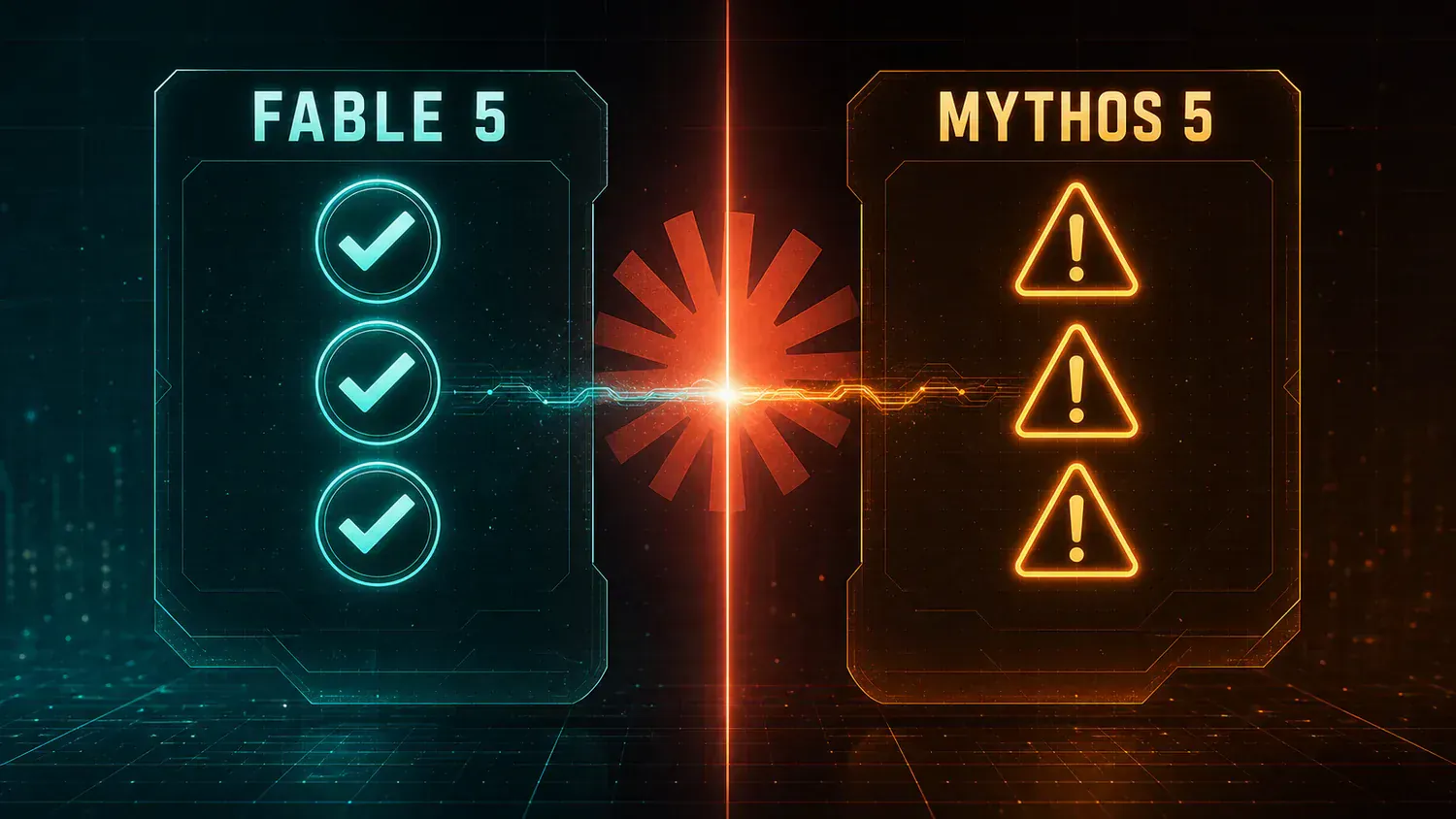
Here is the part worth getting straight, because a lot of the early commentary got it backwards. Mythos 5 is not the locked-down, extra-cautious version of Fable 5. According to Anthropic's own model docs (opens in a new tab), Fable 5 ships with the safety classifiers that can decline requests. Mythos 5 has those classifiers stripped out, with some cyber and bio safeguards lifted, for a short list of vetted security and government partners. So Mythos 5 is the less restricted, higher-risk model, not the safer one.
For an Australian business team, the practical takeaway is simple. Neither model is something you can sign up for today. But the story behind them tells you a lot about where AI procurement, safety claims, and government oversight are heading, and that is worth understanding before you bet a workflow on any frontier model.
When Anthropic announced both models on 9 June 2026, most coverage fixed on Fable 5 and skipped past Mythos 5. The quiet release was deliberate. Mythos 5 was offered through Project Glasswing (opens in a new tab), Anthropic's gated channel for cybersecurity organisations, critical-infrastructure operators, government partners, and select life-sciences researchers, rather than through the normal public product pages.
One detail that circulated early does not hold up: the idea that Mythos 5 had "no pricing page" and lived only behind a generic research programme. Both models share the same published specs and the same documented pricing, and both carry 30-day data retention as Covered Models (Claude API Docs (opens in a new tab)). The difference between them is the safety layer, not the price tag.
The two models share the same underlying model and capabilities. Where they part ways is the classifier stack (Anthropic (opens in a new tab)). Fable 5 keeps the request-declining safeguards. Mythos 5 has them removed for its vetted audience. Some early write-ups claimed Mythos 5 refuses roughly 3.4 times as many prompts as Fable 5 on sensitive queries. That figure is unconfirmed, appears in no Anthropic material, and points the wrong way: with the classifiers removed, Mythos 5 should refuse fewer prompts, not more.
Why Two Models?
Anthropic's choice to ship a pair reads as a bet that the market is splitting in two. One side wants maximum capability with as few guardrails as possible. The other needs systems it can document, audit, and defend to a regulator.
That maps onto the two models, though not the way some early takes had it. Fable 5 is the broadly available, classifier-equipped model for general demanding work. Mythos 5, with safeguards lifted, goes to a narrow set of vetted partners doing security and critical-infrastructure work where having the brakes off is the point (Anthropic, Claude Mythos (opens in a new tab)). Note that the original framing had this inverted, treating Mythos 5 as the "demonstrably safe compliance model." It is closer to the opposite: it is restricted precisely because its high-risk capability is exposed.
Running two near-identical models also gives Anthropic data on what the safety layer actually costs in practice. One claim doing the rounds put the gap at 1.2 percentage points on MMLU-Pro and about 4.7% on coding benchmarks. Those numbers are unconfirmed and look invented. Anthropic states the two models share the same capabilities and specs, with Mythos 5 simply lacking the classifiers, so there is no documented capability gap to measure (Claude API Docs (opens in a new tab)).
The Mythos 5 Safety Architecture
A detailed "three-layer safety system" was attributed to Mythos 5 in early accounts: an "adversarial deliberation" constitution where the model debates safety and capability personas before answering, a real-time monitor checking the full prompt-and-output pair, and a cryptographic provenance log stamped onto every API response for audit trails.
None of that is supported. No Anthropic source or news coverage describes any of these mechanisms, and the figures attached to them, such as a 23% inference overhead and a 7.2x reduction in harmful outputs, appear nowhere. They look fabricated. The reality runs the other way: Mythos 5 has fewer safety controls than Fable 5, not a stack of extra ones, because its classifiers were removed for vetted partners (Claude API Docs (opens in a new tab)).
So if you read claims about Mythos 5's elaborate guardrails, treat them with caution. The documented design point is the absence of the standard classifiers, not their reinforcement.
What the Fable 5 Ban Means for Mythos 5
The export action did not single out Fable 5. The Commerce directive covered both models, and Anthropic suspended both worldwide because it cannot verify a user's nationality in real time (MarkTechPost (opens in a new tab)). This was reportedly the first time the US applied export controls to an AI model itself rather than to chips, and it followed concerns about a jailbreak that bypassed safeguards around finding cybersecurity vulnerabilities (National Law Review (opens in a new tab)).
Because the two models share a base, controls on one effectively reach the other. One detail from the early version, that existing research partners kept "grandfathered" access while new access was paused, is not borne out by the reporting. Anthropic disabled both models for all customers globally, not just new ones.
There was also a claim that several AI safety researchers wrote to the Commerce Department arguing that restricting these models while less-safe international options stay available is counterproductive. That letter campaign is unconfirmed; no source documents it. What is on record is that Anthropic itself disagreed with the directive publicly, arguing the jailbreak in question was narrow and could be reproduced on other public models.
Claude Mythos 5: answer-first summary
Claude Mythos 5 matters because it can change how Founders and operators plan, build, or govern an search and AI-answer workflow. Anthropic quietly shipped Mythos 5 alongside Fable 5, a gated variant with safety classifiers removed.
The direct answer is this: do not treat the topic as a standalone trend. Treat it as a decision about inputs, outputs, review ownership, data exposure, and whether the workflow produces a result that is faster, safer, or more useful than the current process.
Claude Mythos 5: implementation checklist
- Define the user, job to be done, and success metric for the search and AI-answer workflow.
- Collect real examples, policies, source files, customer questions, or search queries before writing prompts or choosing tools.
- Separate low-risk drafts from decisions that need approval, privacy checks, or senior review.
- Document what the AI is allowed to access, what it must not access, and who signs off before production use.
- Review indexed pages, qualified clicks, AI citation visibility, conversion paths after a small pilot rather than judging the idea from a demo.
This keeps the work practical. It also gives search engines and AI answer engines a clean factual structure: what the topic is, who it helps, what to do next, and which risks matter before implementation.
Decision criteria for Claude Mythos 5
| Decision area | What to check | Production signal |
|---|---|---|
| Intent | Does Claude Mythos 5 solve a real workflow problem? | The use case has a named owner and measurable outcome. |
| Data | Can the required data be used safely? | Sensitive data is classified and access is controlled. |
| Quality | Can a reviewer judge the output consistently? | Examples, rubrics, or acceptance criteria exist. |
| Scale | Can the workflow be repeated without hero effort? | The process is documented and can be handed to another team member. |
Practical example for Claude Mythos 5
A small business could use this article to choose one practical test. For example, a manager might take one customer-facing process, one internal document workflow, or one recurring content task and redesign only that step with AI support. The goal is not to automate the whole business at once; it is to learn where AI News creates reliable leverage.
The useful deliverable is a short operating note: the trigger, the source material, the prompt or tool, the review checklist, the escalation rule, and the metric. That note becomes the handover asset for staff training, SEO/GEO content, service delivery, or future agent work.
Risks and controls for Claude Mythos 5
The common failure pattern is moving too quickly from a promising idea into an unmanaged workflow. For Claude Mythos 5, the risk is not only bad output. It can also be unclear data permission, staff confusion, duplicate content, unreviewed customer advice, or a tool that quietly changes cost or capability.
- Control thin summaries with a named owner, a review step, and written acceptance criteria.
- Control duplicate intent with a named owner, a review step, and written acceptance criteria.
- Control weak entity coverage with a named owner, a review step, and written acceptance criteria.
- Control missing internal links with a named owner, a review step, and written acceptance criteria.
Measurement plan for Claude Mythos 5
A useful AI or SEO initiative should leave evidence. Track indexed pages, qualified clicks, AI citation visibility, conversion paths and compare the pilot against the current process. If the measure does not improve, keep the learning but avoid scaling the workflow.
For GEO readiness, the page should also answer the core question directly, define the entities involved, include implementation steps, explain tradeoffs, and link readers to the next relevant AI Kick Start service, guide, tool, or article.
Definitions and entities for Claude Mythos 5
For search, GEO, and staff handover, define the core entities in plain language. In this article the important entities are the workflow owner, the AI tool or model, the source material, the review process, the risk boundary, and the measurable business outcome. Clear definitions make the page easier for people to scan and easier for AI answer engines to quote accurately.
- Workflow owner: the person accountable for deciding whether Claude Mythos 5 belongs in the business process.
- Source material: the documents, examples, policies, URLs, prompts, videos, or customer questions that ground the output.
- Review boundary: the point where a human checks accuracy, privacy, brand voice, or customer impact before the result is used.
- Success metric: the measure that proves whether the search and AI-answer workflow is worth repeating.
Claude Mythos 5 versus doing nothing
Doing nothing is also a decision. The cost may be slow manual work, weaker search visibility, inconsistent advice, duplicated effort, or staff using unmanaged AI tools without a shared process. The practical question is whether a controlled pilot can reduce that cost without creating a larger governance problem.
| Option | When it makes sense | What to watch |
|---|---|---|
| Do nothing | The workflow is rare, low value, or already reliable. | Competitors may improve speed, content depth, or service consistency first. |
| Run a small pilot | The task repeats often and has clear review criteria. | Keep scope tight and measure the result against the current process. |
| Build a production workflow | The pilot is repeatable and risk controls are documented. | Assign ownership, monitoring, training, and a rollback path. |
AI Kick Start handover package for Claude Mythos 5
A production handover should be concrete enough that another person can run it. For Claude Mythos 5, that means a short brief, a workflow map, approved prompts or tool settings, source material, a review checklist, internal links to supporting resources, and a simple measurement sheet. This is the difference between reading about AI and turning it into operational capability.
That packaging also strengthens E-E-A-T. It shows experience through implementation notes, expertise through decision criteria, authoritativeness through source-aware structure, and trust through risks, controls, and review steps. The article becomes useful even if the reader never buys a tool because it helps them make a better operational decision.