




Analysis
For 25 years, finding something online has worked the same way: type a few keywords, scan a page of blue links, click, and hope you guessed right. A new crop of products wants to throw that out. Instead of links, you ask a question in plain English and get a written answer with the sources cited underneath.
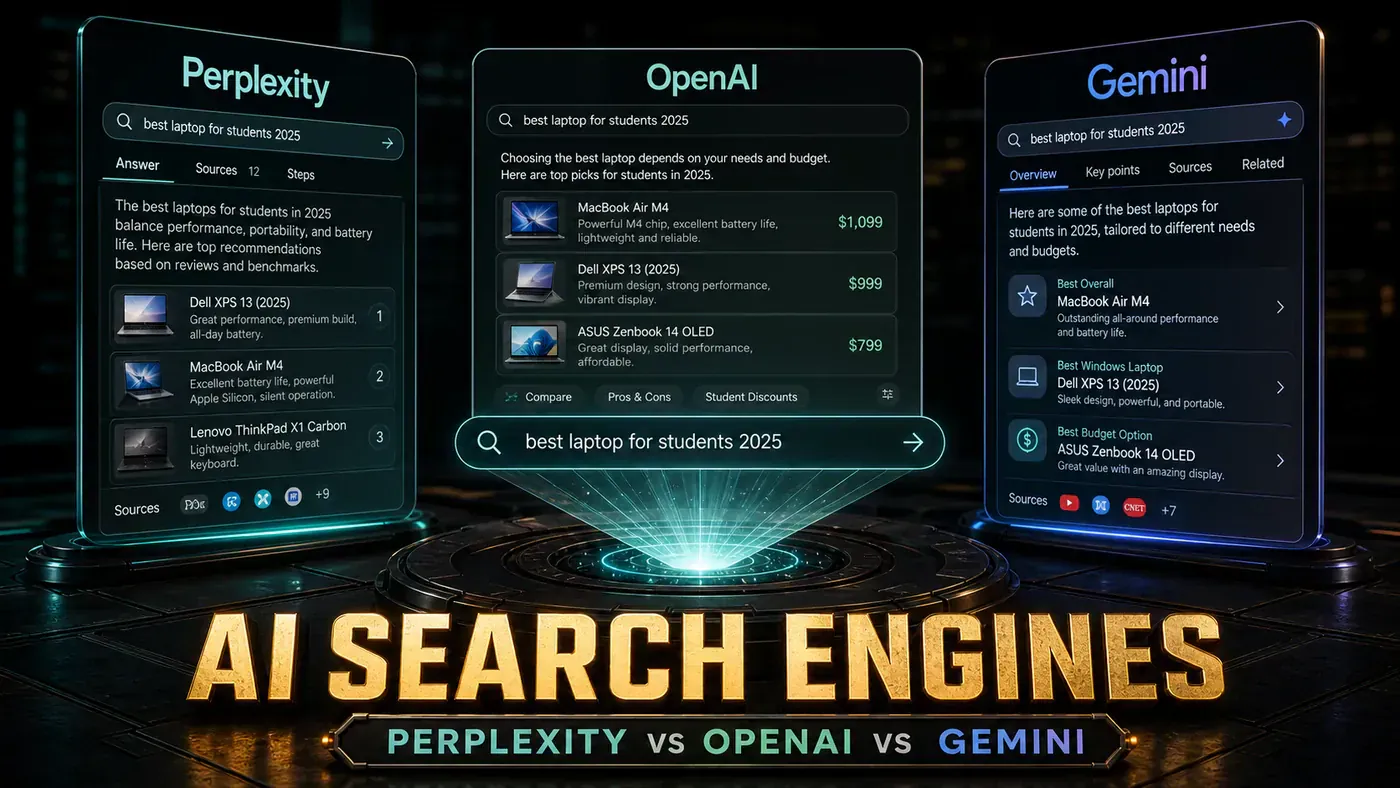
Three names are fighting over what comes next. Perplexity built an answer engine from scratch. OpenAI bolted search onto ChatGPT, the app hundreds of millions of people already open every day. And Google folded AI answers into the search box it has owned for a generation. Whoever gets this right won't just win a product category. They'll set the default for how most people look things up.
For an Australian business, the practical stakes are simpler than the hype suggests. If buyers start asking an assistant "who does X near me" instead of typing it into Google, the question of which engine answers, and whether your business shows up in that answer, becomes a real marketing problem rather than a futurist one.
Here's where each contender actually stands.
Perplexity: The AI-Native Pioneer
Perplexity was the first company to ship an AI search engine people genuinely wanted to use. Founded in August 2022, it never built a traditional search product at all (Perplexity AI, Wikipedia (opens in a new tab)). Every query goes to an AI model that pulls together information from several sources and links each claim back to where it came from.
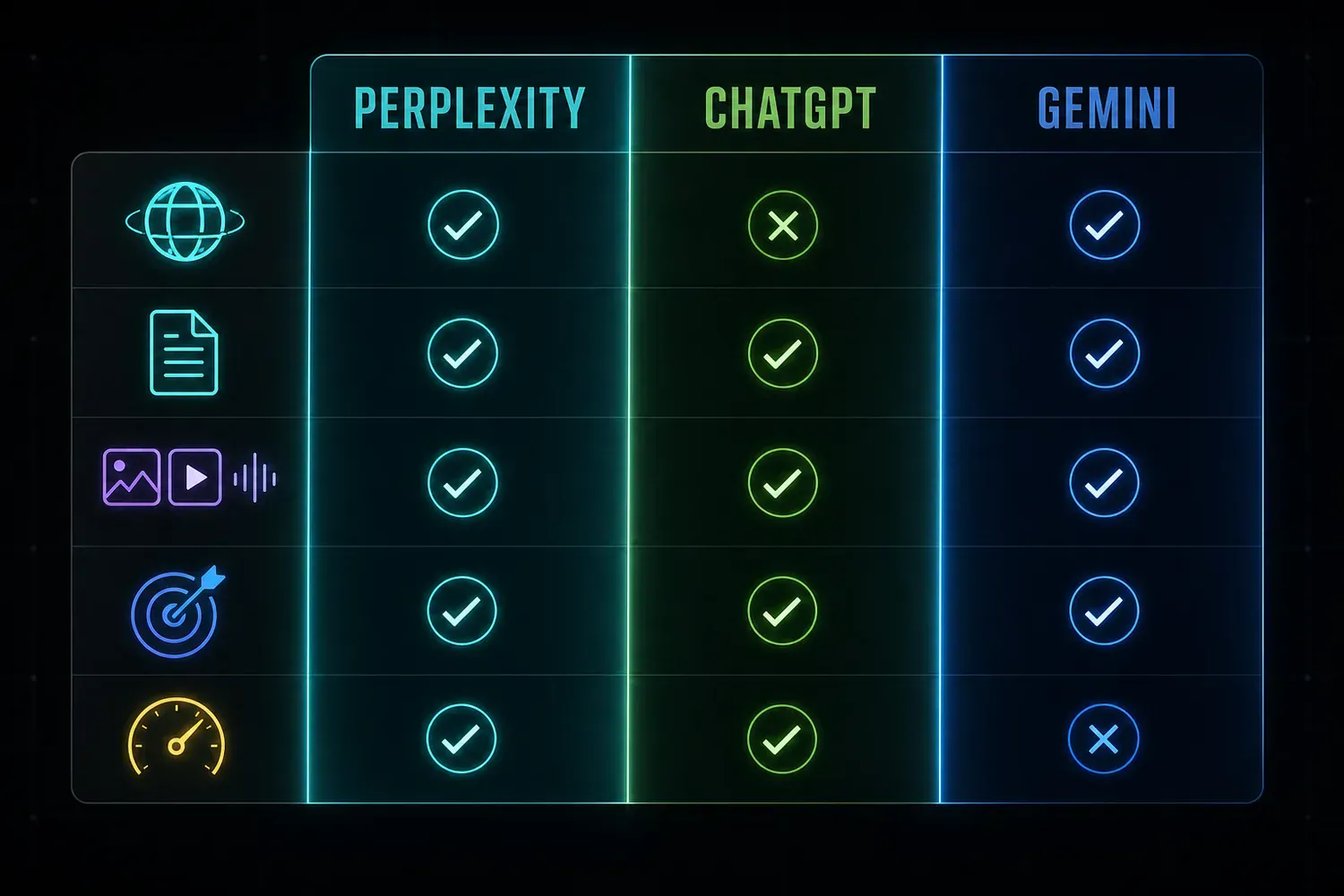
The strengths are easy to point at. Citation quality is the best in the field: claims are tied to specific sources, and those sources tend to be credible. The interface is clean and built for asking questions, without the clutter of a results page. Pro Search (opens in a new tab) runs several searches at once and stitches the results into a fuller answer for harder questions, and Collections lets you save and organise research on a topic, updating it as new material appears (Perplexity AI, Wikipedia (opens in a new tab)).
Reported user numbers vary by source and by how you count. Perplexity has cited figures around 34 to 45 million monthly active users on the core platform, and 100 million-plus across all its products (Perplexity AI Statistics 2026, DemandSage (opens in a new tab)); an earlier draft of this piece put the figure at 65 million monthly users (up from 15 million a year prior), which we couldn't verify against current reporting. On funding, the company has raised well over $1.7 billion in total, with a 2026 valuation reported at roughly $22.6 billion after a Series E in January 2026 (Perplexity Funding & Investors 2026, Tracxn (opens in a new tab)). Worth noting on the business model: Perplexity did experiment with advertising from late 2024, but reportedly pulled out of ads entirely by February 2026 over concerns it would erode user trust (Perplexity pulls the plug on ads, Campaign US (opens in a new tab)).
ChatGPT Search: The Distribution Advantage
OpenAI's ChatGPT Search (opens in a new tab) was announced in October 2024 and reached all users by February 2025 (ChatGPT, Wikipedia (opens in a new tab)). Its edge is reach. ChatGPT serves an enormous audience: OpenAI reported 400 million weekly active users in February 2025, and by February 2026 reporting put that figure closer to 900 million (OpenAI now serves 400M users every week, TechCrunch (opens in a new tab)). That's distribution Perplexity can only dream about. There's no new app to download and no behaviour to change; you flip search on inside the chat window you already use.
The pitch rests on two things: the models and the user base. Answer synthesis reportedly draws on OpenAI's newer GPT-5.5, released in May 2026, which the company says improves results when ChatGPT decides to search the web (Introducing GPT-5.5, OpenAI (opens in a new tab)); whether it's the dedicated search-synthesis model isn't spelled out. Tying search to your conversation history means answers can lean on past chats, and following up ("what's the case against that?") feels smoother than the equivalent in Perplexity.
The gaps are just as visible. Citations aren't as tight as Perplexity's; sometimes the cited source doesn't clearly back the claim. The interface is built for chat, so it can feel busy when all you want is a fact. And it can lag on fast-moving topics, missing the newest information.
Gemini: The Knowledge Graph Advantage
Google's Gemini sits on top of the one asset nobody else has: Google's knowledge graph and live index. Where Perplexity and ChatGPT Search lean on third-party search APIs or limited crawls, Gemini taps the same data behind ordinary Google Search, with a quarter-century of ranking work behind it. Those figures, trillions of pages and 25 years of refinement, are fair descriptions of the scale rather than audited numbers (Google Search I/O 2026 updates, Google blog (opens in a new tab)).
The upside is coverage and freshness. When Gemini answers, it's working from the most complete and current index going. Hooks into Maps, Shopping, Flights and Scholar add structured data the others can't match. And AI Overviews, the AI answer that sits above normal results, reaches around 2 billion monthly users, most of whom have never heard of Perplexity (Google Search I/O 2026 updates, Google blog (opens in a new tab)).
The catch is delivery. Google's AI search has drawn criticism for uneven quality, the odd hallucination, and an experience that feels bolted onto traditional search rather than rebuilt around it. The deeper problem is incentive: Google makes its money from ad-driven search, and AI answers that keep people on the page cut into the clicks that pay the bills.
AI Search: answer-first summary
AI Search matters because it can change how Founders and operators plan, build, or govern an search and AI-answer workflow. AI search is the hottest fight in consumer AI.
The direct answer is this: do not treat the topic as a standalone trend. Treat it as a decision about inputs, outputs, review ownership, data exposure, and whether the workflow produces a result that is faster, safer, or more useful than the current process.
AI Search: implementation checklist
- Define the user, job to be done, and success metric for the search and AI-answer workflow.
- Collect real examples, policies, source files, customer questions, or search queries before writing prompts or choosing tools.
- Separate low-risk drafts from decisions that need approval, privacy checks, or senior review.
- Document what the AI is allowed to access, what it must not access, and who signs off before production use.
- Review indexed pages, qualified clicks, AI citation visibility, conversion paths after a small pilot rather than judging the idea from a demo.
This keeps the work practical. It also gives search engines and AI answer engines a clean factual structure: what the topic is, who it helps, what to do next, and which risks matter before implementation.
Decision criteria for AI Search
| Decision area | What to check | Production signal |
|---|---|---|
| Intent | Does AI Search solve a real workflow problem? | The use case has a named owner and measurable outcome. |
| Data | Can the required data be used safely? | Sensitive data is classified and access is controlled. |
| Quality | Can a reviewer judge the output consistently? | Examples, rubrics, or acceptance criteria exist. |
| Scale | Can the workflow be repeated without hero effort? | The process is documented and can be handed to another team member. |
Practical example for AI Search
A small business could use this article to choose one practical test. For example, a manager might take one customer-facing process, one internal document workflow, or one recurring content task and redesign only that step with AI support. The goal is not to automate the whole business at once; it is to learn where AI News creates reliable leverage.
The useful deliverable is a short operating note: the trigger, the source material, the prompt or tool, the review checklist, the escalation rule, and the metric. That note becomes the handover asset for staff training, SEO/GEO content, service delivery, or future agent work.
Risks and controls for AI Search
The common failure pattern is moving too quickly from a promising idea into an unmanaged workflow. For AI Search, the risk is not only bad output. It can also be unclear data permission, staff confusion, duplicate content, unreviewed customer advice, or a tool that quietly changes cost or capability.
- Control thin summaries with a named owner, a review step, and written acceptance criteria.
- Control duplicate intent with a named owner, a review step, and written acceptance criteria.
- Control weak entity coverage with a named owner, a review step, and written acceptance criteria.
- Control missing internal links with a named owner, a review step, and written acceptance criteria.
Measurement plan for AI Search
A useful AI or SEO initiative should leave evidence. Track indexed pages, qualified clicks, AI citation visibility, conversion paths and compare the pilot against the current process. If the measure does not improve, keep the learning but avoid scaling the workflow.
For GEO readiness, the page should also answer the core question directly, define the entities involved, include implementation steps, explain tradeoffs, and link readers to the next relevant AI Kick Start service, guide, tool, or article.
Definitions and entities for AI Search
For search, GEO, and staff handover, define the core entities in plain language. In this article the important entities are the workflow owner, the AI tool or model, the source material, the review process, the risk boundary, and the measurable business outcome. Clear definitions make the page easier for people to scan and easier for AI answer engines to quote accurately.
- Workflow owner: the person accountable for deciding whether AI Search belongs in the business process.
- Source material: the documents, examples, policies, URLs, prompts, videos, or customer questions that ground the output.
- Review boundary: the point where a human checks accuracy, privacy, brand voice, or customer impact before the result is used.
- Success metric: the measure that proves whether the search and AI-answer workflow is worth repeating.
AI Search versus doing nothing
Doing nothing is also a decision. The cost may be slow manual work, weaker search visibility, inconsistent advice, duplicated effort, or staff using unmanaged AI tools without a shared process. The practical question is whether a controlled pilot can reduce that cost without creating a larger governance problem.
| Option | When it makes sense | What to watch |
|---|---|---|
| Do nothing | The workflow is rare, low value, or already reliable. | Competitors may improve speed, content depth, or service consistency first. |
| Run a small pilot | The task repeats often and has clear review criteria. | Keep scope tight and measure the result against the current process. |
| Build a production workflow | The pilot is repeatable and risk controls are documented. | Assign ownership, monitoring, training, and a rollback path. |
AI Kick Start handover package for AI Search
A production handover should be concrete enough that another person can run it. For AI Search, that means a short brief, a workflow map, approved prompts or tool settings, source material, a review checklist, internal links to supporting resources, and a simple measurement sheet. This is the difference between reading about AI and turning it into operational capability.
That packaging also strengthens E-E-A-T. It shows experience through implementation notes, expertise through decision criteria, authoritativeness through source-aware structure, and trust through risks, controls, and review steps. The article becomes useful even if the reader never buys a tool because it helps them make a better operational decision.