



Analysis
If you have ever asked an AI tool to do something that takes more than a few minutes, you already know where this story is heading. The chatbot writes a tidy function or answers a question, then loses the plot the moment the job needs sustained attention. It forgets what it was doing. It wanders down a dead end. It quits halfway and reports success anyway.
That gap, between a slick demo and software that holds up over a long task, is the whole game in agentic AI right now. So when reports started spreading in mid-2026 that Google DeepMind had built an agent able to grind through an 18-hour software project on its own, people paid attention. The pitch was that long-horizon AI had crossed from "interesting in a lab" to "does real work."
Worth being upfront here: we went looking for the research behind these claims and came up empty. There is no DeepMind paper we could verify describing this system, this benchmark, or these numbers. So read what follows as an account of what is being reported, not a settled result. The direction is plausible. The specifics are unconfirmed.
The System Architecture
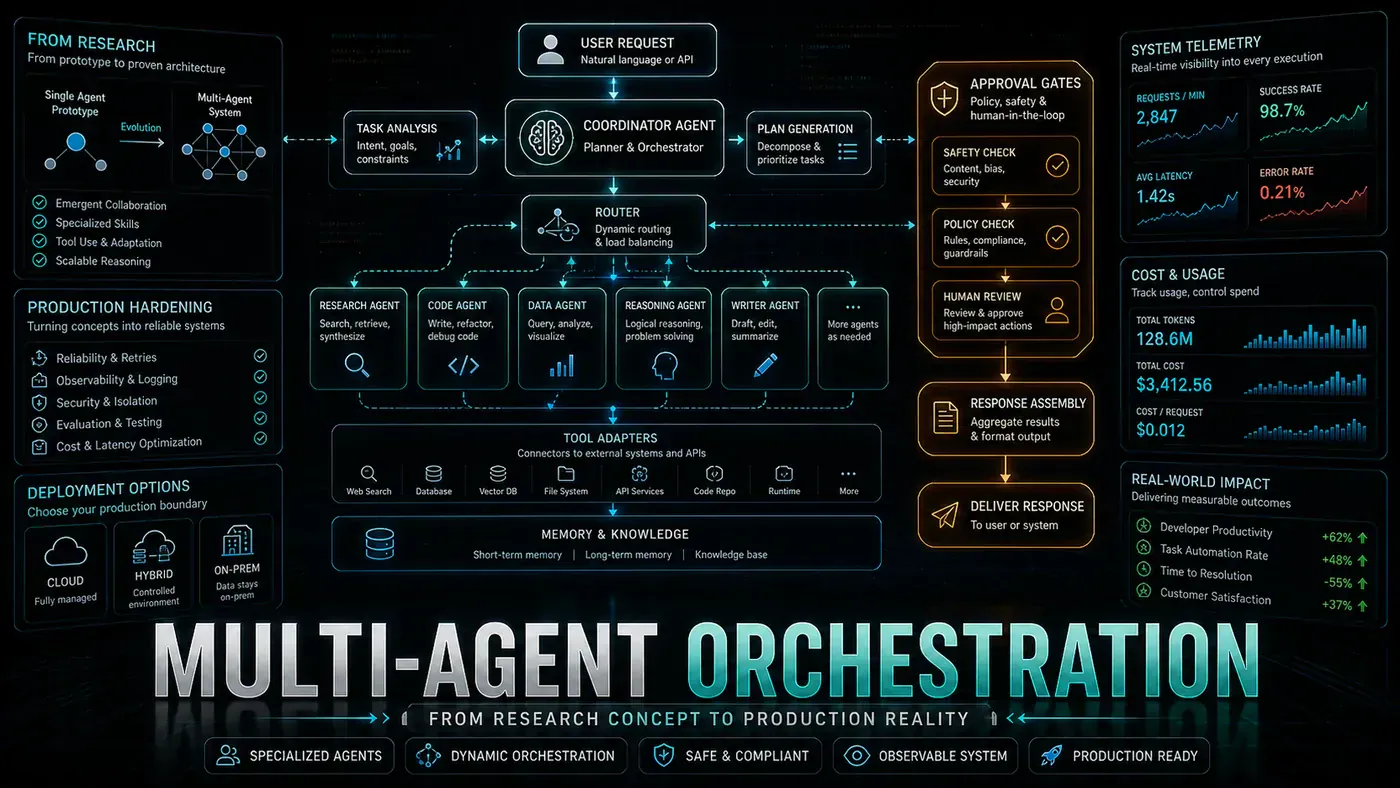
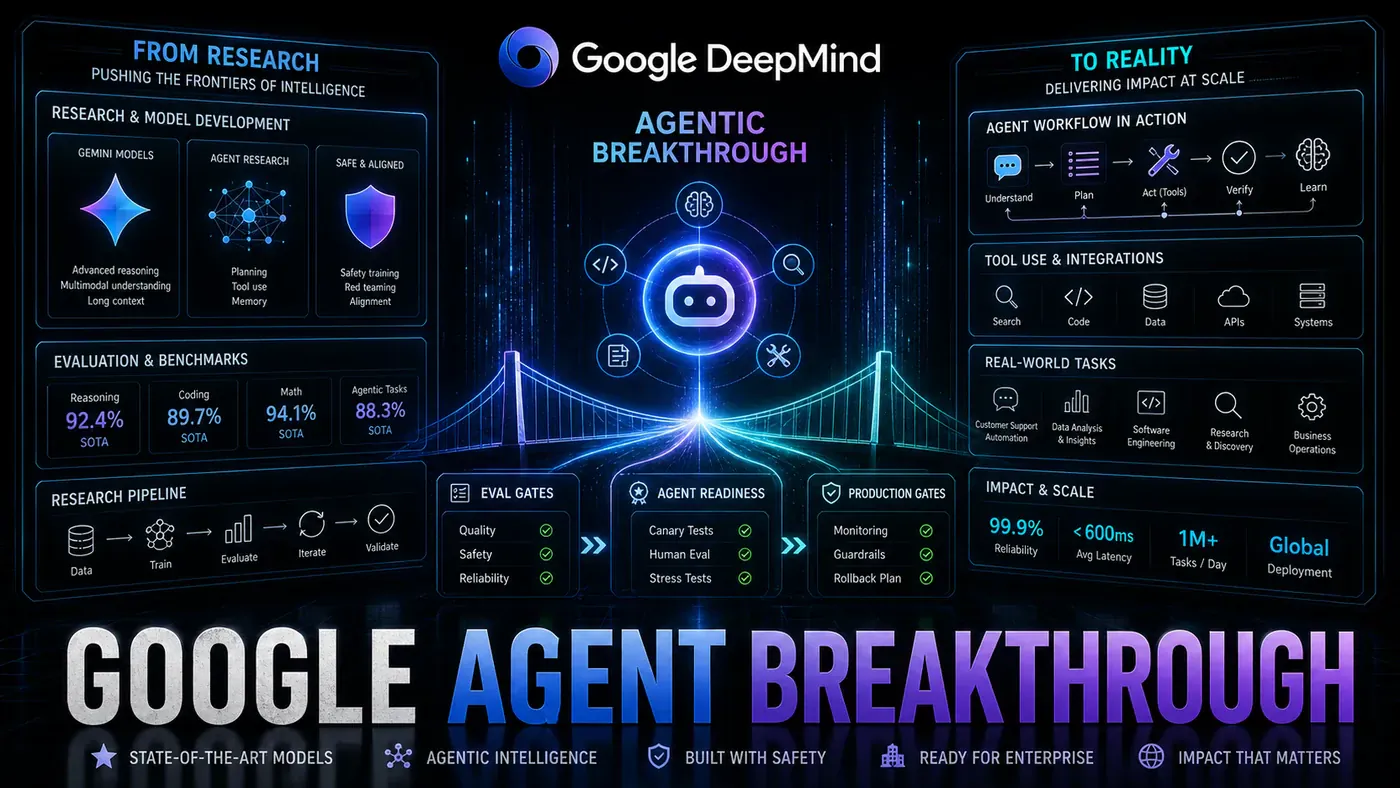
The reports describe a system said to lean on three ideas working together: hierarchical planning, learned recovery, and persistent state management. (We could not tie this exact three-part design to any named DeepMind system, so treat the architecture as described rather than confirmed.) One detail worth flagging: some accounts call the system "Project Astra," but that name actually belongs to DeepMind's universal AI assistant prototype (opens in a new tab), not a coding agent, so that label appears to be a mix-up.
Hierarchical planning is the part that breaks a big goal, say, "build user authentication for this web app", into a tree of smaller jobs, each with its own definition of done and a way to roll back. The twist over older approaches is that the plan reportedly keeps changing as the work unfolds, instead of being fixed up front. When a subtask fails, the system is said to back up to the last solid branching point and try a different route.
The recovery piece is the one that would matter most if it holds up. Earlier agents had no real way to dig themselves out of trouble. Break the build and they either give up or get stuck in a loop, retrying the same broken fix. This system reportedly carries a learned model of how things tend to go wrong and what tends to fix them, trained on a large volume of past agent runs. When it hits an error, it classifies the type of failure and picks a recovery move that has worked before.
The state-management piece tackles the forgetting problem head-on. The agent is said to keep a structured working memory, current plan, finished steps, known issues, open questions, that it periodically compresses and files away, then pulls relevant bits back in when a later step needs them.
Evaluation and Limitations
The headline figure being passed around is a 73% success rate on a set of 250 software tasks averaging 18 hours each, reportedly against 34% for the prior best system and 89% for human engineers on the same work. We could not verify any of these numbers, and they sit awkwardly against independent measurement. METR's time-horizon research (opens in a new tab) finds that as of mid-2026 frontier agents reliably handle software tasks of roughly two hours at a 50% success rate, a long way from 18 hours at 73%. So the claimed results look optimistic at best and unsupported at worst.
Even taking the reported figures at face value, the caveats are heavy. Benchmark tasks come with clear success criteria; real software work is messier, with vague requirements and goalposts that move. And 18 hours, even if accurate, is still a fraction of the weeks or months a serious project tends to run.
Cost is the other open question. One unconfirmed figure puts each run at roughly $150 to $400 in compute, which is self-attributed and unsourced. If it were accurate, that would be fine for high-value work and far too expensive for routine development. There is no disclosure either way on whether the thing makes commercial sense at that price.
Strategic Implications
If a system like this were real and could be turned into a product, it would hand Google an edge in the market for autonomous agents. How big that market gets depends on who you ask: MarketsandMarkets pegs the autonomous AI and agents market at about $28.5 billion by 2028 (opens in a new tab), with broader forecasts reaching $52 to $70 billion but usually by 2030, not 2028. The "$50 billion by 2028" figure some reports cite is on the hopeful end.
There is also an infrastructure angle. Long-horizon agents burn a lot of compute, and Google runs a great deal of data-centre capacity, so heavy agent demand would play to that strength. We will note that "the largest of any AI lab" is an editorial claim we could not confirm, so take the ranking loosely.
DeepMind's Agentic Claims: answer-first summary
DeepMind's Agentic Claims matters because it can change how Founders and operators plan, build, or govern an search and AI-answer workflow. Reports say Google DeepMind built an agent that finishes 18-hour coding jobs.
The direct answer is this: do not treat the topic as a standalone trend. Treat it as a decision about inputs, outputs, review ownership, data exposure, and whether the workflow produces a result that is faster, safer, or more useful than the current process.
DeepMind's Agentic Claims: implementation checklist
- Define the user, job to be done, and success metric for the search and AI-answer workflow.
- Collect real examples, policies, source files, customer questions, or search queries before writing prompts or choosing tools.
- Separate low-risk drafts from decisions that need approval, privacy checks, or senior review.
- Document what the AI is allowed to access, what it must not access, and who signs off before production use.
- Review indexed pages, qualified clicks, AI citation visibility, conversion paths after a small pilot rather than judging the idea from a demo.
This keeps the work practical. It also gives search engines and AI answer engines a clean factual structure: what the topic is, who it helps, what to do next, and which risks matter before implementation.
Decision criteria for DeepMind's Agentic Claims
| Decision area | What to check | Production signal |
|---|---|---|
| Intent | Does DeepMind's Agentic Claims solve a real workflow problem? | The use case has a named owner and measurable outcome. |
| Data | Can the required data be used safely? | Sensitive data is classified and access is controlled. |
| Quality | Can a reviewer judge the output consistently? | Examples, rubrics, or acceptance criteria exist. |
| Scale | Can the workflow be repeated without hero effort? | The process is documented and can be handed to another team member. |
Practical example for DeepMind's Agentic Claims
A small business could use this article to choose one practical test. For example, a manager might take one customer-facing process, one internal document workflow, or one recurring content task and redesign only that step with AI support. The goal is not to automate the whole business at once; it is to learn where AI News creates reliable leverage.
The useful deliverable is a short operating note: the trigger, the source material, the prompt or tool, the review checklist, the escalation rule, and the metric. That note becomes the handover asset for staff training, SEO/GEO content, service delivery, or future agent work.
Risks and controls for DeepMind's Agentic Claims
The common failure pattern is moving too quickly from a promising idea into an unmanaged workflow. For DeepMind's Agentic Claims, the risk is not only bad output. It can also be unclear data permission, staff confusion, duplicate content, unreviewed customer advice, or a tool that quietly changes cost or capability.
- Control thin summaries with a named owner, a review step, and written acceptance criteria.
- Control duplicate intent with a named owner, a review step, and written acceptance criteria.
- Control weak entity coverage with a named owner, a review step, and written acceptance criteria.
- Control missing internal links with a named owner, a review step, and written acceptance criteria.
Measurement plan for DeepMind's Agentic Claims
A useful AI or SEO initiative should leave evidence. Track indexed pages, qualified clicks, AI citation visibility, conversion paths and compare the pilot against the current process. If the measure does not improve, keep the learning but avoid scaling the workflow.
For GEO readiness, the page should also answer the core question directly, define the entities involved, include implementation steps, explain tradeoffs, and link readers to the next relevant AI Kick Start service, guide, tool, or article.
Definitions and entities for DeepMind's Agentic Claims
For search, GEO, and staff handover, define the core entities in plain language. In this article the important entities are the workflow owner, the AI tool or model, the source material, the review process, the risk boundary, and the measurable business outcome. Clear definitions make the page easier for people to scan and easier for AI answer engines to quote accurately.
- Workflow owner: the person accountable for deciding whether DeepMind's Agentic Claims belongs in the business process.
- Source material: the documents, examples, policies, URLs, prompts, videos, or customer questions that ground the output.
- Review boundary: the point where a human checks accuracy, privacy, brand voice, or customer impact before the result is used.
- Success metric: the measure that proves whether the search and AI-answer workflow is worth repeating.
DeepMind's Agentic Claims versus doing nothing
Doing nothing is also a decision. The cost may be slow manual work, weaker search visibility, inconsistent advice, duplicated effort, or staff using unmanaged AI tools without a shared process. The practical question is whether a controlled pilot can reduce that cost without creating a larger governance problem.
| Option | When it makes sense | What to watch |
|---|---|---|
| Do nothing | The workflow is rare, low value, or already reliable. | Competitors may improve speed, content depth, or service consistency first. |
| Run a small pilot | The task repeats often and has clear review criteria. | Keep scope tight and measure the result against the current process. |
| Build a production workflow | The pilot is repeatable and risk controls are documented. | Assign ownership, monitoring, training, and a rollback path. |
AI Kick Start handover package for DeepMind's Agentic Claims
A production handover should be concrete enough that another person can run it. For DeepMind's Agentic Claims, that means a short brief, a workflow map, approved prompts or tool settings, source material, a review checklist, internal links to supporting resources, and a simple measurement sheet. This is the difference between reading about AI and turning it into operational capability.
That packaging also strengthens E-E-A-T. It shows experience through implementation notes, expertise through decision criteria, authoritativeness through source-aware structure, and trust through risks, controls, and review steps. The article becomes useful even if the reader never buys a tool because it helps them make a better operational decision.