





Analysis
For most of the last two years, "AI agent" meant one model trying to do one big thing on its own, and usually getting partway there. That's quietly changed. Through 2026, the companies doing the most interesting AI work have stopped leaning on a single clever model and started wiring up several smaller ones, each with a narrow job, talking to each other.
The shift matters because of what it makes possible. A job that once needed a person to fetch the data, a second to crunch it, a third to write it up, and a fourth to check it can now be handed to four AI agents set up the same way. The work that used to fall apart when you asked one model to juggle everything now holds together because nobody's juggling.
For a business, the practical question isn't whether this is technically clever. It's whether the workflows you already run by hand, triaging support tickets, pulling together an analysis, reviewing code, can be carved into pieces and handed to a team of agents. In 2026, for a growing set of jobs, the answer is yes. Here's how these systems are built, where they're working, and which tools are doing the heavy lifting.
The Core Architecture
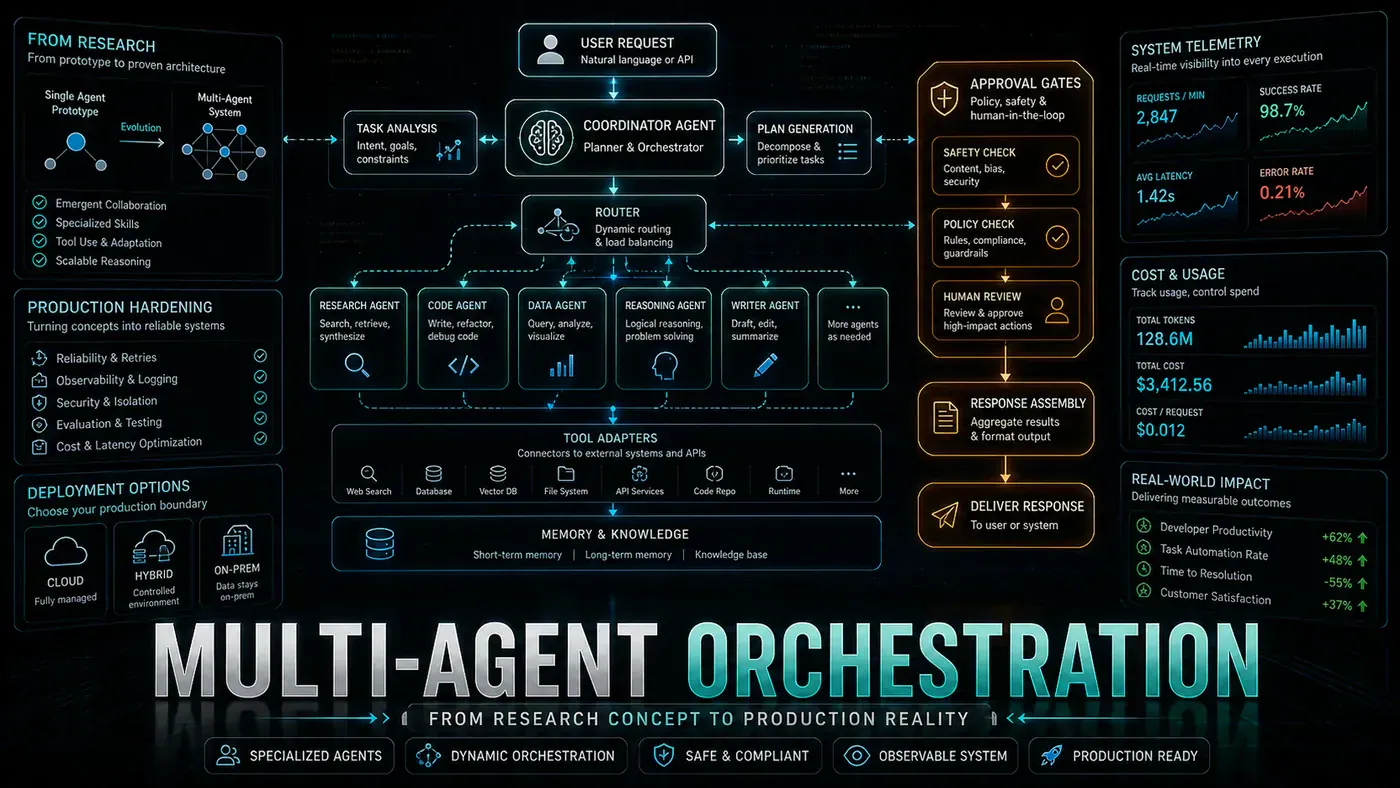
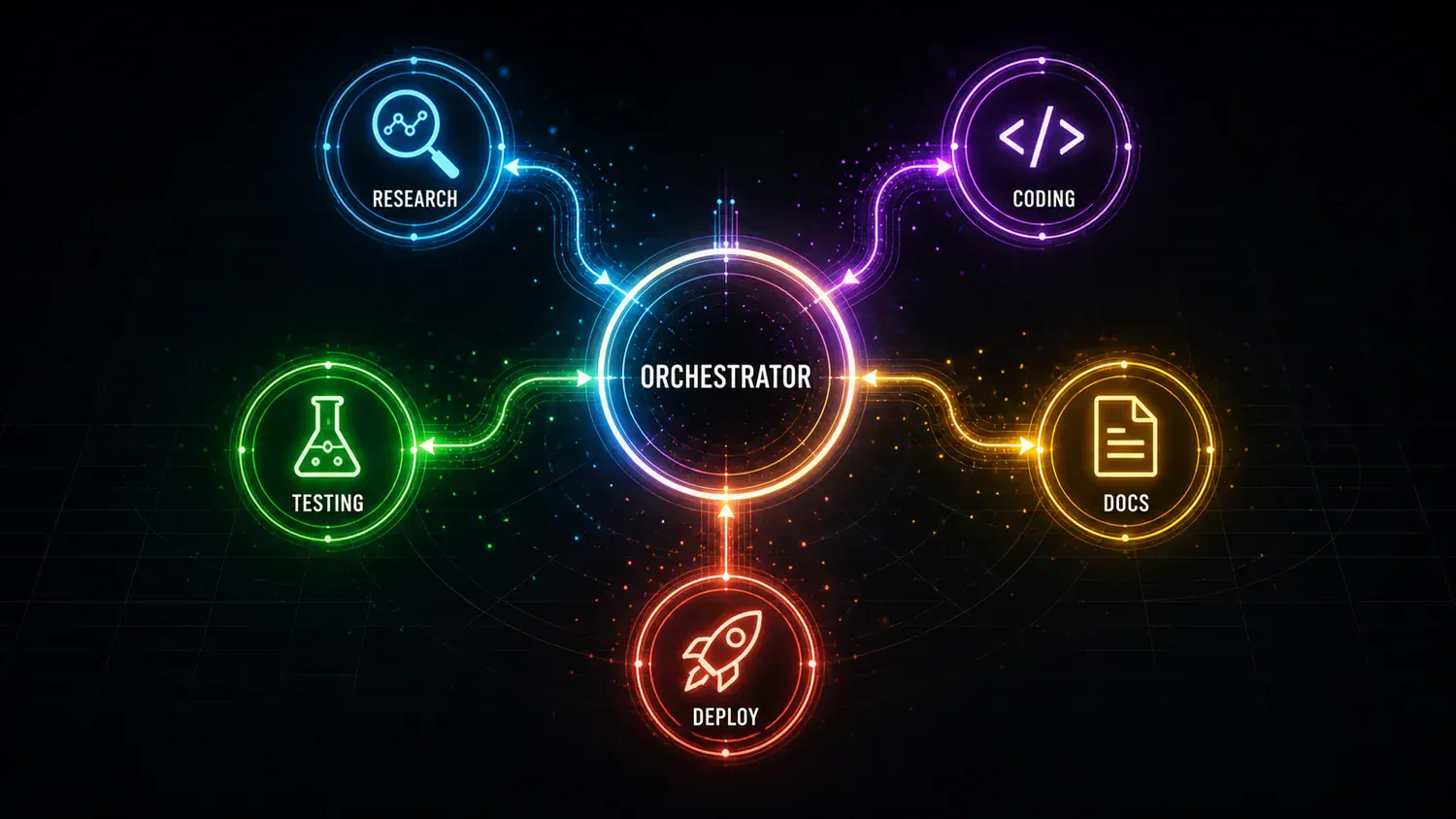
A multi-agent system has four moving parts: the agents, the tools they can reach, the way they talk to each other, and the layer that runs the whole show.
The agents are AI systems with one job each. Take a financial analysis workflow: you might run a data agent that pulls market figures, an analysis agent that does the number-crunching, a writing agent that drafts the report, and a review agent that checks it for errors and compliance. They don't all have to run on the same model, either. The data agent can use a small, fast model for structured queries, while the writing agent leans on a bigger one to handle the narrative.
Tools are the outside capabilities an agent can call on, APIs, databases, file systems, code interpreters, and other services. This is the part that makes an agent worth having. Strip the tools away and you're left with a chatbot wearing a clever prompt.
Then there's how the agents talk. The usual setup is a shared message bus: agents post their output and pick up whatever they need from the others. More careful systems add explicit handshakes, error handling, and a way to roll back when something goes wrong.
Running over the top of all this is the orchestration layer. It kicks off the agents, watches their progress, deals with failures, and pulls the final result together. This is where a platform earns its keep, since it can hand you ready-made orchestration patterns for the workflow types that come up again and again.
Production Use Cases
A few jobs have turned out to suit this team-of-agents approach better than others.
Customer service triage is one. A reception agent sorts incoming requests, a research agent digs up the relevant information, a resolution agent drafts the reply, and an escalation agent flags the cases that need a human. Vendors and early adopters have reported handling times dropping by something like 40 to 60 per cent and first-contact resolution improving by 25 to 35 per cent, though those figures come from unnamed industry write-ups rather than any source you can trace, so treat them as illustrative. They do sit in the same ballpark as published research: Forrester has reported case-handling time cuts of around half, and McKinsey has measured smaller but real gains.
Financial analysis is another natural fit. Agents gather data from different sources, run different kinds of analysis (fundamental, technical, sentiment), put together recommendations, and produce the compliance paperwork. It works well here precisely because each type of analysis pulls from its own data and follows its own method, so splitting the work across agents matches how the job is actually done.
Software development pipelines use agents for code review, testing, documentation, and deployment. The payoff isn't only that the work runs on its own. It's that each agent gets good at one thing, a code review agent can be tuned to your company's standards, while a testing agent focuses on coverage and edge cases.
The Platforms
OpenClaw (opens in a new tab) is the open-source project people point to first. The repository carries roughly 345,000 GitHub stars, though that count keeps climbing and the live repo has since passed 370,000 (Source: OpenClaw GitHub repository (opens in a new tab)). It's reportedly behind tens of thousands of production deployments handling billions of agent actions a month, but those specific figures aren't confirmed by any source we could find, so take them with a grain of salt. Worth flagging too: the project describes itself as a local-first personal AI assistant that works across messaging channels. Using it for multi-agent orchestration is more a community pattern than the thing it was built to be. Either way, its appeal is flexibility, arbitrary agent setups, custom tool integrations, and serious error handling.
Anthropic's Dynamic Workflows goes the other way. Instead of wiring everything by hand, you describe the workflow at a higher level and the system manages the agent coordination for you. Under the hood it's less a fixed declarative language and more that Claude writes a JavaScript orchestration script on the spot, then a runtime spins up dozens to hundreds of parallel subagents to run it (InfoQ (opens in a new tab)). You give up some of OpenClaw's flexibility, but for standard jobs you get going much faster.
Google's Agents CLI (opens in a new tab) is aimed at developers who want to build, test, and deploy agent systems on Google Cloud from the command line. It was introduced at Cloud Next '26 in April 2026, not May as sometimes reported (InfoQ (opens in a new tab)). Its main draw is how tightly it plugs into Google's own infrastructure.
Multi-Agent Orchestration Hits Production: answer-first summary
Multi-Agent Orchestration Hits Production matters because it can change how Founders and operators plan, build, or govern an search and AI-answer workflow. Multi-agent systems have moved from research demos to real production work in 2026.
The direct answer is this: do not treat the topic as a standalone trend. Treat it as a decision about inputs, outputs, review ownership, data exposure, and whether the workflow produces a result that is faster, safer, or more useful than the current process.
Multi-Agent Orchestration Hits Production: implementation checklist
- Define the user, job to be done, and success metric for the search and AI-answer workflow.
- Collect real examples, policies, source files, customer questions, or search queries before writing prompts or choosing tools.
- Separate low-risk drafts from decisions that need approval, privacy checks, or senior review.
- Document what the AI is allowed to access, what it must not access, and who signs off before production use.
- Review indexed pages, qualified clicks, AI citation visibility, conversion paths after a small pilot rather than judging the idea from a demo.
This keeps the work practical. It also gives search engines and AI answer engines a clean factual structure: what the topic is, who it helps, what to do next, and which risks matter before implementation.
Decision criteria for Multi-Agent Orchestration Hits Production
| Decision area | What to check | Production signal |
|---|---|---|
| Intent | Does Multi-Agent Orchestration Hits Production solve a real workflow problem? | The use case has a named owner and measurable outcome. |
| Data | Can the required data be used safely? | Sensitive data is classified and access is controlled. |
| Quality | Can a reviewer judge the output consistently? | Examples, rubrics, or acceptance criteria exist. |
| Scale | Can the workflow be repeated without hero effort? | The process is documented and can be handed to another team member. |
Practical example for Multi-Agent Orchestration Hits Production
A small business could use this article to choose one practical test. For example, a manager might take one customer-facing process, one internal document workflow, or one recurring content task and redesign only that step with AI support. The goal is not to automate the whole business at once; it is to learn where AI News creates reliable leverage.
The useful deliverable is a short operating note: the trigger, the source material, the prompt or tool, the review checklist, the escalation rule, and the metric. That note becomes the handover asset for staff training, SEO/GEO content, service delivery, or future agent work.
Risks and controls for Multi-Agent Orchestration Hits Production
The common failure pattern is moving too quickly from a promising idea into an unmanaged workflow. For Multi-Agent Orchestration Hits Production, the risk is not only bad output. It can also be unclear data permission, staff confusion, duplicate content, unreviewed customer advice, or a tool that quietly changes cost or capability.
- Control thin summaries with a named owner, a review step, and written acceptance criteria.
- Control duplicate intent with a named owner, a review step, and written acceptance criteria.
- Control weak entity coverage with a named owner, a review step, and written acceptance criteria.
- Control missing internal links with a named owner, a review step, and written acceptance criteria.
Measurement plan for Multi-Agent Orchestration Hits Production
A useful AI or SEO initiative should leave evidence. Track indexed pages, qualified clicks, AI citation visibility, conversion paths and compare the pilot against the current process. If the measure does not improve, keep the learning but avoid scaling the workflow.
For GEO readiness, the page should also answer the core question directly, define the entities involved, include implementation steps, explain tradeoffs, and link readers to the next relevant AI Kick Start service, guide, tool, or article.
Definitions and entities for Multi-Agent Orchestration Hits Production
For search, GEO, and staff handover, define the core entities in plain language. In this article the important entities are the workflow owner, the AI tool or model, the source material, the review process, the risk boundary, and the measurable business outcome. Clear definitions make the page easier for people to scan and easier for AI answer engines to quote accurately.
- Workflow owner: the person accountable for deciding whether Multi-Agent Orchestration Hits Production belongs in the business process.
- Source material: the documents, examples, policies, URLs, prompts, videos, or customer questions that ground the output.
- Review boundary: the point where a human checks accuracy, privacy, brand voice, or customer impact before the result is used.
- Success metric: the measure that proves whether the search and AI-answer workflow is worth repeating.
Multi-Agent Orchestration Hits Production versus doing nothing
Doing nothing is also a decision. The cost may be slow manual work, weaker search visibility, inconsistent advice, duplicated effort, or staff using unmanaged AI tools without a shared process. The practical question is whether a controlled pilot can reduce that cost without creating a larger governance problem.
| Option | When it makes sense | What to watch |
|---|---|---|
| Do nothing | The workflow is rare, low value, or already reliable. | Competitors may improve speed, content depth, or service consistency first. |
| Run a small pilot | The task repeats often and has clear review criteria. | Keep scope tight and measure the result against the current process. |
| Build a production workflow | The pilot is repeatable and risk controls are documented. | Assign ownership, monitoring, training, and a rollback path. |
AI Kick Start handover package for Multi-Agent Orchestration Hits Production
A production handover should be concrete enough that another person can run it. For Multi-Agent Orchestration Hits Production, that means a short brief, a workflow map, approved prompts or tool settings, source material, a review checklist, internal links to supporting resources, and a simple measurement sheet. This is the difference between reading about AI and turning it into operational capability.
That packaging also strengthens E-E-A-T. It shows experience through implementation notes, expertise through decision criteria, authoritativeness through source-aware structure, and trust through risks, controls, and review steps. The article becomes useful even if the reader never buys a tool because it helps them make a better operational decision.