



Analysis
If you've shortlisted an AI model lately, you've probably stared at a row of benchmark scores and felt none the wiser. Five models, all scoring somewhere in the high 80s and 90s, and no obvious way to tell which one will actually do your job better.
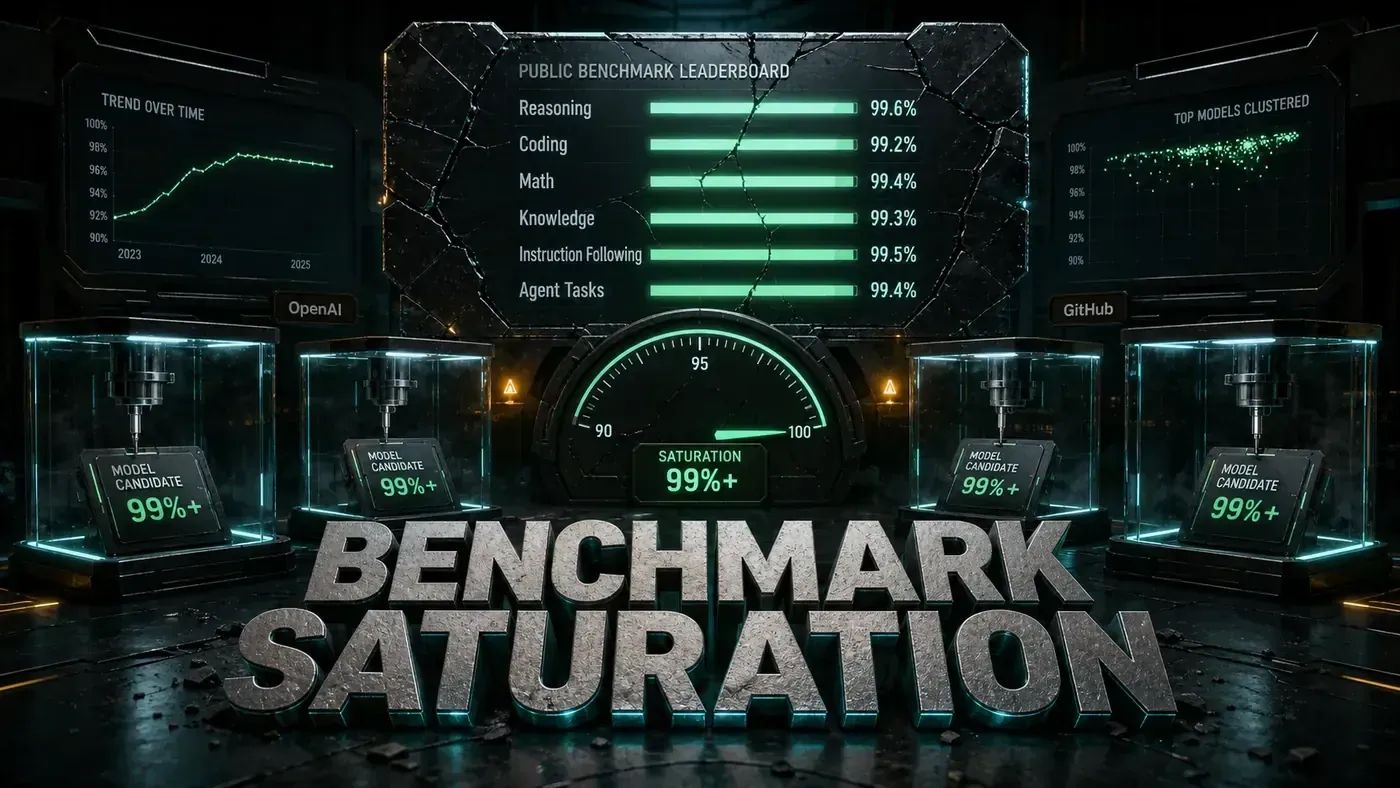
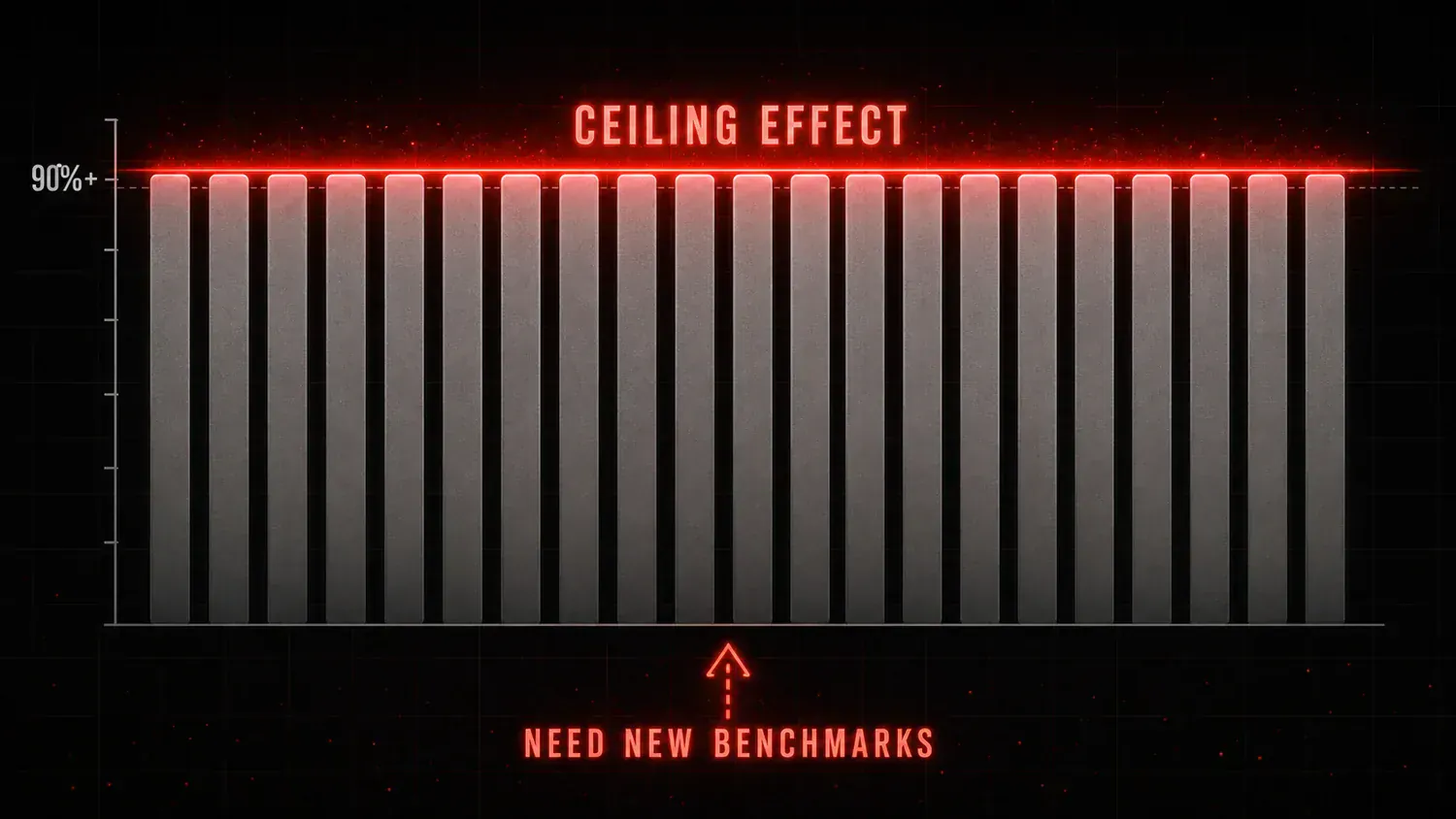
That's the problem in a sentence. The tests we've used for years to rank AI models are getting too easy for the models to beat. When everything scores near the top, the scoreboard stops telling you anything useful.
This isn't a scandal so much as a sign the field has moved on. The headline numbers still get quoted in launch posts and sales decks, but the people choosing models for real work have quietly stopped trusting them. For Australian teams picking a tool for support, document handling, or coding, the takeaway is simple: a high public benchmark score is a weak reason to choose one model over another. What matters is how it does on your tasks.
Below is what's driving the saturation, why it bites, and what's replacing the old scoreboard.
Why Benchmarks Are Saturating
Three things push scores toward the ceiling: contamination, overfitting, and the models simply getting better.
Contamination is when the benchmark itself leaks into the training data. Most major benchmarks are published openly, and modern training runs scrape close to the entire public web. So a model can "see" the questions and answers before it's ever tested, and a strong score then reflects memorisation, not reasoning. The range here is well documented in the literature, with older, heavily discussed benchmarks contaminated worst; one widely cited figure puts roughly 30-50% of popular benchmark content (opens in a new tab) inside the training sets of major models, though that aggregate number is more a rough read across several studies than a single confirmed measurement (Source: contamination research, 2025).
Overfitting is when developers tune for the test on purpose. That can mean fine-tuning on benchmark-style data, prompt engineering aimed at the exact behaviour a benchmark rewards, or just picking the model variant that posts the best score. You end up with benchmark athletes: systems tuned to ace specific tests without being noticeably better at the work people actually need done.
The third driver is the honest one. Models genuinely keep improving, and any fixed test eventually gets fully solved by a capable enough system. The original MMLU spans 57 subjects; its harder successor, MMLU-Pro (opens in a new tab), consolidates those into 14 broader categories and bumps the answer choices from four to ten to make guessing harder. Either way, a model trained on most of recorded human knowledge answering most undergraduate-level questions correctly isn't shocking. In that sense, saturation is a win: it means AI has caught up to human-level performance on these particular tasks.
The Consequences of Saturation
The first cost is practical. Benchmark scores no longer help you choose. When five models all land between 85% and 95% on MMLU-Pro, that 10-point spread tells you almost nothing about which will handle your specific job better. So buyers fall back on word of mouth, vendor marketing, or expensive private testing.
The second cost is the incentives it creates. If public benchmarks can't separate the field, there's less reward for hard capability work and more for benchmark-gaming tricks. Some analysts argue this slowly drains the value benchmarks were supposed to provide as a spur to real progress (Source: industry analysis, 2026), it's Goodhart's law applied to AI, and an argued risk rather than a measured one.
The third cost is the dangerous one. A model that scores 94% on a safety test still fails on the other 6%, and those failures can be exactly the cases you most needed it to get right. A high average can hide the failure modes that matter.
The Industry Response
The field is adjusting in a few directions.
Dynamic benchmarks, which change over time so models can't memorise them, are gaining ground. The LiveBench project (opens in a new tab) releases fresh questions every month and archives the old ones rather than scoring on them. The team describes it as contamination-limited, and the monthly refresh means scores lean far more on live reasoning than on recall.
Task-specific evaluation is replacing the general leaderboard for a lot of real use. Instead of "which model has the highest MMLU score?", teams are asking "which model is best at my task?" That means building your own evaluation set, which costs time and money but tells you something you can actually act on.
Private evaluations run by independent firms are becoming the standard for high-stakes choices. Several consultancies now offer confidential testing against proprietary datasets built to mirror real-world use. They're reportedly pricey, figures in the tens of thousands of dollars per model get mentioned, though that number isn't publicly confirmed, but they surface what public benchmarks can't.
Why Public AI Benchmarks Are Losing Their Meaning: answer-first summary
Why Public AI Benchmarks Are Losing Their Meaning matters because it can change how Founders and operators plan, build, or govern an search and AI-answer workflow. Why AI models scoring above 90% on public benchmarks are eroding the value of evals, and how the industry is rethinking model evaluation.
The direct answer is this: do not treat the topic as a standalone trend. Treat it as a decision about inputs, outputs, review ownership, data exposure, and whether the workflow produces a result that is faster, safer, or more useful than the current process.
Why Public AI Benchmarks Are Losing Their Meaning: implementation checklist
- Define the user, job to be done, and success metric for the search and AI-answer workflow.
- Collect real examples, policies, source files, customer questions, or search queries before writing prompts or choosing tools.
- Separate low-risk drafts from decisions that need approval, privacy checks, or senior review.
- Document what the AI is allowed to access, what it must not access, and who signs off before production use.
- Review indexed pages, qualified clicks, AI citation visibility, conversion paths after a small pilot rather than judging the idea from a demo.
This keeps the work practical. It also gives search engines and AI answer engines a clean factual structure: what the topic is, who it helps, what to do next, and which risks matter before implementation.
Decision criteria for Why Public AI Benchmarks Are Losing Their Meaning
| Decision area | What to check | Production signal |
|---|---|---|
| Intent | Does Why Public AI Benchmarks Are Losing Their Meaning solve a real workflow problem? | The use case has a named owner and measurable outcome. |
| Data | Can the required data be used safely? | Sensitive data is classified and access is controlled. |
| Quality | Can a reviewer judge the output consistently? | Examples, rubrics, or acceptance criteria exist. |
| Scale | Can the workflow be repeated without hero effort? | The process is documented and can be handed to another team member. |
Practical example for Why Public AI Benchmarks Are Losing Their Meaning
A small business could use this article to choose one practical test. For example, a manager might take one customer-facing process, one internal document workflow, or one recurring content task and redesign only that step with AI support. The goal is not to automate the whole business at once; it is to learn where AI News creates reliable leverage.
The useful deliverable is a short operating note: the trigger, the source material, the prompt or tool, the review checklist, the escalation rule, and the metric. That note becomes the handover asset for staff training, SEO/GEO content, service delivery, or future agent work.
Risks and controls for Why Public AI Benchmarks Are Losing Their Meaning
The common failure pattern is moving too quickly from a promising idea into an unmanaged workflow. For Why Public AI Benchmarks Are Losing Their Meaning, the risk is not only bad output. It can also be unclear data permission, staff confusion, duplicate content, unreviewed customer advice, or a tool that quietly changes cost or capability.
- Control thin summaries with a named owner, a review step, and written acceptance criteria.
- Control duplicate intent with a named owner, a review step, and written acceptance criteria.
- Control weak entity coverage with a named owner, a review step, and written acceptance criteria.
- Control missing internal links with a named owner, a review step, and written acceptance criteria.
Measurement plan for Why Public AI Benchmarks Are Losing Their Meaning
A useful AI or SEO initiative should leave evidence. Track indexed pages, qualified clicks, AI citation visibility, conversion paths and compare the pilot against the current process. If the measure does not improve, keep the learning but avoid scaling the workflow.
For GEO readiness, the page should also answer the core question directly, define the entities involved, include implementation steps, explain tradeoffs, and link readers to the next relevant AI Kick Start service, guide, tool, or article.
Definitions and entities for Why Public AI Benchmarks Are Losing Their Meaning
For search, GEO, and staff handover, define the core entities in plain language. In this article the important entities are the workflow owner, the AI tool or model, the source material, the review process, the risk boundary, and the measurable business outcome. Clear definitions make the page easier for people to scan and easier for AI answer engines to quote accurately.
- Workflow owner: the person accountable for deciding whether Why Public AI Benchmarks Are Losing Their Meaning belongs in the business process.
- Source material: the documents, examples, policies, URLs, prompts, videos, or customer questions that ground the output.
- Review boundary: the point where a human checks accuracy, privacy, brand voice, or customer impact before the result is used.
- Success metric: the measure that proves whether the search and AI-answer workflow is worth repeating.
Why Public AI Benchmarks Are Losing Their Meaning versus doing nothing
Doing nothing is also a decision. The cost may be slow manual work, weaker search visibility, inconsistent advice, duplicated effort, or staff using unmanaged AI tools without a shared process. The practical question is whether a controlled pilot can reduce that cost without creating a larger governance problem.
| Option | When it makes sense | What to watch |
|---|---|---|
| Do nothing | The workflow is rare, low value, or already reliable. | Competitors may improve speed, content depth, or service consistency first. |
| Run a small pilot | The task repeats often and has clear review criteria. | Keep scope tight and measure the result against the current process. |
| Build a production workflow | The pilot is repeatable and risk controls are documented. | Assign ownership, monitoring, training, and a rollback path. |
AI Kick Start handover package for Why Public AI Benchmarks Are Losing Their Meaning
A production handover should be concrete enough that another person can run it. For Why Public AI Benchmarks Are Losing Their Meaning, that means a short brief, a workflow map, approved prompts or tool settings, source material, a review checklist, internal links to supporting resources, and a simple measurement sheet. This is the difference between reading about AI and turning it into operational capability.
That packaging also strengthens E-E-A-T. It shows experience through implementation notes, expertise through decision criteria, authoritativeness through source-aware structure, and trust through risks, controls, and review steps. The article becomes useful even if the reader never buys a tool because it helps them make a better operational decision.