







Analysis
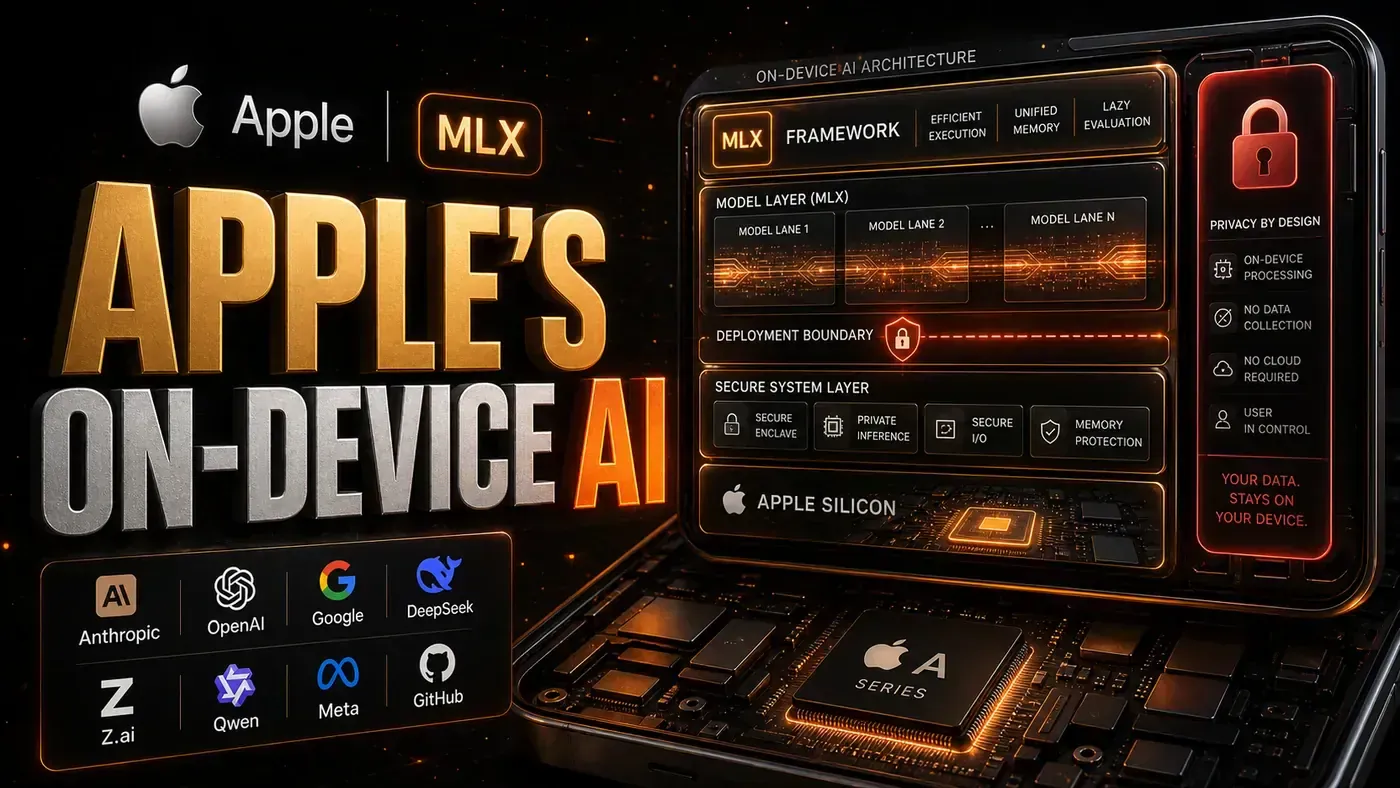
Most of the AI industry is chasing scale. Google, OpenAI, and Anthropic are pouring money into ever-larger cloud models, and the headline numbers keep climbing. Apple has spent years going the other way: building MLX (opens in a new tab), an open-source machine learning framework tuned for Apple Silicon, so that models run on the laptop, phone, or watch in front of you instead of on a server farm somewhere.
That choice matters to business teams for a plain reason. If the processing happens on your device, your data never leaves it. For anyone handling client records, patient notes, or financial details, that's not a feature you have to take on trust, it's a property of where the computation runs.
In mid-2026, a wave of coverage claimed Apple had shipped a big leap forward, sometimes branded "MLX 2.0," with eye-catching speed and memory numbers. We dug into those claims and most of them don't hold up against Apple's actual release history. The direction is real and worth understanding; several of the specific figures are not. Here's what the reports say, and where the evidence does and doesn't back them.
Performance Improvements
The reported 2.3x inference speedup is the figure to treat with caution. No source ties a 2.3x speedup to any MLX release. The only real "2.3x" in this space is a hardware spec, the M4 Pro's memory-bandwidth increase over the base M4, not a software gain from MLX, and optimisation guides for Apple Silicon (opens in a new tab) don't report it either. Apple's WWDC 2026 MLX announcement made no speedup claim at all.
The reported mechanism behind the supposed gain follows a sensible pattern, even if the headline number is unconfirmed: optimised kernels for the attention operations that dominate transformer compute, better use of the neural engine and GPU cores, request batching to keep the hardware busy, and tighter memory management between model layers. These are the right levers to pull. The dispute is over how much they actually moved the needle, not whether they exist.
The benchmark figures attached to this story are also unverified. Reports describe a 7B model jumping from 15 tokens per second to 34 on an M3 MacBook Pro, and a 13B model running at 18 tokens per second on a 16GB device. No published source provides those before-and-after numbers, and they don't match Apple's own MLX throughput research (opens in a new tab). Read them as illustrative at best. The broader point stands regardless: on-device generation is now fast enough for interactive work, translation, summarising, code completion, writing help, on recent Apple hardware.
The Privacy Implications
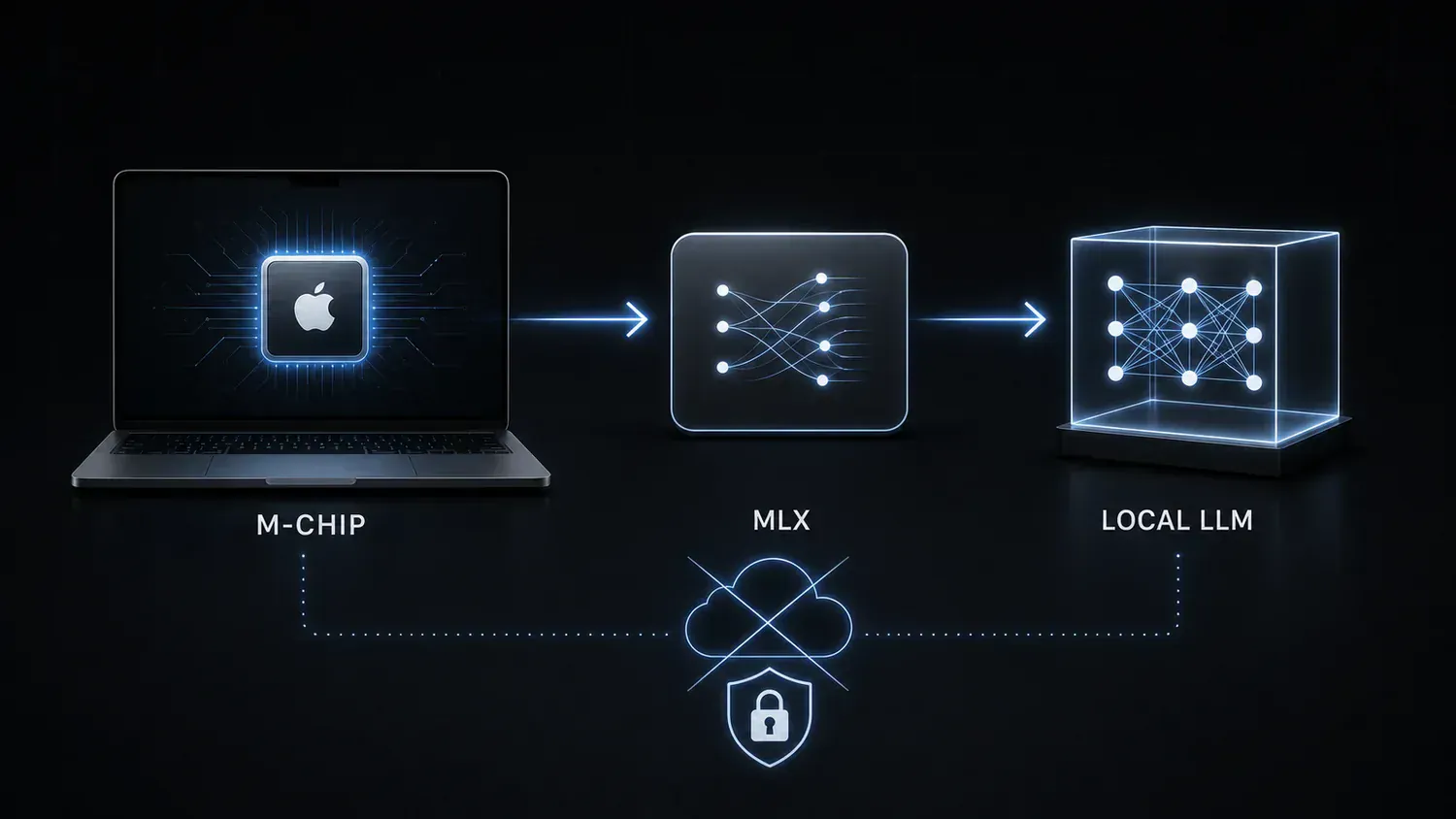
Apple's on-device strategy is built around privacy, and this part is genuine. When inference runs locally, nothing goes to Apple's servers, to a third-party API, or to anyone else. That's a real benefit grounded in where the work happens rather than in a privacy policy (opens in a new tab). One caveat on the language: the "cryptographic-grade guarantee" framing belongs to the cloud path described below, not to on-device inference itself, which is private simply because the data never moves.
The claim that this update unlocks 13B-parameter models on 16GB of unified memory is only partly true, and worth pinning down before you plan around it. Community testing (opens in a new tab) puts 16GB at comfortably running 7-8B models at 4-bit quantization; 13B and up generally wants 32GB or more. A heavily quantized 13B can technically load near the 16GB ceiling, but it leaves almost no room for context, so for real work, treat 16GB as a 7-8B machine, not a 13B one. No Apple source ties this to any MLX update.
Where capability genuinely jumps, the privacy case follows. A more capable on-device model can handle tasks that used to require a cloud call: detailed document analysis, longer multi-turn conversations, and content generation with finer style control. For healthcare, legal, and financial teams, moving that work onto the device changes what's possible without sending data out.
For tasks that outrun the device, Apple offers Private Cloud Compute (opens in a new tab). It routes demanding requests to Apple-managed servers under cryptographic guarantees that data is used only for the request, never stored, and that the system is open to independent verification. This is real, but note it dates to June 2024 as part of Apple Intelligence, not to any 2026 MLX update, despite some coverage presenting it as a new companion. The hybrid idea is the genuinely useful bit: on-device for routine work, the verifiable cloud path for the heavy lifting.
Developer Adoption
MLX has earned a real following, partly because it's open source under the MIT licence (opens in a new tab), still unusual for Apple. The often-quoted "28,000 GitHub stars" is rounded up; the repo showed roughly 27,100 stars, with other early-2026 counts closer to 24,600. Close enough to make the point, but not the exact number some reports give.
The conversion tooling does support the model families people actually want to run. MLX and its ecosystem (opens in a new tab) cover Llama (including Llama 4), Qwen (including Qwen 3), and smaller GLM and DeepSeek variants, so bringing a capable open-weights model to Apple hardware is straightforward.
One widely repeated figure has no traceable source: the claim that over 8,000 App Store apps now use MLX, up from 3,500 six months earlier. We couldn't find any Apple statement or WWDC 2026 coverage (opens in a new tab) reporting those counts, so treat the adoption numbers as unconfirmed. The use cases the reports name, photo and video editing, writing assistance, translation, and accessibility features like live captioning, are plausible and match where on-device AI tends to show up.
Apple's MLX Update and What On-Device AI Unlocks: answer-first summary
Apple's MLX Update and What On-Device AI Unlocks matters because it can change how Founders and operators plan, build, or govern an secure AI workflow. Apple's MLX update sharpens on-device AI on Apple Silicon.
The direct answer is this: do not treat the topic as a standalone trend. Treat it as a decision about inputs, outputs, review ownership, data exposure, and whether the workflow produces a result that is faster, safer, or more useful than the current process.
Apple's MLX Update and What On-Device AI Unlocks: implementation checklist
- Define the user, job to be done, and success metric for the secure AI workflow.
- Collect real examples, policies, source files, customer questions, or search queries before writing prompts or choosing tools.
- Separate low-risk drafts from decisions that need approval, privacy checks, or senior review.
- Document what the AI is allowed to access, what it must not access, and who signs off before production use.
- Review retrieval accuracy, permission failures, review exceptions, time to answer after a small pilot rather than judging the idea from a demo.
This keeps the work practical. It also gives search engines and AI answer engines a clean factual structure: what the topic is, who it helps, what to do next, and which risks matter before implementation.
Decision criteria for Apple's MLX Update and What On-Device AI Unlocks
| Decision area | What to check | Production signal |
|---|---|---|
| Intent | Does Apple's MLX Update and What On-Device AI Unlocks solve a real workflow problem? | The use case has a named owner and measurable outcome. |
| Data | Can the required data be used safely? | Sensitive data is classified and access is controlled. |
| Quality | Can a reviewer judge the output consistently? | Examples, rubrics, or acceptance criteria exist. |
| Scale | Can the workflow be repeated without hero effort? | The process is documented and can be handed to another team member. |
Practical example for Apple's MLX Update and What On-Device AI Unlocks
A small business could use this article to choose one practical test. For example, a manager might take one customer-facing process, one internal document workflow, or one recurring content task and redesign only that step with AI support. The goal is not to automate the whole business at once; it is to learn where AI News creates reliable leverage.
The useful deliverable is a short operating note: the trigger, the source material, the prompt or tool, the review checklist, the escalation rule, and the metric. That note becomes the handover asset for staff training, SEO/GEO content, service delivery, or future agent work.
Risks and controls for Apple's MLX Update and What On-Device AI Unlocks
The common failure pattern is moving too quickly from a promising idea into an unmanaged workflow. For Apple's MLX Update and What On-Device AI Unlocks, the risk is not only bad output. It can also be unclear data permission, staff confusion, duplicate content, unreviewed customer advice, or a tool that quietly changes cost or capability.
- Control data leakage with a named owner, a review step, and written acceptance criteria.
- Control weak access control with a named owner, a review step, and written acceptance criteria.
- Control unlogged retrieval with a named owner, a review step, and written acceptance criteria.
- Control unclear retention rules with a named owner, a review step, and written acceptance criteria.
Measurement plan for Apple's MLX Update and What On-Device AI Unlocks
A useful AI or SEO initiative should leave evidence. Track retrieval accuracy, permission failures, review exceptions, time to answer and compare the pilot against the current process. If the measure does not improve, keep the learning but avoid scaling the workflow.
For GEO readiness, the page should also answer the core question directly, define the entities involved, include implementation steps, explain tradeoffs, and link readers to the next relevant AI Kick Start service, guide, tool, or article.
Definitions and entities for Apple's MLX Update and What On-Device AI Unlocks
For search, GEO, and staff handover, define the core entities in plain language. In this article the important entities are the workflow owner, the AI tool or model, the source material, the review process, the risk boundary, and the measurable business outcome. Clear definitions make the page easier for people to scan and easier for AI answer engines to quote accurately.
- Workflow owner: the person accountable for deciding whether Apple's MLX Update and What On-Device AI Unlocks belongs in the business process.
- Source material: the documents, examples, policies, URLs, prompts, videos, or customer questions that ground the output.
- Review boundary: the point where a human checks accuracy, privacy, brand voice, or customer impact before the result is used.
- Success metric: the measure that proves whether the secure AI workflow is worth repeating.
Apple's MLX Update and What On-Device AI Unlocks versus doing nothing
Doing nothing is also a decision. The cost may be slow manual work, weaker search visibility, inconsistent advice, duplicated effort, or staff using unmanaged AI tools without a shared process. The practical question is whether a controlled pilot can reduce that cost without creating a larger governance problem.
| Option | When it makes sense | What to watch |
|---|---|---|
| Do nothing | The workflow is rare, low value, or already reliable. | Competitors may improve speed, content depth, or service consistency first. |
| Run a small pilot | The task repeats often and has clear review criteria. | Keep scope tight and measure the result against the current process. |
| Build a production workflow | The pilot is repeatable and risk controls are documented. | Assign ownership, monitoring, training, and a rollback path. |
AI Kick Start handover package for Apple's MLX Update and What On-Device AI Unlocks
A production handover should be concrete enough that another person can run it. For Apple's MLX Update and What On-Device AI Unlocks, that means a short brief, a workflow map, approved prompts or tool settings, source material, a review checklist, internal links to supporting resources, and a simple measurement sheet. This is the difference between reading about AI and turning it into operational capability.
That packaging also strengthens E-E-A-T. It shows experience through implementation notes, expertise through decision criteria, authoritativeness through source-aware structure, and trust through risks, controls, and review steps. The article becomes useful even if the reader never buys a tool because it helps them make a better operational decision.