


Introduction: Why This One Belongs on the Watchlist
The phrase "agentic workflows" has moved from a research term into the procurement language of Australian operations leaders faster than most teams have built a shared definition of what it means. The reason it matters for AI Kick Start readers is practical: this is not another launch to admire from a distance. It shapes how founders, operators, and technical teams should think about agentic workflows Australia work over the next few quarters, and the difference between a controlled pilot and an over-extended rollout is the difference between a defensible bet and a six-month cleanup. The conversation in Australian operations circles keeps circling the same three signals. A Melbourne-based operations director at a mid-market professional services firm wants to know whether an agentic workflow can take over the first draft of a client onboarding pack without breaching the firm's professional indemnity insurance. A Brisbane-based head of customer operations at a national retailer wants to know whether an agent can triage the after-hours inbox reliably enough that the Monday backlog stops being a recurring crisis. A Perth-based operations manager at a mining services company wants to know whether an agentic workflow that handles purchase-order matching will still produce a defensible audit trail when the ATO comes calling. The useful lens is the pilot design, not the product demo. For Australian small businesses and technical teams, the right question is not "is this impressive?" The right question is "where does this reduce friction without creating a larger governance, security, or maintenance problem?" That filter matters even more in Australia because the regulator expectations, the document conventions, and the indemnity landscape are not generic - and a workflow that would pass a US-based review can still fail an Australian one for reasons that have nothing to do with the model. If you are looking for the practical foundation before you sign anything, our [agentic workflows guide for Australian operators](/services) is the starting point. For the longer walkthrough grounded in real operating hours, this article is the read.
What the Article Actually Shows
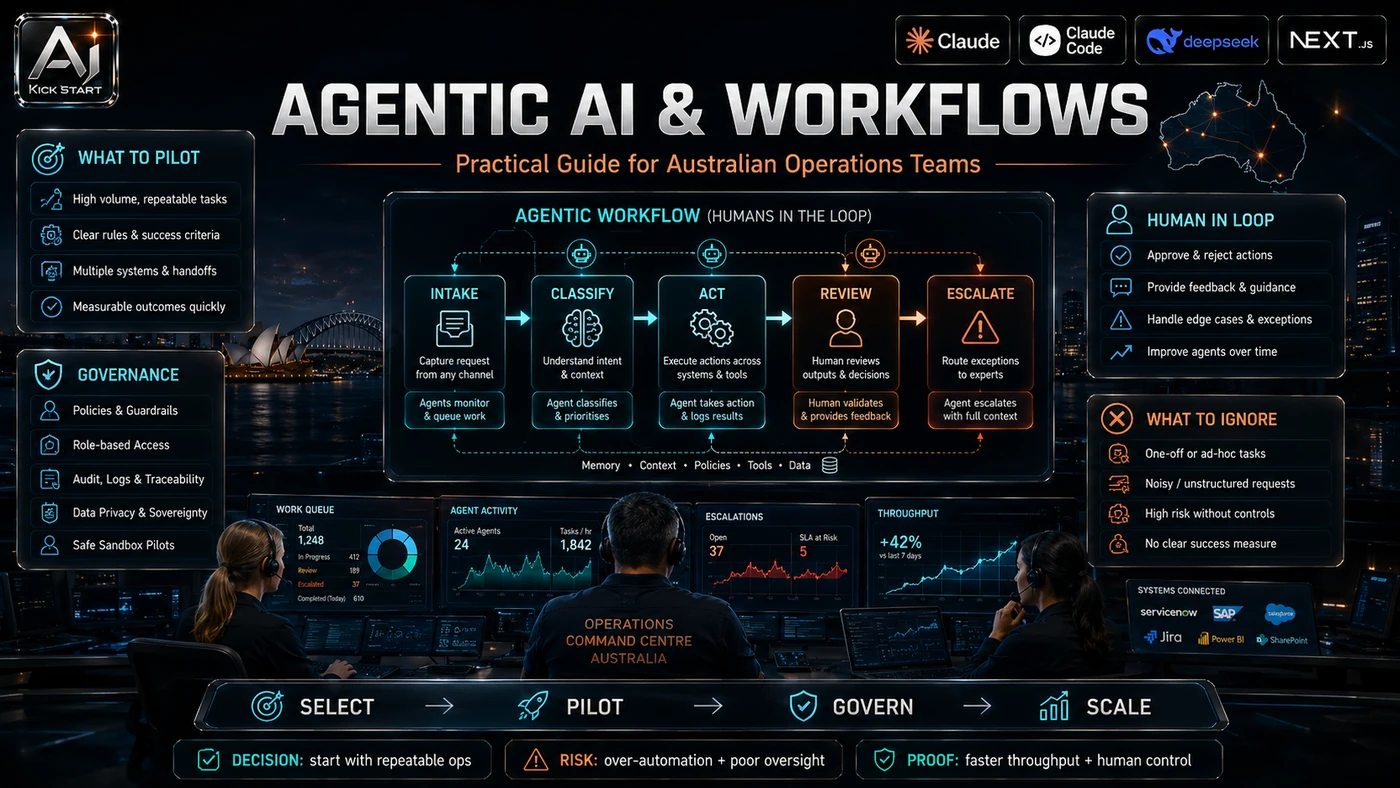
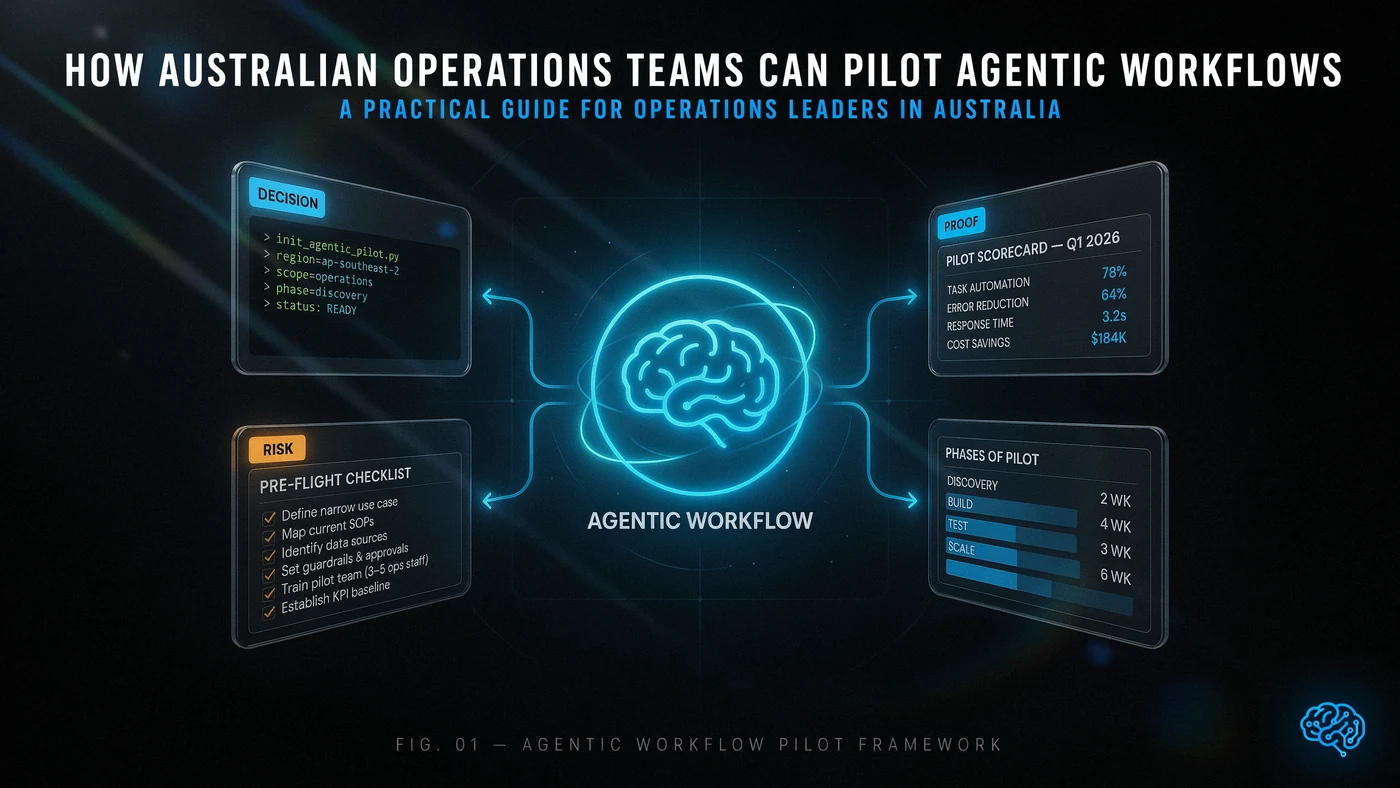
The core pattern is simple: pick one bounded workflow with clear inputs and a clear review point, build a small agent that can do the bounded work, put a human owner on the review, and only then expand to a second workflow. In practice, that means agentic workflows Australia teams can actually run are not the agentic workflows that show up in vendor demos - they are the ones where the workflow can be described in one paragraph and the failure mode can be described in one sentence. The pieces that show up again and again in conversations with Australian operations leaders are: a written definition of the workflow that fits on a page a single named human owner who is paid to review the output a fixed review budget per week, not per quarter a kill switch that any reviewer can pull without escalation an export of every prompt, every decision, and every tool call for the audit log. That is the level at which teams should evaluate it. A demo can be entertaining, but a workflow must survive staff handoff, data boundaries, and real deadlines. To see how a build-your-own multi-agent crew looks in practice, the [Hermes AgentOS walkthrough](/news/article-7qzgAkDN0q0) is the closest reference in the AI Kick Start catalogue, and the [Claude Code loop engineering article](/news/article-JHOSn3FXzzI) - paired with the [Claude Code launch your agent guide](/news/article-cxQLKsktiBA) - shows the developer side of the same pattern. For the cost conversation that always lands six weeks into a pilot, the [DeepSeek DualPath article](/news/article-mG4SmhWyeFA) explains why the per-token economics have shifted and why the bill is not what it would have been twelve months ago.
The Implementation Pattern
The first implementation lesson is to narrow the scope. Pick the workflow that already has a human owner, a measurable output, and a known failure mode - and only that workflow. Broad adoption is usually where agentic workflows Australia fail first because nobody knows which decision the agent is allowed to make and which decision still belongs to a human, and a regional operations team cannot afford the political cost of a bot that quietly misroutes a customer email twice a week. The second lesson is to create a test harness. A useful harness does not have to be complicated. It can be a short brief, ten real examples drawn from last month's actual work, a target accuracy or turnaround time, and one person responsible for judging whether the result is good enough. For an Australian professional services firm, that harness might be ten redacted client onboarding packs, a target draft turnaround under one business day, and a documented human review step before any pack leaves the firm. For a national retailer, it might be ten real customer emails, an expected reply in the brand's own voice, and a clock on the wall. For a resources or infrastructure operator, it might be ten purchase-order line items, a target match accuracy, and a documented check that the matched PO matches the source contract. The third lesson is to capture the process. Document the prompt pack, the tool list, the review rules, the kill switch, and the fallback plan. When the process is documented, it can become a reusable checklist, prompt pack, agent definition, or operating procedure that survives staff turnover. When it is not documented, the team is back to improvising in chat - and an Australian operations team cannot afford that, because the next hire may not arrive for three months and the regulator will not accept "the bot did it" as a defence.
Research Update: What To Correct
This update adds a current-source pass rather than treating the Australian agentic workflows market as already mature. The important corrections are the product surface, the legal and insurance surface, and what should be verified before an operations team depends on the workflow. Treat "agentic workflows Australia" as a category of patterns, not a single product. The useful distinction is single-agent workflow, multi-agent crew, human-in-the-loop pipeline, and fully autonomous loop. They overlap, but they do not overlap on accountability, auditability, or what the regulator will accept. Pricing benchmarks for Australian operations pilots in late 2025 and early 2026 sit between roughly A$8,000 and A$45,000 for a four-to-eight-week scoped engagement, with ongoing managed agent retainers between roughly A$2,500 and A$12,000 per workflow per month depending on review burden, model tier, and tool integrations - but always validate against your own scope, because "agentic workflow" pricing in Australia is not yet standardised and one vendor's pilot is another vendor's strategy deck. Legal and insurance obligations matter: the Australian Prudential Regulation Authority's CPS 230 Operational Risk Management standard, which took effect from 1 July 2025, requires APRA-regulated entities to identify and manage operational risks including those introduced by third-party arrangements and critical operations, and an agentic workflow that touches a critical operation is squarely inside that scope. The Australian Securities and Investments Commission has also been active on AI washing and on misleading conduct around AI capabilities, with enforceable undertakings and Federal Court action in 2024–2025 against vendors and licensees who overstated what their AI tools could do. The Office of the Australian Information Commissioner has published specific guidance on privacy and automated decision-making, and the Notifiable Data Breaches scheme applies whenever an agentic workflow handles personal information. Confirm in writing that the proposed workflow logs every prompt, every tool call, and every decision in a format your auditor can read, and confirm that the workflow's outputs do not exceed the scope of authority your professional indemnity, your financial services licence, or your healthcare registration actually grants you.
Practical Setup and How-To
The useful next step is a controlled pilot with a named owner, fixed inputs, a measurable output, and a review point. Use the sequence below as the first implementation path before expanding the workflow. For an Australian operations team that wants to pilot agentic workflows without committing budget for the year, start by writing a one-page scope that names the workflow, the data inputs, the tool list, the review path, and the exit criteria. Send that scope to two or three providers or to your internal platform team and ask for a fixed-price pilot proposal against it, not a generic "agentic AI" deck. Confirm in writing where the data will be stored, who has access, how it will be deleted at the end of the pilot, whether your prompts and fine-tuning data will be used to train the provider's base models, and which Australian privacy, consumer, and sector-specific obligations apply to the workflow. Run the pilot against your real workload for twenty working days, not against cherry-picked examples, and make sure the test days include a Monday, a Friday, a public holiday or rostered day off, and at least one day when your usual reviewer is on leave so the fallback path gets exercised. Capture turnaround time, accuracy on your harness, staff time saved, and any errors that would have caused a regulator-visible or customer-visible problem. Compare across providers on the same harness, and only then move to a longer contract. If the vendor cannot produce the audit-trail and data-handling answers in writing inside the first call, treat that as the answer and move to the next provider on your list. If your internal platform team cannot produce those answers either, the workflow is not ready for production regardless of who built it.
Pricing, Access, and Comparison Notes
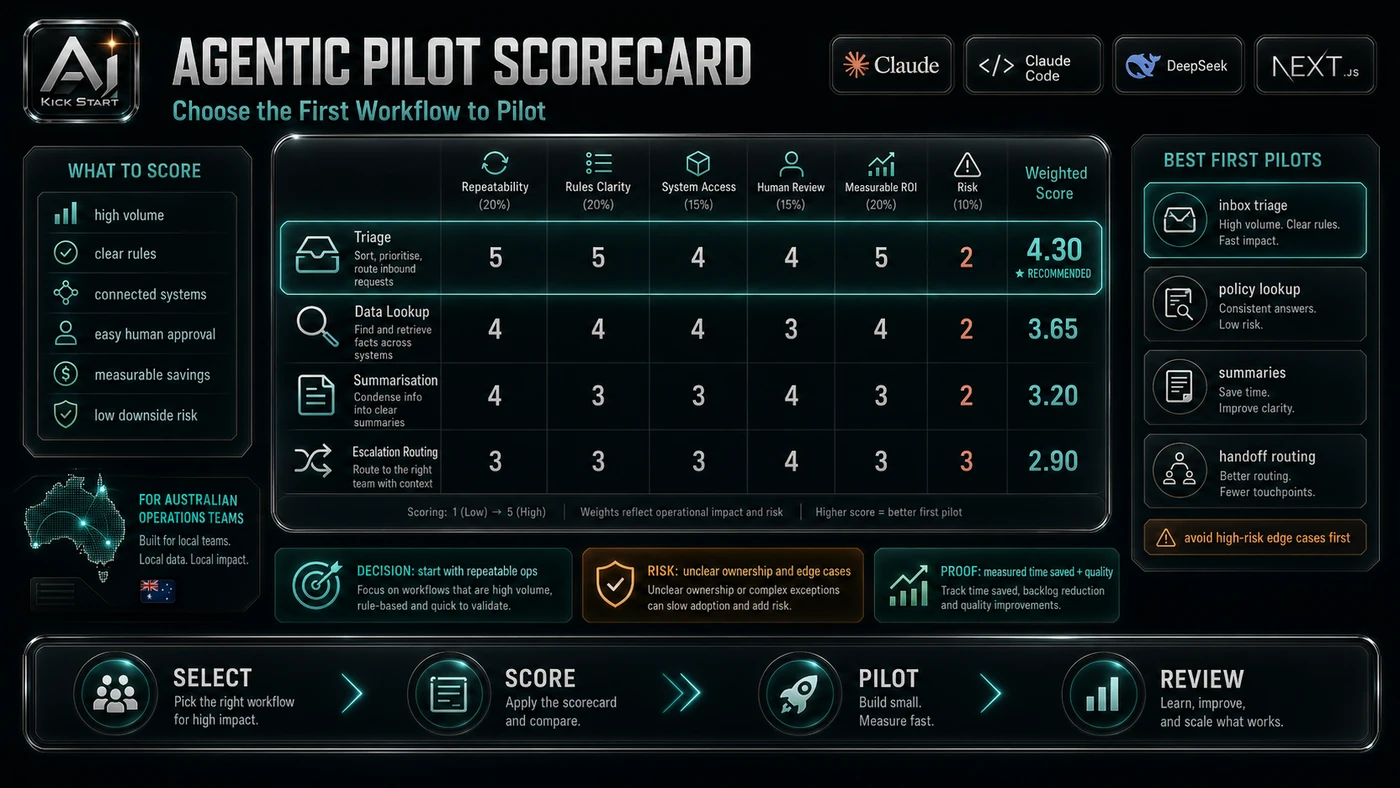
Pricing and access should be checked at implementation time because AI vendor pricing in Australia changes quickly. The safer decision is to compare the tool against the job-to-be-done, not against the marketing deck. A specialist agentic workflows consultancy in Australia will typically charge between A$180 and A$280 per hour for senior engineers and between A$220 and A$380 per hour for partners, with a four-to-eight-week pilot typically landing between A$15,000 and A$60,000 depending on workflow complexity, integration depth, and review burden. A regional agency or Sydney-or-Melbourne-franchised partner will often price a comparable engagement 20 to 40 per cent lower on the implementation line but pass through model API costs at a margin. A global vendor with no Australian presence can undercut those numbers on raw model access, but the cost of timezone translation, security review, and the inevitable Australian-specific compliance retrofit will usually close the gap and then some. Model API costs are a separate line item: hosted frontier models in 2026 typically bill between roughly US$0.50 and US$15 per million tokens depending on model tier, and an agentic workflow that runs many tool calls per task can easily consume 5 to 50 times the tokens a single chat turn would, so a budget that looked comfortable on the chat-only quote can become the dominant line item on the agentic quote. Always separate the implementation labour, the platform or subscription fee, the variable model cost, and the review labour - a low implementation price paired with an unpriced model tier and an unpriced review budget is a warning sign, not a saving. For an Australian operations team, the comparison should also weigh the audit-trail cost: a vendor that does not log every tool call by default will charge you to retrofit the logs later, and that retrofit is usually more expensive than the original engagement. Access Pilot length, region, account type, admin controls, rate limits, audit-log export, and exit clauses. Cost Implementation labour, subscription, model API tokens, retries, hardware, review labour, audit-log storage, and support burden. Fit Workflow reliability, data handling, output quality, observability, human approval needs, and regulator acceptance.
Implementation Notes for Teams
For AI Kick Start readers, this is the production filter: keep the first rollout narrow, make the evidence visible, and do not let the agent cross a business boundary until the review model is clear. Define the workload profile first because the same agentic workflow will perform very differently on a ten-document inbox versus a thousand-document archive, and a regional operations team that runs the test on the wrong dataset will arrive at the wrong conclusion about the platform. Check data residency because Australian organisations handling personal information, health data, financial services client data, or government-adjacent workloads have legal obligations that change the answer to "is the cheapest provider good enough?" - and an Australian operations leader who handles client files in the financial, legal, health, or NDIS space should treat data residency, audit logging, and access controls as non-negotiable rather than preferences. Confirm the exit clause because an operations team that gets locked into a twelve-month contract with a vendor that cannot answer a basic audit-log question in writing is paying twice - once in fees, once in the cost of replacing the workflow later - and the cost of that replacement is usually twice what the original engagement would have cost if it had been scoped properly. Keep a fallback provider with a kill switch, and make sure the prompts, tool definitions, and decision logs sit in a repository you control rather than only inside the vendor's console. For an Australian operations team, that usually means a shared drive, a version-controlled repository, or a SIEM export that the operations lead can hand to a new vendor in a single afternoon, and that single-afternoon handover test is worth performing before signing the contract rather than after. Plan for observability: a regional operations team that cannot see what the agent did last Tuesday will not be able to explain a regulator query, a board question, or a customer complaint, and "the agent did it" is not an answer a regulator, a board, or a customer will accept.
Screenshot and Visual Guidance
The second inline image for this article should make the implementation concrete: a clean agent run-log showing the prompt, the tool calls, the decision, the reviewer, the reviewer note, and the final outcome for one task, with the timestamps and the audit-log export visible in plain language rather than in a marketing screenshot. If the team is documenting a real rollout, capture setup screens, before/after outputs, permission settings, cost meters, kill-switch tests, and review evidence rather than decorative screenshots - the screenshots that matter are the ones your auditor can use to reconstruct the workflow without phoning the vendor.
Where It Fits for Real Teams
For founders, the opportunity is speed with evidence. A short fixed-price agentic workflows pilot with a single bounded workflow will tell you more in four weeks than a six-month "agentic AI strategy" retainer, and the evidence will survive the next staff change in a way that a slide deck will not. For operators, the value is consistency. The right workflow should produce the same output for the same input regardless of which staff member is on shift, and that consistency is the actual product you are buying. For technical teams, the value is leverage. A strong agentic setup lets agents take on repeatable work while engineers keep control over architecture, security, deployment, and final judgement. The practical fit is strongest when the task has clear source material, a known output format, a low-cost way to verify quality, and a clear regulator or insurance position. It is weaker when the task is vague, politically sensitive, legally risky, or dependent on facts that cannot be checked. For Australian professional services firms - accountants, lawyers, allied health practices, mortgage brokers - the regional fit is strongest where the workflow sits behind a clear partner sign-off, and weakest where the workflow would cross into unsupervised client communication. For national retailers and customer operations teams, the fit is strongest in the after-hours, high-volume, low-stakes inbox and weakest in the public-facing complaint escalation path. For resources, infrastructure, and government-adjacent operators, the fit is strongest in the back-office document and reconciliation layer and weakest in any workflow that touches a critical operation under APRA CPS 230 without an explicit control plan in place.
Trade-offs and Risks
The main risk is accountability drift. That risk can be managed, but only if it is named before the workflow becomes normal. A second risk is scope creep, where the same agent that started in the after-hours inbox quietly ends up answering customer-facing complaints because the operations lead did not draw the boundary in writing, and the agent's first public mistake lands on the front page rather than in the back office. AI systems often look better in a screen recording than they feel inside a production workflow. The test is whether the result is repeatable when the source material changes, the operator changes, and the deadline is real. A third risk is regulator exposure, particularly for APRA-regulated entities, AHPRA-registered practitioners, legal practitioners, tax agents, and any operator handling personal information under the Privacy Act - an agentic workflow that operates without the controls those regimes expect will create an enforcement risk that is bigger than the efficiency gain. A fourth risk is the "demo to production" gap: an agentic workflow that works on a vendor's curated test set will behave differently on the messy, inconsistent, politically sensitive real workload of an Australian operations team, and that gap is usually where the first three months of post-pilot cleanup are spent. This is why AI Kick Start generally recommends a staged rollout: sandbox first, internal use second, customer-facing deployment last, and regulator-visible deployment only after the audit trail and review model have been tested end-to-end.
The Next Sensible Test
The next sensible test is a small controlled implementation. Pick one workflow, one owner, one expected output, and one acceptance check. Run it twice. If the second run is easier than the first, the pattern is worth keeping. Do not judge the workflow by the best possible demo. Judge it by the worst acceptable production case. Ask: what happens when the source file is incomplete, the tool is unavailable, the agent loops, the output is wrong, or a staff member needs to explain the result to a customer, a regulator, or a board? If those answers are clear, this belongs in the roadmap. If they are not, it belongs in the lab until the operating model catches up. For an Australian operations team evaluating agentic workflows Australia options, the most useful version of this test is also the cheapest: pick the workflow that has the clearest owner and the clearest failure mode, run the pilot against your real workload, and decide on the evidence. The cost of that pilot is almost always less than the cost of rolling out the wrong workflow to a thousand customers, and the evidence will be useful even if the decision is to wait six months before doing anything else.
Australian Operations Patterns Worth Naming
Australian operations teams do not all share the same workload profile, and the agentic workflows that fit a Sydney fintech back office will not all fit a Brisbane field-services dispatcher or a Perth resources document controller. Four patterns show up often enough in conversations with Australian operations leaders to be worth naming explicitly. The first is the professional services operations pattern across Sydney, Melbourne, Brisbane, and Perth: low-volume but high-stakes client work, partner-level accountability, and a regulator or insurer whose name is on every workflow. The agentic workflows that work here are the ones that improve document turnaround and evidence gathering without crossing the line into unsupervised client communication, and the ones that can produce a defensible audit trail to a Tax Practitioners Board, a Legal Services Commissioner, an AHPRA notification, or a professional indemnity insurer. The second is the national customer operations pattern across retail, telco, utilities, and travel: high-volume customer contact, multilingual customers, twenty-four-hour service expectations, and a public-facing brand that cannot afford a viral mistake. The agentic workflows that work here are the ones that handle the after-hours, high-volume, low-stakes inbox reliably and hand off to a human cleanly for the public-facing complaint escalation, the vulnerable-customer interaction, and the regulator-visible complaint handling. The third is the resources, infrastructure, and government-adjacent operations pattern across mining, energy, transport, and the broader federal and state procurement supply chain: low-volume but regulator-visible document work, a critical-operation exposure under CPS 230 or equivalent state frameworks, and a workforce that is rarely sitting at a desk. The agentic workflows that work here are the ones that produce a clear audit log, sit behind a named human owner, and do not touch a critical operation without an explicit control plan in writing. The fourth is the SMB and regional operations pattern across the Illawarra, the Hunter, the Sunshine Coast, regional Victoria, and the rest of regional Australia: small operations teams wearing multiple hats, a workforce that is paid to do the work rather than to review the work of an agent, and a vendor ecosystem that is uneven. The agentic workflows that work here are the ones that survive a small team without a dedicated AI engineer, the ones that the founder can hand to a new vendor in a single afternoon, and the ones whose audit log a regional auditor or a state regulator can actually read. An Australian operations leader who picks a vendor or platform that understands which of those four patterns the team sits inside will get further in a quarter than one that picks the vendor with the loudest conference booth.
What "Australian-Ready" Actually Means in Practice
A reasonable question from a global vendor is "why does Australian-ready matter when the model is the same?" The honest answer is that Australian-ready buys five things that an offshore-default vendor will struggle to substitute without an explicit retrofit. First, it buys data residency that satisfies APRA, OAIC, the Department of Home Affairs, and the state-based health records and privacy regimes, with the audit-log export that comes with that residency. Second, it buys regulator literacy: a vendor who has read CPS 230, the Privacy Act, the Notifiable Data Breaches scheme, the AI Ethics Framework, and the relevant state health records legislation will arrive at the scoping call already knowing which controls the workflow has to ship with. Third, it buys indemnity literacy: a vendor who can speak to your professional indemnity insurer, your financial services licensee, or your AHPRA registration in language the underwriter accepts is worth more than a vendor who can speak to a venture capital investor in language the conference accepts. Fourth, it buys timezone and roster compatibility: an Australian operations team that runs a twenty-four-hour operation needs an agent that does not go dark during the AEST business day, and an offshore support team that does not know what a "rostered day off" is will quietly break the workflow twice a quarter. Fifth, it buys continuity: when the agentic workflows vendor changes its own model, changes its own pricing, or changes its own region, the Australian-ready vendor will tell you before it happens, and the offshore-default vendor will tell you after. None of those five advantages is absolute, and a global vendor with a strong Australian practice can match them. But the default assumption - that an Australian operations leader should ask why the workflow is Australian-ready and what that label buys them in writing - is still the right default assumption, and the answer should be specific rather than vague.
Helpful Resources
APRA - CPS 230 Operational Risk Management (opens in a new tab) ASIC - Information Sheet 271 AI washing and the Corporations Act (opens in a new tab) OAIC - Privacy and automated decision-making guidance (opens in a new tab) OAIC - Notifiable Data Breaches scheme (opens in a new tab) AHPRA - National Boards and AI in healthcare (opens in a new tab) Tax Practitioners Board - Technology and AI guidance (opens in a new tab) Department of Industry, Science and Resources - Australia's AI Ethics Framework (opens in a new tab) National AI Centre - Responsible AI Index (opens in a new tab) Related AI Kick Start reading: [Hermes AgentOS: a build-your-own multi-agent crew](/news/article-7qzgAkDN0q0) · [Claude Code loop engineering](/news/article-JHOSn3FXzzI) · [Claude Code launch your agent](/news/article-cxQLKsktiBA) · [Crabbox: agent harness notes](/news/article-iYG5tiFfK3E)