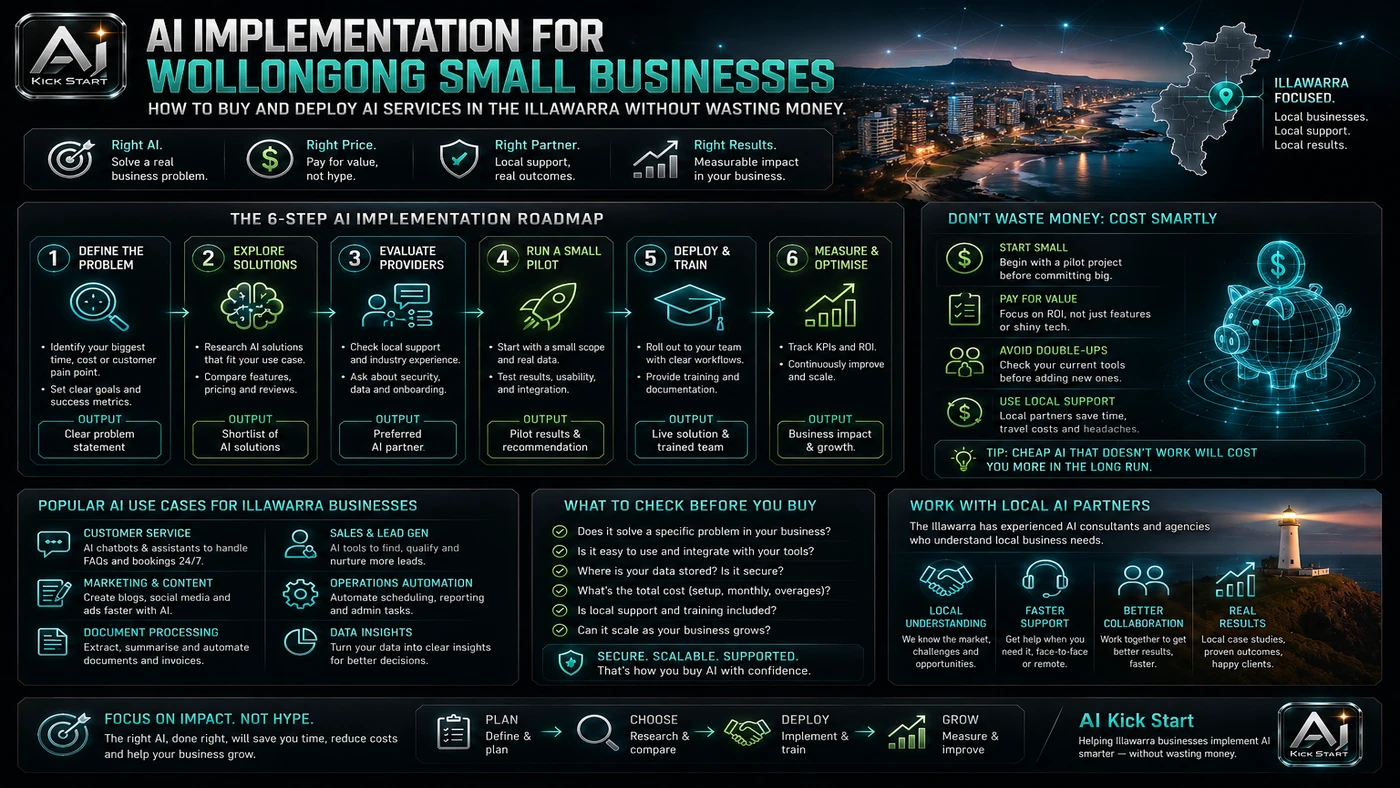
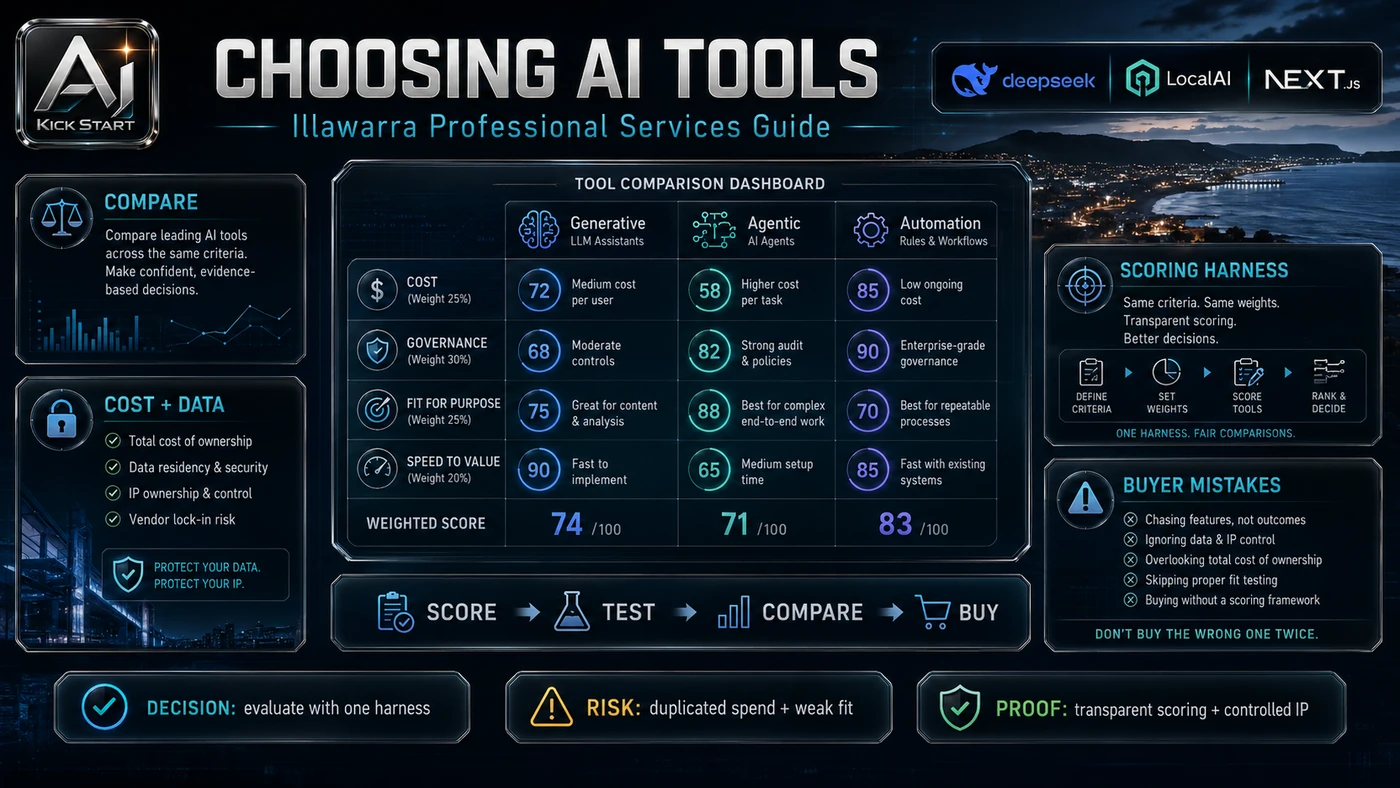



Introduction: Why This One Belongs on the Watchlist
The AI tools catalogue for Australian professional services firms has exploded in 2025 and 2026, and Illawarra-based accounting, legal, allied health, surveying, engineering, and consulting practices are now being pitched by global vendors, Sydney-franchised partners, regional MSPs, and direct-to-consumer SaaS products in roughly equal measure. The reason it matters for AI Kick Start readers is practical: this is not a launch to admire from a distance. It shapes how founders, operators, and technical teams should evaluate AI tools Illawarra work over the next few quarters, and the difference between a defensible toolset and an over-extended one is the difference between a quarter of efficiency gain and a year of cleanup. The conversation in local Illawarra professional services circles keeps circling the same three signals. A Wollongong accounting firm wants to know whether a generative AI tool for client letters will pass a Tax Practitioners Board review and an ATO record-keeping audit, and whether the same tool will be defensible when the firm's professional indemnity insurer renews. A Shellharbour legal practice wants to know whether a document-review tool will hold up to a Legal Services Commissioner inquiry and a discovery production deadline. A Kiama or Nowra allied health practice wants to know whether a clinical note-taking tool will satisfy the Australian Privacy Principles and the relevant state health records legislation when a notifiable data breach happens. The useful lens is the procurement filter, not the feature comparison. For Australian small businesses and technical teams, the right question is not "which tool is most capable?" The right question is "which tool will survive the regulator, the insurer, the partner sign-off, and the next staff change?" That filter matters even more in a regional market, where the local talent pool is smaller, the failure modes are quieter, and a bad tool decision can sit unchallenged for a quarter before anyone notices - usually when the audit lands and the workflow has stopped working. If you are looking for a structured way to plan the procurement before you sign anything, our [practical AI tools guide for Australian operators](/services) is the starting point. For an Illawarra-specific buying walkthrough grounded in operator hours, this article is the longer read.
What the Article Actually Shows
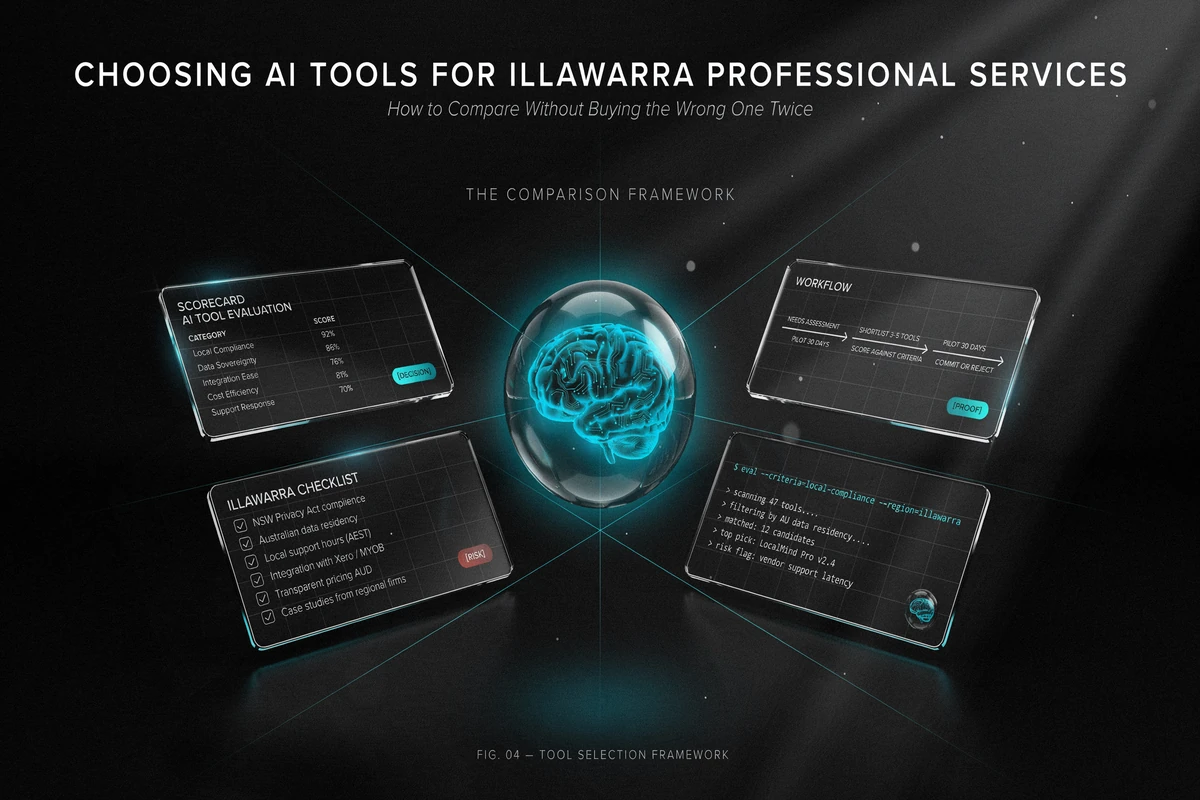
The core pattern is simple: define one measurable job, score each candidate against a fixed harness, pilot the top two on real client work, and only then expand. In practice, that means AI tools Illawarra professional services firms actually keep are not the AI tools that show up in vendor demos - they are the tools that pass the five-question procurement filter before the first invoice is paid. The pieces that show up again and again in conversations with Wollongong, Shellharbour, Kiama, and Nowra partners are: a written scope that names the workflow the tool will and will not touch an audit-log export that a regulator or insurer can read a data-residency answer that is in writing rather than in a sales call a clear answer on whether prompts, fine-tuning data, and client files will be used to train the vendor's base models an exit clause that lets you export prompts, embeddings, fine-tuning weights, and integration configs in a single afternoon. That is the level at which teams should evaluate it. A demo can be entertaining, but a procurement decision must survive staff handoff, partner rotation, data boundaries, and real deadlines. To see how the model layer is shifting under these workloads, the [DeepSeek DualPath article](/news/article-mG4SmhWyeFA) explains why the per-token economics for long-context and agentic workloads have moved in 2026, and the [Hermes AgentOS walkthrough](/news/article-7qzgAkDN0q0) is a useful reference for the kind of internal platform structure that makes a multi-tool rollout workable. For the conceptual foundation that every partner and practice manager should share before any procurement begins, the [20 AI concepts explained guide](/news/article-aanqEqQwjNU) is the closest reference in the AI Kick Start catalogue, and the [ByteDance Seedance coverage](/news/article-8sGVhuoPOXI) and the [Trellis 2 GGUF writeup](/news/article-xVJSiBQ625Y) are useful references for the kind of creative-side tools that an Illawarra firm may add to the procurement list once the document and language workflows are stable.
The Implementation Pattern
The first implementation lesson is to narrow the scope. Pick the workflow that already has a partner sign-off, a measurable output, and a known failure mode - and only that workflow. Broad adoption is usually where AI tools fail first because nobody knows which decision the tool is allowed to make and which decision still belongs to a partner, and a regional professional services firm cannot afford the reputational cost of a bot that quietly misroutes a client email twice a week. The second lesson is to create a test harness. A useful harness does not have to be complicated. It can be a short brief, ten real examples drawn from last month's actual client work, a target accuracy or turnaround time, and one partner responsible for judging whether the result is good enough. For a Wollongong accounting firm, that harness might be ten redacted client letters, a target draft turnaround under one business day, and a documented partner review step before any letter leaves the firm. For a Shellharbour legal practice, it might be ten redacted discovery documents, a target extraction accuracy against a known ground truth, and a documented review by a senior associate before any document is produced. For a Kiama or Nowra allied health practice, it might be ten redacted clinical notes, a target note-completion time, and a documented clinician sign-off before any note is added to the patient record. The third lesson is to capture the process. Document the prompt pack, the tool list, the review rules, the kill switch, and the fallback plan. When the process is documented, it can become a reusable checklist, prompt pack, vendor scorecard, or operating procedure that survives staff turnover. When it is not documented, the team is back to improvising in chat - and an Illawarra professional services firm cannot afford that, because the next hire may not arrive for three months and the regulator will not accept "the tool did it" as a defence.
Research Update: What To Correct
This update adds a current-source pass rather than treating the AI tools Illawarra market as obvious or already well-mapped. The important corrections are the buyer surface, the pricing and contract shape, and what should be verified before a team depends on a tool. Treat "AI tools Illawarra" as a category of products, not a single category. The useful distinction is generative language tools, document and OCR tools, voice and transcription tools, agentic and orchestration tools, image and creative tools, and traditional automation and RPA tools. They overlap on capability, but they do not overlap on auditability, regulator acceptance, or what happens when a client asks for the source of an output. Pricing benchmarks published across Australian industry coverage in late 2025 and early 2026 put professional-services AI tool subscriptions between roughly A$30 and A$350 per user per month for the language and document layer, between roughly A$80 and A$600 per user per month for the voice and transcription layer, and between roughly A$200 and A$2,500 per workflow per month for the agentic and orchestration layer - but always validate against your own scope, because AI tool pricing in Australia is not yet standardised and the same vendor can quote a "professional" tier at three different numbers depending on the negotiation. Sovereignty and regulator obligations matter: Australian organisations handling personal information, health data, financial services client data, or government-adjacent workloads are subject to the Privacy Act 1988 and the Notifiable Data Breaches scheme, and sector-specific regulators including the Tax Practitioners Board, the Legal Services Commissioners in each state and territory, AHPRA, and the Australian Prudential Regulation Authority all have published or signalled expectations for AI-assisted work that touches client files. Confirm in writing where the model is hosted, where the data is stored, who has access, how the data will be deleted at the end of the contract, and whether your prompts, fine-tuning data, and client files will be used to train the vendor's base models - the answer to that last question is the single biggest red flag or green flag in any AI tool relationship, and the default answer from many vendors is "yes, unless you opt out and pay more", which is the wrong default for any Illawarra firm handling client files.
Practical Setup and How-To
The useful next step is a controlled pilot with a named owner, fixed inputs, a measurable output, and a review point. Use the sequence below as the first implementation path before expanding the toolset. For an Illawarra professional services firm that wants to evaluate AI tools without committing budget for the year, start by writing a one-page procurement scope that names the workflow, the data inputs, the review path, the regulator or insurer obligations, and the exit criteria. Send that scope to two or three vendors and ask for a fixed-price pilot proposal against it, not a generic "AI tools" deck. Confirm in writing where the data will be stored, who has access, how it will be deleted at the end of the pilot, and whether your prompts and fine-tuning data will be used to train the vendor's base models. Run the pilot against your real client workload for ten working days, not against cherry-picked examples, and make sure the test days include a Monday, a Friday, a public holiday or rostered day off, and at least one day when your usual reviewer is on leave so the fallback path gets exercised. Capture turnaround time, accuracy on your harness, staff time saved, and any errors that would have caused a regulator-visible or client-visible problem. Compare across vendors on the same harness, and only then move to a longer contract. If the vendor cannot produce the data-handling and audit-log answers in writing inside the first call, treat that as the answer and move to the next vendor on your list. If the vendor can produce the answers but cannot explain them in plain language, that is also the answer - your staff will be the ones living with the tool, and they need to understand it well enough to explain it to a client.
Pricing, Access, and Comparison Notes
Pricing and access should be checked at implementation time because AI tool pricing in Australia changes quickly. The safer decision is to compare the tool against the job-to-be-done, not against the marketing deck. A regional MSP in the Illawarra that resells a global AI tool will often bundle the licence, the integration, and the support into a single per-user fee that lands between roughly A$80 and A$400 per user per month for the language and document layer, depending on tier and review burden. A direct vendor subscription for the same tool will often undercut that bundled price by 20 to 40 per cent, but the buyer pays in staff time for the integration, the security review, and the change-management work that the MSP would have absorbed. A specialist consultancy that scopes, pilots, and hands over a configured tool will typically charge between A$5,000 and A$25,000 for a two-to-six-week engagement, with the licence and the ongoing support billed separately. Model API costs are a separate line item for any tool that bills per token: hosted frontier models in 2026 typically bill between roughly US$0.50 and US$15 per million tokens depending on model tier, and a tool that processes a thousand client documents a month can easily consume 5 to 50 times the tokens a single chat turn would, so a budget that looked comfortable on the chat-only quote can become the dominant line item on the document-processing quote. Always separate the licence, the integration labour, the variable model cost, and the review labour - a low licence price paired with an unpriced model tier and an unpriced review budget is a warning sign, not a saving. For an Illawarra professional services firm, the comparison should also weigh the audit-log cost: a tool that does not log every prompt, every output, and every reviewer note by default will charge you to retrofit the logs later, and that retrofit is usually more expensive than the original engagement. Access Pilot length, region, account type, admin controls, rate limits, audit-log export, and exit clauses. Cost Licence, integration labour, model API tokens, retries, hardware, review labour, audit-log storage, and support burden. Fit Workflow reliability, data handling, output quality, observability, human approval needs, and regulator acceptance.
Implementation Notes for Teams
For AI Kick Start readers, this is the production filter: keep the first rollout narrow, make the evidence visible, and do not let the tool cross a client boundary until the review model is clear. Define the workload profile first because the same AI tool will perform very differently on a ten-document inbox versus a thousand-document archive, and a regional firm that runs the test on the wrong dataset will arrive at the wrong conclusion about the vendor. Check data residency because Australian organisations handling personal information, health data, financial services client data, or government-adjacent workloads have legal obligations that change the answer to "is the cheapest tool good enough?" - and an Illawarra firm that handles client files in the financial, legal, health, or NDIS space should treat data residency, audit logging, and access controls as non-negotiable rather than preferences. Confirm the exit clause because a firm that gets locked into a twelve-month contract with a vendor that cannot answer a basic audit-log question in writing is paying twice - once in fees, once in the cost of replacing the workflow later - and the cost of that replacement is usually twice what the original engagement would have cost if it had been scoped properly. Keep a fallback tool with a kill switch, and make sure the prompts, embeddings, and fine-tuning data sit in a repository you control rather than only inside the vendor's console. For an Illawarra professional services firm, that usually means a shared drive, a version-controlled repository, or a practice management export that the practice manager can hand to a new vendor in a single afternoon, and that single-afternoon handover test is worth performing before signing the contract rather than after. Plan for observability: a regional firm that cannot see what the tool did last Tuesday will not be able to explain a regulator query, a partner query, a client query, or an insurer query, and "the tool did it" is not an answer a regulator, a partner, a client, or an insurer will accept.
Screenshot and Visual Guidance
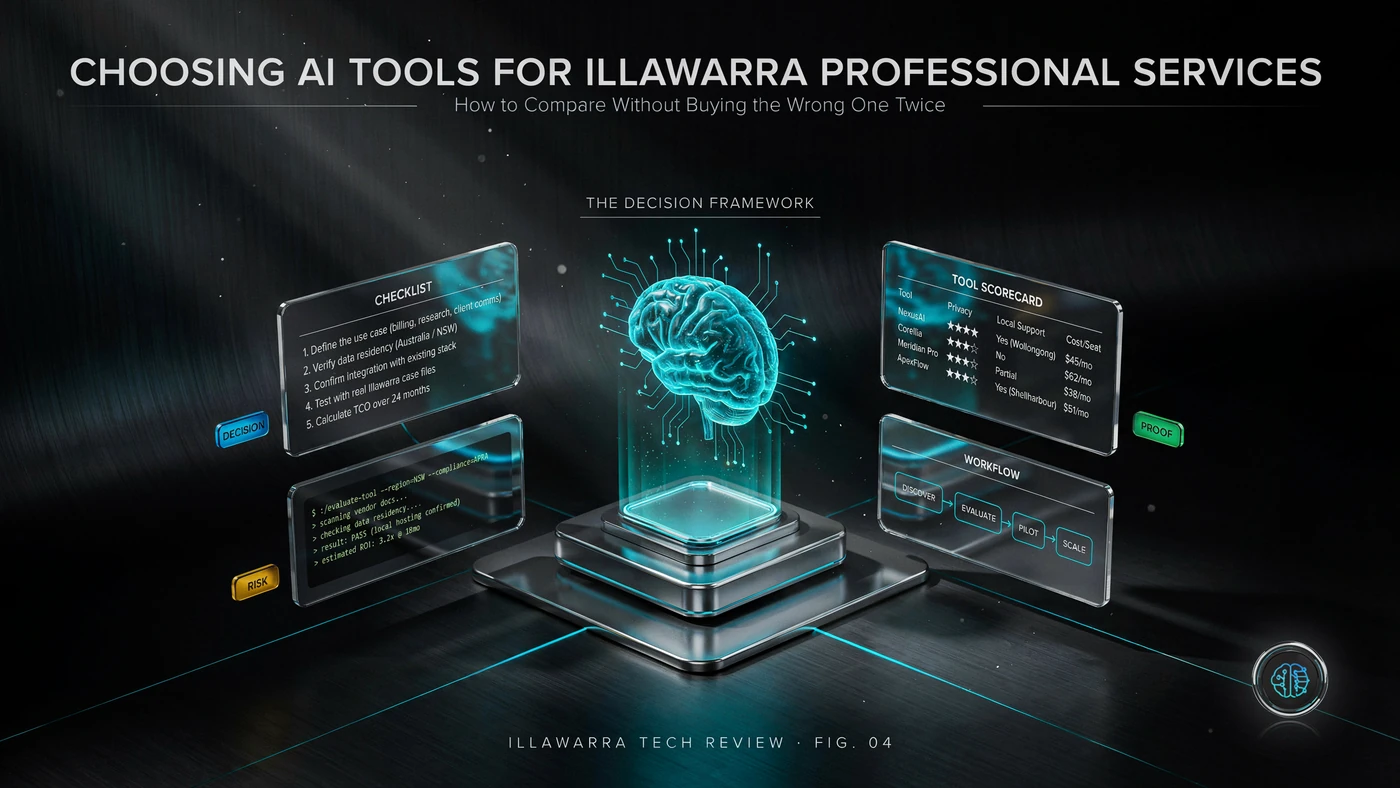
The second inline image for this article should make the procurement concrete: a side-by-side vendor scorecard comparing two or three AI tools on the same Illawarra professional services workflow, with the harness, turnaround time, accuracy, data-handling answer, audit-log export, contract length, exit clause, and named human owner visible in plain language rather than in marketing shorthand. If the team is documenting a real rollout, capture setup screens, before/after outputs, permission settings, cost meters, kill-switch tests, and review evidence rather than decorative screenshots - the screenshots that matter are the ones your successor can use to rebuild the workflow without phoning the vendor.
Where It Fits for Real Teams
For founders and partners, the opportunity is speed with evidence. A short fixed-price pilot with two competing AI tools will tell you more in two weeks than a six-month "AI strategy" retainer, and the evidence will survive the next partner rotation in a way that a slide deck will not. For practice managers and operations leads, the value is consistency. The right tool should produce the same output for the same input regardless of which staff member is on shift, and that consistency is the actual product the firm is buying. For technical teams and the firm members who wear the technical hat, the value is leverage. A strong AI tools setup lets generative, agentic, and traditional automation take on repeatable work while the firm keeps control over review, sign-off, and final judgement. The practical fit is strongest when the task has clear source material, a known output format, a low-cost way to verify quality, and a clear regulator or insurer position. It is weaker when the task is vague, politically sensitive, legally risky, or dependent on facts that cannot be checked. For Australian accounting firms, the fit is strongest in the document drafting, evidence gathering, and reconciliation layer, and weakest in any workflow that touches the final sign-off reserved for the registered tax agent or BAS agent. For Australian legal practices, the fit is strongest in the discovery review, the chronology building, and the document drafting layer, and weakest in any workflow that touches the final advice reserved for the admitted practitioner. For Australian allied health practices, the fit is strongest in the clinical note-taking, the intake triage, and the appointment-reminder layer, and weakest in any workflow that touches the diagnosis, the treatment plan, or the AHPRA-registered clinician's final sign-off. For the broader Illawarra professional services market - surveying, engineering, town planning, architecture, consulting - the same logic applies: the AI tools that work are the ones that sit behind a registered practitioner's sign-off, not the ones that promise to replace it.
Trade-offs and Risks
The main risk is vendor lock-in. That risk can be managed, but only if it is named before the contract is signed. A second risk is accountability drift, where the same vendor sells the discovery call, the pilot, and the ongoing support as three different people and three different scopes, and the Illawarra firm ends up holding the gaps - particularly when the local contact leaves the vendor and the Sydney head office does not know the firm's name. AI systems often look better in a screen recording than they feel inside a production workflow. The test is whether the result is repeatable when the source material changes, the operator changes, the partner changes, and the deadline is real. A third risk is data residency and IP ownership, particularly with offshore-hosted tools where the default answer to "who owns the fine-tuning data?" may not match the answer you would give to your own lawyer, and where the default answer to "where is the data physically stored?" may change without notice when the vendor renews its own infrastructure contract. A fourth risk, specific to the Illawarra professional services market, is continuity of the tool itself: a vendor that is the market leader this quarter may quietly change its pricing, change its data policy, or change its region next quarter, and the firm does not have a Sydney head office to fall back on. This is why AI Kick Start generally recommends a staged rollout: sandbox first, internal use second, client-facing use third, regulator-visible use last. In the Illawarra context, that staging also needs a regional failure-mode check - what happens when the local NBN link drops, the vendor's offshore support team is asleep, and the only person who can answer the regulator's question is the partner on a Saturday morning. If the answer to that question is "we wait until Monday", the workflow is not ready for production.
The Next Sensible Test
The next sensible test is a small controlled implementation. Pick one workflow, one owner, one expected output, and one acceptance check. Run it twice. If the second run is easier than the first, the pattern is worth keeping. Do not judge the tool by the best possible demo. Judge it by the worst acceptable production case. Ask: what happens when the source file is incomplete, the tool is unavailable, the output is wrong, a partner needs to explain the result to a client, or a regulator sends a notice on a Friday afternoon? If those answers are clear, this belongs in the procurement list. If they are not, it belongs in the lab until the operating model catches up. For an Illawarra professional services firm evaluating AI tools Illawarra options, the most useful version of this test is also the cheapest: send the same one-page procurement scope to two or three vendors, run both pilots on the same real client workload, and decide on the evidence. The cost of that parallel pilot is almost always less than the cost of locking into the wrong tool for twelve months, and the evidence will be useful even if the decision is to wait six months before doing anything else.
Illawarra Professional Services Patterns Worth Naming
The Illawarra professional services market is not a generic professional services market, and the AI tools that fit it best are not the AI tools that fit a Sydney CBD or a Melbourne Collins Street practice. Three patterns show up often enough in conversations with Wollongong, Shellharbour, Kiama, and Nowra partners to be worth naming explicitly. The first is the accounting, tax, and bookkeeping pattern across Wollongong, Figtree, Corrimal, Dapto, and Shellharbour: seasonal workflow pressure around BAS, EOFY, and the tax deadline windows, a TPB-registered practitioner whose name is on every client file, and a client base that mixes individuals, small businesses, and the Illawarra's tourism and hospitality operators. The AI tools that work here are the ones that improve document turnaround, evidence gathering, and reconciliation accuracy without crossing the line into the TPB-registered sign-off, and the ones that can produce a defensible audit trail to the ATO and to the firm's professional indemnity insurer. The second is the legal practice pattern across Wollongong, Shellharbour, Kiama, and Nowra: low-volume but high-stakes client work, partner-level accountability, and a Legal Services Commissioner in the relevant state whose expectations are visible in published guidance. The AI tools that work here are the ones that improve discovery review, chronology building, and document drafting without crossing the line into the admitted practitioner's advice, and the ones that can demonstrate a clear audit trail to discovery production, to a costs assessment, and to a professional indemnity renewal. The third is the allied health, NDIS, and community services pattern across Wollongong, Shellharbour, Kiama, and the broader Illawarra: clinician-registered accountability, the relevant state health records legislation, and a client base that often includes vulnerable participants whose data handling deserves particular care. The AI tools that work here are the ones that improve clinical note-taking, intake triage, and appointment-reminder workflows without crossing the line into the registered clinician's diagnosis or treatment plan, and the ones that can demonstrate a clear audit trail to AHPRA, to the NDIS Quality and Safeguards Commission, and to the relevant state health records regulator. A fourth, smaller pattern is the surveying, engineering, town planning, and architecture pattern that runs across the Illawarra's ongoing housing and infrastructure pipeline: a registered practitioner whose name is on every drawing, regulator exposure to NSW planning and building standards, and a client base that includes both private developers and government-adjacent infrastructure work. The AI tools that work here are the ones that improve drafting, scheduling, and document control without crossing the line into the registered practitioner's certification. An Illawarra firm that picks AI tools that understand which of those patterns the practice sits inside will get further in a month than one that picks a tool whose strongest case study is a Sydney CBD SaaS.
Helpful Resources
Australian Government - Privacy Act 1988 and Notifiable Data Breaches scheme (opens in a new tab) Australian Government - Australia's AI Ethics Framework (opens in a new tab) Australian Signals Directorate - Essential Eight maturity model for small businesses (opens in a new tab) Tax Practitioners Board - Technology guidance (opens in a new tab) Legal Services Commissioners - state and territory regulators (opens in a new tab) AHPRA - National Boards and AI in healthcare (opens in a new tab) NSW Government - Small Business Commission (opens in a new tab) Wollongong City Council - Business support and programs (opens in a new tab) Shellharbour City Council - Business and economic development (opens in a new tab) Kiama Municipal Council - Business support (opens in a new tab) Related AI Kick Start reading: [DeepSeek's DualPath: what it means for your AI stack](/news/article-mG4SmhWyeFA) · [Hermes AgentOS: a build-your-own multi-agent crew](/news/article-7qzgAkDN0q0) · [20 AI concepts explained](/news/article-aanqEqQwjNU) · [ByteDance Seedance coverage](/news/article-8sGVhuoPOXI) · [Trellis 2 GGUF writeup](/news/article-xVJSiBQ625Y)