



Introduction: Why This One Belongs on the Watchlist
An optimized ComfyUI workflow for Ideogram-style text and design outputs shows how local creative pipelines keep moving down-market. The reason it matters for AI Kick Start readers is practical: this is not just another launch to admire from a distance. It changes how founders, operators, and technical teams should think about creative AI work over the next few months.
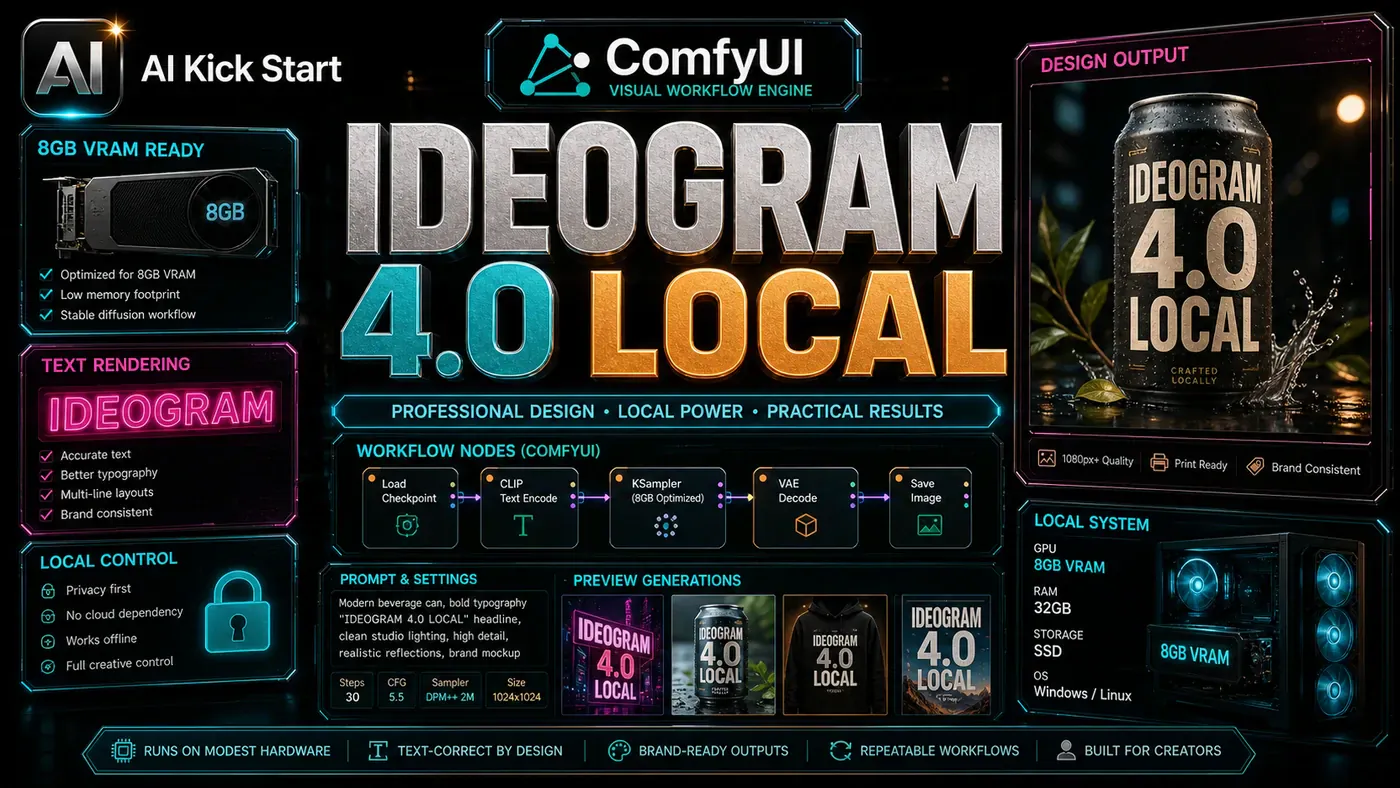
The source transcript repeatedly centres on Ideogram 4.0, ComfyUI and 8GB VRAM, with the video framing the topic as a practical workflow rather than a detached product announcement. That is the useful lens. The video is worth treating as implementation intelligence: what should be tested, what should be ignored for now, and what should become part of a repeatable operating system.
For Australian small businesses and technical teams, the right question is not "is this impressive?" The right question is "where does this reduce friction without creating a larger governance, security, or maintenance problem?"
What the Video Actually Shows
The core pattern is simple: Text-correct image generation is one of the biggest practical needs for marketers and designers. Running a design workflow on modest hardware changes who can experiment locally. The real test is whether text, brand style, and repeatability survive beyond a demo scene.
In practice, that means the update sits inside a broader shift from isolated AI prompts to managed systems. A tool, model, or method only becomes valuable when it has clear inputs, a measurable output, a review path, and a way to repeat the result next week.
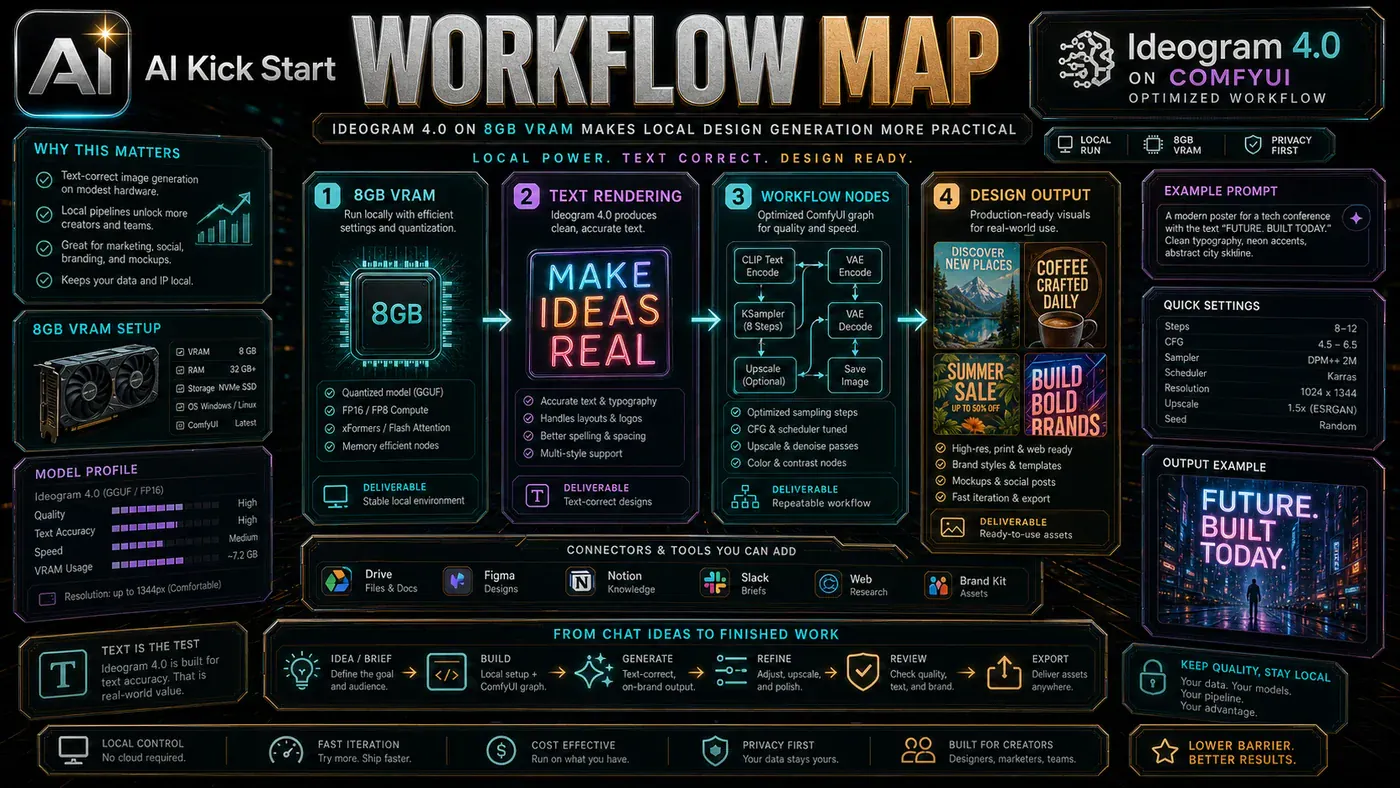
The video's most useful signal is the workflow shape. The moving parts can be summarised as:
- 8GB VRAM
- Text rendering
- Workflow nodes
- Design output
That is the level at which teams should evaluate it. A demo can be entertaining, but a workflow must survive messy source files, staff handoff, data boundaries, and real deadlines.
The Implementation Pattern
The first implementation lesson is to narrow the scope. Test logos, packaging, posters, and social graphics. Broad adoption is usually where AI systems fail first because nobody knows which decision the tool is allowed to make and which decision still belongs to a human.
The second lesson is to create a test harness. Record VRAM usage and failure modes. A useful harness does not have to be complicated. It can be a short brief, a fixed sample dataset, a few expected outputs, and one person responsible for judging whether the result is good enough.
The third lesson is to capture the process. Compare output quality against hosted tools before committing. When the process is documented, it can become a reusable skill, checklist, prompt pack, repo pattern, or operating procedure. When it is not documented, the team is back to improvising in chat.
Research Update: What To Correct
This update adds a current-source pass rather than treating the original video summary as enough. The important corrections are the product surface, plan or pricing constraints, and what should be verified before a team depends on the workflow.
- Ideogram 4.0 is an open-weight model; avoid unqualified open-source wording unless licensing supports it.
- Official strengths are text rendering, layout control, colour palettes, bounding boxes, and high-resolution output.
- The 8GB VRAM angle is a community low-VRAM workflow claim unless locally verified.
Practical Setup and How-To
The useful next step is a controlled pilot with a named owner, fixed inputs, a measurable output, and a review point. Use the sequence below as the first implementation path before expanding the workflow.
- Test posters, social graphics, product mockups, signage, and brand-colour scenes.
- Use structured JSON prompts where layout and text placement matter.
- Measure text accuracy, colour accuracy, repeatability, load time, and VRAM/RAM usage.
- Compare local output with hosted API modes before committing to a pipeline.

Pricing, Access, and Comparison Notes
Pricing and access should be checked at implementation time because AI products change quickly. The safer decision is to compare the tool against the job-to-be-done, not against launch hype.
- Hosted API pricing can be cheaper than local troubleshooting for small volumes.
- Local workflows win when privacy, iteration, or offline control matter.
- Low-VRAM settings may trade quality and speed for accessibility.
| Decision area | What to compare |
|---|---|
| Access | Plan, preview status, region, account type, admin controls, and rate limits. |
| Cost | Subscription, credits, API tokens, retries, hardware, review time, and support burden. |
| Fit | Workflow reliability, data handling, output quality, observability, and human approval needs. |
Implementation Notes for Teams
For AI Kick Start readers, this is the production filter: keep the first rollout narrow, make the evidence visible, and do not let the tool cross a business boundary until the review model is clear.
- Phrase hardware claims as tested workflow, not official minimum.
- Include prompt JSON examples.
- Keep commercial-use checks with final assets.
Screenshot and Visual Guidance
The second inline image for this article should make the implementation concrete: A typography lab bench with poster sheets passing through JSON layout calipers, colour swatches, and a VRAM gauge. If the team is documenting a real rollout, capture setup screens, before/after outputs, permission settings, cost meters, and review evidence rather than decorative screenshots.
Where It Fits for Real Teams
For founders, the opportunity is speed with evidence. This kind of workflow can reduce the time between idea and first useful output, but it should still produce artefacts that a customer, manager, or developer can inspect.
For operators, the value is consistency. If the same task is done slightly differently every time, AI can either make the inconsistency worse or help standardise the path. The difference is whether the workflow has rules, examples, and review checkpoints.
For technical teams, the value is leverage. A strong setup lets agents, models, or creative systems take on repeatable work while engineers keep control over architecture, security, deployment, and final judgement.
The practical fit is strongest when the task has clear source material, a known output format, and a low-cost way to verify quality. It is weaker when the task is vague, politically sensitive, legally risky, or dependent on facts that cannot be checked.
Trade-offs and Risks
The main risk is hardware limits. That risk can be managed, but only if it is named before the workflow becomes normal.
A second risk is text hallucinations. AI systems often look better in a screen recording than they feel inside a production workflow. The test is whether the result is repeatable when the source material changes, the operator changes, and the deadline is real.
The third risk is workflow fragility. This is why AI Kick Start generally recommends a staged rollout: sandbox first, internal use second, customer-facing deployment last.
The Next Sensible Test
The next sensible test is a small controlled implementation. Pick one workflow, one owner, one expected output, and one acceptance check. Run it twice. If the second run is easier than the first, the pattern is worth keeping.
Do not judge the workflow by the best possible demo. Judge it by the worst acceptable production case. Ask: what happens when the source file is incomplete, the tool is unavailable, the output is wrong, or a staff member needs to explain the result to a customer?
If those answers are clear, this belongs in the roadmap. If they are not, it belongs in the lab until the operating model catches up.
Helpful Resources
- drive.google.com (opens in a new tab)
- github.com (opens in a new tab)
- ComfyUI project (opens in a new tab)
- Video Source:
- Ideogram 4.0 on 8GB VRAM! Perfect Text & Designs (Free ComfyUI Workflow) by Tensor Alchemist
Ideogram 4.0 on 8GB VRAM Makes Local Design Generation More Practical: answer-first summary
Ideogram 4.0 on 8GB VRAM Makes Local Design Generation More Practical matters because it can change how Creators, founders and operators plan, build, or govern an tool evaluation workflow. An optimized ComfyUI workflow for Ideogram-style text and design outputs shows how local creative pipelines keep moving down-market.
The direct answer is this: do not treat the topic as a standalone trend. Treat it as a decision about inputs, outputs, review ownership, data exposure, and whether the workflow produces a result that is faster, safer, or more useful than the current process.
Ideogram 4.0 on 8GB VRAM Makes Local Design Generation More Practical: implementation checklist
- Define the user, job to be done, and success metric for the tool evaluation workflow.
- Collect real examples, policies, source files, customer questions, or search queries before writing prompts or choosing tools.
- Separate low-risk drafts from decisions that need approval, privacy checks, or senior review.
- Document what the AI is allowed to access, what it must not access, and who signs off before production use.
- Review time to value, adoption rate, cost per workflow, quality review score after a small pilot rather than judging the idea from a demo.
This keeps the work practical. It also gives search engines and AI answer engines a clean factual structure: what the topic is, who it helps, what to do next, and which risks matter before implementation.
Decision criteria for Ideogram 4.0 on 8GB VRAM Makes Local Design Generation More Practical
| Decision area | What to check | Production signal |
|---|---|---|
| Intent | Does Ideogram 4.0 on 8GB VRAM Makes Local Design Generation More Practical solve a real workflow problem? | The use case has a named owner and measurable outcome. |
| Data | Can the required data be used safely? | Sensitive data is classified and access is controlled. |
| Quality | Can a reviewer judge the output consistently? | Examples, rubrics, or acceptance criteria exist. |
| Scale | Can the workflow be repeated without hero effort? | The process is documented and can be handed to another team member. |
Practical example for Ideogram 4.0 on 8GB VRAM Makes Local Design Generation More Practical
A small business could use this article to choose one practical test. For example, a manager might take one customer-facing process, one internal document workflow, or one recurring content task and redesign only that step with AI support. The goal is not to automate the whole business at once; it is to learn where Creative AI creates reliable leverage.
The useful deliverable is a short operating note: the trigger, the source material, the prompt or tool, the review checklist, the escalation rule, and the metric. That note becomes the handover asset for staff training, SEO/GEO content, service delivery, or future agent work.
Risks and controls for Ideogram 4.0 on 8GB VRAM Makes Local Design Generation More Practical
The common failure pattern is moving too quickly from a promising idea into an unmanaged workflow. For Ideogram 4.0 on 8GB VRAM Makes Local Design Generation More Practical, the risk is not only bad output. It can also be unclear data permission, staff confusion, duplicate content, unreviewed customer advice, or a tool that quietly changes cost or capability.
- Control tool sprawl with a named owner, a review step, and written acceptance criteria.
- Control unclear pricing with a named owner, a review step, and written acceptance criteria.
- Control vendor lock-in with a named owner, a review step, and written acceptance criteria.
- Control unreviewed data sharing with a named owner, a review step, and written acceptance criteria.
Measurement plan for Ideogram 4.0 on 8GB VRAM Makes Local Design Generation More Practical
A useful AI or SEO initiative should leave evidence. Track time to value, adoption rate, cost per workflow, quality review score and compare the pilot against the current process. If the measure does not improve, keep the learning but avoid scaling the workflow.
For GEO readiness, the page should also answer the core question directly, define the entities involved, include implementation steps, explain tradeoffs, and link readers to the next relevant AI Kick Start service, guide, tool, or article.
Definitions and entities for Ideogram 4.0 on 8GB VRAM Makes Local Design Generation More Practical
For search, GEO, and staff handover, define the core entities in plain language. In this article the important entities are the workflow owner, the AI tool or model, the source material, the review process, the risk boundary, and the measurable business outcome. Clear definitions make the page easier for people to scan and easier for AI answer engines to quote accurately.
- Workflow owner: the person accountable for deciding whether Ideogram 4.0 on 8GB VRAM Makes Local Design Generation More Practical belongs in the business process.
- Source material: the documents, examples, policies, URLs, prompts, videos, or customer questions that ground the output.
- Review boundary: the point where a human checks accuracy, privacy, brand voice, or customer impact before the result is used.
- Success metric: the measure that proves whether the tool evaluation workflow is worth repeating.
Ideogram 4.0 on 8GB VRAM Makes Local Design Generation More Practical versus doing nothing
Doing nothing is also a decision. The cost may be slow manual work, weaker search visibility, inconsistent advice, duplicated effort, or staff using unmanaged AI tools without a shared process. The practical question is whether a controlled pilot can reduce that cost without creating a larger governance problem.
| Option | When it makes sense | What to watch |
|---|---|---|
| Do nothing | The workflow is rare, low value, or already reliable. | Competitors may improve speed, content depth, or service consistency first. |
| Run a small pilot | The task repeats often and has clear review criteria. | Keep scope tight and measure the result against the current process. |
| Build a production workflow | The pilot is repeatable and risk controls are documented. | Assign ownership, monitoring, training, and a rollback path. |
AI Kick Start handover package for Ideogram 4.0 on 8GB VRAM Makes Local Design Generation More Practical
A production handover should be concrete enough that another person can run it. For Ideogram 4.0 on 8GB VRAM Makes Local Design Generation More Practical, that means a short brief, a workflow map, approved prompts or tool settings, source material, a review checklist, internal links to supporting resources, and a simple measurement sheet. This is the difference between reading about AI and turning it into operational capability.
That packaging also strengthens E-E-A-T. It shows experience through implementation notes, expertise through decision criteria, authoritativeness through source-aware structure, and trust through risks, controls, and review steps. The article becomes useful even if the reader never buys a tool because it helps them make a better operational decision.