






Briefing
Walk into almost any software team in 2026 and you'll hear the same argument. Is "agentic engineering" a genuinely new job, or is it just regular engineering with shinier tools bolted on? People get heated about it. They shouldn't. The honest answer is that it's a bit of both, and the "bit" that's new is the part that actually matters.
Here's the shift in plain terms. A traditional engineer writes the code. An agentic engineer builds the setup that lets AI agents write the code, then makes sure the output is correct, safe, and worth shipping. Same goal, reliable software, but the day-to-day work looks different enough that the old job titles don't quite fit anymore.
For a business team, the practical question isn't really philosophical. It's: who do I hire, what do I train my current people on, and how do I tell whether any of this is actually working? Those are the things this piece gets into. The tools (Claude Code, Cursor, Copilot and friends) are the easy part to point at. The harder, more valuable shift is in how the work gets done and how you measure it.
The agentic engineer uses new tools. But the mindset, the workflow, and the very definition of "done" are different from traditional software engineering. That's the real story.
The Old Model: Code-Centric Engineering
Traditional software engineering is code-centric. The main output is code. You measure success by features shipped, bugs fixed, and code quality. The engineer's relationship with the code is direct: they think it, type it, debug it, and keep it running.
The skill set runs deep in specific areas: algorithms, data structures, language semantics, framework internals. Seniority comes down to how complex the code is that an engineer can write, and how big the systems are that they can design.
The New Model: Harness-Centric Engineering
Agentic engineering is harness-centric. The main output isn't code. It's the systems that produce code. Success gets measured by agent success rates, rollback rates, and the quality of the constraints and context you feed in. The engineer's relationship with the code is now indirect: they design the environment in which agents do the writing. (This framing, the metrics and the structure that follows, is an analytical view rather than an agreed industry standard.)
The skill set runs broad instead of deep: context engineering, constraint design, building verification pipelines, orchestrating multiple agents. Seniority comes down to how complex a task an engineer can hand off to agents, and how reliable the resulting system turns out to be.
Comparative Skill Matrix
| Dimension | Traditional Engineer | Agentic Engineer |
|---|---|---|
| Primary output | Code | Harnesses and constraints |
| Core skill | Writing correct code | Designing reliable agent systems |
| Debugging | Step through code | Trace agent decisions |
| Quality assurance | Write tests | Build verification pipelines |
| Architecture | Design systems | Design agent topologies |
| Collaboration | Code review | Harness review |
| Learning focus | New languages/frameworks | New agent capabilities/patterns |
| Productivity metric | Lines/features per sprint | Agent tasks per sprint |
| Quality metric | Bug rate | Rollback rate |
The Transition Path
Nobody becomes an agentic engineer overnight. In practice the move tends to follow a recognisable path (again, a maturity model offered as a way to think about it, not a formal standard):
Stage 1: Tool adoption (months 1-3): Using Copilot (opens in a new tab) for completion, Cursor for editing, or Claude Code for specific tasks. The engineer still thinks code-first.
Stage 2: Workflow integration (months 3-6): Building CONVENTIONS.md, system prompts, and basic harnesses. The engineer starts paying attention to agent context.
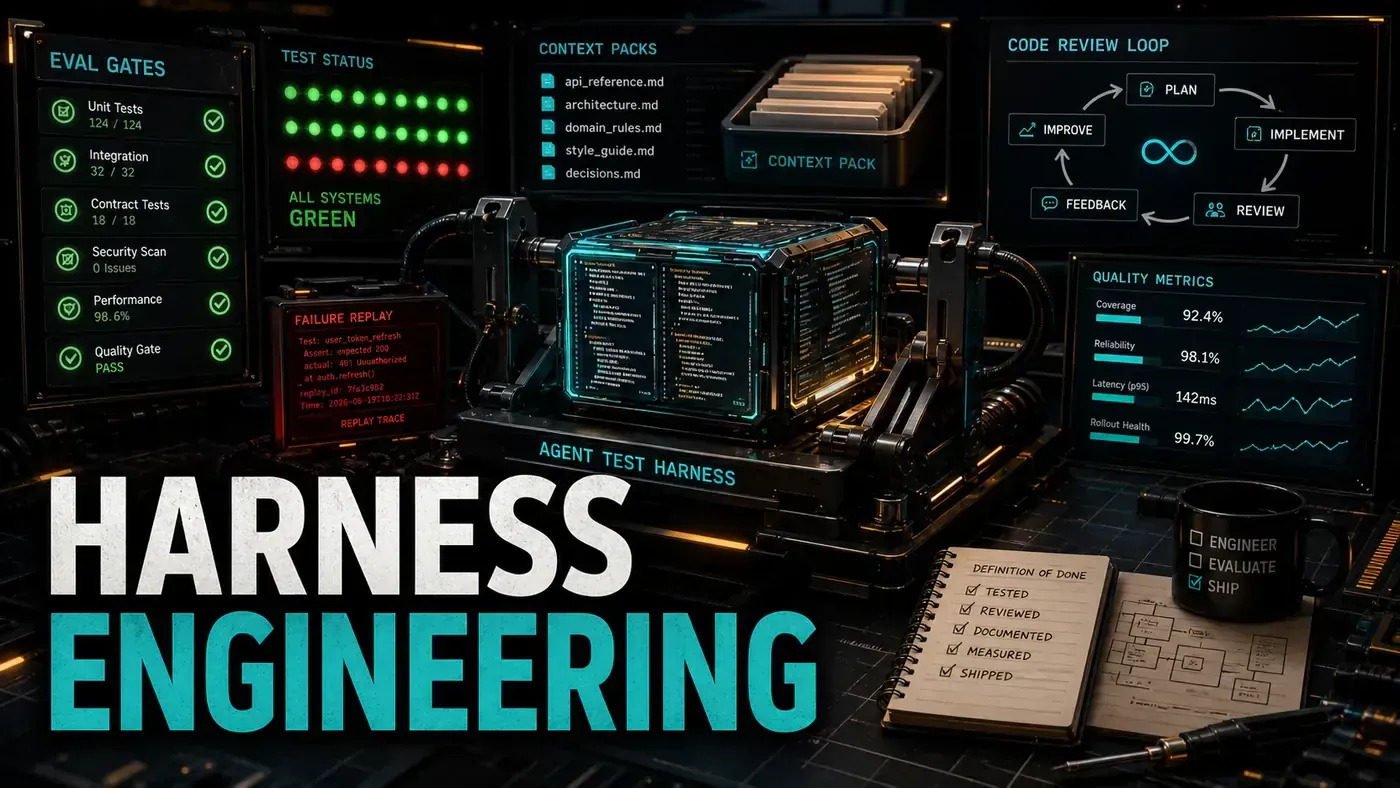
Stage 3: Harness engineering (months 6-12): Designing verification pipelines, constraint systems, and feedback loops. The engineer now thinks harness-first.
Stage 4: Orchestration (months 12-18): Multi-agent systems, meta-harnesses like Omnigent (opens in a new tab) (an open-source meta-harness, omnigent-ai/omnigent (opens in a new tab), that orchestrates Claude Code, Codex, Cursor and others), and team-wide agent infrastructure. The engineer thinks system-first.
Stage 5: Leadership (18+ months): Setting agent strategy, evaluating new tools, and coaching teammates in harness engineering. The engineer thinks organisation-first.
Who Makes the Best Agentic Engineer?
This part surprises people: the strongest agentic engineers often come from non-traditional backgrounds.
- DevOps engineers: Already think in pipelines, constraints, and infrastructure
- Technical writers: Expert at structuring context and writing clearly
- QA engineers: Naturally design verification and validation systems
- Product engineers: Understand the gap between working code and correct code
- Senior generalists: Broad knowledge across domains makes for better context engineering
Algorithm specialists sometimes find it harder going. Their deep expertise in one area doesn't always translate to the broad, cross-domain thinking that harness engineering asks for.
The Future Job Market
In 2026, "agentic engineer" isn't a standard job title. But the skill set is becoming standard. Job postings increasingly ask for things like:
- Experience with Claude Code, Cursor, or the Copilot coding agent (the standalone Copilot Workspace (opens in a new tab) preview was sunset in May 2025 and folded into the Copilot coding agent)
- Prompt and context engineering skills
- CI/CD for agent pipelines
- Multi-agent orchestration experience
- Agent safety and sandboxing knowledge
That AI coding proficiency now reads as a real differentiator on a 2026 resume (opens in a new tab) is well supported. The exact bundle of requirements above is more the author's read of where postings are heading than a surveyed fact.
Looking further out, the author expects dedicated "Agent Infrastructure Engineer" roles to appear at major tech companies around 2027, and reckons agentic engineering could become a standard interview topic for senior software roles by 2028. Both are predictions, not established fact, so treat them as informed guesses rather than a forecast you can bank on.
Conclusion
The agentic engineer is a new role. The tools are different, the mindset is different, the metrics are different, and the career path is different. But it grows from the same root: wanting to build reliable software systems.
Traditional engineering skills don't go obsolete. They become the foundation that harness engineering is built on. You can't design a good harness without understanding code. You can't verify an agent's output without knowing what correct looks like. You can't constrain an agent without understanding the problem you're solving.
The agentic engineer isn't someone who stopped coding. They levelled up: from writing code to designing the systems that write code. That isn't the same job with better tools. It's a new job, built on old skills, facing new problems, with new rewards.
The Agentic Engineer: answer-first summary
The Agentic Engineer matters because it can change how Australian business teams plan, build, or govern an agent workflow. Agentic coding changes what engineers do, but does it change who they are?
The direct answer is this: do not treat the topic as a standalone trend. Treat it as a decision about inputs, outputs, review ownership, data exposure, and whether the workflow produces a result that is faster, safer, or more useful than the current process.
The Agentic Engineer: implementation checklist
- Define the user, job to be done, and success metric for the agent workflow.
- Collect real examples, policies, source files, customer questions, or search queries before writing prompts or choosing tools.
- Separate low-risk drafts from decisions that need approval, privacy checks, or senior review.
- Document what the AI is allowed to access, what it must not access, and who signs off before production use.
- Review successful task completion, review time, fallback rate, operator corrections after a small pilot rather than judging the idea from a demo.
This keeps the work practical. It also gives search engines and AI answer engines a clean factual structure: what the topic is, who it helps, what to do next, and which risks matter before implementation.
Decision criteria for The Agentic Engineer
| Decision area | What to check | Production signal |
|---|---|---|
| Intent | Does The Agentic Engineer solve a real workflow problem? | The use case has a named owner and measurable outcome. |
| Data | Can the required data be used safely? | Sensitive data is classified and access is controlled. |
| Quality | Can a reviewer judge the output consistently? | Examples, rubrics, or acceptance criteria exist. |
| Scale | Can the workflow be repeated without hero effort? | The process is documented and can be handed to another team member. |
Practical example for The Agentic Engineer
A small business could use this article to choose one practical test. For example, a manager might take one customer-facing process, one internal document workflow, or one recurring content task and redesign only that step with AI support. The goal is not to automate the whole business at once; it is to learn where Code creates reliable leverage.
The useful deliverable is a short operating note: the trigger, the source material, the prompt or tool, the review checklist, the escalation rule, and the metric. That note becomes the handover asset for staff training, SEO/GEO content, service delivery, or future agent work.
Risks and controls for The Agentic Engineer
The common failure pattern is moving too quickly from a promising idea into an unmanaged workflow. For The Agentic Engineer, the risk is not only bad output. It can also be unclear data permission, staff confusion, duplicate content, unreviewed customer advice, or a tool that quietly changes cost or capability.
- Control unclear tool permissions with a named owner, a review step, and written acceptance criteria.
- Control silent failures with a named owner, a review step, and written acceptance criteria.
- Control prompt drift with a named owner, a review step, and written acceptance criteria.
- Control weak audit trails with a named owner, a review step, and written acceptance criteria.
Measurement plan for The Agentic Engineer
A useful AI or SEO initiative should leave evidence. Track successful task completion, review time, fallback rate, operator corrections and compare the pilot against the current process. If the measure does not improve, keep the learning but avoid scaling the workflow.
For GEO readiness, the page should also answer the core question directly, define the entities involved, include implementation steps, explain tradeoffs, and link readers to the next relevant AI Kick Start service, guide, tool, or article.
Definitions and entities for The Agentic Engineer
For search, GEO, and staff handover, define the core entities in plain language. In this article the important entities are the workflow owner, the AI tool or model, the source material, the review process, the risk boundary, and the measurable business outcome. Clear definitions make the page easier for people to scan and easier for AI answer engines to quote accurately.
- Workflow owner: the person accountable for deciding whether The Agentic Engineer belongs in the business process.
- Source material: the documents, examples, policies, URLs, prompts, videos, or customer questions that ground the output.
- Review boundary: the point where a human checks accuracy, privacy, brand voice, or customer impact before the result is used.
- Success metric: the measure that proves whether the agent workflow is worth repeating.
The Agentic Engineer versus doing nothing
Doing nothing is also a decision. The cost may be slow manual work, weaker search visibility, inconsistent advice, duplicated effort, or staff using unmanaged AI tools without a shared process. The practical question is whether a controlled pilot can reduce that cost without creating a larger governance problem.
| Option | When it makes sense | What to watch |
|---|---|---|
| Do nothing | The workflow is rare, low value, or already reliable. | Competitors may improve speed, content depth, or service consistency first. |
| Run a small pilot | The task repeats often and has clear review criteria. | Keep scope tight and measure the result against the current process. |
| Build a production workflow | The pilot is repeatable and risk controls are documented. | Assign ownership, monitoring, training, and a rollback path. |
AI Kick Start handover package for The Agentic Engineer
A production handover should be concrete enough that another person can run it. For The Agentic Engineer, that means a short brief, a workflow map, approved prompts or tool settings, source material, a review checklist, internal links to supporting resources, and a simple measurement sheet. This is the difference between reading about AI and turning it into operational capability.
That packaging also strengthens E-E-A-T. It shows experience through implementation notes, expertise through decision criteria, authoritativeness through source-aware structure, and trust through risks, controls, and review steps. The article becomes useful even if the reader never buys a tool because it helps them make a better operational decision.