


Introduction: Why This One Belongs on the Watchlist
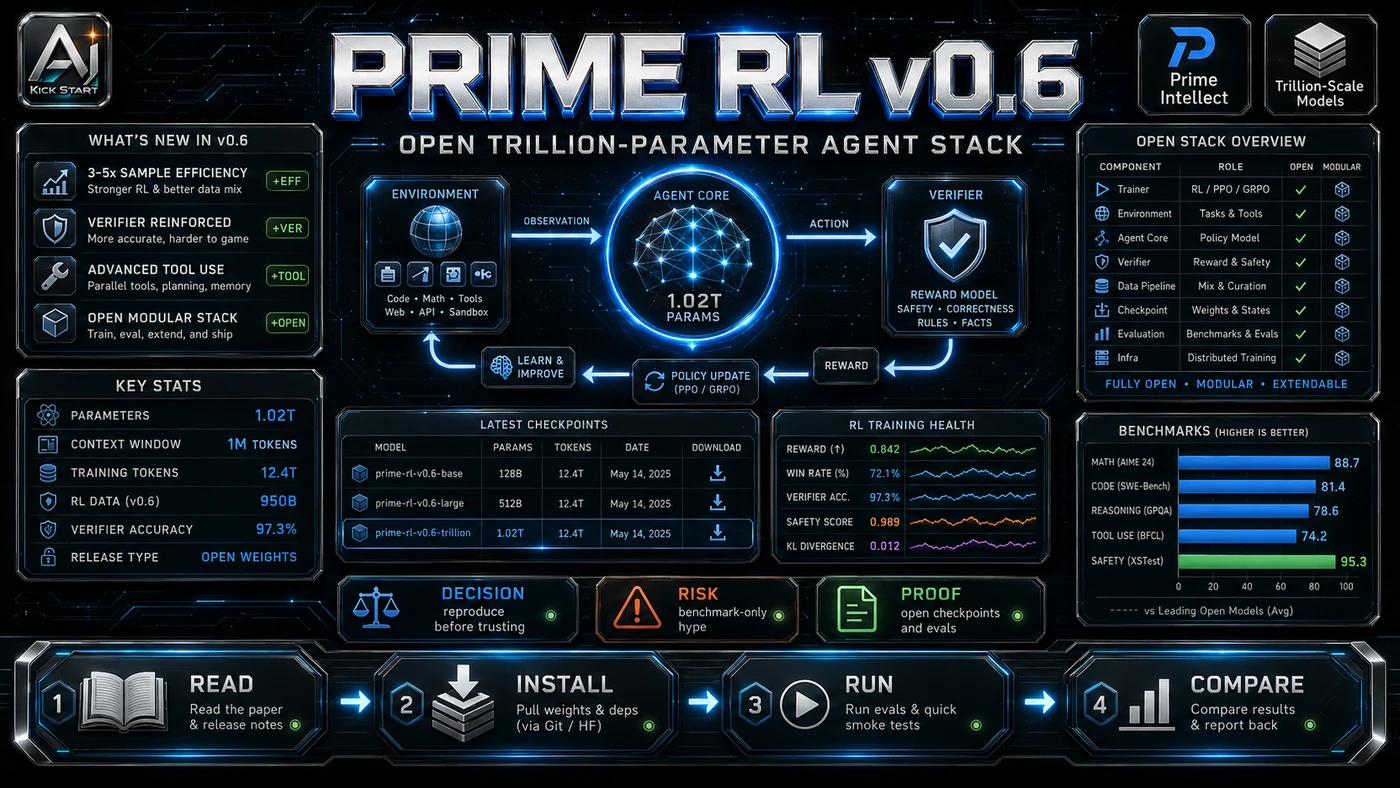
Prime Intellect's PrimeRL v0.6 brings sub-five-minute RL step times on trillion-parameter MoE models and GLM-5 agentic training at 131k context. The reason it matters for AI Kick Start readers is practical: this is not just another launch to admire from a distance. It changes how founders, operators, and technical teams should think about AI Infrastructure work over the next few months. The source transcript repeatedly centres on PrimeRL v0.6, trillion-parameter MoE models and open-source reinforcement learning, with the video framing the topic as a practical workflow rather than a detached product announcement. That is the useful lens. The video is worth treating as implementation intelligence: what should be tested, what should be ignored for now, and what should become part of a repeatable operating system. For Australian small businesses and technical teams, the right question is not "is this impressive?" The right question is "where does this reduce friction without creating a larger governance, security, or maintenance problem?"
What the Video Actually Shows
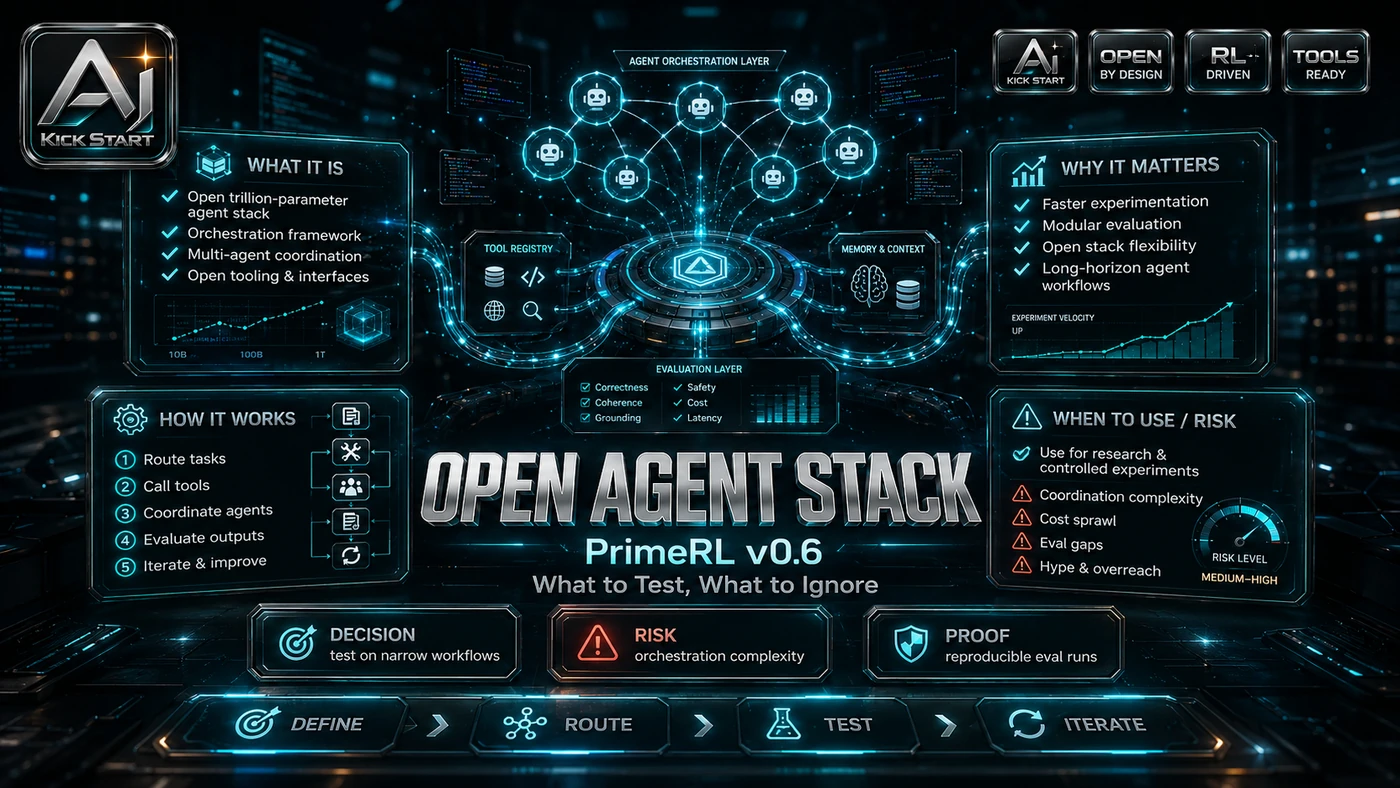
The BoxminingAI briefing claims sub-five-minute RL step times on trillion-parameter MoE models, roughly 1,000 steps in about three days, GLM-5 agentic training at 131k sequence length, and support for GLM-5, Kimi, and NeMo-Megatron. The core pattern is simple: separate inference generation from policy updates, replay inference routing decisions during training, and validate everything through multi-turn verifier tasks. In practice, that means the update sits inside a broader shift from isolated AI prompts to managed systems. A tool, model, or method only becomes valuable when it has clear inputs, a measurable output, a review path, and a way to repeat the result next week. The video's most useful signal is the workflow shape. The moving parts can be summarised as: inference pool trainer orchestrator verifier environment. That is the level at which teams should evaluate it. A demo can be entertaining, but a workflow must survive messy source files, staff handoff, data boundaries, and real deadlines.
The Implementation Pattern
The first implementation lesson is to narrow the scope. The trillion-parameter headline is not the pattern to copy; copy the separation of concerns that lets inference, training, and evaluation scale independently. PrimeRL v0.6 uses asynchronous RL with separate GPU pools: vLLM-backed FP8 inference with expert parallelism, prefill-decode disaggregation, and Mooncake Store KV offloading, plus FSDP2-based PyTorch training with 3-D parallelism and block-scaled FP8. An orchestrator moves rollouts and weights, the verifiers library scores multi-turn tasks, and router replay aligns inference and trainer routing. Broad adoption is usually where AI systems fail first because nobody knows which decision the tool is allowed to make and which decision still belongs to a human. The second lesson is to create a test harness. A useful harness does not have to be complicated. It can be a short brief, a fixed sample dataset, a few expected outputs, and one person responsible for judging whether the result is good enough. The third lesson is to capture the process. When the process is documented, it can become a reusable skill, checklist, prompt pack, repo pattern, or operating procedure. When it is not documented, the team is back to improvising in chat.
Research Update: What To Correct
This update adds a current-source pass rather than treating the original video summary as enough. The important corrections are the product surface, plan or pricing constraints, and what should be verified before a team depends on the workflow. Three points need tightening before the claims travel internally. First, EcomBench attribution: the video names Vibrant Labs as the source of a live Shopify benchmark called EcomBench, but our search found CommerceBench by Lazer Technologies and a separate academic EcomBench, with no clear public link to Vibrant Labs, so treat that reference as unverified. Second, sub-five-minute steps is a benchmark point, not a guarantee: Prime Intellect achieved it on 28 H200 nodes with GLM-5 on SWE tasks, and your step time depends on model size, sequence length, batch size, environment latency, and network topology. Third, W&B and OpenPipe are distinct: W&B's serverless RL is a managed training service, while OpenPipe's ART is an open-source GRPO library.
Practical Setup and How-To
The useful next step is a controlled pilot with a named owner, fixed inputs, a measurable output, and a review point. Use the sequence below as the first implementation path before expanding the workflow. Start with a local sanity check on a single GPU using the repo's reverse_text example, which trains a Qwen3-0.6B model on one consumer GPU to validate environment, CUDA, and dependencies. Move to a small multi-GPU task such as wordle or alphabet_sort on 2-4 H100s to exercise multi-turn rollouts and LoRA-based training. Add your own verifier using the verifiers library to wrap one real task, defining a deterministic rubric first because a bad reward function is cheap to fix at small scale and catastrophic at scale. Only then scale hardware, remembering that most Australian teams will win with a 7B-30B domain-tuned model and a clean reward signal, not by chasing trillion-parameter scale.
Pricing, Access, and Comparison Notes
Pricing and access should be checked at implementation time because AI products change quickly. The safer decision is to compare the tool against the job-to-be-done, not against launch hype. PrimeRL is Apache 2.0 and free to run; the cost is compute, people, and time. Prime Intellect hosted compute lists on-demand H200 nodes from roughly USD $1.23-$1.99 per hour per GPU at the time of writing, so a 28-node H200 run at the claimed pace would land in the mid-five-figures for a few days. Compare spot pricing and egress costs across AWS, GCP, Azure, CoreWeave, and Lambda because RL training is chatty across nodes. Alternatives include OpenPipe ART for smaller models and fast iteration, W&B Serverless RL as a managed service, and Unsloth or TRL for lighter-weight fine-tuning. Access Plan, preview status, region, account type, admin controls, and rate limits. Cost Subscription, credits, API tokens, retries, hardware, review time, and support burden. Fit Workflow reliability, data handling, output quality, observability, and human approval needs.
Implementation Notes for Teams
For AI Kick Start readers, this is the production filter: keep the first rollout narrow, make the evidence visible, and do not let the tool cross a business boundary until the review model is clear. Pin versions and mirror the repo by forking or vendoring it, pinning a release tag, and running your own CI builds instead of curling install scripts into production. Segment networks so the trainer, inference pool, and orchestrator sit on a dedicated VPC or tenant with strict egress rules. Version your PrimeRL TOML configs in git and require review for changes to parallelism, batch size, or reward shaping. Log rollout lengths, parse failures, off-policy steps, and crash rates from step one. Start with a test harness that can replay the same task against the base model, fine-tuned model, and a baseline API model.
Screenshot and Visual Guidance
The second inline image for this article should make the implementation concrete: a clean architecture diagram showing the disaggregated trainer-inference-orchestrator flow, with inference and training as separate services and the orchestrator as the contract where business logic lives in the verifier environment and reward function. If the team is documenting a real rollout, capture setup screens, before/after outputs, permission settings, cost meters, and review evidence rather than decorative screenshots.
Where It Fits for Real Teams
For founders, the opportunity is speed with evidence. This release can shrink the gap between idea and useful output for teams building domain-specific agents, as long as the artefacts can be inspected. For operators, the value is consistency. AI amplifies inconsistency unless the workflow has rules, examples, and review checkpoints. For technical teams, the value is leverage. A strong setup lets agents take repeatable work while engineers keep architecture, security, and final judgement. The practical fit is strongest when the task has clear source material, a known output format, and a low-cost way to verify quality. It is weaker when the task is vague, politically sensitive, legally risky, or dependent on facts that cannot be checked. This release suits AI product companies distilling specialised models, enterprise teams with structured tasks such as contract review or support triage, and research groups benchmarking open models without leaking data. It is least relevant if your problem is prompt reliability, retrieval, or workflow orchestration; solve those first.
Trade-offs and Risks
The main risk is compute cost and volatility. That risk can be managed, but only if it is named before the workflow becomes normal. A second risk is reward hacking and eval leakage. AI systems often look better in a screen recording than they feel inside a production workflow. The test is whether the result is repeatable when the source material changes, the operator changes, and the deadline is real. A third risk is operational complexity. This is why AI Kick Start generally recommends a staged rollout: sandbox first, internal use second, customer-facing deployment last. Also weigh vendor and licence hygiene, because PrimeRL is Apache 2.0 but models like GLM-5, Kimi, and Nemotron have their own licences, and talent density, because this stack assumes someone who can debug distributed training.
The Next Sensible Test
The next sensible test is a small controlled implementation. Pick one workflow, one owner, one expected output, and one acceptance check. Run it twice. If the second run is easier than the first, the pattern is worth keeping. Do not judge the workflow by the best possible demo. Judge it by the worst acceptable production case. Ask: what happens when the source file is incomplete, the tool is unavailable, the output is wrong, or a staff member needs to explain the result to a customer? If those answers are clear, this belongs in the roadmap. If they are not, it belongs in the lab until the operating model catches up. Run a two-week spike on one task, build a verifier, train a Qwen3-4B or Qwen3-8B model, and compare trained, base, and frontier API models on a 100-task hold-out set.