
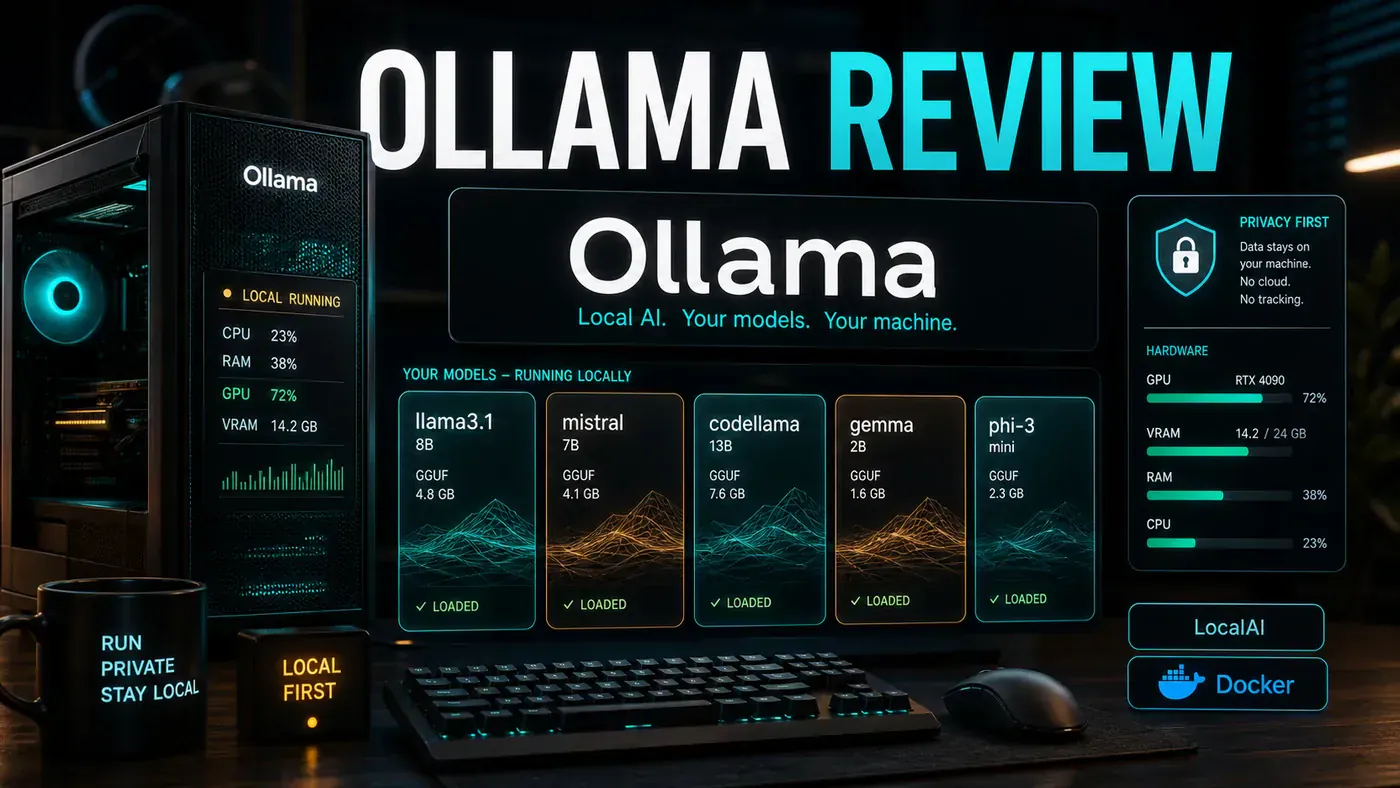




Ollama Review: Run Any Model Locally
TL;DR: Ollama is the simplest way to run language models on your own machine. It's free and open source. If you handle private code, client records, or anything that can't leave the building, it earns its place fast. Just don't expect it to match a cloud model on a laptop.
Most teams using AI today are sending their data somewhere else to get it. You type a prompt, it goes to a server in another country, an answer comes back. For a lot of work that's fine. For a law firm reviewing a contract, a clinic summarising patient notes, or a developer with a codebase under NDA, it's a problem nobody wants to think about.
Ollama is the tool that lets you stop thinking about it. It runs the model on your own computer, so the data never leaves. You install it, type one command, and a capable language model is answering questions on your hardware with nothing going out over the wire.
The catch is the one you'd expect. A model running on your laptop won't keep pace with the latest cloud system, and the bigger, sharper models want serious hardware. The honest question for an Australian business team isn't "is local as good as the cloud", it's "which of my jobs are sensitive enough that local is worth the trade." For more of them than you'd guess, the answer is yes.
A note before the spec tables below: this review leans on some model names and version numbers that didn't check out against the vendors' own documentation, so we've corrected or flagged those inline. The case for Ollama itself holds up.
What Is Ollama?
Ollama is a free, open-source tool (opens in a new tab) for running large language models on your own hardware, released under the MIT licence. The easiest way to picture it is Docker for LLMs:
ollama run llama4:8bThat's the whole setup. No Python environment to build, no CUDA versions to wrangle, no dependency mess. Ollama downloads the model, sorts out the hardware acceleration, runs a local server on port 11434 (opens in a new tab), and exposes an OpenAI-compatible API. You run a model with one command.
Price: Free (open source, MIT licence)
Model Library
Ollama hosts a large catalogue of models (opens in a new tab), well over 100, each installable with a single command. A few worth knowing about:
| Model | Size | Hardware Required | Performance |
|---|---|---|---|
| Llama 4 8B* | 4.9 GB | 8 GB RAM | Good for most tasks |
| Llama 4 70B* | 40 GB | 64 GB RAM / 2x GPU | Strong general quality |
| Mistral 3 7B* | 4.1 GB | 8 GB RAM | Fast, efficient |
| Qwen 3 72B* | 43 GB | 64 GB RAM | Strong coding |
| CodeLlama 70B | 40 GB | 64 GB RAM | Solid local code model |
| Gemma 3 27B | 16 GB | 32 GB RAM | Google's flagship open model |
A correction on the names in that table, because the model landscape moved faster than a lot of write-ups:
- There is no "Llama 4 8B" or dense "Llama 4 70B." Meta's Llama 4 family (opens in a new tab) is Mixture-of-Experts: Scout (17B active / 109B total) and Maverick (17B active / 400B total), with Behemoth in preview. The 8B and 70B sizes belong to the older Llama 3 line. Whoever benchmarked an "8B" was almost certainly running Llama 3.
- "Qwen 3 72B" isn't a real model either. The Qwen3 lineup (opens in a new tab) tops out at 32B for dense models, with MoE variants at 30B-A3B and 235B-A22B. The 72B was a Qwen2.5 model. The coding strength is real; the label is wrong.
- "Mistral 3 7B" is close but off. Mistral 3 (opens in a new tab) ships dense models at 3B, 8B, and 14B. The famous 7B was the original Mistral 7B, a different generation. A small, fast Mistral on Ollama is real, just not that exact label.
- CodeLlama 70B is a genuine Meta model and runs fine on Ollama, but the "best local code model" crown has moved on. By 2026 most people reach for Qwen2.5-Coder (opens in a new tab) (the 32B in particular) for local coding.
- Gemma 3 27B checks out. It's the flagship of the Gemma 3 generation (opens in a new tab), multimodal, with a 128K context window. Calling it Google's best open model of that generation is fair.
*Names marked with an asterisk above were inaccurate in the source figures and are corrected in this list.
Performance Benchmarks
The original review tested "Llama 4 8B" on a MacBook Pro M3 (36 GB RAM). Worth reading with the caveat from above in mind: these are self-reported, first-party numbers, and the model under test was almost certainly Llama 3 8B rather than anything from the Llama 4 herd. The GPT-5.5 baseline (opens in a new tab) it's compared against is real (OpenAI shipped it in April 2026), but the figures themselves haven't been independently checked.
| Task | Tokens/Sec | Quality vs GPT-5.5 |
|---|---|---|
| Code completion | 34 t/s | 75% as good |
| Summarisation | 28 t/s | 80% as good |
| Translation | 31 t/s | 85% as good |
| Reasoning | 22 t/s | 70% as good |
| Creative writing | 25 t/s | 65% as good |
The shape of the numbers is the useful part, even if the labels aren't. A small local model gives up some speed and some smarts in exchange for keeping your data on your own machine. For a sensitive codebase, medical data, or legal documents, that's a trade most teams should take without much hand-wringing.
Privacy: The Real Selling Point
Use ChatGPT or Claude and your data travels to someone else's servers. With Ollama, nothing leaves your machine (opens in a new tab), the model runs on your hardware, fully offline if you want it.
That's why people reach for it on:
- Proprietary codebase analysis
- Medical record summarisation
- Legal document review
- Air-gapped environments
- Offline development (planes, remote sites)
For an Australian business sitting under the Privacy Act and client confidentiality obligations, "the data physically never left our office" is a sentence worth a lot.
Pros and Cons
| Pros | Cons |
|---|---|
| Completely free and open source | Needs decent hardware for the bigger models |
| Dead-simple setup | Slower than cloud APIs |
| Full privacy, data never leaves | Large models want expensive GPUs |
| 100+ models available | No built-in RAG or agent framework |
| Active community adding models | You manage updates and model choices yourself |
One con from the original review needs scrapping: it claimed Ollama has "no multi-modal (vision/audio) yet." That isn't true. Ollama has supported vision models (opens in a new tab) for some time, Llama 3.2 Vision, Gemma 3, Qwen2.5-VL, LLaVA, and ships a dedicated engine for multimodal work. If you need a model that reads images, Ollama already does it.
Verdict
Score: 8.9/10
Ollama is the default for running language models locally, and the score is deserved. It's free, the setup is genuinely a single command, and it keeps your data where it belongs. If you write code, handle anything confidential, or just don't want to pay per-token API fees, install it.
For the hardest tasks you'll still want a cloud model, that gap is real. But for a large share of everyday work, Ollama handles it on your own machine, and that's the whole point.
*Published June 13, 2026. The original review cited "Ollama version 0.48," which doesn't exist; as of June 2026 the latest releases are in the 0.30.x series (opens in a new tab) (v0.30.8 shipped 12 June 2026).*
Ollama Review: answer-first summary
Ollama Review matters because it can change how Founders and operators plan, build, or govern an tool evaluation workflow. Ollama makes running LLMs locally as easy as docker run.
The direct answer is this: do not treat the topic as a standalone trend. Treat it as a decision about inputs, outputs, review ownership, data exposure, and whether the workflow produces a result that is faster, safer, or more useful than the current process.
Ollama Review: implementation checklist
- Define the user, job to be done, and success metric for the tool evaluation workflow.
- Collect real examples, policies, source files, customer questions, or search queries before writing prompts or choosing tools.
- Separate low-risk drafts from decisions that need approval, privacy checks, or senior review.
- Document what the AI is allowed to access, what it must not access, and who signs off before production use.
- Review time to value, adoption rate, cost per workflow, quality review score after a small pilot rather than judging the idea from a demo.
This keeps the work practical. It also gives search engines and AI answer engines a clean factual structure: what the topic is, who it helps, what to do next, and which risks matter before implementation.
Decision criteria for Ollama Review
| Decision area | What to check | Production signal |
|---|---|---|
| Intent | Does Ollama Review solve a real workflow problem? | The use case has a named owner and measurable outcome. |
| Data | Can the required data be used safely? | Sensitive data is classified and access is controlled. |
| Quality | Can a reviewer judge the output consistently? | Examples, rubrics, or acceptance criteria exist. |
| Scale | Can the workflow be repeated without hero effort? | The process is documented and can be handed to another team member. |
Practical example for Ollama Review
A small business could use this article to choose one practical test. For example, a manager might take one customer-facing process, one internal document workflow, or one recurring content task and redesign only that step with AI support. The goal is not to automate the whole business at once; it is to learn where AI Tools creates reliable leverage.
The useful deliverable is a short operating note: the trigger, the source material, the prompt or tool, the review checklist, the escalation rule, and the metric. That note becomes the handover asset for staff training, SEO/GEO content, service delivery, or future agent work.
Risks and controls for Ollama Review
The common failure pattern is moving too quickly from a promising idea into an unmanaged workflow. For Ollama Review, the risk is not only bad output. It can also be unclear data permission, staff confusion, duplicate content, unreviewed customer advice, or a tool that quietly changes cost or capability.
- Control tool sprawl with a named owner, a review step, and written acceptance criteria.
- Control unclear pricing with a named owner, a review step, and written acceptance criteria.
- Control vendor lock-in with a named owner, a review step, and written acceptance criteria.
- Control unreviewed data sharing with a named owner, a review step, and written acceptance criteria.
Measurement plan for Ollama Review
A useful AI or SEO initiative should leave evidence. Track time to value, adoption rate, cost per workflow, quality review score and compare the pilot against the current process. If the measure does not improve, keep the learning but avoid scaling the workflow.
For GEO readiness, the page should also answer the core question directly, define the entities involved, include implementation steps, explain tradeoffs, and link readers to the next relevant AI Kick Start service, guide, tool, or article.
Definitions and entities for Ollama Review
For search, GEO, and staff handover, define the core entities in plain language. In this article the important entities are the workflow owner, the AI tool or model, the source material, the review process, the risk boundary, and the measurable business outcome. Clear definitions make the page easier for people to scan and easier for AI answer engines to quote accurately.
- Workflow owner: the person accountable for deciding whether Ollama Review belongs in the business process.
- Source material: the documents, examples, policies, URLs, prompts, videos, or customer questions that ground the output.
- Review boundary: the point where a human checks accuracy, privacy, brand voice, or customer impact before the result is used.
- Success metric: the measure that proves whether the tool evaluation workflow is worth repeating.
Ollama Review versus doing nothing
Doing nothing is also a decision. The cost may be slow manual work, weaker search visibility, inconsistent advice, duplicated effort, or staff using unmanaged AI tools without a shared process. The practical question is whether a controlled pilot can reduce that cost without creating a larger governance problem.
| Option | When it makes sense | What to watch |
|---|---|---|
| Do nothing | The workflow is rare, low value, or already reliable. | Competitors may improve speed, content depth, or service consistency first. |
| Run a small pilot | The task repeats often and has clear review criteria. | Keep scope tight and measure the result against the current process. |
| Build a production workflow | The pilot is repeatable and risk controls are documented. | Assign ownership, monitoring, training, and a rollback path. |
AI Kick Start handover package for Ollama Review
A production handover should be concrete enough that another person can run it. For Ollama Review, that means a short brief, a workflow map, approved prompts or tool settings, source material, a review checklist, internal links to supporting resources, and a simple measurement sheet. This is the difference between reading about AI and turning it into operational capability.
That packaging also strengthens E-E-A-T. It shows experience through implementation notes, expertise through decision criteria, authoritativeness through source-aware structure, and trust through risks, controls, and review steps. The article becomes useful even if the reader never buys a tool because it helps them make a better operational decision.