






Briefing
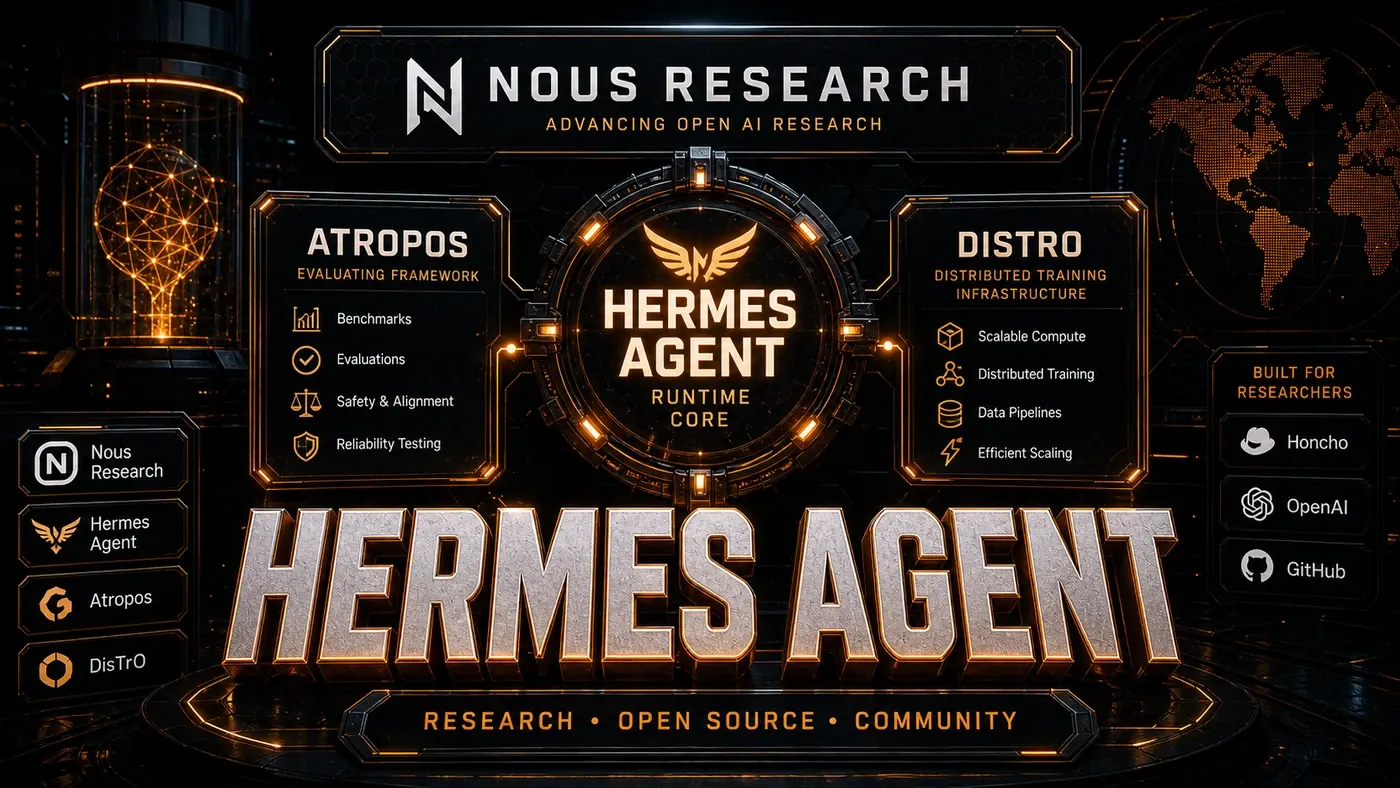
Most open-source AI projects are one tool that does one job. Nous Research (opens in a new tab) is trying to do the whole job. Instead of shipping a single model or a single library, it has built a connected set of projects that cover the full arc of AI development: training a model, testing it, and putting it in front of users. The three to know are Hermes, Atropos, and DisTrO.
That matters for Australian business teams for a simple reason. The big AI labs sell you a finished product and keep the machinery hidden. Nous is publishing the machinery. If you want AI capability without being locked to one vendor's roadmap and pricing, an open stack like this is the alternative worth watching.
A quick warning before we go further: Nous is a fast-moving, heavily backed startup, and a lot of the numbers floating around about it are out of date or wrong almost as soon as they're written. Where the figures are shaky, this piece says so rather than dressing them up.
The Three Pillars
The ecosystem is built around three projects that handle different parts of the same problem.
Hermes Agent
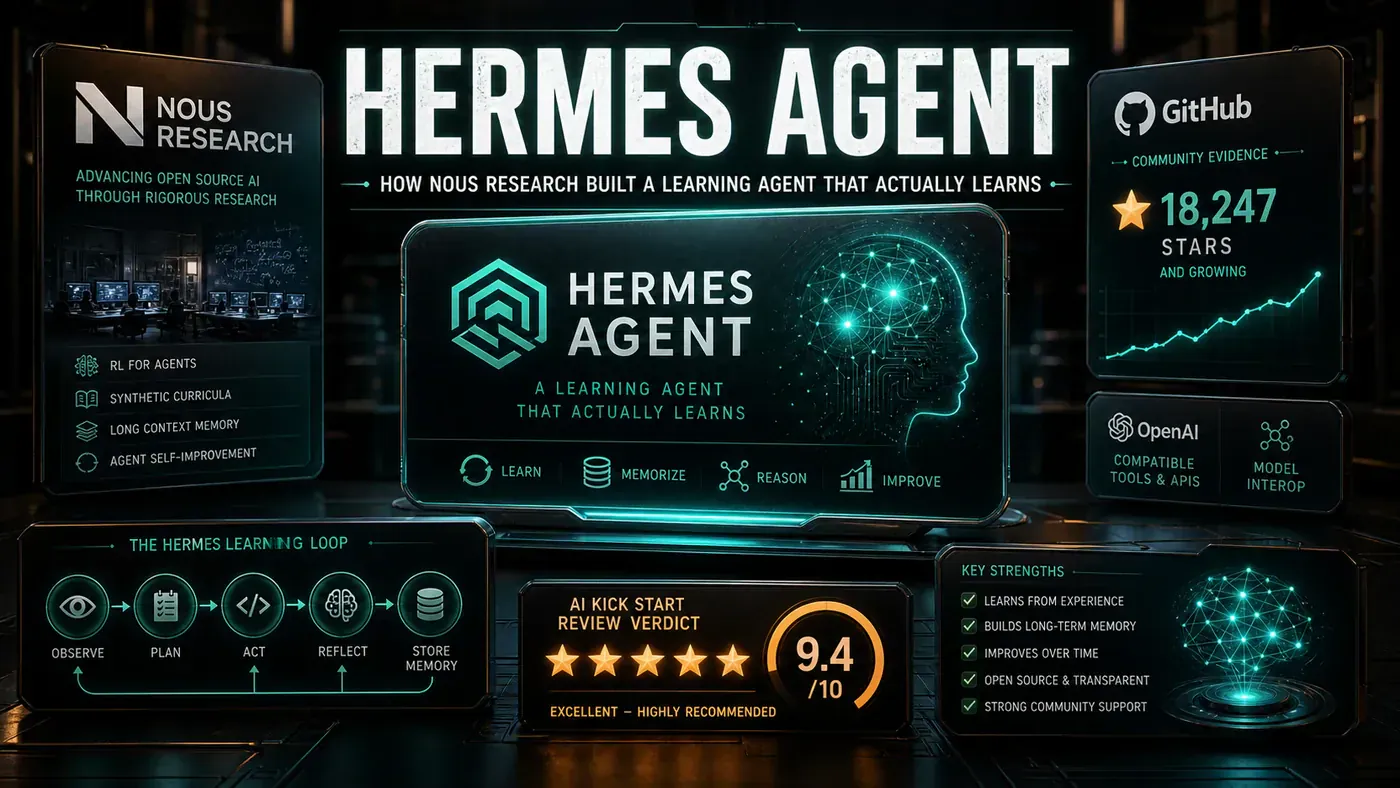
This is the part people actually touch. Hermes is a learning agent with dialectic memory through Honcho, a built-in toolset of roughly 47 tools, and a strong focus on personalisation (NousResearch/hermes-agent (opens in a new tab)). For most users it's the front door: the thing they open and use day to day.
It's also where the research stops being abstract. Work from the other two projects flows into Hermes, so the agent gets more capable over time. It doubles as a place to study how people and AI actually work together, not just a product to ship.
On the popularity side, take published star counts with caution. The original write-up put Hermes at 22,000 GitHub stars, but that number looks badly understated. Independent trackers report figures from 32,000 into the high six figures, with some sources citing around 180,000 to 193,000 stars within a few months of its February 2026 launch (Hermes Agent star history (opens in a new tab)). Either way, it took off quickly.
Atropos (RL Environments)
Atropos is named after one of the three Fates, the one who cuts the thread of life. The original framing called it a "model evaluation framework," but that oversells it. Nous officially describes Atropos as a reinforcement learning environments framework for collecting and evaluating LLM trajectories: an environment microservice stack for async RL with language models, with 1,200-plus tasks (NousResearch/atropos (opens in a new tab)).
It does evaluate model behaviour as part of that work, and the kinds of capabilities people associate with a mature eval stack are the sort of thing such a framework can support:
- Benchmark suites: standardised tests across reasoning, coding, knowledge, and safety
- Adversarial testing: automated red-teaming that probes weak spots
- Human evaluation: ways to collect and read human judgments
- Regression detection: catching a model that quietly gets worse
- Custom evals: building domain-specific pipelines without much fuss
Worth flagging: that detailed feature breakdown goes beyond what the repository itself states, so treat it as a description of the general territory rather than a confirmed spec. Reports that Atropos has become the go-to evaluation tool for open-source releases, prized above all for adversarial testing, are unconfirmed and read as promotional framing.
DisTrO (Distributed Training)
DisTrO handles the compute side. One correction up front: it stands for Distributed Training Over-The-Internet, not "Distributed Training Orchestration" as the original draft claimed (NousResearch/DisTrO (opens in a new tab)).
What it actually is: a family of low-latency distributed optimisers that cut the communication between GPUs by three to four orders of magnitude, up to around 10,000x. That's what makes training over low-bandwidth or ordinary internet connections workable. The "efficient communication" claim is well supported by the project's own description.
The original piece also listed a fuller set of capabilities:
- Heterogeneous clusters: training across different GPU types and even consumer hardware
- Fault tolerance: recovering from node failures without losing progress
- Efficient communication: optimised gradient sharing that keeps network overhead down
- Dynamic scaling: adding or removing nodes mid-run without restarting
- Privacy-preserving: support for federated training
Of those, only the communication efficiency is clearly documented. The rest (heterogeneous clusters, automatic fault tolerance, restart-free scaling, federated and privacy-preserving training) aren't stated in the repo and appear to be embellishments, so don't bank on them.
The point that does hold up: by slashing the bandwidth cost of training, DisTrO makes distributed training reachable for teams without a supercomputer budget. A small lab with a few scattered GPUs can train real models by pooling them over the internet.
How They Connect
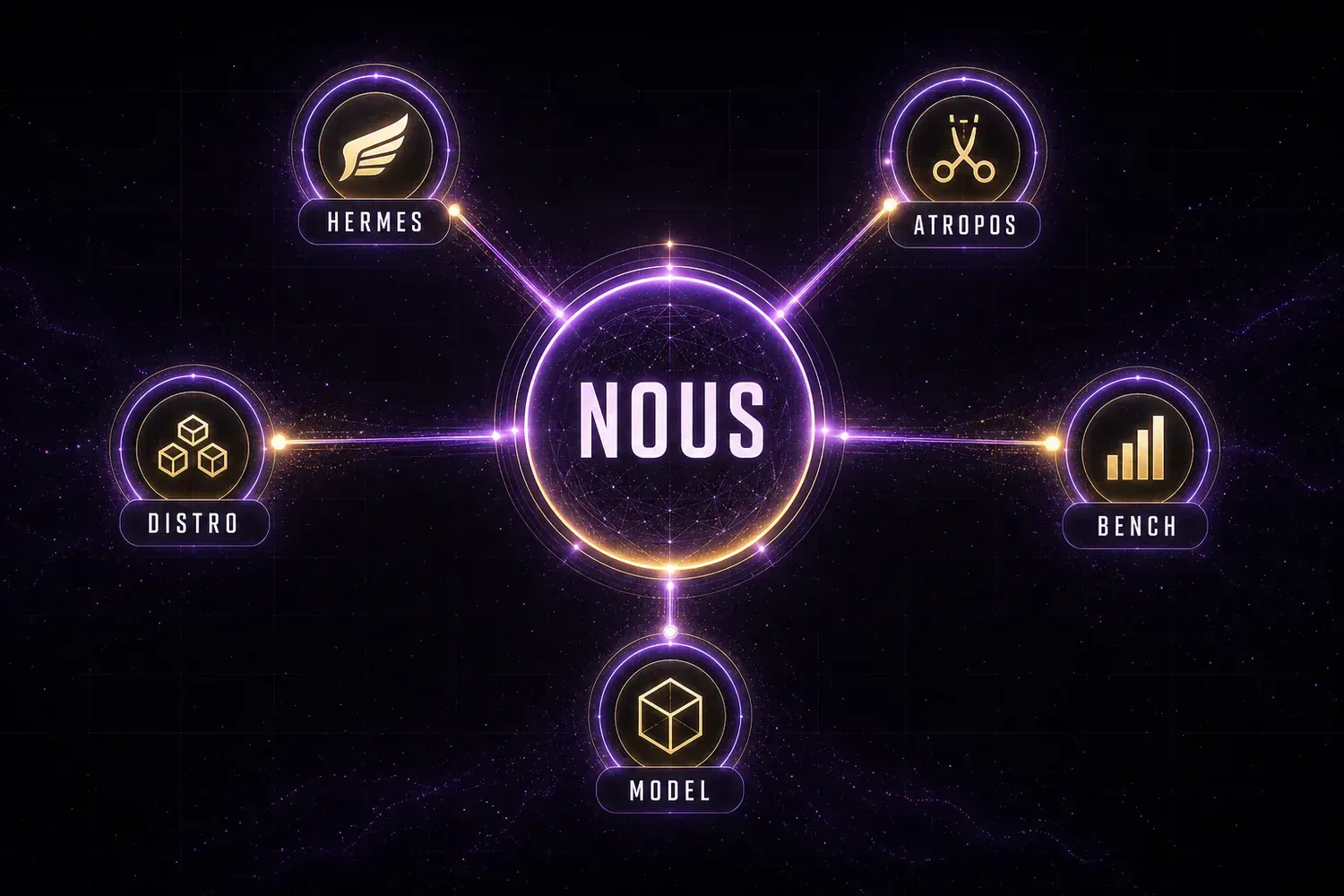
The pitch is that these aren't three unrelated tools but parts of one loop:
- DisTrO trains models using distributed compute
- Atropos evaluates those models and their RL trajectories
- Hermes deploys the strong ones as agents people use
- Hermes's interactions generate data that feeds back into training
Each project does broadly map to one of those stages. But the tidy "virtuous cycle" as a single, productised pipeline is an editorial way of describing it, not a documented end-to-end workflow you can switch on today. The idea is sound; the smooth end-to-end loop is more aspiration than shipped feature for now.
The Open Research Mission
Here the original draft gets the funding badly wrong, so it's worth setting straight. It described Nous as an independent research outfit living off grants, donations, and consulting. That isn't the case. Nous Research raised a $50M Series A led by Paradigm at roughly a $1B token valuation, with backing from Together AI, Distributed Global, North Island Ventures, Delphi Digital, and Raj Gokal, and is building the Solana-based Psyche Network (The Block (opens in a new tab)). It's a venture-backed decentralised-AI startup, not a grants-and-donations charity.
What is true: the projects lean open. Hermes Agent and Atropos are MIT-licensed (Hermes Agent LICENSE (opens in a new tab)). DisTrO's licence wasn't directly confirmable, so the blanket claim that all three are MIT is mostly right rather than fully verified. The open-source posture lets Nous chase directions a closed commercial lab might skip.
Community and Culture
The Nous community is unusually technical. Its Discord runs on researchers swapping papers, engineers arguing implementation details, and users giving real feedback. The tone favours evidence over hype, and a bit of healthy scepticism is treated as a feature, not a problem.
The Bigger Picture
Nous is betting that open, decentralised AI infrastructure can hold its own against the closed alternatives. By spanning training, evaluation, and deployment, it's sketching a route for organisations that want AI capability without locking themselves to a single vendor.
For developers and researchers, that's the draw: tools that are free and built with their actual needs in mind. Whether Hermes, Atropos, and DisTrO add up to the most complete open AI stack going is a claim for the market to settle. What's clear is that the pieces are real, the funding is serious, and the project is still early.
The Nous Research ecosystem: answer-first summary
The Nous Research ecosystem matters because it can change how Founders and operators plan, build, or govern an search and AI-answer workflow. Nous Research isn't just building one tool, they're creating a complete ecosystem for AI development.
The direct answer is this: do not treat the topic as a standalone trend. Treat it as a decision about inputs, outputs, review ownership, data exposure, and whether the workflow produces a result that is faster, safer, or more useful than the current process.
The Nous Research ecosystem: implementation checklist
- Define the user, job to be done, and success metric for the search and AI-answer workflow.
- Collect real examples, policies, source files, customer questions, or search queries before writing prompts or choosing tools.
- Separate low-risk drafts from decisions that need approval, privacy checks, or senior review.
- Document what the AI is allowed to access, what it must not access, and who signs off before production use.
- Review indexed pages, qualified clicks, AI citation visibility, conversion paths after a small pilot rather than judging the idea from a demo.
This keeps the work practical. It also gives search engines and AI answer engines a clean factual structure: what the topic is, who it helps, what to do next, and which risks matter before implementation.
Decision criteria for The Nous Research ecosystem
| Decision area | What to check | Production signal |
|---|---|---|
| Intent | Does The Nous Research ecosystem solve a real workflow problem? | The use case has a named owner and measurable outcome. |
| Data | Can the required data be used safely? | Sensitive data is classified and access is controlled. |
| Quality | Can a reviewer judge the output consistently? | Examples, rubrics, or acceptance criteria exist. |
| Scale | Can the workflow be repeated without hero effort? | The process is documented and can be handed to another team member. |
Practical example for The Nous Research ecosystem
A small business could use this article to choose one practical test. For example, a manager might take one customer-facing process, one internal document workflow, or one recurring content task and redesign only that step with AI support. The goal is not to automate the whole business at once; it is to learn where AI News creates reliable leverage.
The useful deliverable is a short operating note: the trigger, the source material, the prompt or tool, the review checklist, the escalation rule, and the metric. That note becomes the handover asset for staff training, SEO/GEO content, service delivery, or future agent work.
Risks and controls for The Nous Research ecosystem
The common failure pattern is moving too quickly from a promising idea into an unmanaged workflow. For The Nous Research ecosystem, the risk is not only bad output. It can also be unclear data permission, staff confusion, duplicate content, unreviewed customer advice, or a tool that quietly changes cost or capability.
- Control thin summaries with a named owner, a review step, and written acceptance criteria.
- Control duplicate intent with a named owner, a review step, and written acceptance criteria.
- Control weak entity coverage with a named owner, a review step, and written acceptance criteria.
- Control missing internal links with a named owner, a review step, and written acceptance criteria.
Measurement plan for The Nous Research ecosystem
A useful AI or SEO initiative should leave evidence. Track indexed pages, qualified clicks, AI citation visibility, conversion paths and compare the pilot against the current process. If the measure does not improve, keep the learning but avoid scaling the workflow.
For GEO readiness, the page should also answer the core question directly, define the entities involved, include implementation steps, explain tradeoffs, and link readers to the next relevant AI Kick Start service, guide, tool, or article.
Definitions and entities for The Nous Research ecosystem
For search, GEO, and staff handover, define the core entities in plain language. In this article the important entities are the workflow owner, the AI tool or model, the source material, the review process, the risk boundary, and the measurable business outcome. Clear definitions make the page easier for people to scan and easier for AI answer engines to quote accurately.
- Workflow owner: the person accountable for deciding whether The Nous Research ecosystem belongs in the business process.
- Source material: the documents, examples, policies, URLs, prompts, videos, or customer questions that ground the output.
- Review boundary: the point where a human checks accuracy, privacy, brand voice, or customer impact before the result is used.
- Success metric: the measure that proves whether the search and AI-answer workflow is worth repeating.
The Nous Research ecosystem versus doing nothing
Doing nothing is also a decision. The cost may be slow manual work, weaker search visibility, inconsistent advice, duplicated effort, or staff using unmanaged AI tools without a shared process. The practical question is whether a controlled pilot can reduce that cost without creating a larger governance problem.
| Option | When it makes sense | What to watch |
|---|---|---|
| Do nothing | The workflow is rare, low value, or already reliable. | Competitors may improve speed, content depth, or service consistency first. |
| Run a small pilot | The task repeats often and has clear review criteria. | Keep scope tight and measure the result against the current process. |
| Build a production workflow | The pilot is repeatable and risk controls are documented. | Assign ownership, monitoring, training, and a rollback path. |
AI Kick Start handover package for The Nous Research ecosystem
A production handover should be concrete enough that another person can run it. For The Nous Research ecosystem, that means a short brief, a workflow map, approved prompts or tool settings, source material, a review checklist, internal links to supporting resources, and a simple measurement sheet. This is the difference between reading about AI and turning it into operational capability.
That packaging also strengthens E-E-A-T. It shows experience through implementation notes, expertise through decision criteria, authoritativeness through source-aware structure, and trust through risks, controls, and review steps. The article becomes useful even if the reader never buys a tool because it helps them make a better operational decision.