





Three tools, three philosophies
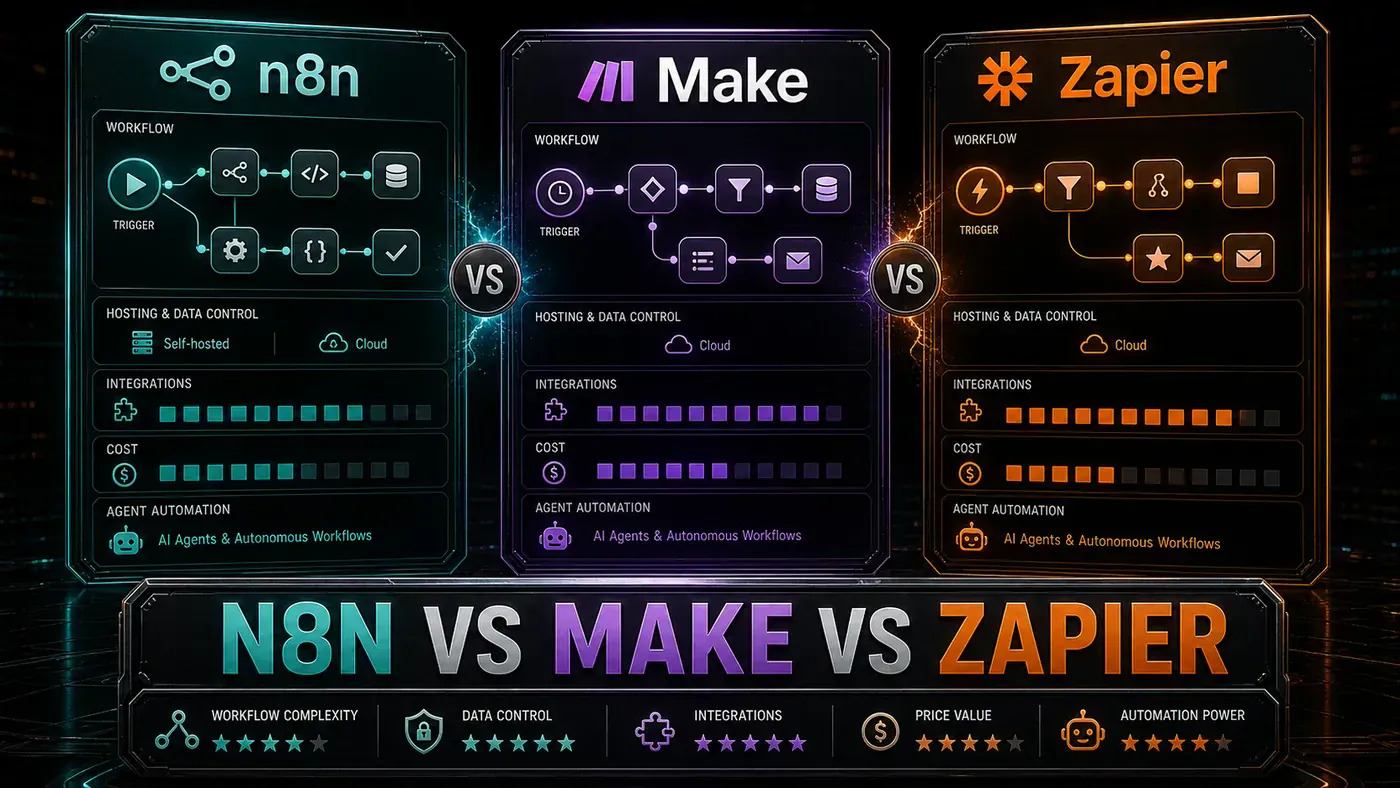
n8n, Make, and Zapier all connect apps and automate workflows, but they are built on different bets. Zapier bets on simplicity and breadth: the largest app catalogue and the gentlest on-ramp. Make bets on visual power: a canvas that handles complex branching and data shaping at moderate cost. n8n bets on control: an open-source engine you can self-host, with deep AI and agent support and no per-task billing. The right answer depends less on features in isolation and more on your data sensitivity, your volume, and who maintains the workflows. We work across all three, and the choice is usually made by the constraints below, not by brand preference.
Data sovereignty
This is the sharpest difference. Zapier and Make are cloud-only: your data flows through their infrastructure, predominantly hosted offshore, on every run. For many marketing and admin workflows that is fine. For workflows touching personal information, health records, or financial data, it introduces a third party into the data path that you must account for. n8n can be self-hosted, including on Australian infrastructure, so the data never leaves an environment you control. For Australian businesses with obligations under the Privacy Act, that distinction matters, and the OAIC's privacy guidance is the reference point for deciding whether a cloud automation tool is acceptable for a given dataset.
Source notes: OAIC privacy guidance
Cost at scale
The pricing models diverge as you grow. Zapier charges per task, every step in every run, so cost scales directly with volume; a high-frequency workflow can become surprisingly expensive. Make charges per operation but typically gives more value per dollar at moderate volume, and its bundling makes multi-step workflows cheaper than Zapier's equivalent. n8n self-hosted has effectively no per-run cost, you pay for the server, so at high volume it is dramatically cheaper, with the trade-off that you carry the hosting and maintenance. The rule of thumb: low volume favours Zapier's convenience, moderate volume favours Make's economics, and high volume or sensitive data favours self-hosted n8n.
Self-hosting and control
Only n8n offers genuine self-hosting. You run it on your own VPS or server, control updates, hold the credentials, and keep the data in your environment. That control is the whole point for security-conscious work, but it is not free: someone has to provision the server, keep it patched, and own uptime. Zapier and Make remove that burden entirely, which is a real benefit for teams without technical operations capacity. There is no universally correct answer here, only a trade between control and convenience. Teams that want n8n's control without the operations overhead often have us deploy and maintain it for them as part of a secure automation build.
AI and agent support
All three have added AI features, but they are not equal. n8n has invested heavily in AI and agent workflows, with native nodes for building multi-step agents, tool use, and chaining models together, and it works cleanly with both OpenAI and Anthropic models. Make has solid AI modules and a capable visual approach to chaining AI steps. Zapier offers AI actions and a chatbot builder that suit simpler assist-and-draft patterns well. If your roadmap is mostly connecting apps with the occasional AI summarisation step, any of the three works. If you are building genuine agent workflows with tool use and decision loops, n8n is the most capable, and the provider documentation is the place to confirm what each model supports.
Source notes: OpenAI platform documentation, Anthropic Claude documentation
Learning curve
Zapier is the easiest to start: a linear trigger-and-action model that a non-technical operator can build in minutes. Make is steeper because its canvas exposes more power, branching, iterators, data transformation, which is exactly why capable users prefer it once past the initial climb. n8n sits steepest of the three: the self-hosting and the expression syntax assume some technical comfort, and the payoff is the most flexibility and the lowest running cost. Match the tool to the builder. A non-technical team that must own its own automations is usually better served by Zapier or Make, even if n8n would be cheaper at scale.
How to choose
Decide in this order. First, data sensitivity: if the workflow touches personal, health, or financial data that should not leave Australian-controlled infrastructure, self-hosted n8n is the safe default. Second, volume: high run counts favour n8n on cost; low to moderate favour Zapier or Make on simplicity. Third, the builder: if non-technical staff must maintain it, lean Zapier or Make. Fourth, AI ambition: serious agent work favours n8n. Most businesses end up with a blend, Zapier or Make for low-risk marketing and admin automations, and self-hosted n8n for anything touching sensitive data or running at high volume.
n8n vs Make vs Zapier: answer-first summary
n8n vs Make vs Zapier matters because it can change how Operations teams plan, build, or govern an AI implementation workflow. An honest comparison of n8n, Make, and Zapier across data sovereignty, cost at scale, self-hosting, AI and agent support, and learning curve.
The direct answer is this: do not treat the topic as a standalone trend. Treat it as a decision about inputs, outputs, review ownership, data exposure, and whether the workflow produces a result that is faster, safer, or more useful than the current process.
n8n vs Make vs Zapier: implementation checklist
- Define the user, job to be done, and success metric for the AI implementation workflow.
- Collect real examples, policies, source files, customer questions, or search queries before writing prompts or choosing tools.
- Separate low-risk drafts from decisions that need approval, privacy checks, or senior review.
- Document what the AI is allowed to access, what it must not access, and who signs off before production use.
- Review time saved, quality score, review effort, business outcome after a small pilot rather than judging the idea from a demo.
This keeps the work practical. It also gives search engines and AI answer engines a clean factual structure: what the topic is, who it helps, what to do next, and which risks matter before implementation.
Decision criteria for n8n vs Make vs Zapier
| Decision area | What to check | Production signal |
|---|---|---|
| Intent | Does n8n vs Make vs Zapier solve a real workflow problem? | The use case has a named owner and measurable outcome. |
| Data | Can the required data be used safely? | Sensitive data is classified and access is controlled. |
| Quality | Can a reviewer judge the output consistently? | Examples, rubrics, or acceptance criteria exist. |
| Scale | Can the workflow be repeated without hero effort? | The process is documented and can be handed to another team member. |
Practical example for n8n vs Make vs Zapier
A small business could use this article to choose one practical test. For example, a manager might take one customer-facing process, one internal document workflow, or one recurring content task and redesign only that step with AI support. The goal is not to automate the whole business at once; it is to learn where Automation creates reliable leverage.
The useful deliverable is a short operating note: the trigger, the source material, the prompt or tool, the review checklist, the escalation rule, and the metric. That note becomes the handover asset for staff training, SEO/GEO content, service delivery, or future agent work.
Risks and controls for n8n vs Make vs Zapier
The common failure pattern is moving too quickly from a promising idea into an unmanaged workflow. For n8n vs Make vs Zapier, the risk is not only bad output. It can also be unclear data permission, staff confusion, duplicate content, unreviewed customer advice, or a tool that quietly changes cost or capability.
- Control unclear use case with a named owner, a review step, and written acceptance criteria.
- Control weak data quality with a named owner, a review step, and written acceptance criteria.
- Control missing governance with a named owner, a review step, and written acceptance criteria.
- Control no measurement with a named owner, a review step, and written acceptance criteria.
Measurement plan for n8n vs Make vs Zapier
A useful AI or SEO initiative should leave evidence. Track time saved, quality score, review effort, business outcome and compare the pilot against the current process. If the measure does not improve, keep the learning but avoid scaling the workflow.
For GEO readiness, the page should also answer the core question directly, define the entities involved, include implementation steps, explain tradeoffs, and link readers to the next relevant AI Kick Start service, guide, tool, or article.
Definitions and entities for n8n vs Make vs Zapier
For search, GEO, and staff handover, define the core entities in plain language. In this article the important entities are the workflow owner, the AI tool or model, the source material, the review process, the risk boundary, and the measurable business outcome. Clear definitions make the page easier for people to scan and easier for AI answer engines to quote accurately.
- Workflow owner: the person accountable for deciding whether n8n vs Make vs Zapier belongs in the business process.
- Source material: the documents, examples, policies, URLs, prompts, videos, or customer questions that ground the output.
- Review boundary: the point where a human checks accuracy, privacy, brand voice, or customer impact before the result is used.
- Success metric: the measure that proves whether the AI implementation workflow is worth repeating.
n8n vs Make vs Zapier versus doing nothing
Doing nothing is also a decision. The cost may be slow manual work, weaker search visibility, inconsistent advice, duplicated effort, or staff using unmanaged AI tools without a shared process. The practical question is whether a controlled pilot can reduce that cost without creating a larger governance problem.
| Option | When it makes sense | What to watch |
|---|---|---|
| Do nothing | The workflow is rare, low value, or already reliable. | Competitors may improve speed, content depth, or service consistency first. |
| Run a small pilot | The task repeats often and has clear review criteria. | Keep scope tight and measure the result against the current process. |
| Build a production workflow | The pilot is repeatable and risk controls are documented. | Assign ownership, monitoring, training, and a rollback path. |
AI Kick Start handover package for n8n vs Make vs Zapier
A production handover should be concrete enough that another person can run it. For n8n vs Make vs Zapier, that means a short brief, a workflow map, approved prompts or tool settings, source material, a review checklist, internal links to supporting resources, and a simple measurement sheet. This is the difference between reading about AI and turning it into operational capability.
That packaging also strengthens E-E-A-T. It shows experience through implementation notes, expertise through decision criteria, authoritativeness through source-aware structure, and trust through risks, controls, and review steps. The article becomes useful even if the reader never buys a tool because it helps them make a better operational decision.