





Find repeated work
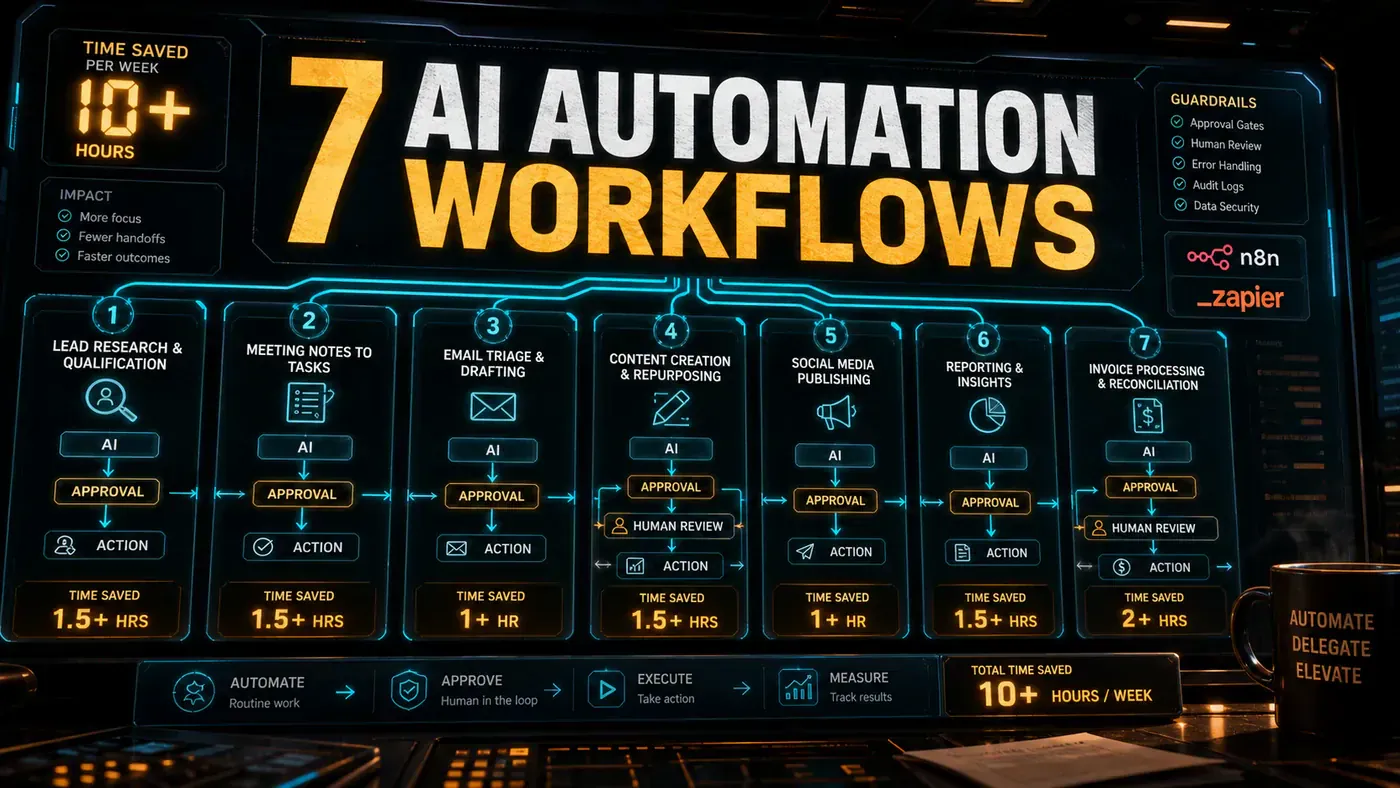
The best automation candidates are repeated, rule-heavy, and already documented by habit, even if not formally written down. Ask the team which task they would happily never do again, then watch how it is actually done. If the steps are stable from week to week, such as copy the data, rename it, summarise it, send it on, it is a candidate. If every instance needs a judgement call, it is better suited to AI-assisted drafting with a person finishing the job. Frequency matters more than size: a ten-minute task done daily is worth more than an hour-long task done quarterly.
Automate the preparation step
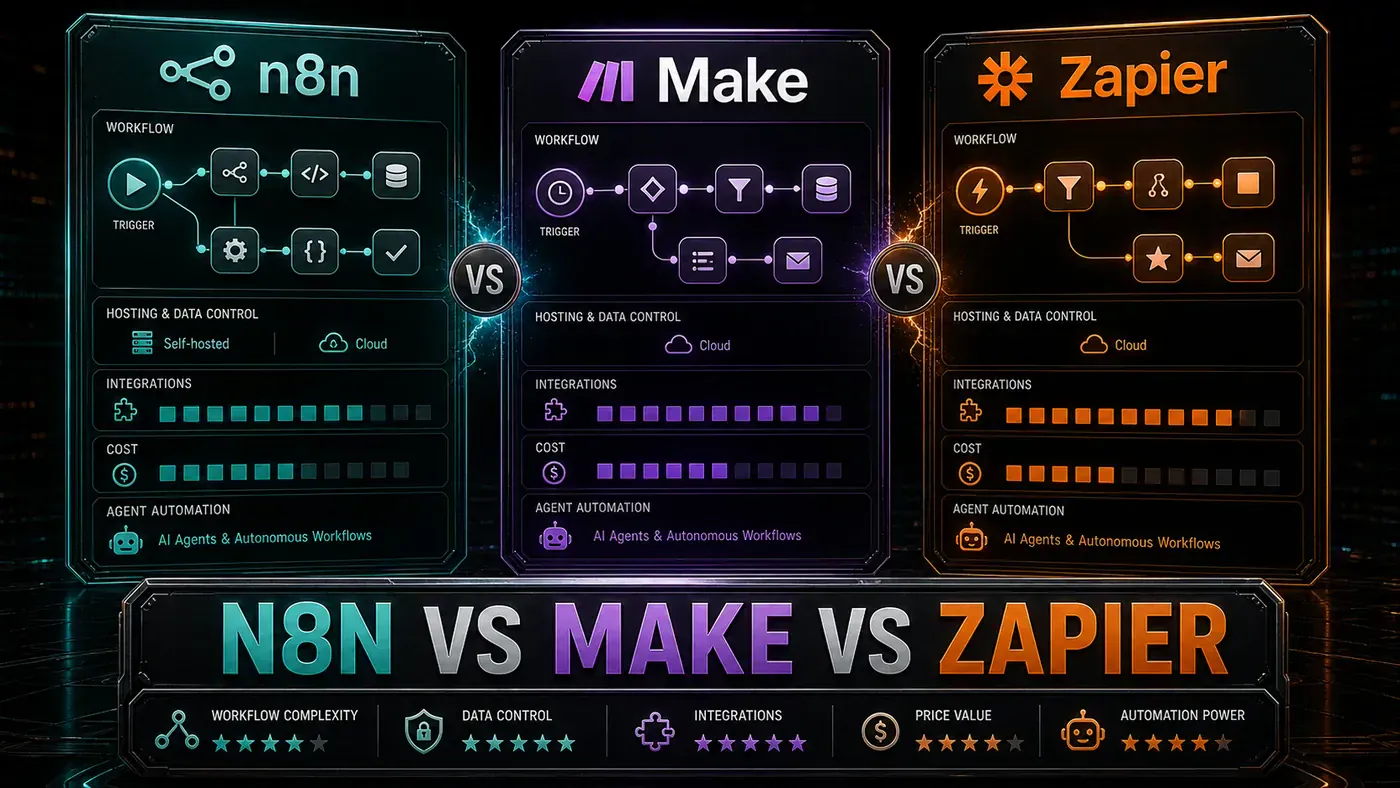
The first win is often drafting, summarising, classifying, routing, or pre-filling work rather than making the final decision. Preparation automations carry less risk because a person still signs off, and they are easier to build because tools like n8n, Make, and Zapier already connect to most common business apps. Start where the data already lives, such as the inbox, the CRM, or the project tracker, because integration effort is the real cost in most builds. The n8n documentation is a useful way to see what a workflow tool can reach before committing.
Source notes: n8n documentation
Keep a human checkpoint
Automations should prepare work. Sensitive customer, finance, compliance, publishing, and employment actions need review. This is also where Australian obligations apply: workflows that handle personal information should line up with the OAIC's privacy guidance, and anything granted system credentials should follow Australian Cyber Security Centre basics such as scoped access and multi-factor authentication. The checkpoint is not a bottleneck when it is designed as a queue with a clear approve-or-edit decision.
Source notes: OAIC privacy guidance, Australian Cyber Security Centre
Measure the saved loop
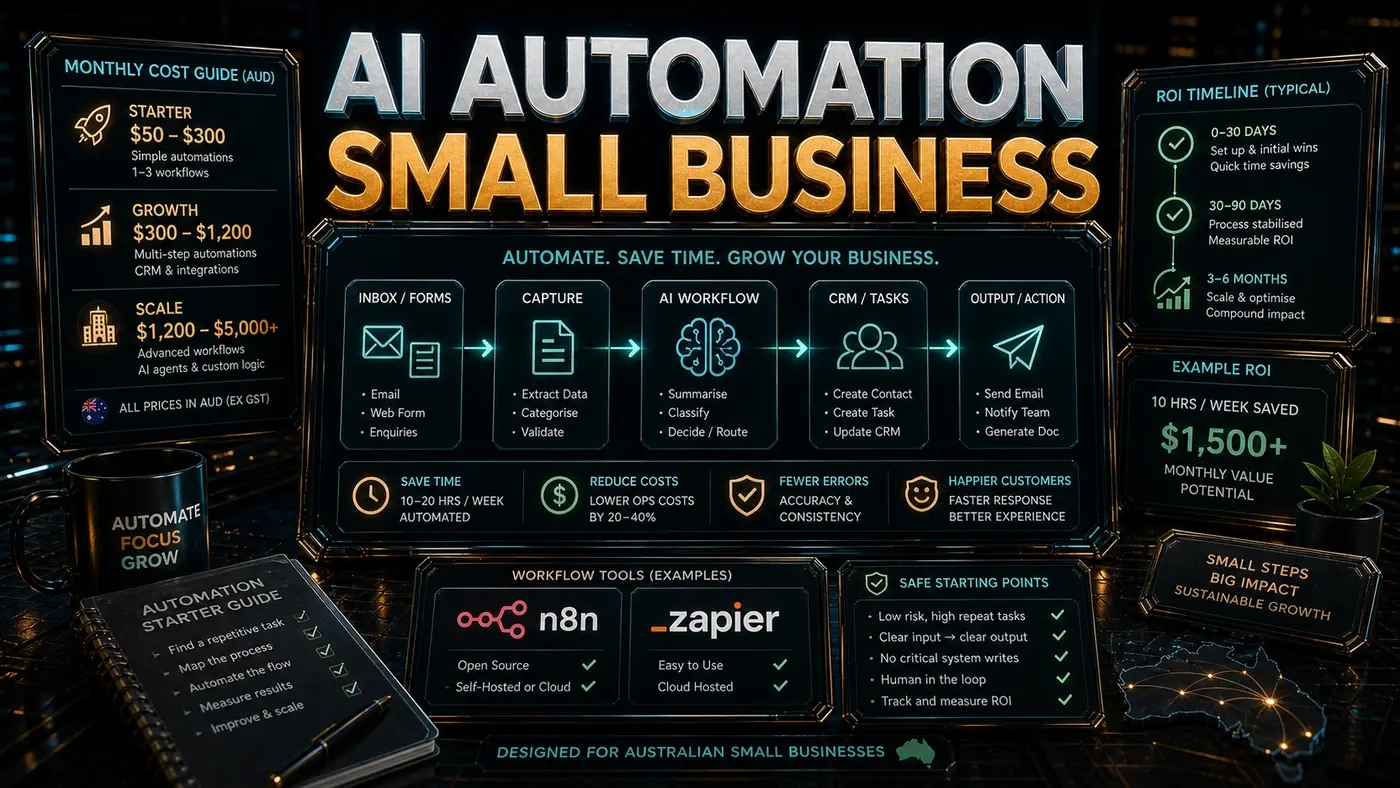
Track time saved, error reduction, lead response speed, publishing velocity, reporting quality, or fewer handoffs. Baseline first: time three or four real runs of the manual process before automating, so the saving is a measured fact rather than a guess. Pick one number before the build and measure it the same way afterwards. A claim like it feels faster does not survive a budget conversation. Lead replies went from four hours to ten minutes does.
Make ownership explicit
Every automation needs a named owner who knows how to run it, pause it, update it, and explain it to the team. Unowned automations fail silently: an API changes or a form field gets renamed, and nobody notices until a customer does. The owner's job is a monthly check that the automation is still running, still accurate, and still worth keeping. Ownership also covers the prompt and the template: when output quality drifts, the owner is the person who notices and adjusts.
A worked example: the Friday report
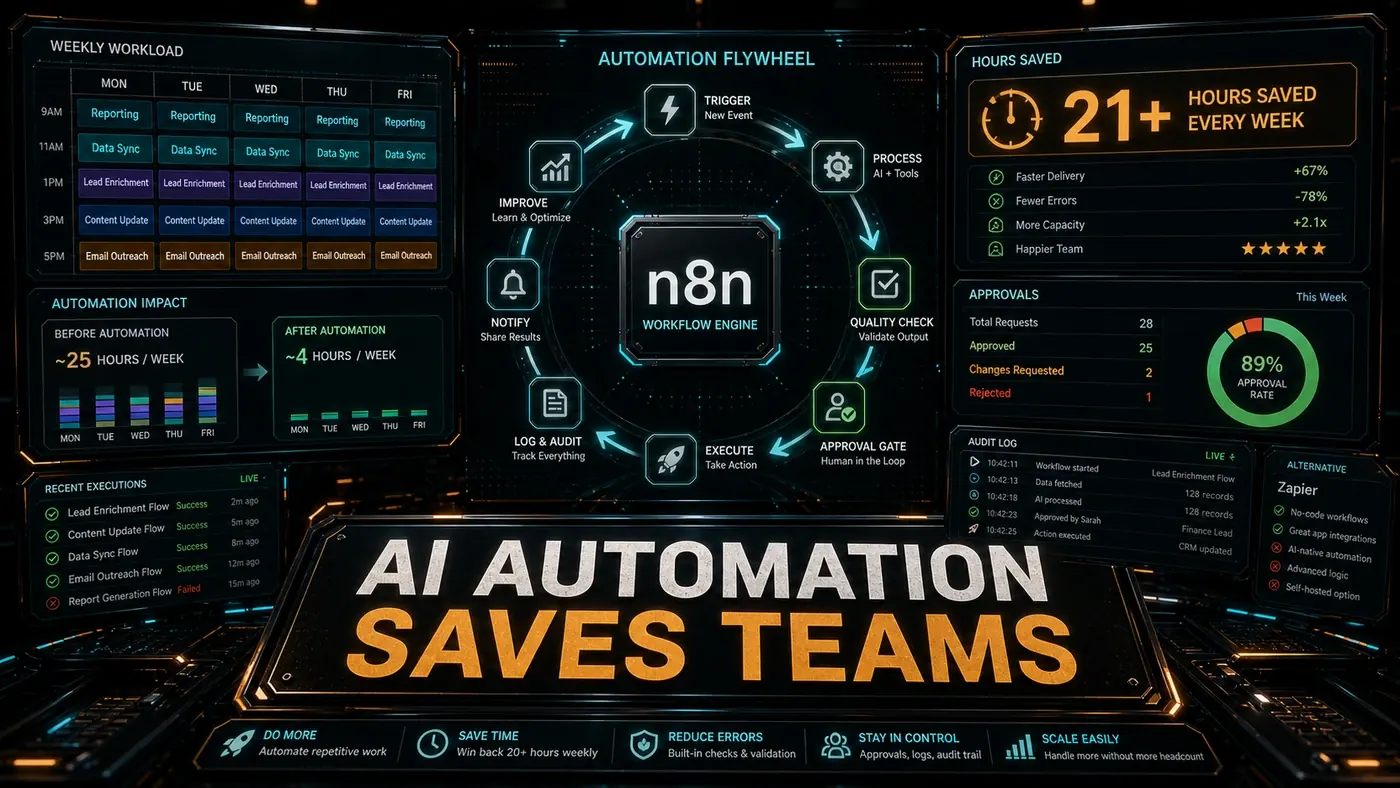
An agency spent about five hours every Friday building client status reports: pulling numbers from three systems, pasting them into a template, and writing a summary. The automation now collects the numbers on a schedule, fills the template, and uses an AI step to draft the summary paragraph. The account manager reviews and edits each report in about ten minutes. Five hours became under one, reports go out on time every week, and the review step means a wrong number has never reached a client. The build took two days and paid for itself inside a month.
Common automation mistakes
Automating a broken process, which only produces mistakes faster. Skipping the human checkpoint on customer-facing output. Leaving automations undocumented, so the business depends on one person's memory. Connecting tools with shared admin logins instead of scoped credentials. Chasing full autonomy on day one instead of starting with preparation steps. And stopping measurement after launch: the value case should be re-checked monthly, because volumes, prices, and processes change.
How AI automation saves teams hours every week: answer-first summary
How AI automation saves teams hours every week matters because it can change how Operations teams plan, build, or govern an AI implementation workflow. Where AI automation actually saves time, and how to keep approvals, logs, and quality controls in place.
The direct answer is this: do not treat the topic as a standalone trend. Treat it as a decision about inputs, outputs, review ownership, data exposure, and whether the workflow produces a result that is faster, safer, or more useful than the current process.
How AI automation saves teams hours every week: implementation checklist
- Define the user, job to be done, and success metric for the AI implementation workflow.
- Collect real examples, policies, source files, customer questions, or search queries before writing prompts or choosing tools.
- Separate low-risk drafts from decisions that need approval, privacy checks, or senior review.
- Document what the AI is allowed to access, what it must not access, and who signs off before production use.
- Review time saved, quality score, review effort, business outcome after a small pilot rather than judging the idea from a demo.
This keeps the work practical. It also gives search engines and AI answer engines a clean factual structure: what the topic is, who it helps, what to do next, and which risks matter before implementation.
Decision criteria for How AI automation saves teams hours every week
| Decision area | What to check | Production signal |
|---|---|---|
| Intent | Does How AI automation saves teams hours every week solve a real workflow problem? | The use case has a named owner and measurable outcome. |
| Data | Can the required data be used safely? | Sensitive data is classified and access is controlled. |
| Quality | Can a reviewer judge the output consistently? | Examples, rubrics, or acceptance criteria exist. |
| Scale | Can the workflow be repeated without hero effort? | The process is documented and can be handed to another team member. |
Practical example for How AI automation saves teams hours every week
A small business could use this article to choose one practical test. For example, a manager might take one customer-facing process, one internal document workflow, or one recurring content task and redesign only that step with AI support. The goal is not to automate the whole business at once; it is to learn where Automation creates reliable leverage.
The useful deliverable is a short operating note: the trigger, the source material, the prompt or tool, the review checklist, the escalation rule, and the metric. That note becomes the handover asset for staff training, SEO/GEO content, service delivery, or future agent work.
Risks and controls for How AI automation saves teams hours every week
The common failure pattern is moving too quickly from a promising idea into an unmanaged workflow. For How AI automation saves teams hours every week, the risk is not only bad output. It can also be unclear data permission, staff confusion, duplicate content, unreviewed customer advice, or a tool that quietly changes cost or capability.
- Control unclear use case with a named owner, a review step, and written acceptance criteria.
- Control weak data quality with a named owner, a review step, and written acceptance criteria.
- Control missing governance with a named owner, a review step, and written acceptance criteria.
- Control no measurement with a named owner, a review step, and written acceptance criteria.
Measurement plan for How AI automation saves teams hours every week
A useful AI or SEO initiative should leave evidence. Track time saved, quality score, review effort, business outcome and compare the pilot against the current process. If the measure does not improve, keep the learning but avoid scaling the workflow.
For GEO readiness, the page should also answer the core question directly, define the entities involved, include implementation steps, explain tradeoffs, and link readers to the next relevant AI Kick Start service, guide, tool, or article.
Definitions and entities for How AI automation saves teams hours every week
For search, GEO, and staff handover, define the core entities in plain language. In this article the important entities are the workflow owner, the AI tool or model, the source material, the review process, the risk boundary, and the measurable business outcome. Clear definitions make the page easier for people to scan and easier for AI answer engines to quote accurately.
- Workflow owner: the person accountable for deciding whether How AI automation saves teams hours every week belongs in the business process.
- Source material: the documents, examples, policies, URLs, prompts, videos, or customer questions that ground the output.
- Review boundary: the point where a human checks accuracy, privacy, brand voice, or customer impact before the result is used.
- Success metric: the measure that proves whether the AI implementation workflow is worth repeating.
How AI automation saves teams hours every week versus doing nothing
Doing nothing is also a decision. The cost may be slow manual work, weaker search visibility, inconsistent advice, duplicated effort, or staff using unmanaged AI tools without a shared process. The practical question is whether a controlled pilot can reduce that cost without creating a larger governance problem.
| Option | When it makes sense | What to watch |
|---|---|---|
| Do nothing | The workflow is rare, low value, or already reliable. | Competitors may improve speed, content depth, or service consistency first. |
| Run a small pilot | The task repeats often and has clear review criteria. | Keep scope tight and measure the result against the current process. |
| Build a production workflow | The pilot is repeatable and risk controls are documented. | Assign ownership, monitoring, training, and a rollback path. |
AI Kick Start handover package for How AI automation saves teams hours every week
A production handover should be concrete enough that another person can run it. For How AI automation saves teams hours every week, that means a short brief, a workflow map, approved prompts or tool settings, source material, a review checklist, internal links to supporting resources, and a simple measurement sheet. This is the difference between reading about AI and turning it into operational capability.
That packaging also strengthens E-E-A-T. It shows experience through implementation notes, expertise through decision criteria, authoritativeness through source-aware structure, and trust through risks, controls, and review steps. The article becomes useful even if the reader never buys a tool because it helps them make a better operational decision.