

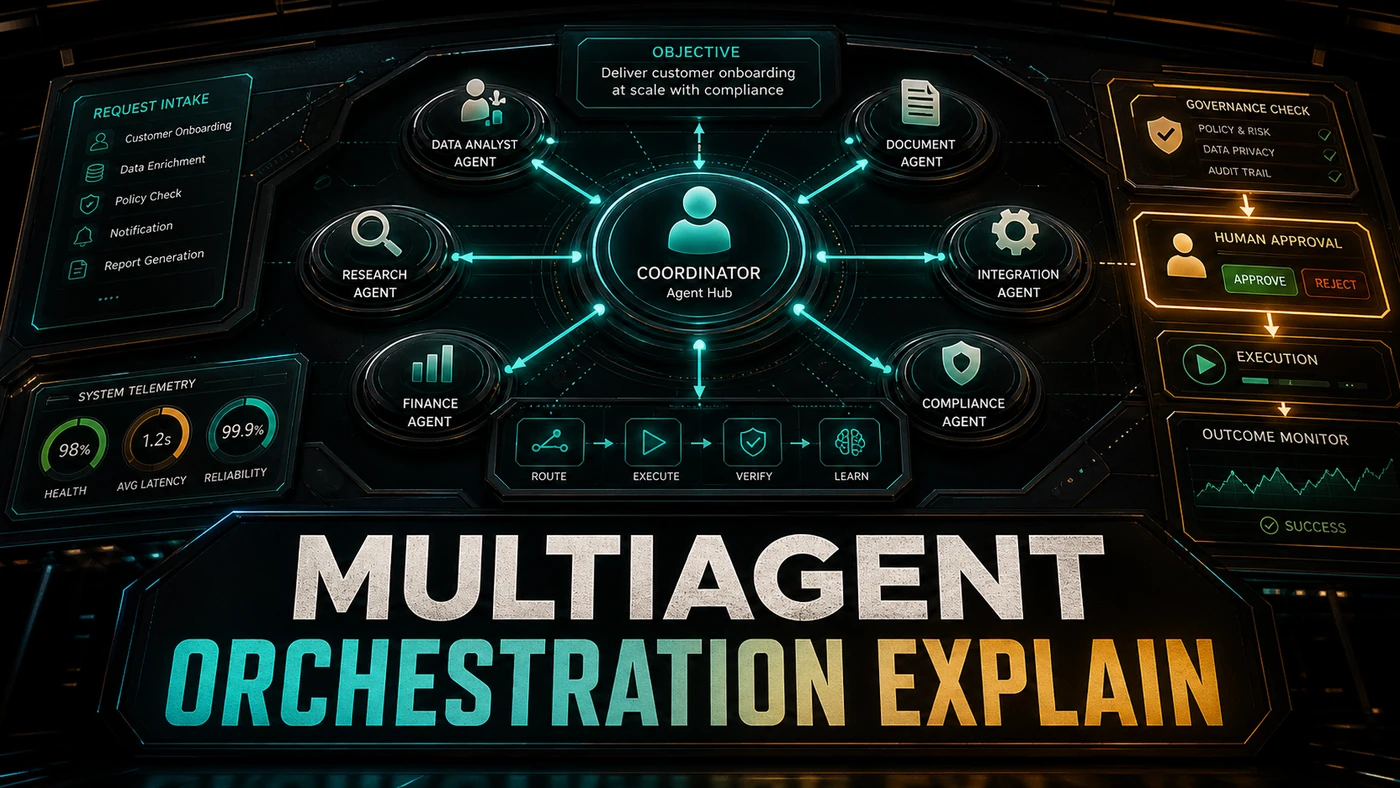


What orchestration actually means
Multi-agent orchestration is the coordination of several specialised AI agents, each with a narrow job, by a controlling layer that assigns work, passes results between them, and decides what happens next. Think of it less as one clever assistant and more as a small team with a supervisor. One agent researches, another evaluates, another drafts, and an orchestrator routes the work and enforces the rules. The value is not novelty; it is that breaking a complex task into specialised roles produces more reliable, more reviewable results than asking a single general agent to do everything at once.
The research-decide-act pattern
Most useful orchestration follows a simple three-phase loop. Research: one or more agents gather the relevant facts, pull records, read documents, search a knowledge base, summarise context. Decide: a reasoning step weighs the gathered information against the rules and proposes a course of action, but does not execute it. Act: the chosen action is carried out, sending a reply, updating a record, generating a report, usually after a checkpoint. Separating these phases is what makes the system trustworthy. When research, decision, and action are tangled together, a mistake is hard to trace. When they are distinct, you can inspect what was gathered, what was decided, and what was done, and intervene at any step.
Human approval gates
An approval gate is a deliberate stop where the system holds and waits for a person before proceeding. In a well-designed orchestration, the research and decision phases run freely, but the act phase pauses on anything consequential: customer-facing messages, financial transactions, record changes, anything involving personal information. The person sees what the system found, what it proposes, and why, then approves, edits, or rejects. This is not a limitation to be engineered away; it is the control that lets you deploy agents on real work safely. For workflows touching personal information, those gates are also where Australian privacy obligations are honoured, and the OAIC's guidance is the reference for what needs human accountability.
Source notes: OAIC privacy guidance
When a single agent is enough
Multi-agent is not automatically better. If a task is genuinely one job, drafting a reply, summarising a document, classifying an enquiry, a single well-scoped agent is simpler, cheaper, easier to debug, and easier to govern. Reach for orchestration only when the task naturally splits into distinct roles that benefit from specialisation, or when the work is long enough that one agent loses the thread. A good test: if you would assign the whole task to one capable contractor with a checklist, use one agent. If you would assign it to a small team with a coordinator, orchestration earns its complexity. Starting with a single agent and splitting only when you hit a real limit is almost always the right sequence.
Why specialisation helps
Narrow agents are more reliable than broad ones for the same reason narrow job descriptions produce better hires. An agent with one clear responsibility, a defined input, and a defined output can be tested, measured, and trusted. An agent asked to research, judge, write, and act in a single sweep has more ways to go wrong and fewer places to inspect when it does. Specialisation also makes the system composable: a research agent that works well can be reused across several workflows, and a drafting agent can be improved once and benefit every process that calls it. The provider documentation from OpenAI and Anthropic describes the tool-use and multi-step patterns these systems are built on, useful background when scoping a build.
Source notes: OpenAI platform documentation, Anthropic Claude documentation
Governance and observability
An orchestrated system must be observable or it cannot be trusted. Every agent's inputs, outputs, decisions, and tool calls should be logged, so that when an answer looks wrong you can trace which step produced it. Each agent should hold only the permissions its job requires, never a shared master credential, which keeps a single compromised step from reaching systems it had no business touching. The Australian Cyber Security Centre's guidance on scoped access and logging is a practical baseline for how to wire this safely. Observability is also what turns a one-off build into a maintainable system: the logs are where you find the failure modes worth fixing.
Source notes: Australian Cyber Security Centre
A worked example
A services firm built an orchestration to handle inbound tender opportunities. A research agent reads the tender document and pulls the requirements, deadlines, and evaluation criteria. A second agent checks those against the firm's capability matrix and past projects, then proposes a go or no-go with reasoning. On a go, a drafting agent assembles a response outline from approved templates. Every step is logged, and the act phase, submitting anything, is gated: a partner reviews the recommendation and the draft before a word leaves the building. The orchestration turned a two-day triage into a half-day review, without ever letting an agent commit the firm to a bid on its own. That balance, fast preparation, human decision, is what good orchestration delivers, and it is how we design agent systems for clients.