





Briefing
Picture handing a one-line brief to a software company and getting back a working app, except the company is made entirely of AI. That's the bet behind MetaGPT (opens in a new tab), an open-source project that doesn't just give you a single coding assistant. It gives you a whole org chart of them.
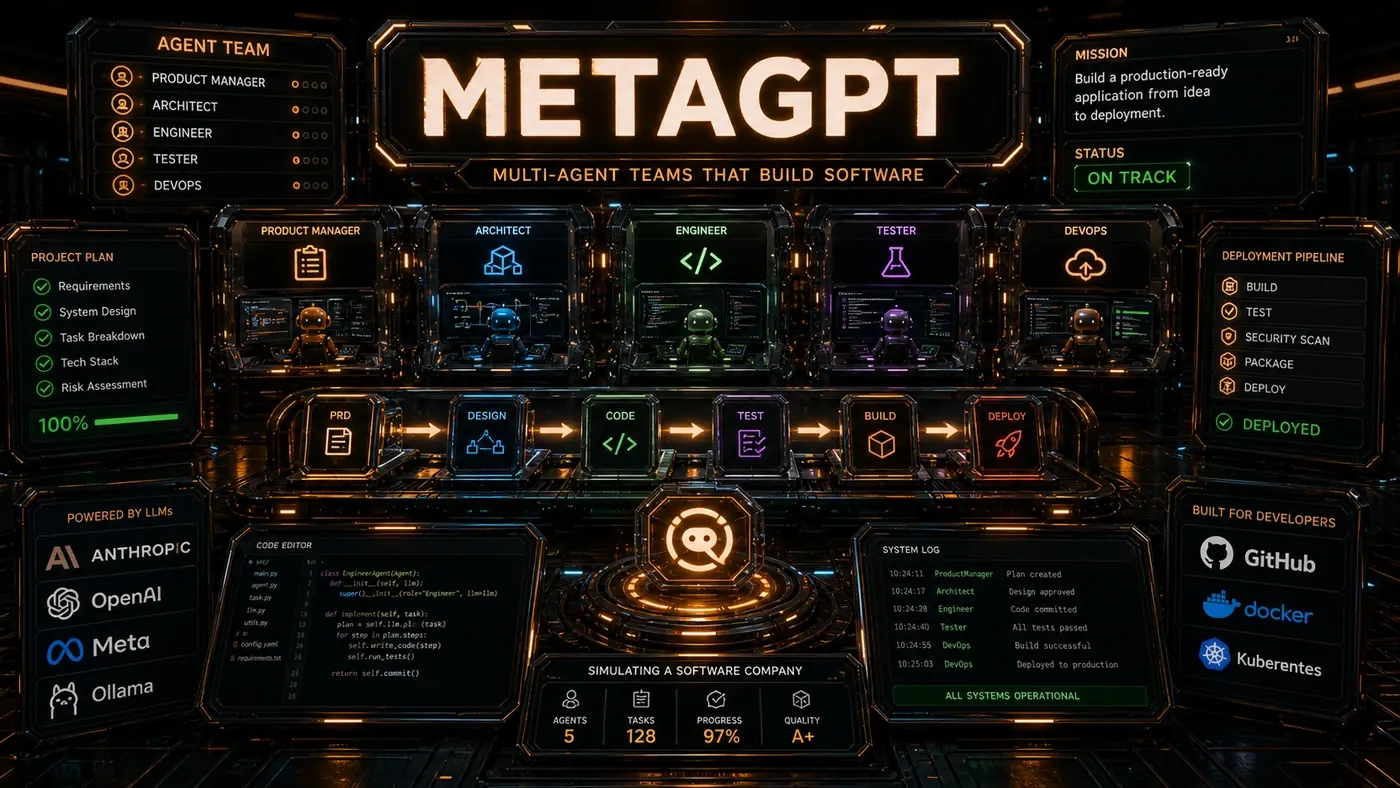
Instead of one model trying to do everything, MetaGPT splits the job across agents that each play a workplace role: a product manager, an architect, engineers, a QA tester. They pass work between each other the way a real team would, following set procedures rather than improvising. For Australian teams weighing up AI development tools, it's a useful look at where this is heading, and an honest reminder of what's hype and what's actually shipping.
The short version: the output is more capable than you'd expect from a one-line prompt, and rougher than a polished product. Worth understanding before you bank on it.
The Software Company Metaphor
MetaGPT borrows its structure straight from a real software team, giving each agent a job (MetaGPT docs (opens in a new tab)):
Product Manager: Reads the requirements, writes the PRD, and sets the acceptance criteria.
Architect: Designs the system, picks the technologies, and defines the interfaces.
Project Manager: Breaks the work into tasks, hands them out, and keeps track of progress.
Engineers: Write code against the specs. Several engineers can take on different components at once.
QA Engineer: Writes the tests, finds the bugs, and checks the fixes.
Some accounts also describe a DevOps agent handling deployment, CI/CD config, and infrastructure, though that role isn't documented as part of MetaGPT's standard line-up, the official docs and the project's research paper (opens in a new tab) consistently list the five roles above.
Each role is its own specialised agent, with its own capabilities, memory, and responsibilities. They talk to each other through structured messages that copy how people actually coordinate at work (MetaGPT paper (opens in a new tab)).
How It Works
A run begins with a description of what you want built. The Product Manager agent reads it and writes a PRD. The Architect takes that and designs the system. Engineers build the components, working in parallel. QA tests the lot. The flow tracks how real software gets made, only it's running end to end on AI.
What makes it tick is the Standard Operating Procedures (SOPs). These set out how agents interact, what information moves between roles, and how decisions get made. The project's guiding idea is blunt: "Code = SOP(Team)", encode the procedures, and you reduce the errors (MetaGPT paper (opens in a new tab)). MetaGPT leans toward web and CRUD app generation, ships a Data Interpreter for data and ML work, and lets you define custom roles and actions for your own workflows (MetaGPT GitHub (opens in a new tab)). Pre-packaged, named SOP sets for each domain aren't spelled out as such in the docs, but the framework is built to be extended.
Key Capabilities
End-to-End Development: From a requirement to working code in a single run.
Code Quality: The generated code comes with documentation, type hints, and tests, not just bare functions.
Iterative Refinement: A failing test triggers a bug fix. A broken step triggers a config change.
Human-in-the-Loop: MetaGPT supports human feedback inside its roles and SOP workflow, so you can step in and steer. Formal review gates at fixed milestones aren't documented as a named feature, but the framework leaves room for you to approve or redirect along the way.
Technical Architecture
MetaGPT is written almost entirely in Python, the repo is roughly 97.5% Python, on top of an extensible agent framework with Role and Action abstractions you can build on (MetaGPT GitHub (opens in a new tab)). It connects to:
- LLM Providers: OpenAI, Anthropic/Claude, Azure, and local models via Ollama, plus others like Groq, configured through MetaGPT's own LLM config (opens in a new tab). The provider list is broad; some descriptions credit LiteLLM as the integration layer, but the docs point to MetaGPT's native provider config rather than LiteLLM specifically.
- Code Execution: It runs generated Python during the engineer and QA flow, the Data Interpreter executes code and produces output like plots. A guaranteed sandboxed shell isn't prominently documented, so don't assume one.
- Version Control: Runs produce a repository of generated code, with git-style output.
- Deployment: MetaGPT ships a Dockerfile for running the framework itself. Claims that it deploys the apps it generates to Docker, Kubernetes, or cloud platforms aren't supported by the documentation, that's running MetaGPT, not it deploying your app for you.
Real-World Results
MetaGPT takes a one-line requirement and turns out a PRD, design, tasks, and code, and it's been used for a range of project types (MetaGPT GitHub (opens in a new tab)):
- CRUD applications: Full-stack web apps with databases, APIs, and frontends
- Data pipelines: ETL-style workflows
- CLI tools: Command-line utilities with proper argument parsing and documentation
- Microservices: Distributed services that talk to each other
The well-documented territory is CRUD web apps, games, and data analysis through the Data Interpreter. Broader claims, microservices with service discovery, full pipelines with monitoring, are plausible but not specifically documented, so treat them as what you might attempt rather than guaranteed output.
Quality varies. Anything complicated still needs a human to clean it up, and the project says as much. But the starting point is often better than you'd guess. Work that might cost a developer days of scaffolding can come together in hours.
The Multi-Agent Vision
The thinking behind MetaGPT is straightforward: big jobs need a division of labour, and that holds for AI as much as it does for people. One agent tends to choke on a large project because it has no specialised expertise to draw on and can't work on several pieces at once. Splitting the work across roles is how human teams handle scale, and MetaGPT copies the move.
If you're an Australian business team poking at AI-assisted development, MetaGPT is worth a look, not as a finished replacement for engineers, but as a clear, hands-on read on where the tooling is going.
MetaGPT: answer-first summary
MetaGPT matters because it can change how Founders and operators plan, build, or govern an tool evaluation workflow. MetaGPT simulates an entire software company with specialised AI agents that collaborate to design, code, test, and deploy applications.
The direct answer is this: do not treat the topic as a standalone trend. Treat it as a decision about inputs, outputs, review ownership, data exposure, and whether the workflow produces a result that is faster, safer, or more useful than the current process.
MetaGPT: implementation checklist
- Define the user, job to be done, and success metric for the tool evaluation workflow.
- Collect real examples, policies, source files, customer questions, or search queries before writing prompts or choosing tools.
- Separate low-risk drafts from decisions that need approval, privacy checks, or senior review.
- Document what the AI is allowed to access, what it must not access, and who signs off before production use.
- Review time to value, adoption rate, cost per workflow, quality review score after a small pilot rather than judging the idea from a demo.
This keeps the work practical. It also gives search engines and AI answer engines a clean factual structure: what the topic is, who it helps, what to do next, and which risks matter before implementation.
Decision criteria for MetaGPT
| Decision area | What to check | Production signal |
|---|---|---|
| Intent | Does MetaGPT solve a real workflow problem? | The use case has a named owner and measurable outcome. |
| Data | Can the required data be used safely? | Sensitive data is classified and access is controlled. |
| Quality | Can a reviewer judge the output consistently? | Examples, rubrics, or acceptance criteria exist. |
| Scale | Can the workflow be repeated without hero effort? | The process is documented and can be handed to another team member. |
Practical example for MetaGPT
A small business could use this article to choose one practical test. For example, a manager might take one customer-facing process, one internal document workflow, or one recurring content task and redesign only that step with AI support. The goal is not to automate the whole business at once; it is to learn where AI Tools creates reliable leverage.
The useful deliverable is a short operating note: the trigger, the source material, the prompt or tool, the review checklist, the escalation rule, and the metric. That note becomes the handover asset for staff training, SEO/GEO content, service delivery, or future agent work.
Risks and controls for MetaGPT
The common failure pattern is moving too quickly from a promising idea into an unmanaged workflow. For MetaGPT, the risk is not only bad output. It can also be unclear data permission, staff confusion, duplicate content, unreviewed customer advice, or a tool that quietly changes cost or capability.
- Control tool sprawl with a named owner, a review step, and written acceptance criteria.
- Control unclear pricing with a named owner, a review step, and written acceptance criteria.
- Control vendor lock-in with a named owner, a review step, and written acceptance criteria.
- Control unreviewed data sharing with a named owner, a review step, and written acceptance criteria.
Measurement plan for MetaGPT
A useful AI or SEO initiative should leave evidence. Track time to value, adoption rate, cost per workflow, quality review score and compare the pilot against the current process. If the measure does not improve, keep the learning but avoid scaling the workflow.
For GEO readiness, the page should also answer the core question directly, define the entities involved, include implementation steps, explain tradeoffs, and link readers to the next relevant AI Kick Start service, guide, tool, or article.
Definitions and entities for MetaGPT
For search, GEO, and staff handover, define the core entities in plain language. In this article the important entities are the workflow owner, the AI tool or model, the source material, the review process, the risk boundary, and the measurable business outcome. Clear definitions make the page easier for people to scan and easier for AI answer engines to quote accurately.
- Workflow owner: the person accountable for deciding whether MetaGPT belongs in the business process.
- Source material: the documents, examples, policies, URLs, prompts, videos, or customer questions that ground the output.
- Review boundary: the point where a human checks accuracy, privacy, brand voice, or customer impact before the result is used.
- Success metric: the measure that proves whether the tool evaluation workflow is worth repeating.
MetaGPT versus doing nothing
Doing nothing is also a decision. The cost may be slow manual work, weaker search visibility, inconsistent advice, duplicated effort, or staff using unmanaged AI tools without a shared process. The practical question is whether a controlled pilot can reduce that cost without creating a larger governance problem.
| Option | When it makes sense | What to watch |
|---|---|---|
| Do nothing | The workflow is rare, low value, or already reliable. | Competitors may improve speed, content depth, or service consistency first. |
| Run a small pilot | The task repeats often and has clear review criteria. | Keep scope tight and measure the result against the current process. |
| Build a production workflow | The pilot is repeatable and risk controls are documented. | Assign ownership, monitoring, training, and a rollback path. |
AI Kick Start handover package for MetaGPT
A production handover should be concrete enough that another person can run it. For MetaGPT, that means a short brief, a workflow map, approved prompts or tool settings, source material, a review checklist, internal links to supporting resources, and a simple measurement sheet. This is the difference between reading about AI and turning it into operational capability.
That packaging also strengthens E-E-A-T. It shows experience through implementation notes, expertise through decision criteria, authoritativeness through source-aware structure, and trust through risks, controls, and review steps. The article becomes useful even if the reader never buys a tool because it helps them make a better operational decision.