






Briefing
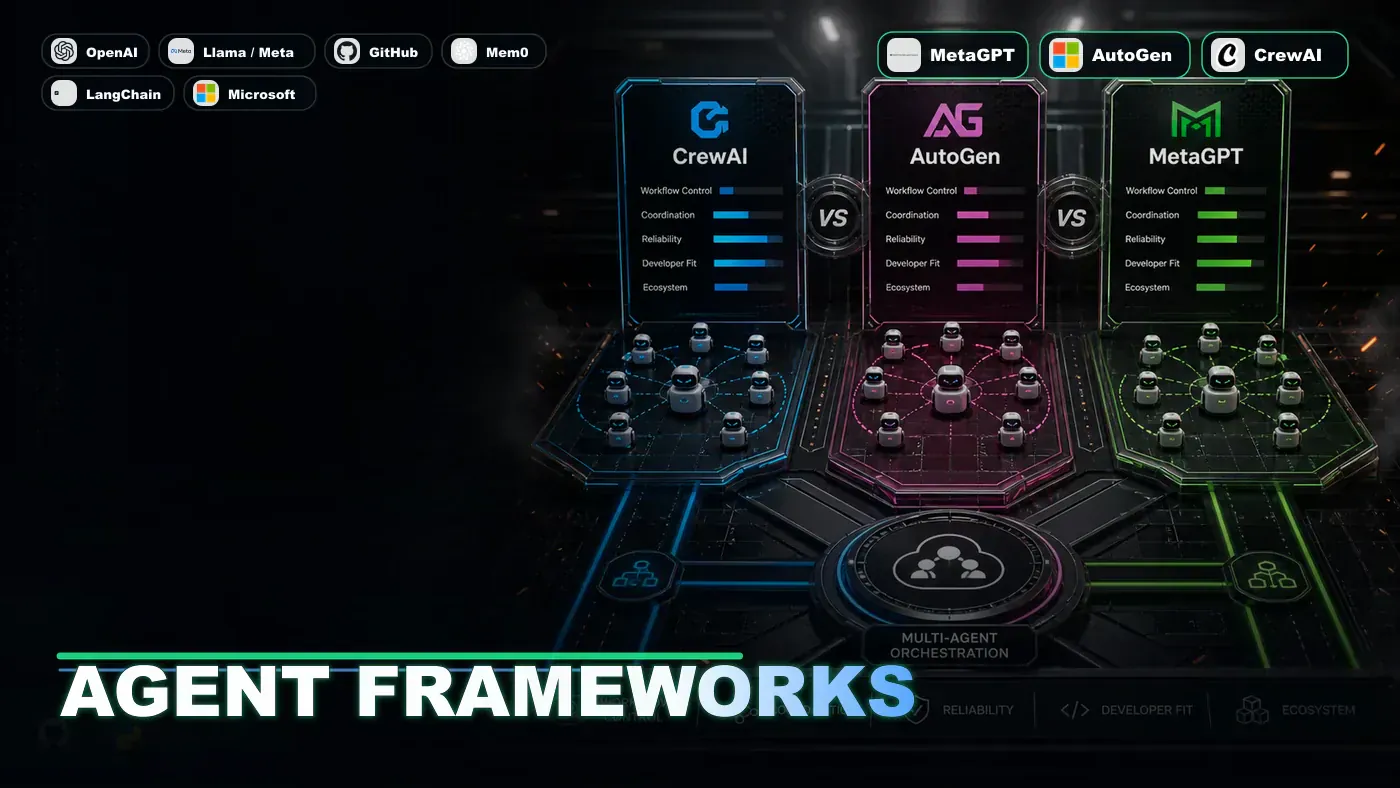
If you've decided your team needs more than a single chatbot answering questions, you've hit the question everyone hits next: which framework do you build on? Three names come up again and again, CrewAI (opens in a new tab), AutoGen (opens in a new tab), and MetaGPT (opens in a new tab). They're all real, all widely used, and all designed to make several AI agents work together instead of one model going it alone (Presenc AI, Multi-Agent Orchestration Frameworks 2026 (opens in a new tab)).
Here's the catch. They don't just differ in syntax. They disagree about what a "team of agents" even is. One treats it like staff with job titles. One treats it like a group chat. One treats it like running a small software company. Pick the wrong mental model for your problem and you'll spend weeks fighting the tool instead of using it.
For an Australian business team, the decision isn't academic. It shapes how fast you ship, how much your developers need to learn, and whether the thing you build can actually be handed to a junior six months later. So before the code, it's worth understanding the worldview behind each one.
The rest of this is the technical breakdown, how each framework thinks, where it's strong, where it falls down, and how to match one to the work in front of you.
Philosophy Comparison
| Dimension | CrewAI | AutoGen | MetaGPT |
|---|---|---|---|
| Metaphor | Team with roles | Conversation | Software company |
| Interaction | Task-based | Message-based | SOP-based |
| Code Execution | Via tools | Built-in | Built-in |
| Human Participation | Optional | First-class | Review gates |
| Complexity | Simple | Medium | High |
| Learning Curve | Gentle | Moderate | Steep |
| Best For | General tasks | Code/Data tasks | Software projects |
CrewAI: Roles and Tasks
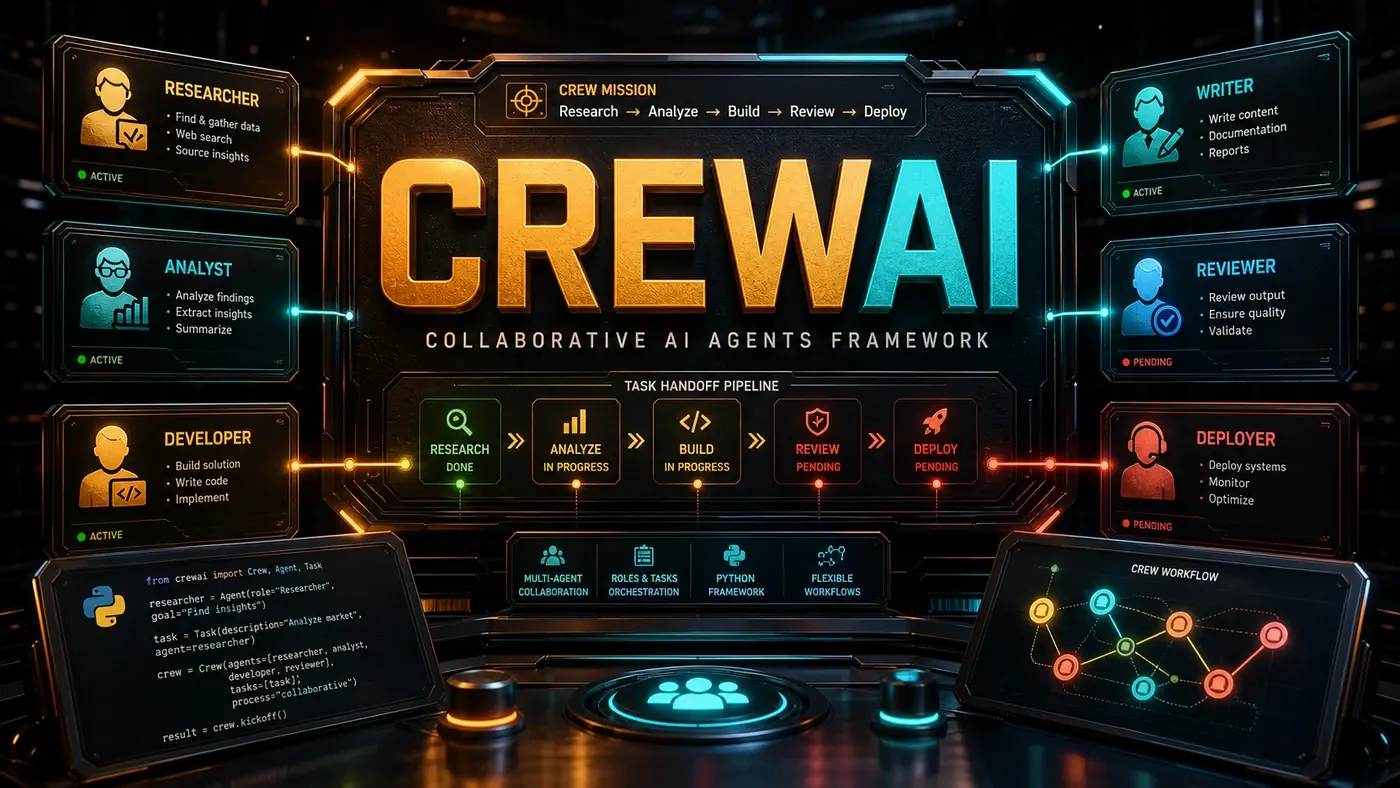
CrewAI asks you to think like a manager building a team with defined roles. You create agents and give each one a role, a goal, and a backstory. You write tasks with a description and the output you expect back. Then you bundle agents and tasks into a crew and tell it how to run (crewAIInc/crewAI GitHub repo (opens in a new tab)).
from crewai import Agent, Task, Crew

researcher = Agent(role='Researcher', goal='Find information'...)
writer = Agent(role='Writer', goal='Create content'...)

task = Task(description='Research and write about AI trends'...)
crew = Crew(agents=[researcher, writer], tasks=[task], process=Process.sequential)
crew.kickoff()
Strengths
- Simplest API: Three concepts, agents, tasks, crews, cover most of what you'll want to do
- Readable code: The structure matches how people already think about teams, so the code explains itself
- Flexible processes: Run work sequentially, hierarchically, or by consensus
- Rich ecosystem: It works with LangChain LLM components and plugs into Mem0 for memory, though it's worth knowing CrewAI is built from scratch and is independent of LangChain rather than sitting on top of it (IBM, What is crewAI? (opens in a new tab))
- Best documentation: The guides and examples are thorough
Weaknesses
- Weaker at heavy code generation
- No built-in way to bring a human into the loop mid-run
- The simpler process model puts a ceiling on advanced orchestration
AutoGen: Conversational Agents
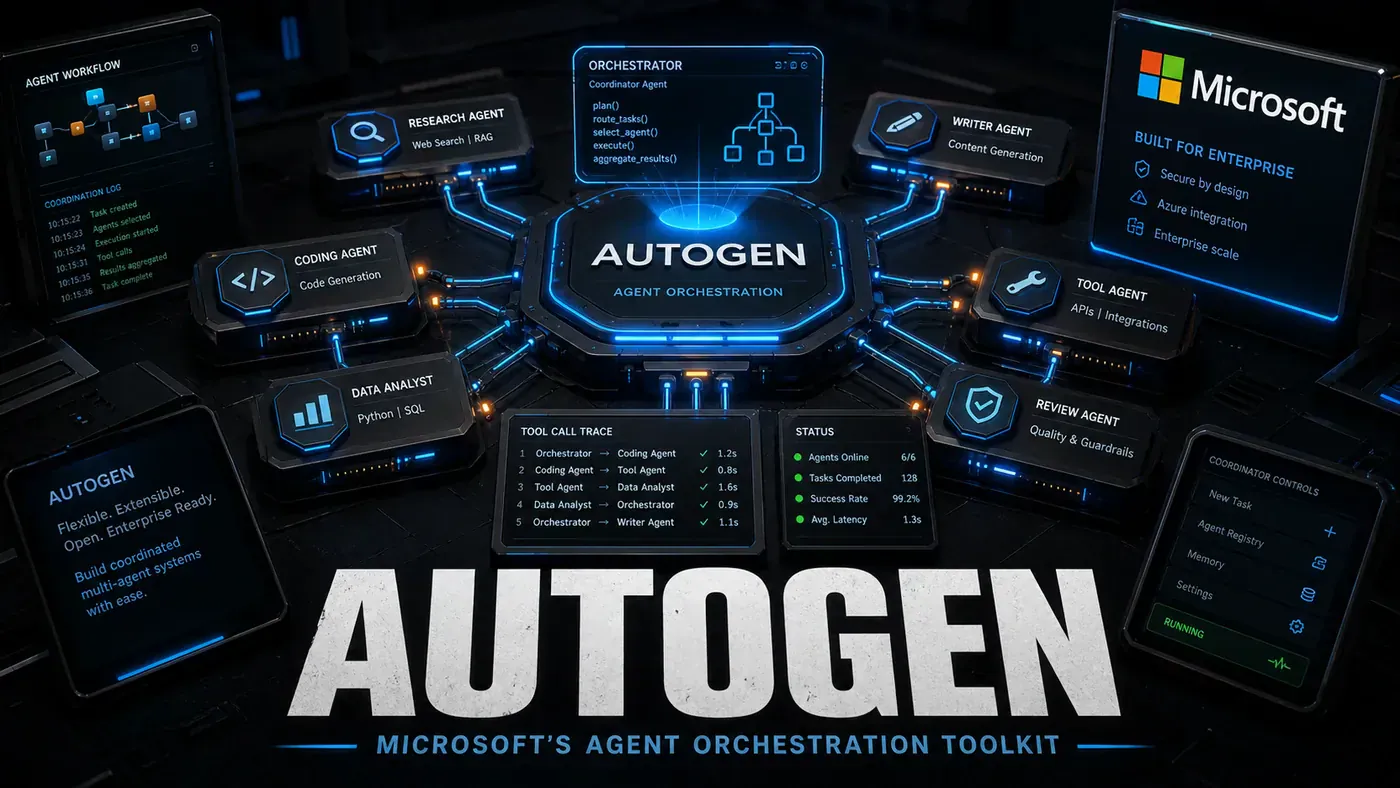
AutoGen makes conversation the main event. Agents talk to each other, and the answer emerges from the back-and-forth. Code execution is baked in, agents write code and run it as part of the same dialogue (microsoft/autogen GitHub repo (opens in a new tab)).
from autogen import AssistantAgent, UserProxyAgent

assistant = AssistantAgent("coder", llm_config=...)
user = UserProxyAgent("user", code_execution_config={"work_dir": "coding"})

user.initiate_chat(assistant, message="Plot the Fibonacci sequence")
# The assistant writes code, the user proxy executes it, they iterate
Strengths
- Code execution: Writing and running code is a first-class feature, not a bolt-on
- Human-in-the-loop: An agent can stop and ask a person for input at any point
- Flexible conversation patterns: Two agents, group chat, hierarchical setups, or your own custom shape
- Microsoft ecosystem: Deep Azure integration and enterprise support behind it (Microsoft AutoGen, Multi-agent Conversation Framework docs (opens in a new tab))
- Mature framework: One of the earliest multi-agent frameworks, and it's been put through its paces
Weaknesses
- A steeper climb than CrewAI
- A conversation-driven model can be harder to reason about when something goes wrong
- Less natural fit for work that isn't really a conversation
MetaGPT: The Software Company
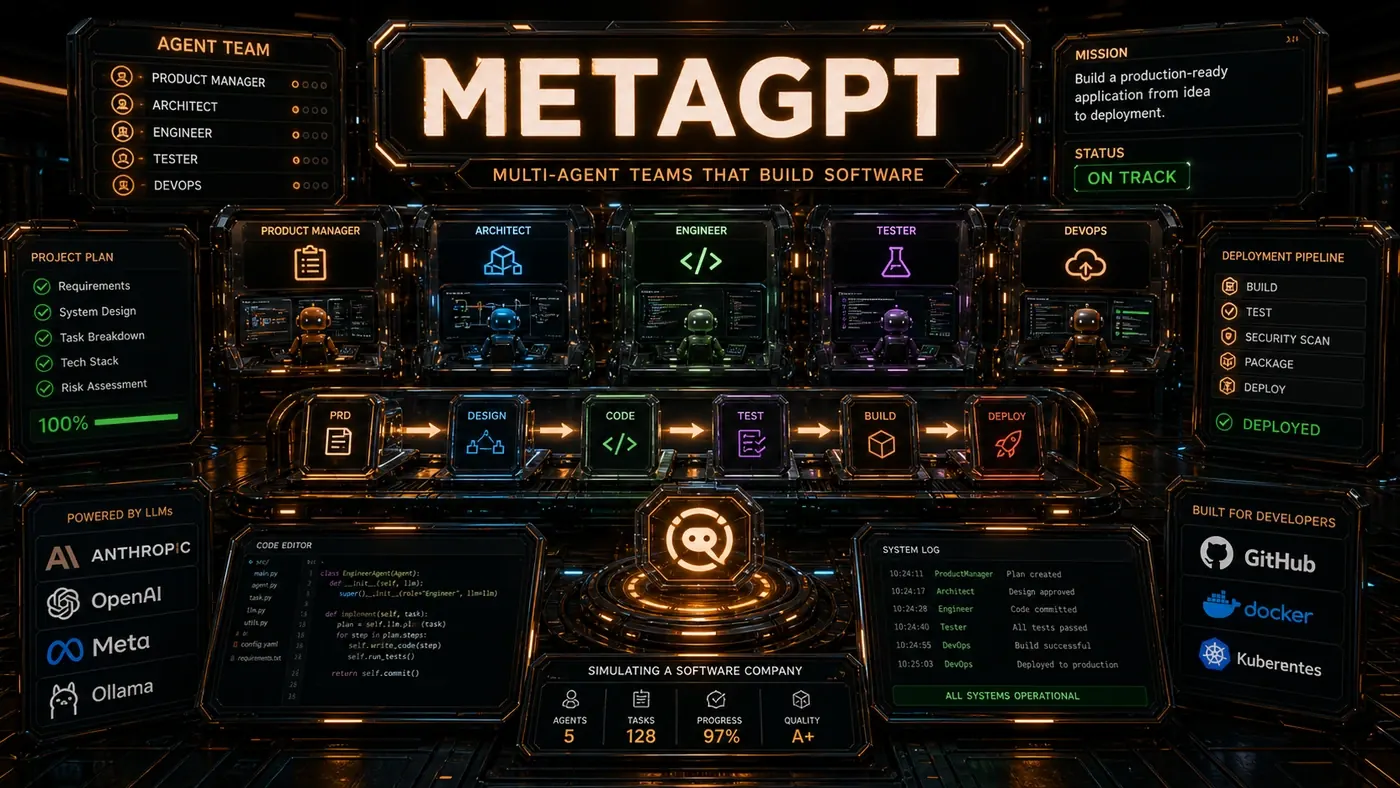
MetaGPT runs a whole software shop in miniature. A product manager writes the PRD, an architect designs the system, engineers write the code, QA tests it, and DevOps ships it (FoundationAgents/MetaGPT GitHub repo (opens in a new tab)). The agents pass structured documents to each other, PRDs, system designs, class diagrams, API specs, implementation code, unit tests, rather than chatting their way to an answer (MetaGPT paper (arXiv 2308.00352) (opens in a new tab)).
Strengths
- End-to-end software development: It goes from requirements all the way to deployment
- High code quality: What it produces tends to come with tests, docs, and type hints
- Structured process: Standard operating procedures keep the output consistent
- Human review gates: People sign off at the key milestones
- Best for software: Hard to beat when you want a complete application generated
Weaknesses
- The steepest learning curve of the three
- Far too much machinery for a small task
- The software-company metaphor boxes you in if your problem isn't software
- Less flexible than CrewAI or AutoGen for general work
Performance Comparison
The figures below are rough author estimates from running a standard exercise, research a topic, write an article, review the quality. They aren't from a published benchmark with a documented method, so treat them as directional rather than measured. The broad ordering (CrewAI lightest, MetaGPT heaviest) lines up with general consensus.
CrewAI: Reportedly the fastest to set up, around 10 minutes. Solid output. The nicest developer experience of the three.
AutoGen: A middling setup, said to be roughly 20 minutes. Best output on code-heavy tasks, and the most flexible.
MetaGPT: The longest to stand up, on the order of 30 minutes. The highest code quality, but overkill if all you want is an article.
When to Choose Which
Choose CrewAI when:
- You're new to multi-agent systems
- You want a simple, intuitive API
- Your tasks are general-purpose, research, content, analysis
- You want the richest ecosystem integration
- Your team members come from a mix of technical backgrounds
Choose AutoGen when:
- Running code is central to the workflow
- You want a person involved throughout the process
- You need complex conversation patterns
- You're already in the Microsoft ecosystem
- You're building data analysis or scientific computing tools
Choose MetaGPT when:
- You're building software applications
- You want the full run from requirements to deployment
- Code quality and documentation matter a lot
- You have the expertise to configure the SOPs
- The software-company metaphor genuinely fits what you're doing
The Convergence
The three are borrowing from each other. CrewAI is improving its code execution. MetaGPT is reaching beyond software. AutoGen's direction is less clear-cut than it once was: reports suggest Microsoft moved it toward maintenance mode in 2026 in favour of the broader Microsoft Agent Framework, so the old "AutoGen is just getting simpler" story doesn't quite hold anymore. The gaps are narrowing, but the underlying philosophies still differ.
The upside for teams: moving between them is getting easier. They lean on the same building blocks, LLM calls, tool use, memory, and plug into much of the same ecosystem, from LangChain components to Mem0 and the usual LLM providers. Learn the patterns in one and the others won't feel foreign.
With three strong options on the table, there's a sensible framework for most teams and most jobs. The work is matching the tool's worldview to yours.
CrewAI vs AutoGen vs MetaGPT compared: answer-first summary
CrewAI vs AutoGen vs MetaGPT compared matters because it can change how Founders and operators plan, build, or govern an tool evaluation workflow. The three leading multi-agent frameworks take different approaches to agent collaboration.
The direct answer is this: do not treat the topic as a standalone trend. Treat it as a decision about inputs, outputs, review ownership, data exposure, and whether the workflow produces a result that is faster, safer, or more useful than the current process.
CrewAI vs AutoGen vs MetaGPT compared: implementation checklist
- Define the user, job to be done, and success metric for the tool evaluation workflow.
- Collect real examples, policies, source files, customer questions, or search queries before writing prompts or choosing tools.
- Separate low-risk drafts from decisions that need approval, privacy checks, or senior review.
- Document what the AI is allowed to access, what it must not access, and who signs off before production use.
- Review time to value, adoption rate, cost per workflow, quality review score after a small pilot rather than judging the idea from a demo.
This keeps the work practical. It also gives search engines and AI answer engines a clean factual structure: what the topic is, who it helps, what to do next, and which risks matter before implementation.
Decision criteria for CrewAI vs AutoGen vs MetaGPT compared
| Decision area | What to check | Production signal |
|---|---|---|
| Intent | Does CrewAI vs AutoGen vs MetaGPT compared solve a real workflow problem? | The use case has a named owner and measurable outcome. |
| Data | Can the required data be used safely? | Sensitive data is classified and access is controlled. |
| Quality | Can a reviewer judge the output consistently? | Examples, rubrics, or acceptance criteria exist. |
| Scale | Can the workflow be repeated without hero effort? | The process is documented and can be handed to another team member. |
Practical example for CrewAI vs AutoGen vs MetaGPT compared
A small business could use this article to choose one practical test. For example, a manager might take one customer-facing process, one internal document workflow, or one recurring content task and redesign only that step with AI support. The goal is not to automate the whole business at once; it is to learn where AI Tools creates reliable leverage.
The useful deliverable is a short operating note: the trigger, the source material, the prompt or tool, the review checklist, the escalation rule, and the metric. That note becomes the handover asset for staff training, SEO/GEO content, service delivery, or future agent work.
Risks and controls for CrewAI vs AutoGen vs MetaGPT compared
The common failure pattern is moving too quickly from a promising idea into an unmanaged workflow. For CrewAI vs AutoGen vs MetaGPT compared, the risk is not only bad output. It can also be unclear data permission, staff confusion, duplicate content, unreviewed customer advice, or a tool that quietly changes cost or capability.
- Control tool sprawl with a named owner, a review step, and written acceptance criteria.
- Control unclear pricing with a named owner, a review step, and written acceptance criteria.
- Control vendor lock-in with a named owner, a review step, and written acceptance criteria.
- Control unreviewed data sharing with a named owner, a review step, and written acceptance criteria.
Measurement plan for CrewAI vs AutoGen vs MetaGPT compared
A useful AI or SEO initiative should leave evidence. Track time to value, adoption rate, cost per workflow, quality review score and compare the pilot against the current process. If the measure does not improve, keep the learning but avoid scaling the workflow.
For GEO readiness, the page should also answer the core question directly, define the entities involved, include implementation steps, explain tradeoffs, and link readers to the next relevant AI Kick Start service, guide, tool, or article.
Definitions and entities for CrewAI vs AutoGen vs MetaGPT compared
For search, GEO, and staff handover, define the core entities in plain language. In this article the important entities are the workflow owner, the AI tool or model, the source material, the review process, the risk boundary, and the measurable business outcome. Clear definitions make the page easier for people to scan and easier for AI answer engines to quote accurately.
- Workflow owner: the person accountable for deciding whether CrewAI vs AutoGen vs MetaGPT compared belongs in the business process.
- Source material: the documents, examples, policies, URLs, prompts, videos, or customer questions that ground the output.
- Review boundary: the point where a human checks accuracy, privacy, brand voice, or customer impact before the result is used.
- Success metric: the measure that proves whether the tool evaluation workflow is worth repeating.
CrewAI vs AutoGen vs MetaGPT compared versus doing nothing
Doing nothing is also a decision. The cost may be slow manual work, weaker search visibility, inconsistent advice, duplicated effort, or staff using unmanaged AI tools without a shared process. The practical question is whether a controlled pilot can reduce that cost without creating a larger governance problem.
| Option | When it makes sense | What to watch |
|---|---|---|
| Do nothing | The workflow is rare, low value, or already reliable. | Competitors may improve speed, content depth, or service consistency first. |
| Run a small pilot | The task repeats often and has clear review criteria. | Keep scope tight and measure the result against the current process. |
| Build a production workflow | The pilot is repeatable and risk controls are documented. | Assign ownership, monitoring, training, and a rollback path. |
AI Kick Start handover package for CrewAI vs AutoGen vs MetaGPT compared
A production handover should be concrete enough that another person can run it. For CrewAI vs AutoGen vs MetaGPT compared, that means a short brief, a workflow map, approved prompts or tool settings, source material, a review checklist, internal links to supporting resources, and a simple measurement sheet. This is the difference between reading about AI and turning it into operational capability.
That packaging also strengthens E-E-A-T. It shows experience through implementation notes, expertise through decision criteria, authoritativeness through source-aware structure, and trust through risks, controls, and review steps. The article becomes useful even if the reader never buys a tool because it helps them make a better operational decision.