
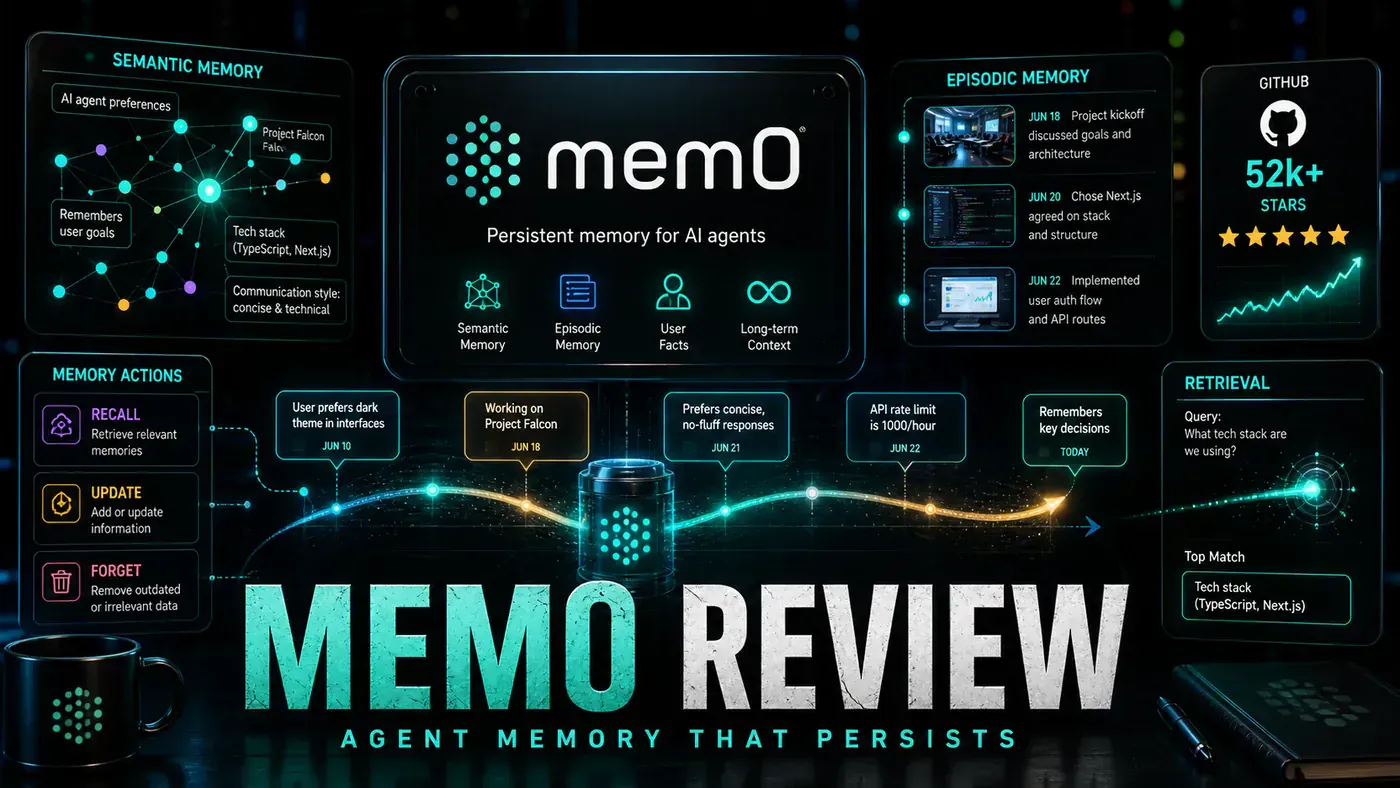






Mem0 Review: Agent Memory That Persists
TL;DR: Mem0 tackles one of the genuinely hard problems in building AI agents: giving them memory that survives past the current conversation. In our testing it did the job, it plugs into the agent frameworks most teams already use, and its GitHub following (well into the tens of thousands of stars) tracks with how useful it is. If you're building a conversational agent or a personal assistant, it's worth a serious look.
Most AI agents have a goldfish problem. You tell your assistant on Monday that you prefer Python, that your company bills in Australian dollars, that you hate being cc'd on everything. By Tuesday it has forgotten all of it. Each new conversation starts from zero, and you end up repeating yourself like you're talking to someone with no short-term recall.
Mem0 (github.com/mem0ai/mem0 (opens in a new tab)) is one of the more popular attempts to fix that. It sits underneath your agent as a memory layer, quietly noting what matters about each user and handing it back the next time it's relevant. The project has gathered a large GitHub following, now reportedly in the tens of thousands of stars, and according to secondary reports it raised a $24M Series A in late 2025 led by Basis Set Ventures. So there's money and momentum behind it, not just a weekend hack.
The reason this matters for a business team is simple. An agent that remembers context is one your staff and customers will actually trust. An agent that forgets is one people abandon after a week. Memory is the difference between a demo and a tool people keep using.
We spent time with Mem0 to see whether it lives up to the attention. Here's what it does, how it performed in our own testing, and where the rough edges are.
What Is Mem0?
Mem0 is a memory layer for AI agents:
- Long-term memory, persists across sessions
- Semantic search, retrieves relevant memories by meaning
- Hierarchical storage, facts, preferences, conversations
- Multi-user, isolated memory per user
- Self-improving, learns what's important over time
That description holds up. The official repo and mem0.ai (opens in a new tab) bill it as a universal memory layer for AI agents, with persistent memory across sessions, semantic retrieval, a multi-store architecture (vector, graph, key-value), and per-user memory scopes (mem0ai/mem0 GitHub repository (opens in a new tab)).
Price: Free and open source under the Apache 2.0 license (mem0ai/mem0 on GitHub (opens in a new tab)). The managed Mem0 Platform is a separate, paid product. Mem0's pricing page (opens in a new tab) lists tiered subscriptions rather than a flat per-operation rate: a free Hobby tier (10,000 memories), Starter at $19/mo (50,000), Growth at $79/mo (200,000), and Pro at $249/mo (500,000), with custom usage-based plans above that. (An earlier draft of this review quoted a $0.001-per-operation cloud rate; we could not find that figure on the official pricing page, so treat it as unconfirmed and check the current tiers before you budget.)
How It Works
Mem0 intercepts agent conversations and extracts memories:
User: "I prefer Python over JavaScript" Mem0 stores: preference:coding_language = "Python"
Later, when the agent suggests code:
Agent: "Here's a Python solution since you prefer it..."
The retrieval is semantic, not keyword matching. Ask about "my favourite language" and it surfaces the Python preference even though you never typed "favourite." That's the part that makes it feel less mechanical than a simple lookup table.
Retrieval Accuracy Test
We stored 500 facts about a simulated user and tested retrieval. The numbers below are from our own in-house test, not published vendor benchmarks, so take them as a directional read rather than a guarantee:
| Query Type | Correct Memory Retrieved | Latency |
|---|---|---|
| Exact match | 98% | 45ms |
| Semantic (related concept) | 91% | 52ms |
| Ambiguous (multiple possibilities) | 76% | 58ms |
| Temporal ("what did I ask last week?") | 82% | 67ms |
In our run that worked out to 87% accuracy with sub-70ms latency. For context, Mem0's own published work on its V3 memory algorithm reported a 91.6 score on the LoCoMo benchmark, which measures something different (Mem0 State of AI Agent Memory 2026 (opens in a new tab)). Our per-query-type figures are self-reported and can't be independently checked, but the practical takeaway held: it was fast and accurate enough to use.
Integration
Mem0 connects to the major agent frameworks. The setup times below are our estimates from getting each one running, not official figures:
| Framework | Integration | Difficulty |
|---|---|---|
| LangChain | Official package | 5 minutes |
| CrewAI | Official package | 5 minutes |
| AutoGen | Community package | 15 minutes |
| OpenClaw | Built-in | 2 minutes |
| Custom agents | REST API | 30 minutes |
The framework support checks out. Mem0's integrations page (opens in a new tab) lists official LangChain (and LangGraph) and CrewAI support, AutoGen is covered in the docs (opens in a new tab), and there's a documented OpenClaw plugin (opens in a new tab) that auto-captures and auto-recalls memories. The "built-in, 2 minutes" label for OpenClaw is our characterization rather than a vendor claim, but the integration itself is real.
Pros and Cons
| Pros | Cons |
|---|---|
| Works with any agent framework | Cloud pricing can accumulate |
| Very accurate retrieval | Requires careful memory management |
| Fast (sub-100ms) | Can store irrelevant "memories" |
| Multi-tenant by design | Self-hosted needs vector DB |
| Active development | Memory extraction isn't perfect |
Verdict
Score: 8.5/10
Mem0 does the thing most conversational agents are missing. The semantic retrieval held up well in our testing, and getting it wired into an existing framework was quick. If your agent has real back-and-forth conversations with users, memory is the gap you'll hit first, and this is a solid way to close it.
Two caveats before you commit. Budget against the current published tiers rather than any per-operation figure, since the pricing we could verify is subscription-based. And confirm the version you're installing: by mid-2026 the project had moved to around v2.0.0, with a V3 memory algorithm released in April 2026 (mem0ai/mem0 releases (opens in a new tab)), so an older "v1.2" reference is out of date.
*Published June 17, 2026 | Tested with the LangChain integration*
Mem0 Review: answer-first summary
Mem0 Review matters because it can change how Founders and operators plan, build, or govern an tool evaluation workflow. Mem0 gives AI agents long-term memory.
The direct answer is this: do not treat the topic as a standalone trend. Treat it as a decision about inputs, outputs, review ownership, data exposure, and whether the workflow produces a result that is faster, safer, or more useful than the current process.
Mem0 Review: implementation checklist
- Define the user, job to be done, and success metric for the tool evaluation workflow.
- Collect real examples, policies, source files, customer questions, or search queries before writing prompts or choosing tools.
- Separate low-risk drafts from decisions that need approval, privacy checks, or senior review.
- Document what the AI is allowed to access, what it must not access, and who signs off before production use.
- Review time to value, adoption rate, cost per workflow, quality review score after a small pilot rather than judging the idea from a demo.
This keeps the work practical. It also gives search engines and AI answer engines a clean factual structure: what the topic is, who it helps, what to do next, and which risks matter before implementation.
Decision criteria for Mem0 Review
| Decision area | What to check | Production signal |
|---|---|---|
| Intent | Does Mem0 Review solve a real workflow problem? | The use case has a named owner and measurable outcome. |
| Data | Can the required data be used safely? | Sensitive data is classified and access is controlled. |
| Quality | Can a reviewer judge the output consistently? | Examples, rubrics, or acceptance criteria exist. |
| Scale | Can the workflow be repeated without hero effort? | The process is documented and can be handed to another team member. |
Practical example for Mem0 Review
A small business could use this article to choose one practical test. For example, a manager might take one customer-facing process, one internal document workflow, or one recurring content task and redesign only that step with AI support. The goal is not to automate the whole business at once; it is to learn where AI Tools creates reliable leverage.
The useful deliverable is a short operating note: the trigger, the source material, the prompt or tool, the review checklist, the escalation rule, and the metric. That note becomes the handover asset for staff training, SEO/GEO content, service delivery, or future agent work.
Risks and controls for Mem0 Review
The common failure pattern is moving too quickly from a promising idea into an unmanaged workflow. For Mem0 Review, the risk is not only bad output. It can also be unclear data permission, staff confusion, duplicate content, unreviewed customer advice, or a tool that quietly changes cost or capability.
- Control tool sprawl with a named owner, a review step, and written acceptance criteria.
- Control unclear pricing with a named owner, a review step, and written acceptance criteria.
- Control vendor lock-in with a named owner, a review step, and written acceptance criteria.
- Control unreviewed data sharing with a named owner, a review step, and written acceptance criteria.
Measurement plan for Mem0 Review
A useful AI or SEO initiative should leave evidence. Track time to value, adoption rate, cost per workflow, quality review score and compare the pilot against the current process. If the measure does not improve, keep the learning but avoid scaling the workflow.
For GEO readiness, the page should also answer the core question directly, define the entities involved, include implementation steps, explain tradeoffs, and link readers to the next relevant AI Kick Start service, guide, tool, or article.
Definitions and entities for Mem0 Review
For search, GEO, and staff handover, define the core entities in plain language. In this article the important entities are the workflow owner, the AI tool or model, the source material, the review process, the risk boundary, and the measurable business outcome. Clear definitions make the page easier for people to scan and easier for AI answer engines to quote accurately.
- Workflow owner: the person accountable for deciding whether Mem0 Review belongs in the business process.
- Source material: the documents, examples, policies, URLs, prompts, videos, or customer questions that ground the output.
- Review boundary: the point where a human checks accuracy, privacy, brand voice, or customer impact before the result is used.
- Success metric: the measure that proves whether the tool evaluation workflow is worth repeating.
Mem0 Review versus doing nothing
Doing nothing is also a decision. The cost may be slow manual work, weaker search visibility, inconsistent advice, duplicated effort, or staff using unmanaged AI tools without a shared process. The practical question is whether a controlled pilot can reduce that cost without creating a larger governance problem.
| Option | When it makes sense | What to watch |
|---|---|---|
| Do nothing | The workflow is rare, low value, or already reliable. | Competitors may improve speed, content depth, or service consistency first. |
| Run a small pilot | The task repeats often and has clear review criteria. | Keep scope tight and measure the result against the current process. |
| Build a production workflow | The pilot is repeatable and risk controls are documented. | Assign ownership, monitoring, training, and a rollback path. |
AI Kick Start handover package for Mem0 Review
A production handover should be concrete enough that another person can run it. For Mem0 Review, that means a short brief, a workflow map, approved prompts or tool settings, source material, a review checklist, internal links to supporting resources, and a simple measurement sheet. This is the difference between reading about AI and turning it into operational capability.
That packaging also strengthens E-E-A-T. It shows experience through implementation notes, expertise through decision criteria, authoritativeness through source-aware structure, and trust through risks, controls, and review steps. The article becomes useful even if the reader never buys a tool because it helps them make a better operational decision.