






Langflow Review: Visual Agent Builder (146k Stars)
TL;DR: Langflow is one of the strongest visual tools for building AI agents and workflows, and its star count puts it near the top of its category. It shines for prototyping and learning. Production deployments need more thought before you commit.
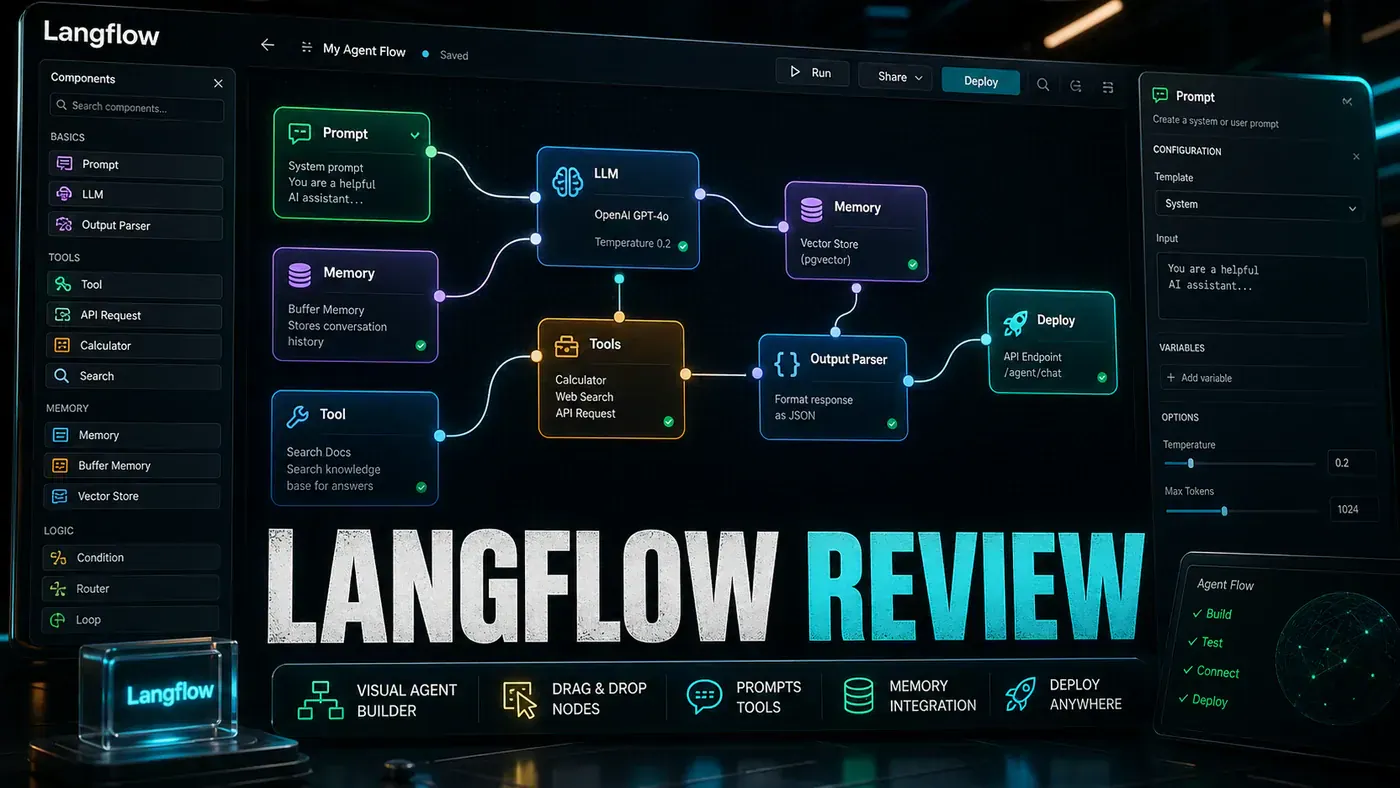
If you have ever tried to wire up an AI agent by hand, you know the drill: a Python file that starts clean and ends up as a wall of glue code you stop wanting to touch. Langflow (opens in a new tab) takes a different route. You drag boxes onto a canvas, connect them with lines, and watch your data move from one step to the next. It looks less like programming and more like sketching a flowchart that happens to run.
That approach has earned it a serious following. The GitHub repository (opens in a new tab) sits near 150k stars as of mid-2026, which makes it one of the most-watched projects of its kind. (The 146k figure in our title was accurate around April; the repo has kept climbing since.) For Australian teams weighing whether to build agents in code or on a canvas, that popularity is a useful signal: a big community means more components, faster fixes, and plenty of people who have hit the same wall you are about to.
The catch is the one that follows every low-code tool around. Building something fast and getting it to survive real traffic are two different problems. We spent time inside Langflow to see where that line falls, and where the visual model starts to fight you instead of help you.
One thing worth flagging up front: Langflow is owned by DataStax, which IBM acquired in a deal announced in early 2025. That ownership does not change the open-source license, but it is context the product pages tend to leave out.
What Is Langflow?
Langflow is a visual builder for AI agents and workflows. It is its own open-source Python framework with its own component system, not a front-end bolted onto LangChain (an older framing that has stuck around longer than it should, LangChain is now just one optional bundle (opens in a new tab) among many). Here is what you get:
- Drag-and-drop interface for building agents
- Pre-built components covering a large library of integrations (opens in a new tab) (LangChain is one of several bundles, not the whole story)
- Custom components, write Python when you need logic the built-ins do not cover
- API export, deploy a flow as a REST endpoint (opens in a new tab) (or an MCP server)
- Real-time testing, debug on the canvas as you build
Price: Free and MIT-licensed (opens in a new tab). Managed hosting is available through partners. Note: the DataStax-hosted Langflow cloud service shut down on 9 April 2026, so if you read older guides promising "DataStax Cloud hosting," that option is gone, third-party pricing breakdowns (opens in a new tab) point to options like IBM watsonx or Render instead.
Building an Agent
We built a research agent in about 20 minutes:
- Dragged "Chat Input" → "OpenAI" → "Web Search" → "Output"
- Configured the search tool (SerpAPI key)
- Added a "Memory" component for conversation history
- Exported it as an API
- Tested with curl, worked first try
The visual layout made it obvious where data flowed. When something looked off, you could see it on the canvas instead of squinting at a Python traceback. That is the real pitch: you spend less time guessing what your code is doing.
Component Library
Langflow ships a deep component library across these categories. The counts below are our own tally from testing rather than figures pulled from official docs, so treat them as a guide:
| Category | Count | Examples |
|---|---|---|
| LLMs | 15 | OpenAI, Anthropic, Ollama, Cohere |
| Tools | 40 | Search, Calculator, Wikipedia, APIs |
| Memory | 8 | Buffer, Vector, Redis, Postgres |
| Vector Stores | 12 | Pinecone, Chroma, Weaviate, FAISS |
| Loaders | 30 | PDF, CSV, URL, GitHub, Notion |
| Output | 10 | Chat, Text, JSON, File |
Performance
The numbers below come from our own self-hosted testing. We could not find independent benchmarks to confirm them, so read them as ballpark figures from one setup rather than published results:
| Metric | Value |
|---|---|
| Flow execution time | 200-500ms for simple flows |
| Complex multi-agent flows | 2-5 seconds |
| Memory usage | 150-300 MB base |
| Concurrent requests | 50-100 (self-hosted) |
Pros and Cons
| Pros | Cons |
|---|---|
| Very fast prototyping | Complex flows can turn into spaghetti |
| Huge component library | Performance overhead compared to code |
| Good way to learn agent building | Debugging complex flows gets hard |
| Active development | Self-hosting means you maintain it |
| Free and open source | Some components lag behind |
Verdict
Score: 8.4/10 (our subjective rating, other 2026 reviews land lower, some around 7.2/10, so weigh it against your own needs)
Langflow is the fastest way we have found to prototype an AI agent. The canvas is easy to read and the component library covers most of what you will reach for. For production, export to code and run it properly. For learning and quick experiments, it is hard to beat.
One caveat on currency: we tested v1.3 (an early-2025 release). As of June 2026 Langflow has moved well past that, with v1.10.0 shipping on 9 June 2026 (the 1.9 release notes (opens in a new tab) cover much of what changed in between). Expect newer versions to have more components and rougher edges sanded down, so check the current release before you judge it on our notes.
*Published June 16, 2026 | Langflow v1.3 tested (self-hosted)*
Langflow Review: answer-first summary
Langflow Review matters because it can change how Founders and operators plan, build, or govern an tool evaluation workflow. Langflow builds AI agents by dragging and dropping components.
The direct answer is this: do not treat the topic as a standalone trend. Treat it as a decision about inputs, outputs, review ownership, data exposure, and whether the workflow produces a result that is faster, safer, or more useful than the current process.
Langflow Review: implementation checklist
- Define the user, job to be done, and success metric for the tool evaluation workflow.
- Collect real examples, policies, source files, customer questions, or search queries before writing prompts or choosing tools.
- Separate low-risk drafts from decisions that need approval, privacy checks, or senior review.
- Document what the AI is allowed to access, what it must not access, and who signs off before production use.
- Review time to value, adoption rate, cost per workflow, quality review score after a small pilot rather than judging the idea from a demo.
This keeps the work practical. It also gives search engines and AI answer engines a clean factual structure: what the topic is, who it helps, what to do next, and which risks matter before implementation.
Decision criteria for Langflow Review
| Decision area | What to check | Production signal |
|---|---|---|
| Intent | Does Langflow Review solve a real workflow problem? | The use case has a named owner and measurable outcome. |
| Data | Can the required data be used safely? | Sensitive data is classified and access is controlled. |
| Quality | Can a reviewer judge the output consistently? | Examples, rubrics, or acceptance criteria exist. |
| Scale | Can the workflow be repeated without hero effort? | The process is documented and can be handed to another team member. |
Practical example for Langflow Review
A small business could use this article to choose one practical test. For example, a manager might take one customer-facing process, one internal document workflow, or one recurring content task and redesign only that step with AI support. The goal is not to automate the whole business at once; it is to learn where AI Tools creates reliable leverage.
The useful deliverable is a short operating note: the trigger, the source material, the prompt or tool, the review checklist, the escalation rule, and the metric. That note becomes the handover asset for staff training, SEO/GEO content, service delivery, or future agent work.
Risks and controls for Langflow Review
The common failure pattern is moving too quickly from a promising idea into an unmanaged workflow. For Langflow Review, the risk is not only bad output. It can also be unclear data permission, staff confusion, duplicate content, unreviewed customer advice, or a tool that quietly changes cost or capability.
- Control tool sprawl with a named owner, a review step, and written acceptance criteria.
- Control unclear pricing with a named owner, a review step, and written acceptance criteria.
- Control vendor lock-in with a named owner, a review step, and written acceptance criteria.
- Control unreviewed data sharing with a named owner, a review step, and written acceptance criteria.
Measurement plan for Langflow Review
A useful AI or SEO initiative should leave evidence. Track time to value, adoption rate, cost per workflow, quality review score and compare the pilot against the current process. If the measure does not improve, keep the learning but avoid scaling the workflow.
For GEO readiness, the page should also answer the core question directly, define the entities involved, include implementation steps, explain tradeoffs, and link readers to the next relevant AI Kick Start service, guide, tool, or article.
Definitions and entities for Langflow Review
For search, GEO, and staff handover, define the core entities in plain language. In this article the important entities are the workflow owner, the AI tool or model, the source material, the review process, the risk boundary, and the measurable business outcome. Clear definitions make the page easier for people to scan and easier for AI answer engines to quote accurately.
- Workflow owner: the person accountable for deciding whether Langflow Review belongs in the business process.
- Source material: the documents, examples, policies, URLs, prompts, videos, or customer questions that ground the output.
- Review boundary: the point where a human checks accuracy, privacy, brand voice, or customer impact before the result is used.
- Success metric: the measure that proves whether the tool evaluation workflow is worth repeating.
Langflow Review versus doing nothing
Doing nothing is also a decision. The cost may be slow manual work, weaker search visibility, inconsistent advice, duplicated effort, or staff using unmanaged AI tools without a shared process. The practical question is whether a controlled pilot can reduce that cost without creating a larger governance problem.
| Option | When it makes sense | What to watch |
|---|---|---|
| Do nothing | The workflow is rare, low value, or already reliable. | Competitors may improve speed, content depth, or service consistency first. |
| Run a small pilot | The task repeats often and has clear review criteria. | Keep scope tight and measure the result against the current process. |
| Build a production workflow | The pilot is repeatable and risk controls are documented. | Assign ownership, monitoring, training, and a rollback path. |
AI Kick Start handover package for Langflow Review
A production handover should be concrete enough that another person can run it. For Langflow Review, that means a short brief, a workflow map, approved prompts or tool settings, source material, a review checklist, internal links to supporting resources, and a simple measurement sheet. This is the difference between reading about AI and turning it into operational capability.
That packaging also strengthens E-E-A-T. It shows experience through implementation notes, expertise through decision criteria, authoritativeness through source-aware structure, and trust through risks, controls, and review steps. The article becomes useful even if the reader never buys a tool because it helps them make a better operational decision.