








Briefing
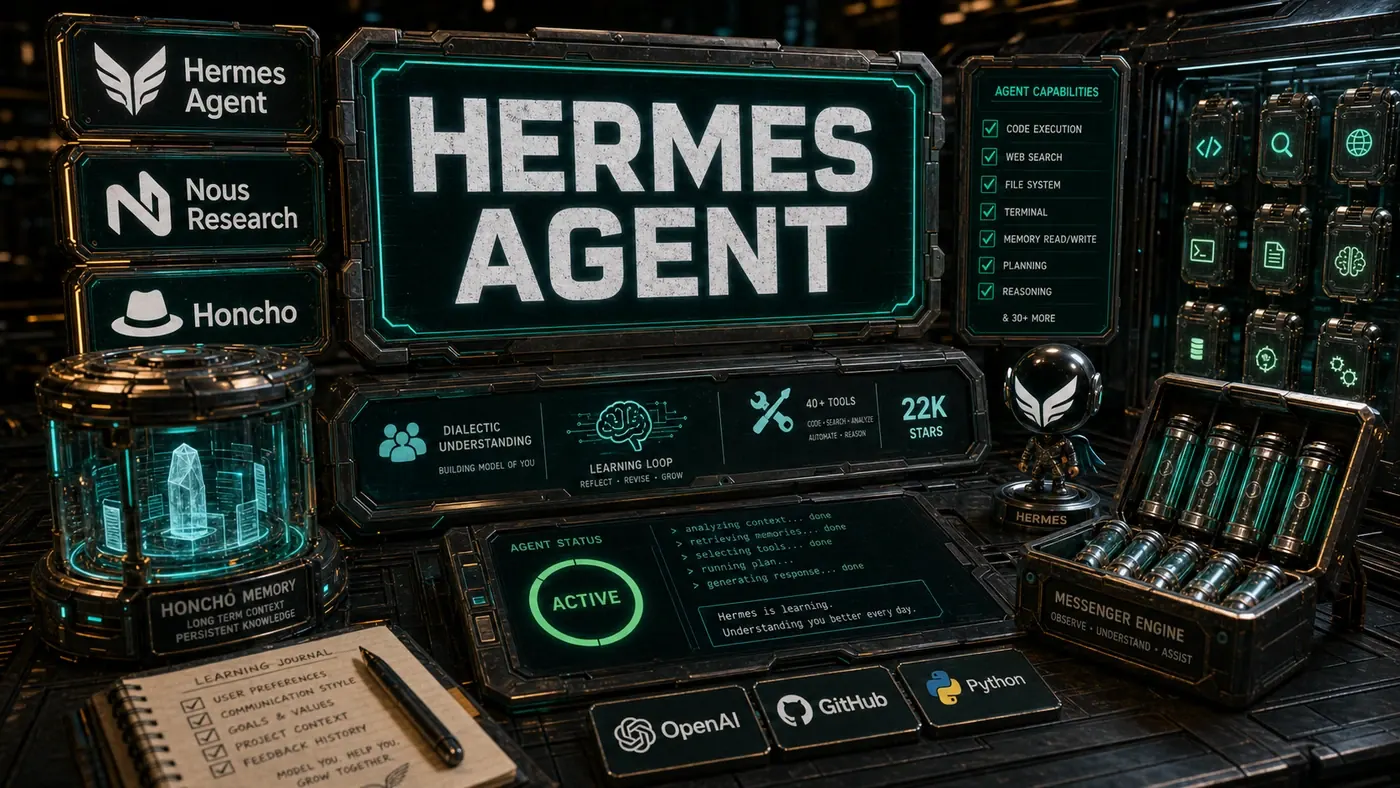
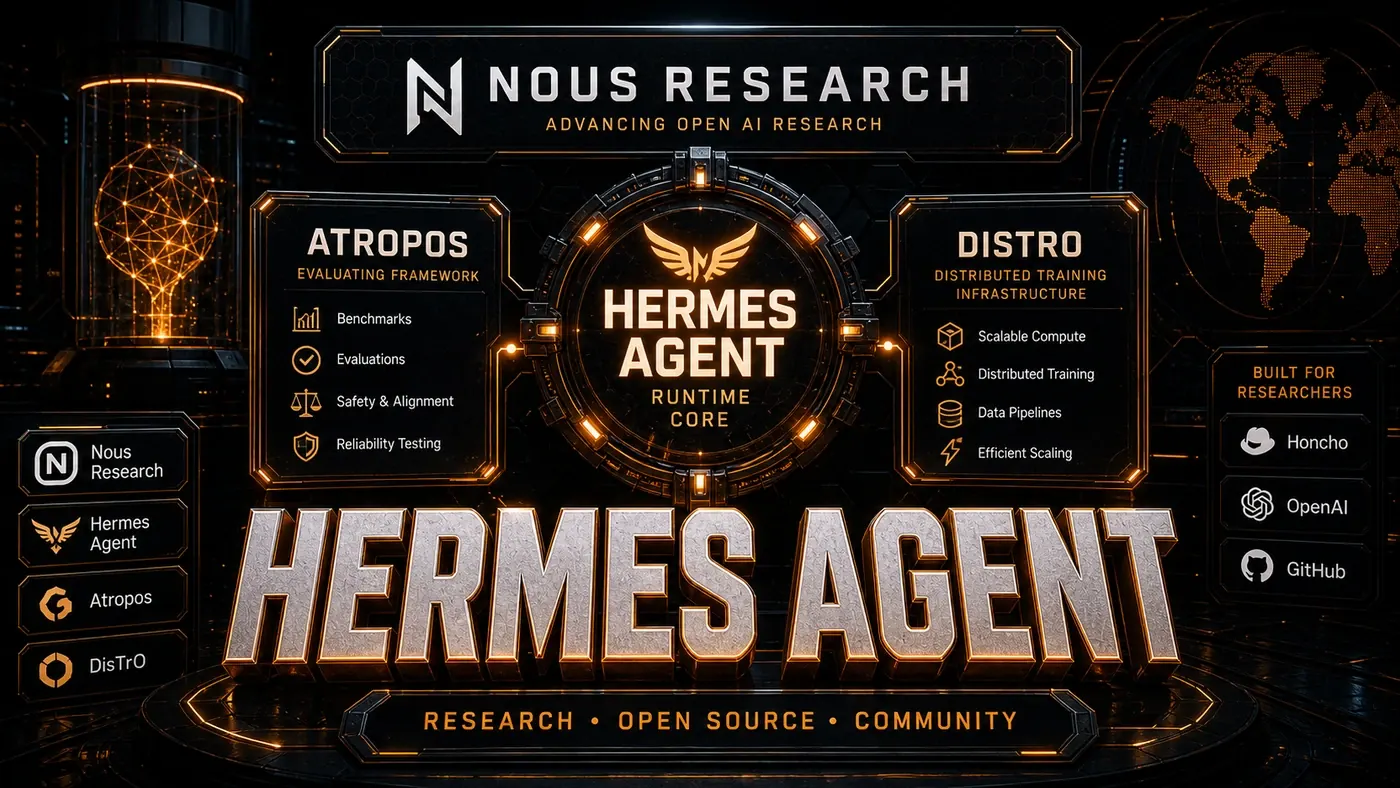
Hermes (opens in a new tab) is not just another agent framework with a REPL and some tool bindings. The thing that sets it apart is a self-improving learning loop that Nous Research (opens in a new tab) has been working on since the project went public in February 2026. It ships under an MIT license (opens in a new tab), runs on Python, and (the project reportedly counts around 142 contributors, a figure we couldn't confirm against the repo) has picked up a following among engineers who want an agent that gets better the more they use it.
Most agent tools have the memory of a goldfish. You walk one through your codebase, your conventions, the dead end you hit last Tuesday, and the next time you open it you are starting from zero. Hermes is built around the opposite idea: an agent that keeps a record of what it did, looks back at how it went, and folds the lessons into the next run.
That sounds like a small thing. In practice it changes how the tool behaves over weeks rather than minutes. Some long-term users say the agent feels noticeably sharper every couple of weeks, though that is an impression rather than a benchmark.
For a business team, the question underneath all this is simple. An agent that remembers your past work and stops repeating the same mistakes is worth real money in saved time. An agent that quietly logs everything it touches is also something you need to understand before you switch it on. Here is how the loop actually works.
The Core Loop Architecture
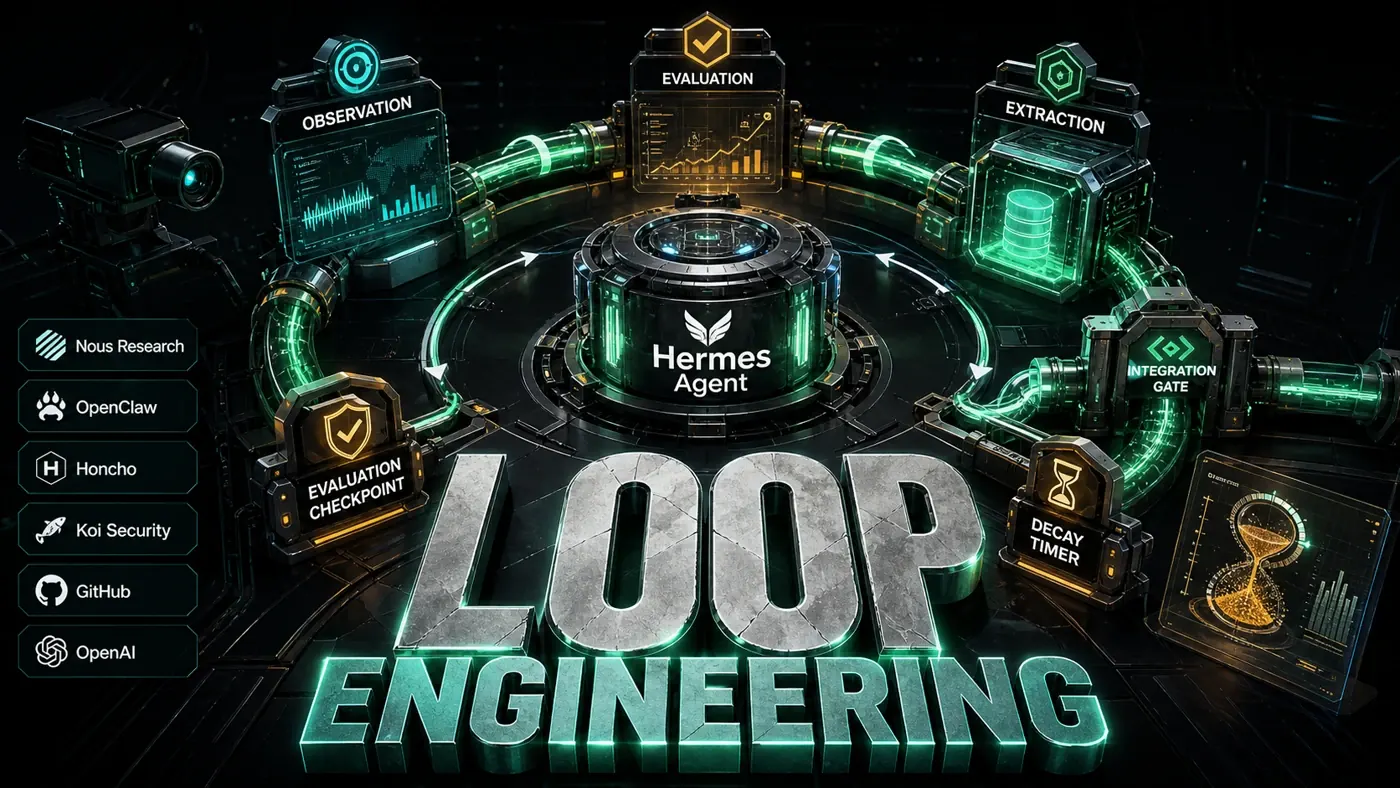
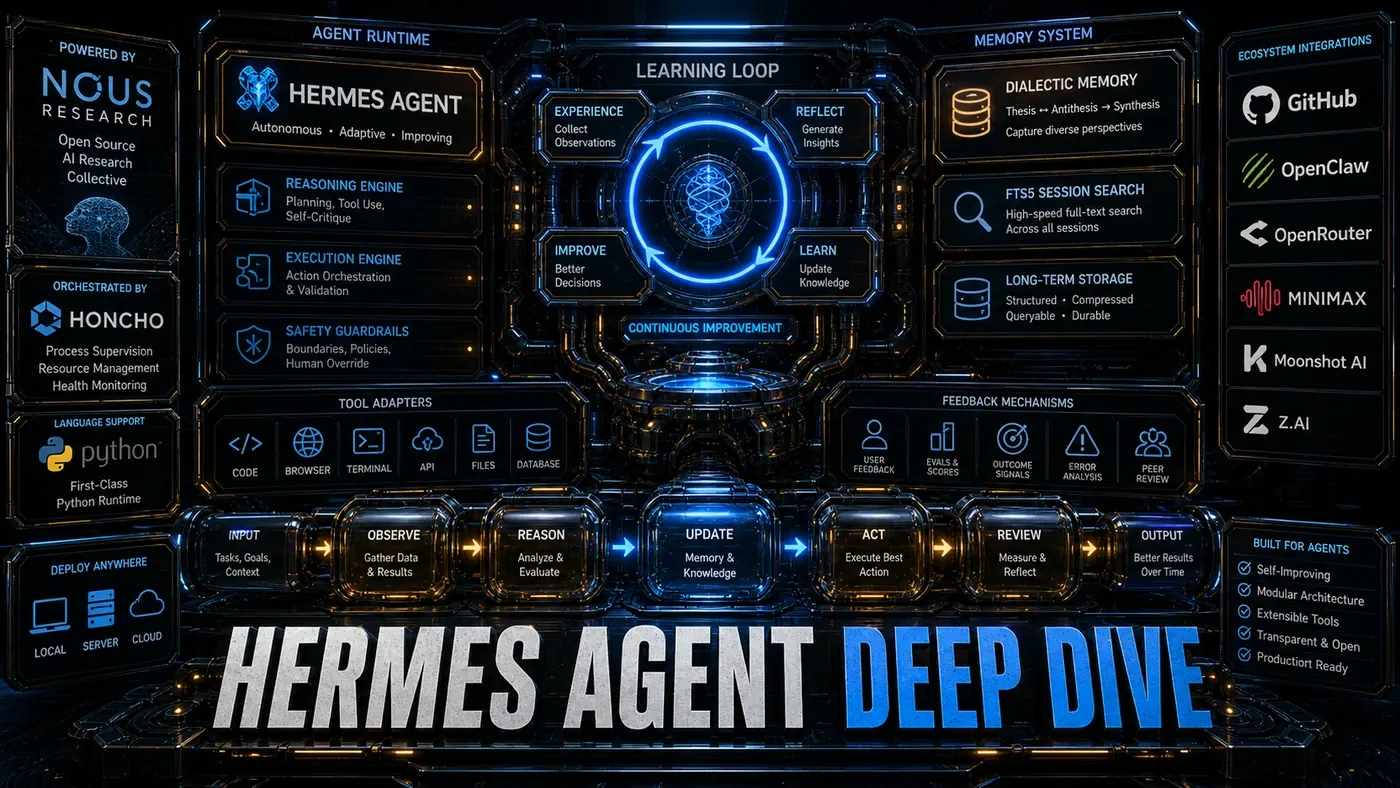
The Hermes learning loop is best understood as four phases: Observe, Reflect, Compress, and Integrate. Each session feeds the next, which is where the compounding comes from. (Worth flagging: this exact four-phase naming is the article's framing. The official docs (opens in a new tab) describe the loop in different terms, closer to plan, execute, reflect, synthesise, so treat the labels below as a useful map rather than the product's own wording.)
Observe
In the Observe phase, Hermes captures tool calls, model responses, and your corrections into an FTS5-indexed SQLite database. FTS5 session search with LLM summarisation is a documented Hermes feature (opens in a new tab), and FTS5 is SQLite's full-text engine, so retrieval across a large history is fast. Beyond the raw text, the schema is said to store execution context: working directory, environment variables, git state, dependency versions. That richer logging is reportedly what makes later retrieval precise instead of keyword noise, though the specific schema fields and any sub-second performance claim aren't confirmed in official sources.
Reflect
The Reflect phase reportedly runs after each session, using a configurable LLM (said to default to Hermes 3 via Nous Portal (opens in a new tab)). A reflection step in the loop is documented; the asynchronous timing, the default model, and the self-arguing structure below are the author's account rather than confirmed behaviour. The idea is that this is more than a summary: the model is described as arguing with itself about what went wrong, which assumptions were off, and which heuristics need updating. That is also where the Honcho (opens in a new tab) dialectic user modelling memory does its work.
Honcho, from Plastic Labs, does not just store facts about you. It models how you think. It tracks decision patterns and user preferences (opens in a new tab) such as your tolerance for risk and whether you favour explicit or implicit error handling. When you keep rejecting a certain kind of generated code, Honcho is meant to encode that and steer future output away from it. The dialectic part means it can push back: if you once leaned on functional patterns but have lately been accepting imperative ones, it flags the contradiction. (Honcho's dialectic user modelling is real and integrated with Hermes; the specific "challenge you when you contradict yourself" behaviour is the author's elaboration on that framing.)
Compress
Long sessions produce enormous context windows. The Compress phase distils successful patterns into reusable "skill signatures", compact representations of a problem type, the tools used, and the solution structure. These are said to feed into the agentskills.io ecosystem (opens in a new tab), which would make them portable across Hermes instances: a signature built on your laptop loaded into a production deployment and run with the same behaviour. Hermes' compatibility with the agentskills.io open standard is documented; the "skill signatures" terminology and the portability story are not confirmed verbatim, so read them as the article's description.
Integrate
The final phase merges new skill signatures with existing knowledge, settles conflicts, and prunes stale patterns. Integration reportedly runs on a schedule (the article cites a six-hour default) and can be triggered by hand with hermes loop integrate. The pruning is said to be aggressive: a pattern unused for 30 days gets archived to cold storage, which is meant to head off the "agent got worse" problem you see in systems whose context only ever grows. None of these specific parameters (the six-hour cadence, the exact command, the 30-day rule) appears in official sources, so treat them as illustrative.
FTS5 Session Search
One of the more underrated parts of Hermes is its FTS5 session search with LLM summarisation (opens in a new tab). Run hermes search "postgres migration error" and it searches every session in your history, ranks the results by relevance, then has an LLM write a synthetic answer drawn from all of them. It is less a search box than institutional memory you can query.
# Search across all historical sessions
hermes search "optimising slow queries"

# Trigger manual integration
hermes loop integrate

# Export learned skills for sharing
hermes skills export --format agentskills.io
Compatibility and Runtime
Hermes runs on Python 3.11+ (opens in a new tab) and works with the agentskills.io skill specification. It supports a wide range of model providers (opens in a new tab): Nous Portal for first-party models, OpenRouter for access to 200+ models, plus direct integration with z.ai/GLM, Kimi/Moonshot, MiniMax, and OpenAI. The roughly $5 per month VPS figure often quoted assumes a 2 vCPU / 4 GB RAM instance running the lightweight runtime with periodic model calls. Hermes is self-hostable and light enough for that class of box, but no official source pins down this exact cost or spec, so take it as a reasonable estimate rather than a published number.
The Migration Path
If you are coming from OpenClaw, `hermes claw migrate` (opens in a new tab) handles most of the move. It imports your settings, memories, skills, and API keys, preserves channel configurations, and maps OpenClaw AgentSkills to Hermes equivalents. The article's description of it converting MEMORY.md and daily journals into Honcho dialectic memory entries is its own framing; the official guide (opens in a new tab) talks about migrating workspace files, memories, skills, and command allowlists. The migration is not perfect, since OpenClaw's messaging-first design does not map cleanly onto Hermes' agent-first model, but it covers the common case in about ten minutes.
How the Hermes Agent Learning Loop Works: answer-first summary
How the Hermes Agent Learning Loop Works matters because it can change how Developers and technical teams plan, build, or govern an search and AI-answer workflow. Inside Nous Research's self-improving agent runtime: the dialectic memory, FTS5 session search and feedback loops that make Hermes agents better over time.
The direct answer is this: do not treat the topic as a standalone trend. Treat it as a decision about inputs, outputs, review ownership, data exposure, and whether the workflow produces a result that is faster, safer, or more useful than the current process.
How the Hermes Agent Learning Loop Works: implementation checklist
- Define the user, job to be done, and success metric for the search and AI-answer workflow.
- Collect real examples, policies, source files, customer questions, or search queries before writing prompts or choosing tools.
- Separate low-risk drafts from decisions that need approval, privacy checks, or senior review.
- Document what the AI is allowed to access, what it must not access, and who signs off before production use.
- Review indexed pages, qualified clicks, AI citation visibility, conversion paths after a small pilot rather than judging the idea from a demo.
This keeps the work practical. It also gives search engines and AI answer engines a clean factual structure: what the topic is, who it helps, what to do next, and which risks matter before implementation.
Decision criteria for How the Hermes Agent Learning Loop Works
| Decision area | What to check | Production signal |
|---|---|---|
| Intent | Does How the Hermes Agent Learning Loop Works solve a real workflow problem? | The use case has a named owner and measurable outcome. |
| Data | Can the required data be used safely? | Sensitive data is classified and access is controlled. |
| Quality | Can a reviewer judge the output consistently? | Examples, rubrics, or acceptance criteria exist. |
| Scale | Can the workflow be repeated without hero effort? | The process is documented and can be handed to another team member. |
Practical example for How the Hermes Agent Learning Loop Works
A small business could use this article to choose one practical test. For example, a manager might take one customer-facing process, one internal document workflow, or one recurring content task and redesign only that step with AI support. The goal is not to automate the whole business at once; it is to learn where Code creates reliable leverage.
The useful deliverable is a short operating note: the trigger, the source material, the prompt or tool, the review checklist, the escalation rule, and the metric. That note becomes the handover asset for staff training, SEO/GEO content, service delivery, or future agent work.
Risks and controls for How the Hermes Agent Learning Loop Works
The common failure pattern is moving too quickly from a promising idea into an unmanaged workflow. For How the Hermes Agent Learning Loop Works, the risk is not only bad output. It can also be unclear data permission, staff confusion, duplicate content, unreviewed customer advice, or a tool that quietly changes cost or capability.
- Control thin summaries with a named owner, a review step, and written acceptance criteria.
- Control duplicate intent with a named owner, a review step, and written acceptance criteria.
- Control weak entity coverage with a named owner, a review step, and written acceptance criteria.
- Control missing internal links with a named owner, a review step, and written acceptance criteria.
Measurement plan for How the Hermes Agent Learning Loop Works
A useful AI or SEO initiative should leave evidence. Track indexed pages, qualified clicks, AI citation visibility, conversion paths and compare the pilot against the current process. If the measure does not improve, keep the learning but avoid scaling the workflow.
For GEO readiness, the page should also answer the core question directly, define the entities involved, include implementation steps, explain tradeoffs, and link readers to the next relevant AI Kick Start service, guide, tool, or article.
Definitions and entities for How the Hermes Agent Learning Loop Works
For search, GEO, and staff handover, define the core entities in plain language. In this article the important entities are the workflow owner, the AI tool or model, the source material, the review process, the risk boundary, and the measurable business outcome. Clear definitions make the page easier for people to scan and easier for AI answer engines to quote accurately.
- Workflow owner: the person accountable for deciding whether How the Hermes Agent Learning Loop Works belongs in the business process.
- Source material: the documents, examples, policies, URLs, prompts, videos, or customer questions that ground the output.
- Review boundary: the point where a human checks accuracy, privacy, brand voice, or customer impact before the result is used.
- Success metric: the measure that proves whether the search and AI-answer workflow is worth repeating.
How the Hermes Agent Learning Loop Works versus doing nothing
Doing nothing is also a decision. The cost may be slow manual work, weaker search visibility, inconsistent advice, duplicated effort, or staff using unmanaged AI tools without a shared process. The practical question is whether a controlled pilot can reduce that cost without creating a larger governance problem.
| Option | When it makes sense | What to watch |
|---|---|---|
| Do nothing | The workflow is rare, low value, or already reliable. | Competitors may improve speed, content depth, or service consistency first. |
| Run a small pilot | The task repeats often and has clear review criteria. | Keep scope tight and measure the result against the current process. |
| Build a production workflow | The pilot is repeatable and risk controls are documented. | Assign ownership, monitoring, training, and a rollback path. |
AI Kick Start handover package for How the Hermes Agent Learning Loop Works
A production handover should be concrete enough that another person can run it. For How the Hermes Agent Learning Loop Works, that means a short brief, a workflow map, approved prompts or tool settings, source material, a review checklist, internal links to supporting resources, and a simple measurement sheet. This is the difference between reading about AI and turning it into operational capability.
That packaging also strengthens E-E-A-T. It shows experience through implementation notes, expertise through decision criteria, authoritativeness through source-aware structure, and trust through risks, controls, and review steps. The article becomes useful even if the reader never buys a tool because it helps them make a better operational decision.