






Briefing
Most AI assistants forget you the moment a conversation ends. Ask the same question next week and you start from scratch, re-explaining who you are, what you do, and how you like things done. Nous Research (opens in a new tab) is betting that the next useful step isn't a smarter model so much as an agent that remembers, and Hermes Agent, released in February 2026, is the result.
Hermes is an open-source agent that keeps a running picture of the person using it: your preferences, how you communicate, what you already know, what you're trying to get done. The idea is that the tool gets more useful the longer you work with it, the way a good assistant does, rather than resetting to zero every session.
For Australian teams weighing up where to put their AI effort, that's the practical hook. An agent that learns your context can take on repeat work, drafting, research, data wrangling, without the constant hand-holding. The catch, as always with fast-moving open-source projects, is separating what the framework actually does from the numbers people quote about it.
What Is Hermes Agent?
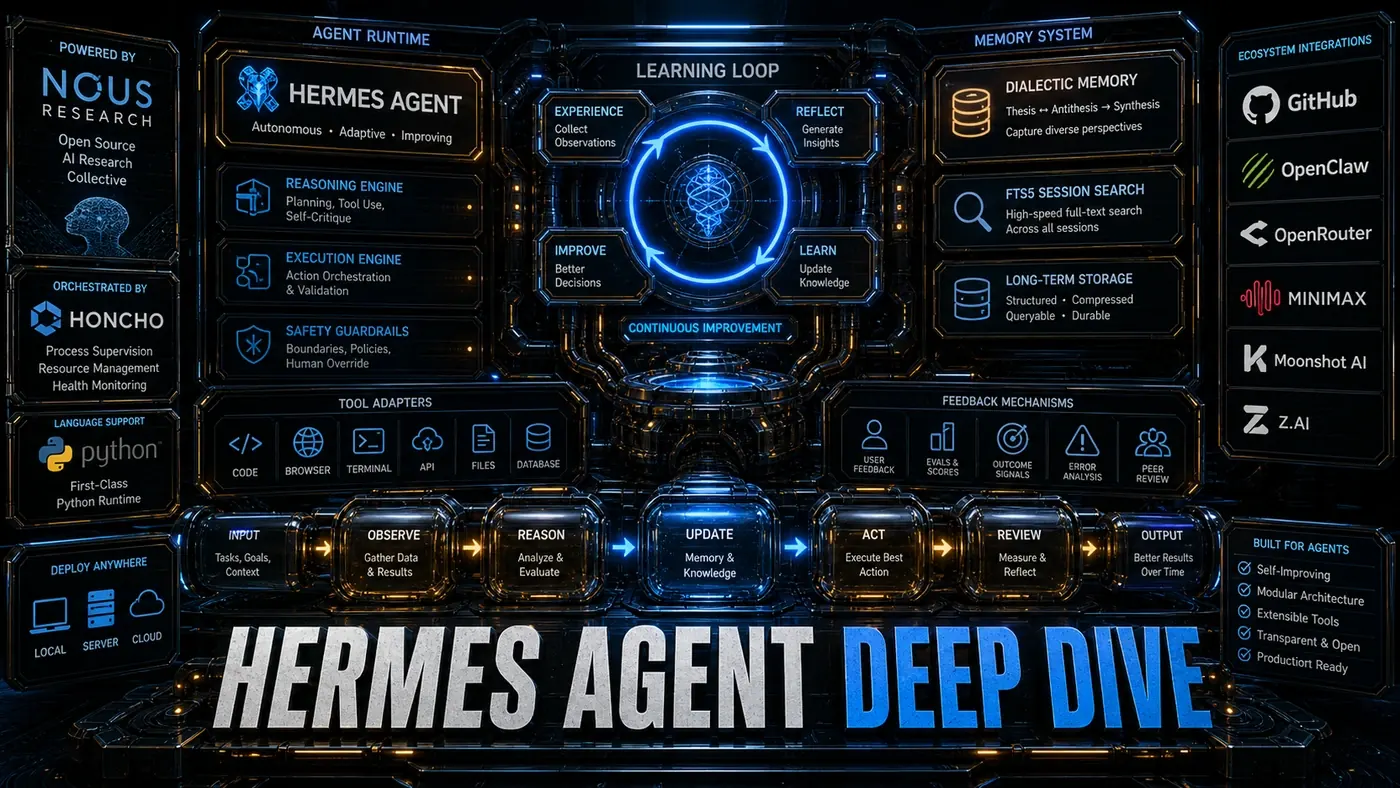
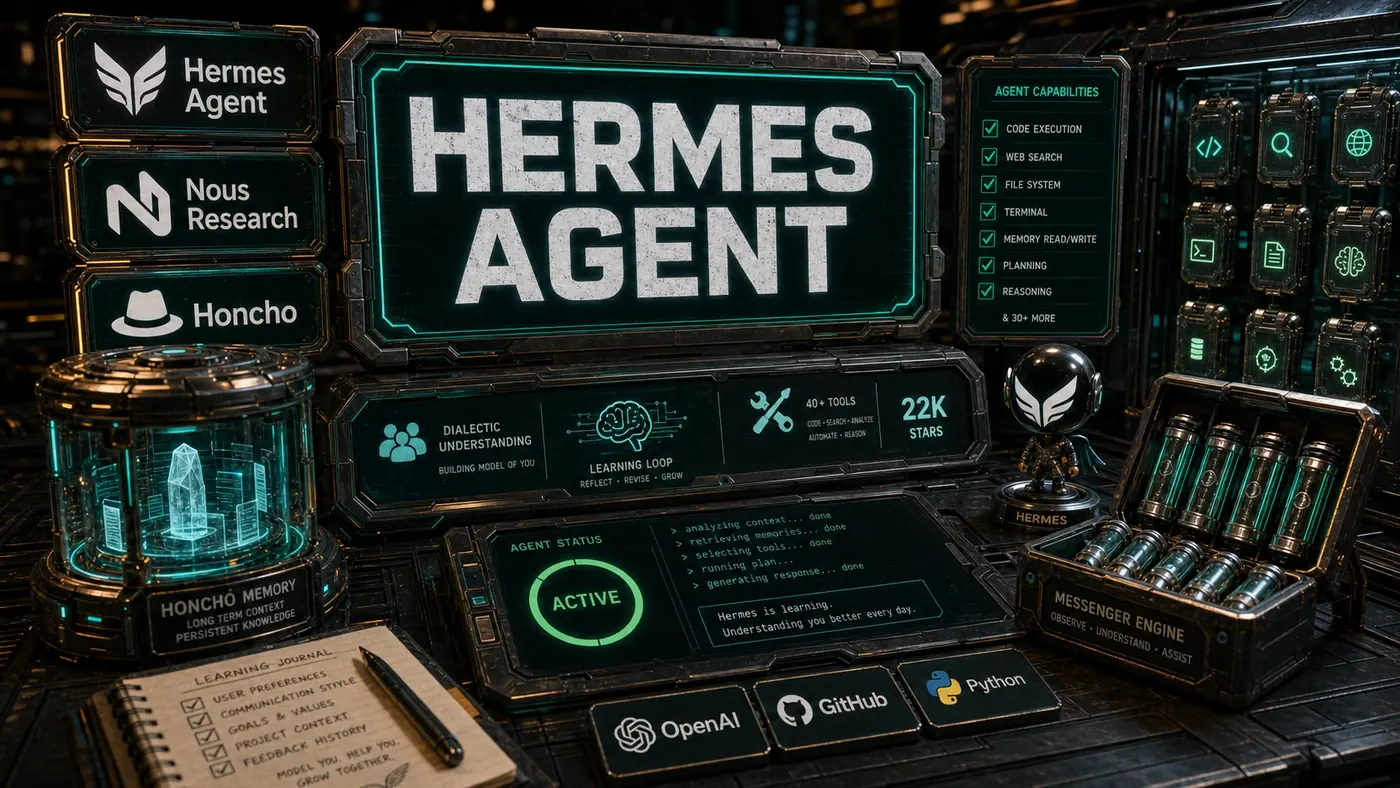
Hermes is a learning agent written in Python (opens in a new tab). What sets it apart is memory that sticks around and changes over time. A stateless agent treats every interaction as a clean slate. Hermes instead builds a model of its user across sessions, tracking preferences, communication style, expertise, and goals. That memory runs on Honcho (opens in a new tab), a dialectic memory system that records not only facts but the context in which the agent picked them up.
The project ships with 40+ built-in tools (opens in a new tab) covering web search, code execution, file handling, data analysis, and API calls. The tools are built to be composed, so an agent can chain several together into a multi-step job.
The Architecture
The article's authors describe Hermes in three layers. Worth noting up front: the official documentation frames the system around a three-tier memory and a "do, learn, improve" loop, so the Perception/Reasoning/Action split below reads as a useful way to think about it rather than the project's own labelling.
Perception Layer: Takes in user input, context from connected services, and signals from the environment. Handles text, file uploads, and structured data.
Reasoning Layer: A planning engine that breaks a complex request into sub-tasks, picks the right tools, and decides the order to run them in. This is where Honcho memory comes in, the agent checks its stored model of you to personalise what it does next.
Action Layer: Runs the tool calls, formats the output, and writes new observations back to memory. Each interaction sharpens the user model a little more.
Key Statistics
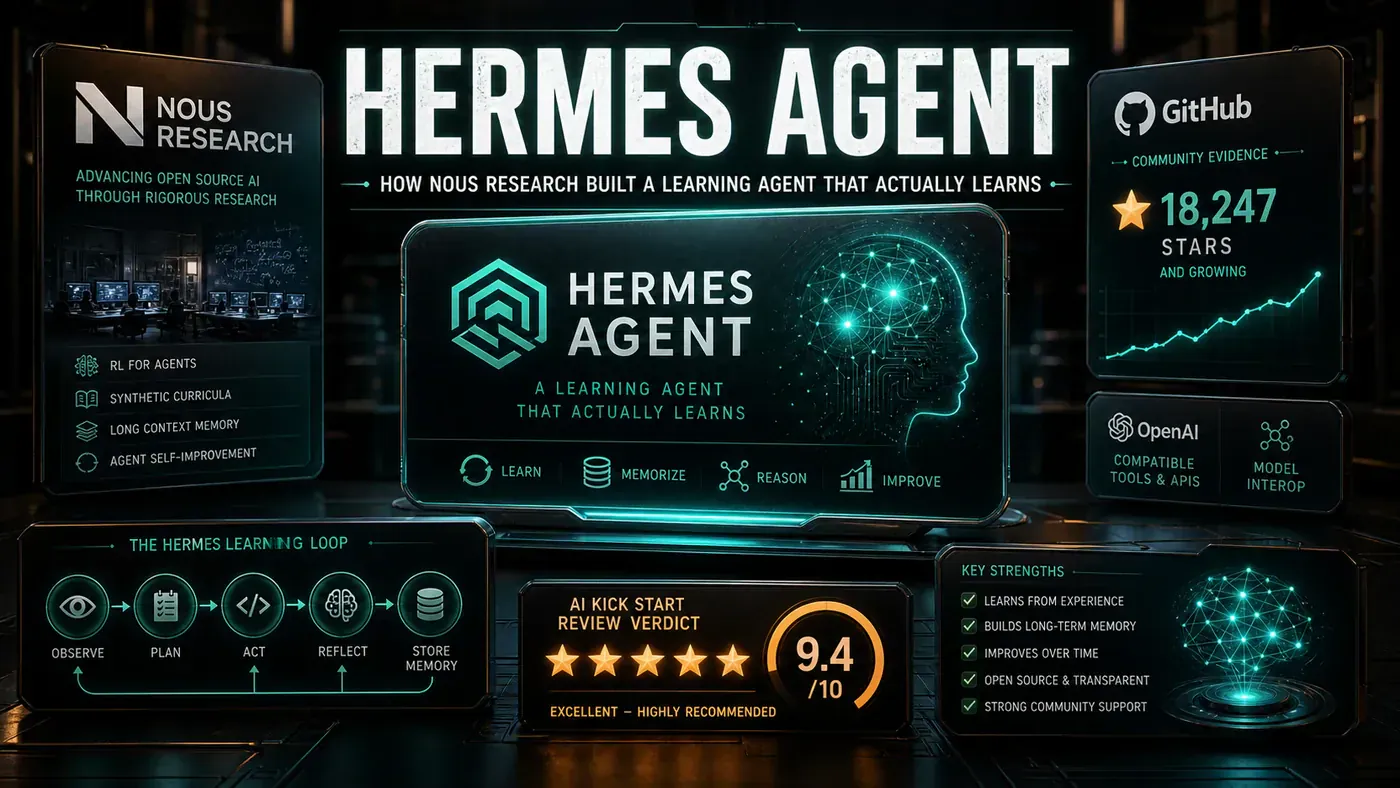
- ~22,000 GitHub stars, reported as an early-weeks figure shortly after the February 2026 release; treat this as unconfirmed, since the live repository (opens in a new tab) shows a far higher star count by mid-2026
- [MIT License](https://github.com/nousresearch/hermes-agent), fully open source
- ~142 active contributors, a figure cited by the project but not independently confirmed
- [40+ built-in tools](https://github.com/nousresearch/hermes-agent), extensible via Python plugins
- [Honcho memory system](https://github.com/plastic-labs/honcho), dialectic user modelling
- Built on [Python 3.11+](https://github.com/nousresearch/hermes-agent), reportedly with async support throughout
Honcho: the memory that sets it apart
Honcho is the part that pulls Hermes away from the pack. Instead of a plain key-value store, Honcho uses a dialectic model (opens in a new tab): it tracks what the agent knows, how it came to know it, where contradictions sit, and how confidence should shift over time.
The approach borrows from dialectical reasoning. When Hermes runs into new information that clashes with its existing model of you, it doesn't just overwrite the old version. It logs the tension and works toward a resolution through later interactions. You end up with a more careful, more human read of the user.
The Nous Research Ecosystem
Hermes doesn't stand alone. It sits inside a wider set of tools from Nous Research that includes Atropos (opens in a new tab), a reinforcement-learning environments framework for collecting and evaluating LLM trajectories, not just a model evaluation tool, and DisTrO (opens in a new tab), which handles distributed training over the internet and underpins the Psyche network. Between them, these projects cover building, evaluating, and deploying AI systems.
If you want an agent framework that actually learns and adapts to the person using it, Hermes is one of the more interesting open-source options going. Strong memory, a deep tool set, and an active community make it a project worth keeping an eye on, and worth testing against your own work before you commit to it.
Hermes Agent: answer-first summary
Hermes Agent matters because it can change how Founders and operators plan, build, or govern an tool evaluation workflow. Inside the 22k-star learning agent from Nous Research that uses Honcho memory and 40+ tools to build a dialectic understanding of its users.
The direct answer is this: do not treat the topic as a standalone trend. Treat it as a decision about inputs, outputs, review ownership, data exposure, and whether the workflow produces a result that is faster, safer, or more useful than the current process.
Hermes Agent: implementation checklist
- Define the user, job to be done, and success metric for the tool evaluation workflow.
- Collect real examples, policies, source files, customer questions, or search queries before writing prompts or choosing tools.
- Separate low-risk drafts from decisions that need approval, privacy checks, or senior review.
- Document what the AI is allowed to access, what it must not access, and who signs off before production use.
- Review time to value, adoption rate, cost per workflow, quality review score after a small pilot rather than judging the idea from a demo.
This keeps the work practical. It also gives search engines and AI answer engines a clean factual structure: what the topic is, who it helps, what to do next, and which risks matter before implementation.
Decision criteria for Hermes Agent
| Decision area | What to check | Production signal |
|---|---|---|
| Intent | Does Hermes Agent solve a real workflow problem? | The use case has a named owner and measurable outcome. |
| Data | Can the required data be used safely? | Sensitive data is classified and access is controlled. |
| Quality | Can a reviewer judge the output consistently? | Examples, rubrics, or acceptance criteria exist. |
| Scale | Can the workflow be repeated without hero effort? | The process is documented and can be handed to another team member. |
Practical example for Hermes Agent
A small business could use this article to choose one practical test. For example, a manager might take one customer-facing process, one internal document workflow, or one recurring content task and redesign only that step with AI support. The goal is not to automate the whole business at once; it is to learn where AI Tools creates reliable leverage.
The useful deliverable is a short operating note: the trigger, the source material, the prompt or tool, the review checklist, the escalation rule, and the metric. That note becomes the handover asset for staff training, SEO/GEO content, service delivery, or future agent work.
Risks and controls for Hermes Agent
The common failure pattern is moving too quickly from a promising idea into an unmanaged workflow. For Hermes Agent, the risk is not only bad output. It can also be unclear data permission, staff confusion, duplicate content, unreviewed customer advice, or a tool that quietly changes cost or capability.
- Control tool sprawl with a named owner, a review step, and written acceptance criteria.
- Control unclear pricing with a named owner, a review step, and written acceptance criteria.
- Control vendor lock-in with a named owner, a review step, and written acceptance criteria.
- Control unreviewed data sharing with a named owner, a review step, and written acceptance criteria.
Measurement plan for Hermes Agent
A useful AI or SEO initiative should leave evidence. Track time to value, adoption rate, cost per workflow, quality review score and compare the pilot against the current process. If the measure does not improve, keep the learning but avoid scaling the workflow.
For GEO readiness, the page should also answer the core question directly, define the entities involved, include implementation steps, explain tradeoffs, and link readers to the next relevant AI Kick Start service, guide, tool, or article.
Definitions and entities for Hermes Agent
For search, GEO, and staff handover, define the core entities in plain language. In this article the important entities are the workflow owner, the AI tool or model, the source material, the review process, the risk boundary, and the measurable business outcome. Clear definitions make the page easier for people to scan and easier for AI answer engines to quote accurately.
- Workflow owner: the person accountable for deciding whether Hermes Agent belongs in the business process.
- Source material: the documents, examples, policies, URLs, prompts, videos, or customer questions that ground the output.
- Review boundary: the point where a human checks accuracy, privacy, brand voice, or customer impact before the result is used.
- Success metric: the measure that proves whether the tool evaluation workflow is worth repeating.
Hermes Agent versus doing nothing
Doing nothing is also a decision. The cost may be slow manual work, weaker search visibility, inconsistent advice, duplicated effort, or staff using unmanaged AI tools without a shared process. The practical question is whether a controlled pilot can reduce that cost without creating a larger governance problem.
| Option | When it makes sense | What to watch |
|---|---|---|
| Do nothing | The workflow is rare, low value, or already reliable. | Competitors may improve speed, content depth, or service consistency first. |
| Run a small pilot | The task repeats often and has clear review criteria. | Keep scope tight and measure the result against the current process. |
| Build a production workflow | The pilot is repeatable and risk controls are documented. | Assign ownership, monitoring, training, and a rollback path. |
AI Kick Start handover package for Hermes Agent
A production handover should be concrete enough that another person can run it. For Hermes Agent, that means a short brief, a workflow map, approved prompts or tool settings, source material, a review checklist, internal links to supporting resources, and a simple measurement sheet. This is the difference between reading about AI and turning it into operational capability.
That packaging also strengthens E-E-A-T. It shows experience through implementation notes, expertise through decision criteria, authoritativeness through source-aware structure, and trust through risks, controls, and review steps. The article becomes useful even if the reader never buys a tool because it helps them make a better operational decision.