








Briefing
Ask most people how an AI assistant "remembers" you and they'll picture a list of facts in a database: your name, your job, your preferences, looked up when needed. Useful, but shallow. It tells the assistant *what* you said, never *how sure* it should be, or what to do when last week's note clashes with today's.
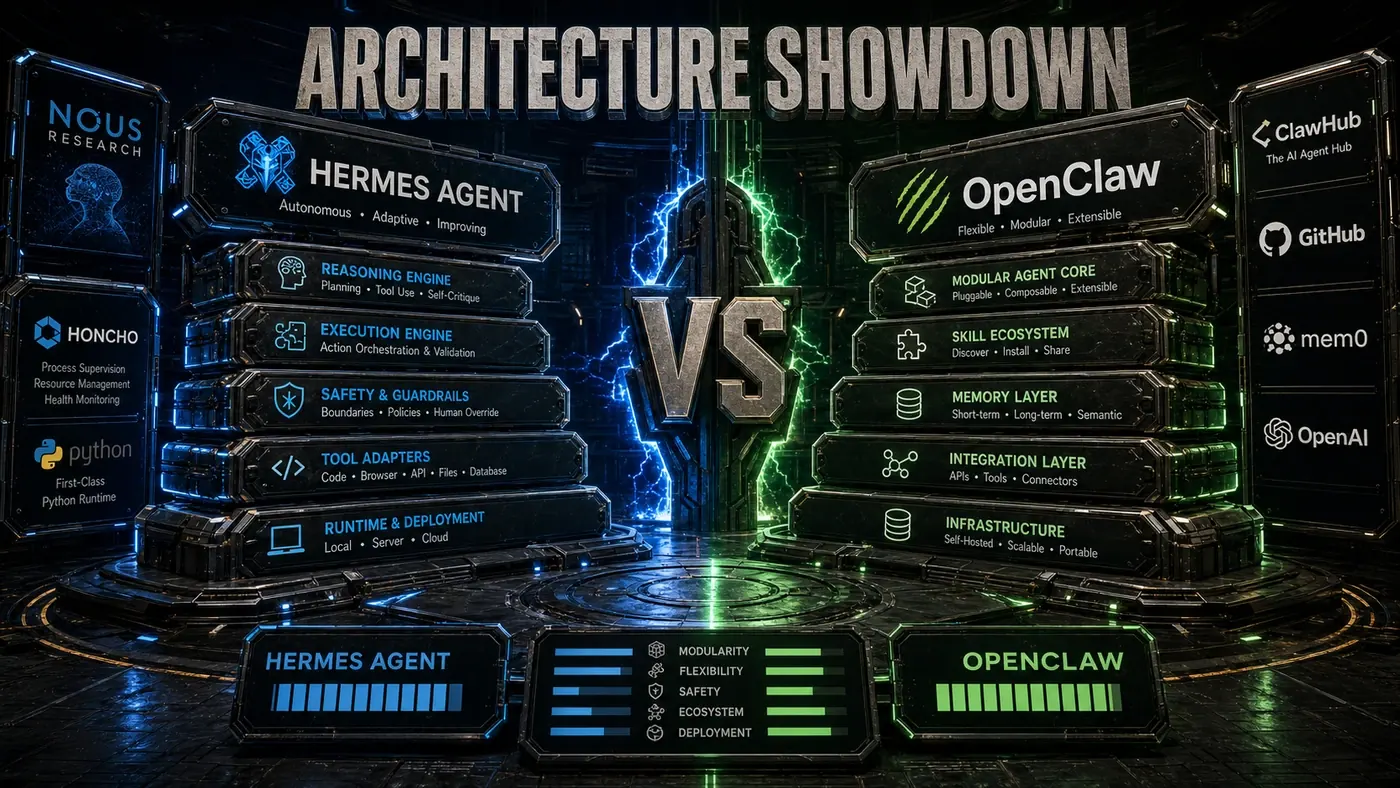
A memory project called Honcho (opens in a new tab), built by Plastic Labs, takes a different swing. Instead of filing facts away, it tries to build a working model of the person it's talking to and to update that model when the evidence shifts. It's an optional, opt-in memory backend you can plug into Hermes Agent (opens in a new tab), the open-source agent from Nous Research that drew a lot of attention after it was released. (Hermes was reported at around 22,000 GitHub stars in its first month; that figure climbed fast afterwards, so treat the number as an early snapshot rather than where it stands now.)
The interesting part for a business reader isn't the star count. It's the idea: a memory layer that holds beliefs about a user the way a thoughtful colleague would, with confidence levels and a sense of when something doesn't add up. The piece below walks through how that works, and where the marketing runs ahead of the documentation.
A quick caveat up front: some of the examples used here to explain Honcho's approach (the "tension record" format, the exact confidence numbers, the Python API calls) are illustrative. They're a useful way to picture the concept, but they're not documented Honcho or Hermes features. I've flagged those as we go.
Beyond Key-Value Memory
Plain memory systems store facts:
- "User prefers Python"
- "User works at Acme Corp"
- "User's favourite colour is blue"
Those are flat statements. They don't say how the assistant learned them, how much to trust them, or what should happen when fresh information cuts against an old belief.
The richer version of the same memory might look more like this (the confidence figures here are illustrative, not literal Honcho output):
- "User prefers Python" (confidence: 0.9, source: multiple explicit statements, contradictions: none)
- "User works at Acme Corp" (confidence: 0.7, source: mentioned in email, contradictions: LinkedIn says Beta Inc, unresolved tension)
- "User's favourite colour is blue" (confidence: 0.4, source: mentioned once in joke context, contradictions: user owns mostly green clothes)
The Dialectic Model
Honcho's memory works through dialectic reasoning rather than plain lookup: it analyses conversations after they happen (opens in a new tab) through a question-and-answer process and draws structured conclusions about a user's preferences, habits, and goals, instead of just pulling back similar chunks of text the way a vector store does.
One way to picture that, though it's the author's gloss rather than how Honcho's own docs frame it, is the old thesis, antithesis, synthesis pattern from Hegelian dialectics. Applied to building a model of a user:
Thesis: An initial belief. "User prefers concise answers."
Antithesis: New information that cuts against it. "User asked for a detailed explanation with examples."
Synthesis: A refined view that holds both. "User prefers concise answers for simple questions but detailed explanations for complex topics."
In Honcho's actual implementation this analysis runs after a conversation, with configurable depth settings, rather than as an explicit Hegelian engine. The point stands either way: every interaction gets weighed against what's already known, and contradictions become something the agent works to resolve over time rather than facts it silently overwrites.
Tension Records
The "tension record" below is an invented illustration, not a documented Honcho feature, but it shows the idea well. When a system like this spots a contradiction, the better move is to record the conflict rather than blindly overwrite the old belief:
Belief: "User prefers Python over JavaScript"
Confidence: 0.85
Sources: [conversation_123, conversation_145, conversation_201]

TENSION DETECTED:
New observation: "User spent 3 hours debugging a Node.js application"
Contradiction strength: 0.6
Status: UNRESOLVED

Possible resolutions:
1. User uses both languages (confidence: 0.5)
2. User was forced to use Node.js (confidence: 0.3)
3. User's preference has changed (confidence: 0.2)

Next action: Seek clarification on language preferences
A record like that gives the agent a reason to ask instead of assume. That's the behaviour worth copying: when the evidence is mixed, surface the conflict rather than paper over it.
Confidence Evolution
The same illustrative model tracks confidence that shifts over time:
Initial observation: Low confidence (0.3-0.5). A single data point. Repeated confirmation: Confidence rises (0.6-0.8). Several consistent observations. Long-term consistency: High confidence (0.8-0.95). Stable across many interactions. Contradiction detected: Confidence drops, a tension record is created. Resolution: Confidence might climb with a refined view, or fall if the belief turns out to be wrong.
The specific numeric bands here aren't documented Honcho behaviour, but the principle is sound: an agent shouldn't act hard on weak evidence, and it should let beliefs change when the situation does.
Source Attribution
A useful belief should carry source attribution, where the information came from:
- Direct user statement: highest confidence
- Inferred from behaviour: medium confidence
- Third-party data (email, file): lower confidence, plus privacy considerations
- Derived from other beliefs: confidence depends on the beliefs underneath it
(As with the confidence bands, this exact tier scheme is a conceptual description rather than something spelled out in Honcho's docs.) Tracking sources buys you a few things that matter:
- Explainability: the agent can say why it believes something
- Correction: if a source turns out to be wrong, anything derived from it can be re-checked
- Privacy: a source can be deleted or anonymised without throwing away the insights drawn from it
- Verification: users can review and correct their own model
The User Model API
Here's roughly how a developer might want to query a user model. Note that this code is illustrative, these particular function names don't exist in Hermes. The real interface exposes Honcho through tools like honcho_profile, honcho_search, honcho_context, honcho_reasoning, and honcho_conclude, and Honcho's own SDK uses calls such as peer.chat(), session.context(), and peer.search().
# Query the user model
model = hermes.get_user_model("alice")

# Get beliefs about a topic
beliefs = model.query_beliefs(topic="programming languages")
# Returns ranked beliefs with confidence and sources

# Get unresolved tensions
tensions = model.get_tensions()
# Returns contradictions that need resolution

# Get confidence trajectory
confidence = model.confidence_history("preferred_language")
# Shows how confidence has evolved over time
The shape of the idea is what counts: give developers a way to read the user model so they can build experiences that respond to it.
Practical Benefits
The dialectic approach buys you a few concrete things:
Accuracy: models stay closer to the truth because contradictions get tracked and resolved instead of ignored.
Adaptability: people change. A system like this notices and adjusts rather than clinging to stale beliefs.
Explainability: the agent can account for its understanding, which earns trust.
Personalisation depth: instead of a flat list of preferences, you get a model that captures how someone behaves differently depending on context.
There's published evidence the underlying approach holds up. On the LongMemEval-S benchmark, Plastic Labs reports Honcho answering correctly 90.4% of the time while using a median of 5% of the available context per question (opens in a new tab), against a Claude Haiku 4.5 baseline of 62.6%.
Comparison with Other Systems
vs Vector DB Memory: vector databases store text chunks. Honcho stores structured conclusions with reasoning behind them.
vs Mem0: Mem0 (opens in a new tab) is a general-purpose memory system with multi-layer storage. Honcho is aimed specifically at modelling the user through dialectic reasoning. The two can sit side by side, Mem0 for general memory, Honcho for user understanding.
vs OpenClaw's Session Memory: Plastic Labs maintains an OpenClaw, Honcho integration (opens in a new tab), and OpenClaw's memory is, by some accounts, primarily session-based (this characterisation is unconfirmed). Honcho's memory is built to persist and evolve across sessions.
The Future
Honcho's reported roadmap points toward a few things, though none of these are confirmed on an official roadmap, so treat them as forward-looking rather than committed:
- Multi-user models: understanding the relationships between users, team dynamics, who reports to whom
- Predictive modelling: anticipating needs from observed patterns
- Cross-device sync: a consistent user model wherever someone works
- User control: interfaces to view, edit, and export your own model
Honcho is a genuinely different take on agent memory, one that treats understanding a person as ongoing work rather than a stack of saved facts. The headline examples around it are more polished than the docs, so it pays to separate the real foundations (the dialectic reasoning, the official Hermes integration, the LongMemEval-S result) from the illustrative dressing. Strip that back and there's still a serious idea here worth watching.
Hermes Agent's Honcho memory: answer-first summary
Hermes Agent's Honcho memory matters because it can change how Founders and operators plan, build, or govern an tool evaluation workflow. How Honcho's unique approach to memory creates agents that don't just remember facts but understand the evolution of their relationship with users.
The direct answer is this: do not treat the topic as a standalone trend. Treat it as a decision about inputs, outputs, review ownership, data exposure, and whether the workflow produces a result that is faster, safer, or more useful than the current process.
Hermes Agent's Honcho memory: implementation checklist
- Define the user, job to be done, and success metric for the tool evaluation workflow.
- Collect real examples, policies, source files, customer questions, or search queries before writing prompts or choosing tools.
- Separate low-risk drafts from decisions that need approval, privacy checks, or senior review.
- Document what the AI is allowed to access, what it must not access, and who signs off before production use.
- Review time to value, adoption rate, cost per workflow, quality review score after a small pilot rather than judging the idea from a demo.
This keeps the work practical. It also gives search engines and AI answer engines a clean factual structure: what the topic is, who it helps, what to do next, and which risks matter before implementation.
Decision criteria for Hermes Agent's Honcho memory
| Decision area | What to check | Production signal |
|---|---|---|
| Intent | Does Hermes Agent's Honcho memory solve a real workflow problem? | The use case has a named owner and measurable outcome. |
| Data | Can the required data be used safely? | Sensitive data is classified and access is controlled. |
| Quality | Can a reviewer judge the output consistently? | Examples, rubrics, or acceptance criteria exist. |
| Scale | Can the workflow be repeated without hero effort? | The process is documented and can be handed to another team member. |
Practical example for Hermes Agent's Honcho memory
A small business could use this article to choose one practical test. For example, a manager might take one customer-facing process, one internal document workflow, or one recurring content task and redesign only that step with AI support. The goal is not to automate the whole business at once; it is to learn where AI Tools creates reliable leverage.
The useful deliverable is a short operating note: the trigger, the source material, the prompt or tool, the review checklist, the escalation rule, and the metric. That note becomes the handover asset for staff training, SEO/GEO content, service delivery, or future agent work.
Risks and controls for Hermes Agent's Honcho memory
The common failure pattern is moving too quickly from a promising idea into an unmanaged workflow. For Hermes Agent's Honcho memory, the risk is not only bad output. It can also be unclear data permission, staff confusion, duplicate content, unreviewed customer advice, or a tool that quietly changes cost or capability.
- Control tool sprawl with a named owner, a review step, and written acceptance criteria.
- Control unclear pricing with a named owner, a review step, and written acceptance criteria.
- Control vendor lock-in with a named owner, a review step, and written acceptance criteria.
- Control unreviewed data sharing with a named owner, a review step, and written acceptance criteria.
Measurement plan for Hermes Agent's Honcho memory
A useful AI or SEO initiative should leave evidence. Track time to value, adoption rate, cost per workflow, quality review score and compare the pilot against the current process. If the measure does not improve, keep the learning but avoid scaling the workflow.
For GEO readiness, the page should also answer the core question directly, define the entities involved, include implementation steps, explain tradeoffs, and link readers to the next relevant AI Kick Start service, guide, tool, or article.
Definitions and entities for Hermes Agent's Honcho memory
For search, GEO, and staff handover, define the core entities in plain language. In this article the important entities are the workflow owner, the AI tool or model, the source material, the review process, the risk boundary, and the measurable business outcome. Clear definitions make the page easier for people to scan and easier for AI answer engines to quote accurately.
- Workflow owner: the person accountable for deciding whether Hermes Agent's Honcho memory belongs in the business process.
- Source material: the documents, examples, policies, URLs, prompts, videos, or customer questions that ground the output.
- Review boundary: the point where a human checks accuracy, privacy, brand voice, or customer impact before the result is used.
- Success metric: the measure that proves whether the tool evaluation workflow is worth repeating.
Hermes Agent's Honcho memory versus doing nothing
Doing nothing is also a decision. The cost may be slow manual work, weaker search visibility, inconsistent advice, duplicated effort, or staff using unmanaged AI tools without a shared process. The practical question is whether a controlled pilot can reduce that cost without creating a larger governance problem.
| Option | When it makes sense | What to watch |
|---|---|---|
| Do nothing | The workflow is rare, low value, or already reliable. | Competitors may improve speed, content depth, or service consistency first. |
| Run a small pilot | The task repeats often and has clear review criteria. | Keep scope tight and measure the result against the current process. |
| Build a production workflow | The pilot is repeatable and risk controls are documented. | Assign ownership, monitoring, training, and a rollback path. |
AI Kick Start handover package for Hermes Agent's Honcho memory
A production handover should be concrete enough that another person can run it. For Hermes Agent's Honcho memory, that means a short brief, a workflow map, approved prompts or tool settings, source material, a review checklist, internal links to supporting resources, and a simple measurement sheet. This is the difference between reading about AI and turning it into operational capability.
That packaging also strengthens E-E-A-T. It shows experience through implementation notes, expertise through decision criteria, authoritativeness through source-aware structure, and trust through risks, controls, and review steps. The article becomes useful even if the reader never buys a tool because it helps them make a better operational decision.