


Briefing
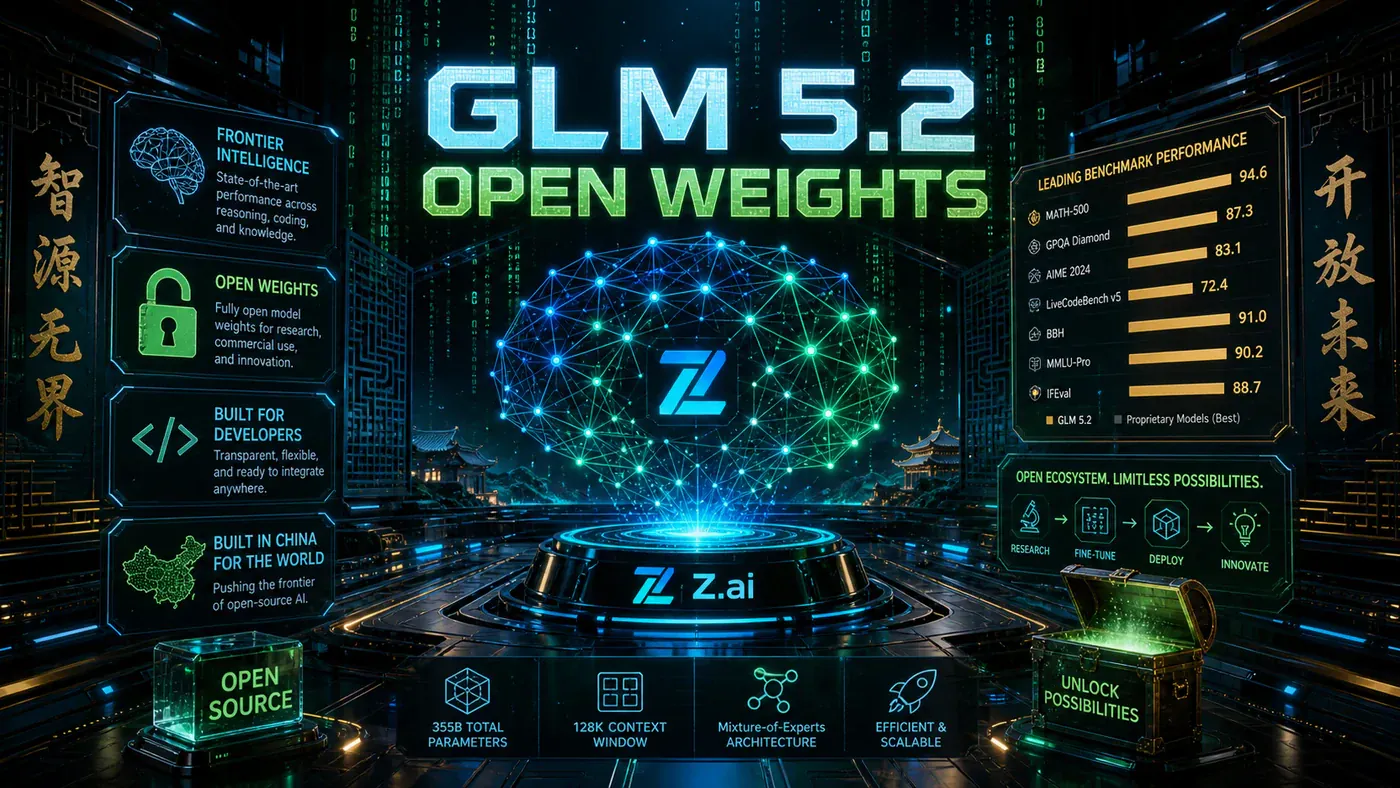
![Banner Image - A futuristic neural network visualization with glowing blue and green nodes interconnected, representing the GLM 5.2 model architecture, set against a dark background with subtle Chinese design elements and open-source code flowing through the connections]
Introduction: The Surprise Contender Shaking Up the AI Landscape
When Z.AI quietly released the weights for GLM 5.2 in late June 2026, few expected it to cause the seismic shift that has since rippled through the artificial intelligence community. Industry analyst Sam Witteveen, who has closely tracked the Chinese AI ecosystem for years, initially hesitated to even cover the release. After all, Chinese AI companies had developed a frustrating pattern of teasing impressive models while withholding the actual weights, leaving developers and enterprises dependent on proprietary APIs with all the accompanying restrictions.
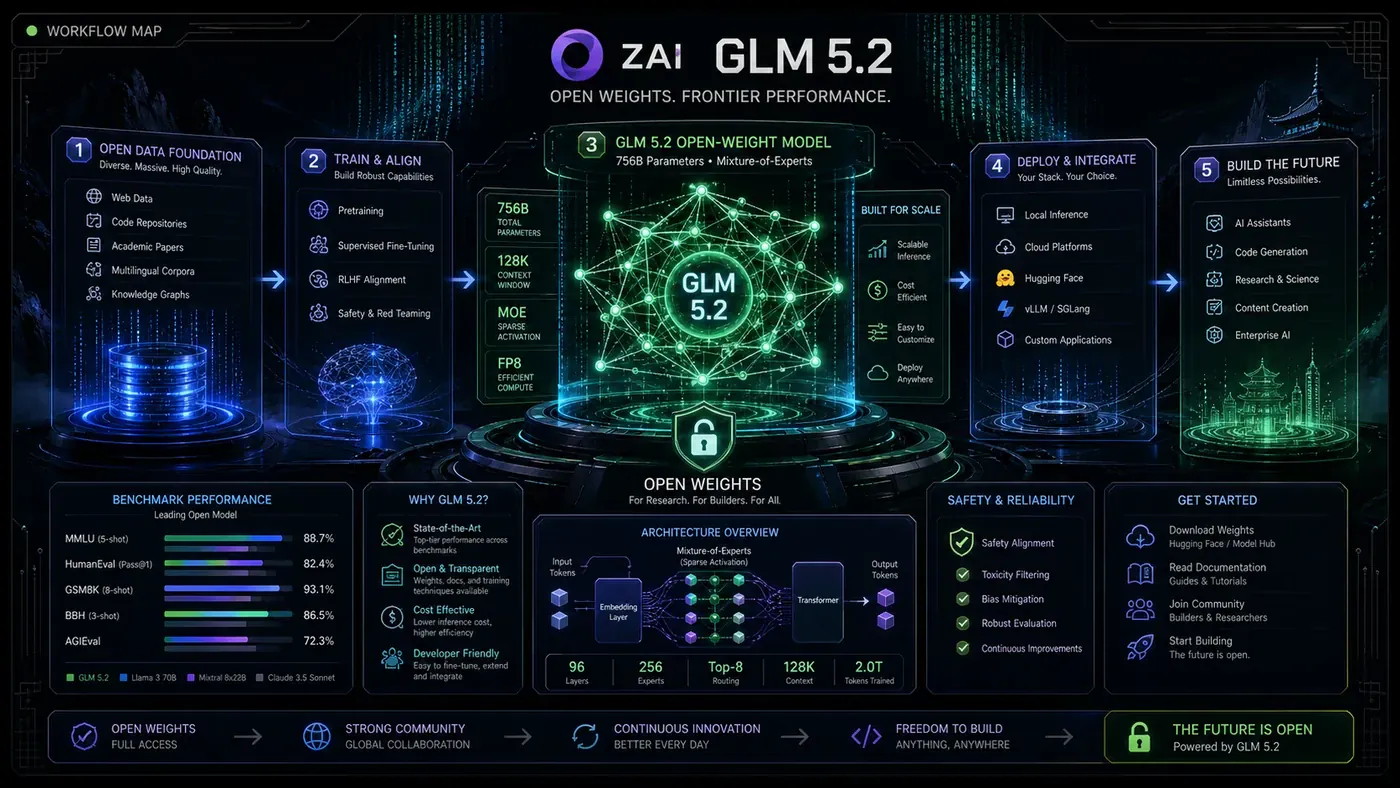
But GLM 5.2 proved different - and dramatically so. Within hours of Z.AI publishing both the full and FP8 quantised weight files on Hugging Face, the model began climbing benchmark leaderboards at a pace that demanded attention. It wasn't merely competitive with the proprietary offerings from the so-called "frontier labs" - Anthropic, OpenAI, and Google - it was actively outperforming them across a range of critical tasks. Witteveen's decision to create a detailed analysis wasn't born of obligation, but of genuine surprise at what he discovered during an afternoon of rigorous testing.
This article examines GLM 5.2's benchmark performance, architectural innovations, real-world capabilities, pricing, and what it signals for the increasingly competitive AI landscape.
Breaking the Pattern: Why Open Weights Matter More Than Ever
Witteveen's reluctance to cover Chinese models stems from a genuine industry pain point. Over the past year, several Chinese AI labs followed a familiar playbook: announce an impressive model, publish strong benchmarks, then restrict access to proprietary APIs while keeping weights locked away. This left the open-source community perpetually several steps behind.
The tide, however, appears to be turning. MiniMax 3 released its weights. Several Qwen models have become openly available. And now Z.AI has fully committed to openness with GLM 5.2, releasing both the complete model and an FP8-quantised variant. Access to base models enables the fine-tuning that makes frontier-level AI accessible to organisations without the resources to negotiate paid agreements - as Cursor did to access Kimi's base model through Fireworks AI for their own fine-tuning. Z.AI's decision suggests either extraordinary confidence in their upstream capabilities or a recognition that ecosystem adoption drives commercial success.
Benchmark Dominance: The Numbers Behind the Hype
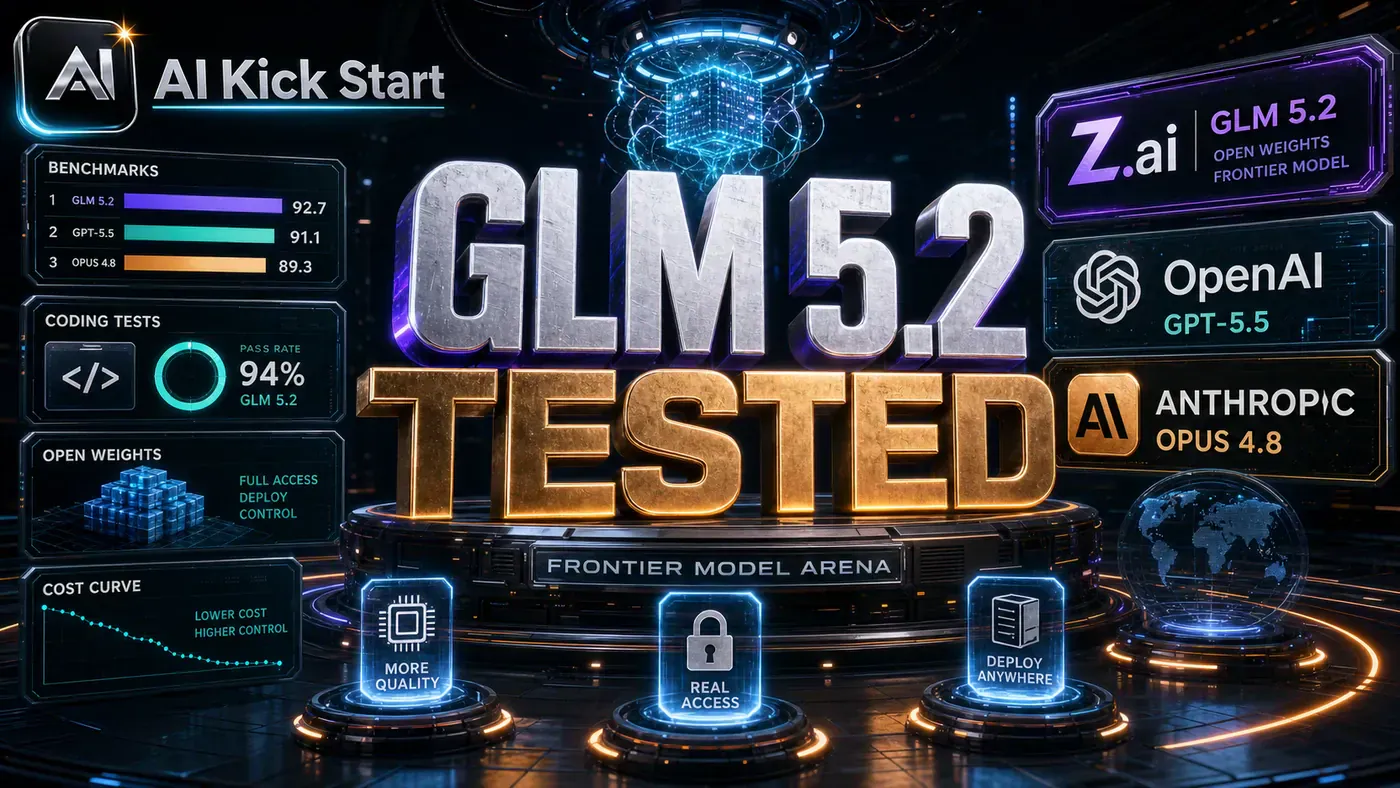
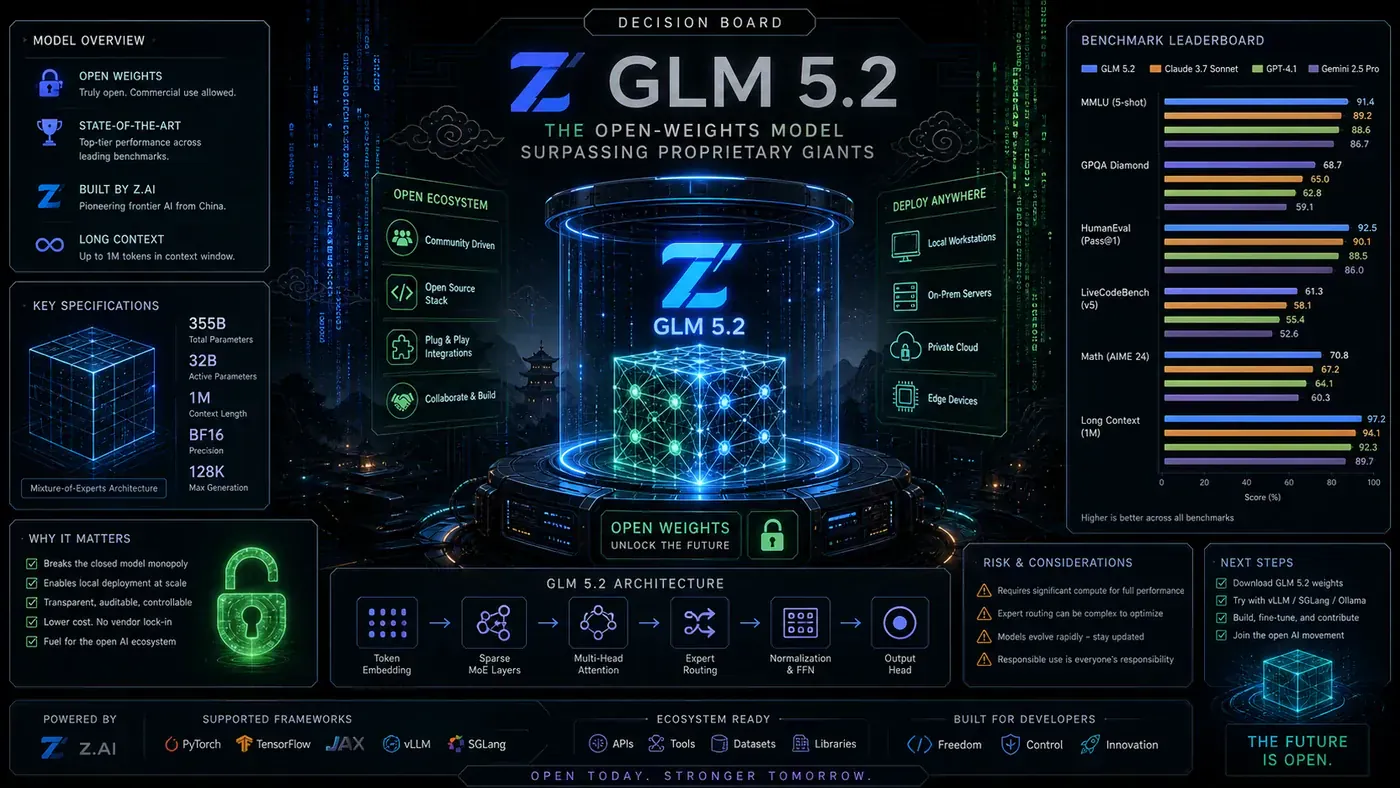
The benchmark data Z.AI published alongside GLM 5.2 tells a compelling story. On a comprehensive suite of evaluations measuring coding ability, reasoning, mathematics, and long-horizon task completion, the model ranks among the very best in the world. It is beaten only by Anthropic's Opus 4.8 - and the recently withdrawn Fable model, which is no longer available to most users. On some evaluations, even OpenAI's latest offerings fall short.
Agentic Coding: The DeepSui Benchmark
Perhaps the most revealing metric is the model's performance on DeepSui, the emerging benchmark positioned to replace the increasingly saturated SWE-bench Pro. DeepSui measures a model's ability to navigate complex software engineering tasks autonomously - planning, coding, debugging, and iterating across extended workflows. GLM 5.2 demonstrates a substantial leap over its predecessor, GLM 5.1, which itself was considered a capable model. This improvement signals that Z.AI has made genuine advances in post-training methodology, particularly around reinforcement learning from human feedback (RLHF) and chain-of-thought optimisation.
The benchmark comparisons show GLM 5.2 sitting comfortably alongside Anthropic's and OpenAI's best offerings on TerminalBench, another agentic coding evaluation. For a model whose weights are freely downloadable and deployable on consumer-grade hardware, this level of performance was virtually unthinkable eighteen months ago.
Multi-Token Prediction: Speed Without Sacrifice
One architectural innovation Z.AI has adopted - following in the footsteps of Meta's Llama and other recent models - is multi-token prediction. Rather than predicting a single token at each forward pass, the model learns to predict multiple future tokens simultaneously. The practical effect, as Witteveen observed during testing, is notably faster inference without the quality degradation that sometimes accompanies speed-oriented optimisations. During his OpenRouter-based testing, he consistently achieved 36 to 40 tokens per second - a figure that makes the model genuinely usable for interactive applications, not merely batch processing tasks.
The Artificial Analysis Verification: Independent Confirmation
While manufacturer-published benchmarks always warrant sceptical examination, the independent validation from Artificial Analysis provided the final nudge that convinced Witteveen this model deserved serious attention. Artificial Analysis has established a reputation for thorough, transparent model evaluation, testing across diverse task categories with methodologies designed to minimise gaming or overfitting.
Their data reveals an enormous performance gap between GLM 5.1 and GLM 5.2 - far larger than typical incremental version bumps in the AI industry. In Artificial Analysis's composite scoring, only GPT 5.5, Opus 4.8, and the now-unavailable Fable 5 rank higher. And even that hierarchy comes with important caveats.
The Fable Problem: Why Availability Matters
Witteveen highlights a fascinating and underreported issue with Fable's benchmark performance. Before Anthropic withdrew the model, independent testing revealed that Fable achieved its impressive scores largely through a fallback mechanism to Opus 4.8. When queried on topics that triggered Fable's safety filters - which happened with surprising frequency, often for seemingly innocuous prompts - the system would automatically fall back to Opus 4.8 to complete the task. Without this fallback, Fable's actual standalone performance was notably weaker, marred by excessive refusals that caused it to fail tasks entirely.
This means GLM 5.2 effectively competes head-to-head with the best actually-available model in the world. Among models you can actually download, deploy, and use today without restriction, it sits at the very pinnacle.
Competitive Positioning Against Other Open Models
The Artificial Analysis data also shows GLM 5.2 handily outperforming other recent open-weights releases. It beats DeepSeek's Pro model, Alibaba's Qwen 3.7 Max, and MiniMax's M3 - all of which launched within the preceding weeks. The pace of advancement in Chinese open-weights AI has become genuinely extraordinary, with each new release leapfrogging the last.
Token Strategy: The Long Chain-of-Thought Approach
One of the most revealing aspects of Artificial Analysis's evaluation is their token usage visualisation. GLM 5.2, particularly in its "Max" configuration, generates remarkably long chains of thought before producing final answers. It outputs more reasoning tokens than DeepSeek, more than Qwen K, and even more than Fable. On the ideal intelligence-per-token curve - where the green zone represents high capability with efficient token usage - GLM 5.2 sits firmly in the high-intelligence, high-token-usage quadrant.
Extended reasoning chains often produce more reliable outputs, particularly for complex coding and mathematical tasks. Witteveen observed that the reasoning tokens scaled appropriately to task complexity - increasing substantially for difficult logic puzzles while remaining concise for straightforward queries. The model invests tokens where they matter.
The broader context is telling. OpenAI has been intensely focused since GPT 5.1 on maintaining high intelligence while reducing token consumption. The industry appears to be moving through a cycle: first extending chains of thought to push capability boundaries, then optimising for efficiency. GLM 5.2 may represent the current peak of the extension phase.
Design Arena: Front-End Development Supremacy
Where GLM 5.2 truly distinguishes itself is in the Design Arena benchmark, where it ranks above Anthropic's Claude models - traditionally considered the gold standard for user interface and front-end code generation. This capability has immediate practical implications for developers, product designers, and agencies.
Witteveen demonstrated this with a prompt to create a homepage for "Dario's Wellness Retreat" in the Tuscan hills. The model generated a sophisticated single-page website with scroll-triggered animations, responsive layout, and what Witteveen described as an "Anthropic look" - clean, modern, and visually polished. The model included multiple animation types for elements entering and exiting the viewport, demonstrating genuine comprehension of contemporary web design patterns. This capability positions GLM 5.2 as a genuine productivity multiplier for developers and designers.
Real-World Testing: Putting GLM 5.2 Through Its Paces
Beyond the benchmarks, Witteveen subjected GLM 5.2 to a series of practical evaluations using OpenRouter as the API gateway, accessing Z.AI's hosted inference. The results across multiple task types paint a picture of a remarkably versatile model.
The Pelican Test and SVG Generation
A favourite evaluation among AI testers is the "pelican on a bike" challenge - asking the model to generate an SVG illustration of the requested scene. It's a deceptively difficult task that tests spatial reasoning, understanding of physics and balance, and the ability to translate natural language into precise vector graphics code. GLM 5.2 passed with flying colours, producing a coherent, visually plausible pelican perched on a bicycle, rendered entirely as SVG.
Long-Form Writing Capabilities
One persistent weakness of many language models is their reluctance or inability to generate genuinely long-form content. Ask for 5,000 words and receive 500 - a frustrating experience for writers, researchers, and content creators. GLM 5.2 proved notably different. When tasked with writing a lengthy article, it consistently produced outputs exceeding 5,000 tokens, maintaining coherence and relevance across extended passages. This capability alone makes it a viable tool for serious writing workflows, from drafting reports to generating educational content.
Reasoning Quality and Token Scaling
Witteveen was particularly impressed by the model's adaptive reasoning. Unlike some models that either under-think difficult problems or over-think simple ones, GLM 5.2 appeared to modulate its reasoning depth appropriately. Simple requests received concise treatment; complex logic puzzles triggered extended internal deliberation visible in the thinking tokens. This calibration is technically difficult to achieve and suggests sophisticated training on diverse reasoning trajectories.
Pricing and Deployment: Democratising Access to Frontier AI
Perhaps the most disruptive aspect of GLM 5.2 is its pricing. Available through OpenRouter at $1.40 per million input tokens and $4.40 per million output tokens, it undercuts proprietary alternatives by enormous margins. For comparison, Anthropic's Opus models and OpenAI's GPT-5-class offerings typically charge an order of magnitude more - often 10-20x the price for comparable or inferior performance.
This pricing creates a compelling economic case even accounting for GLM 5.2's tendency to use more output tokens than some competitors. If a task requires twice as many tokens but costs one-tenth as much per token, the net cost saving remains substantial. For high-volume applications - customer support automation, content generation, code assistance - these savings compound rapidly.
Deployment Options and Data Sovereignty
Currently, Z.AI serves the model directly through OpenRouter, but the open-weights nature of GLM 5.2 means this is just the beginning. Witteveen expects Together AI and other inference providers to begin hosting the model within days, giving users meaningful choice about where their data resides. For organisations with strict data sovereignty requirements - healthcare providers, financial institutions, government agencies - the ability to self-host a frontier-capable model on private infrastructure is transformative.
An organisation can deploy GLM 5.2 entirely within European data centres, or on-premises, without depending on API access to providers in other jurisdictions. Witteveen flags an important consideration for OpenRouter users: different providers have different data retention and training policies. The transparency that comes with choosing your infrastructure provider is one of open weights' most underappreciated benefits.
A Rethinking of AI Strategy for Teams and Enterprises
Witteveen describes rethinking his approach of paying monthly subscriptions to multiple Chinese model providers, in favour of simply paying per token through OpenRouter. When a single open-weights model can match or exceed multiple proprietary subscriptions, the economic logic is compelling.
Mid-tier offerings like Sonnet and Gemini Flash now face genuine competitive pressure. If an open-weights model can outperform them at a fraction of the cost, the performance gap that once justified premium pricing has narrowed dramatically.
The Road Ahead: What GLM 5.2 Signals for the Industry
GLM 5.2 is part of a larger pattern. The Chinese AI ecosystem, once perceived as trailing American labs by six to twelve months, is now releasing models competing for the absolute top tier. DeepSeek, Qwen, MiniMax, and now Z.AI have all published 2026 models that challenge or exceed the best proprietary American offerings.
The pressure is most acute for Google, with Gemini 3.5 Pro still on the horizon. Anthropic and OpenAI maintain edges in specific domains - reasoning and safety, multimodal capabilities - but the margin is thinning. The notion of three untouchable American frontier labs has given way to a genuinely multipolar AI landscape.
For developers and enterprises, this is unambiguously positive. More capable open models mean more options, lower costs, greater data sovereignty, and reduced dependence on any single provider. The strategic default of routing all AI workloads to OpenAI or Anthropic APIs deserves reconsideration.
Conclusion
GLM 5.2 is not merely an incremental improvement - it is a statement of intent from Z.AI and a validation of the open-weights development philosophy. By releasing a model that competes with the best proprietary offerings on benchmarks, surpasses them in front-end code generation, and does so at a fraction of the cost with full weight availability, Z.AI has raised the stakes for the entire industry.
The model is not without trade-offs. Its lengthy reasoning chains mean higher token consumption per task. The Chinese origin may raise compliance questions for some regulated industries. And the inference provider ecosystem remains less mature than those surrounding OpenAI or Anthropic.
But these caveats pale against the fundamental value proposition. GLM 5.2 delivers frontier-level intelligence with the flexibility, transparency, and cost structure that only open weights can provide. For organisations paying premium prices for proprietary models, it demands evaluation. For developers building AI-powered applications, it offers a powerful new option. And for the industry, it is yet another signal that the era of AI exclusivity is ending - and the era of AI abundance is accelerating.
Helpful Resources
Official Resources
- Z.AI GLM 5.2 Blog Post - Official announcement with detailed benchmark data, architecture notes, and release information: https://z.ai/blog/glm-5.2 (opens in a new tab)
- GLM 5.2 Model Weights (Hugging Face) - Download the full and FP8-quantised model weights for local deployment and fine-tuning: https://huggingface.co/collections/zai-org/glm-52 (opens in a new tab)
- Artificial Analysis Benchmarks - Independent evaluation of GLM 5.2 including composite scores, token usage analysis, and comparisons with competing models: https://artificialanalysis.ai/models/glm-5-2 (opens in a new tab)
Deployment and Access
- OpenRouter - Unified API gateway for accessing GLM 5.2 and hundreds of other models with standardised interfaces and provider selection: https://openrouter.ai (opens in a new tab)
- Together AI (expected hosting provider) - Inference-as-a-service platform likely to add GLM 5.2 support: https://www.together.ai (opens in a new tab)
- Fireworks AI - Fast inference infrastructure for open-weights models: https://fireworks.ai (opens in a new tab)
Related Models and Context
- MiniMax 3 - Recently released open-weights model from MiniMax: weights available on Hugging Face
- Qwen 3.7 Max - Alibaba's latest open-weights offering, available via API and select weight releases
- DeepSeek Pro - DeepSeek's professional-grade model series
- DeepSui Benchmark - Emerging software engineering evaluation replacing SWE-bench Pro
- TerminalBench - Agentic coding benchmark for measuring autonomous software development capabilities
Tools and Utilities Mentioned
- Cursor - AI-powered code editor that fine-tunes proprietary models for enhanced coding assistance: https://cursor.com (opens in a new tab)
- Hugging Face - Primary distribution platform for open-weights AI models: https://huggingface.co (opens in a new tab)
Related Links
- Sam Witteveen's YouTube Channel - In-depth AI model analysis and industry commentary: https://www.youtube.com/@samwitteveenai (opens in a new tab)
- Original Video - "GLM 5.2 - The Top NEW Open Weights Model": https://www.youtube.com/watch?v=10C8VMN3hjU