
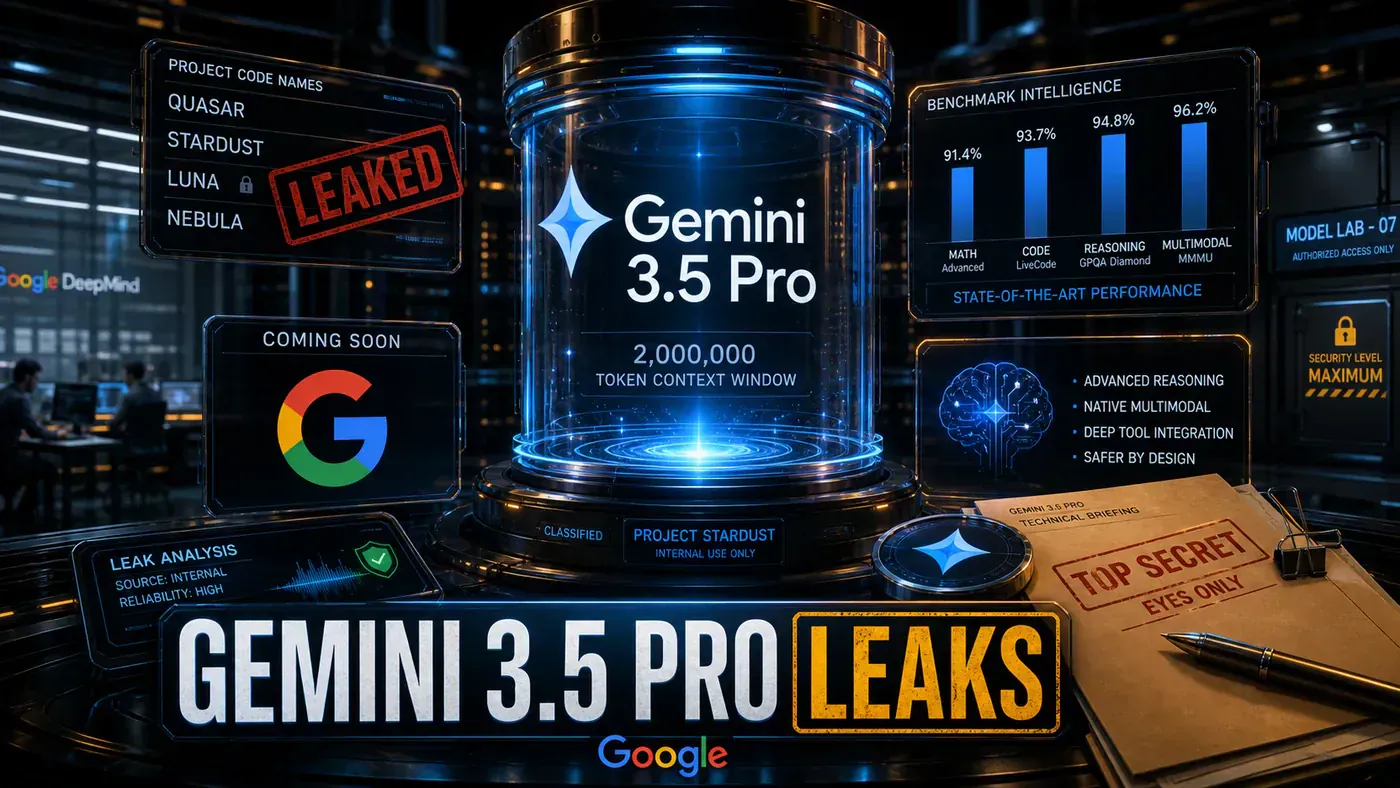


From a tiny "coming soon" tag to a 2 million-token memory, leaked codenames and a critical question nobody's asking: is Google about to change the AI race, or stumble at the finish line?
The artificial intelligence industry moves at a pace that can feel almost parodic. Every few weeks, another frontier model drops, another benchmark is shattered, and another headline declares that "everything changes today." For practitioners trying to actually get work done - not just spectate from the sidelines - it is exhausting. The real skill is not keeping up with every launch; it is knowing which ones genuinely matter for the work you do.
Gemini 3.5 Pro matters.
Google's next flagship model has not even launched yet, and already it is one of the most discussed releases of 2025. A quiet tag spotted on a webpage, internal builds floating around under a coffee-themed codename, and a list of leaked features that sound almost too ambitious - they all point to something significant arriving within weeks. But beneath the excitement sits a harder question that early testers have already raised, one that could define whether this launch soars or falls flat.
Here is everything the leaks, clues and Google's own hints are telling us about Gemini 3.5 Pro - and what to watch for when it finally arrives.
The Leak: How It All Started
Google I/O and the Delay That Made Everyone Groan
The story begins at Google I/O on 19 May 2025. The annual developer conference is typically where Google unveils its most important AI work, and expectations were sky-high for the debut of Gemini 3.5 Pro, the successor to what was already one of the most capable model families on the market. Attendees and livestream viewers alike were waiting for the announcement.
It never came.
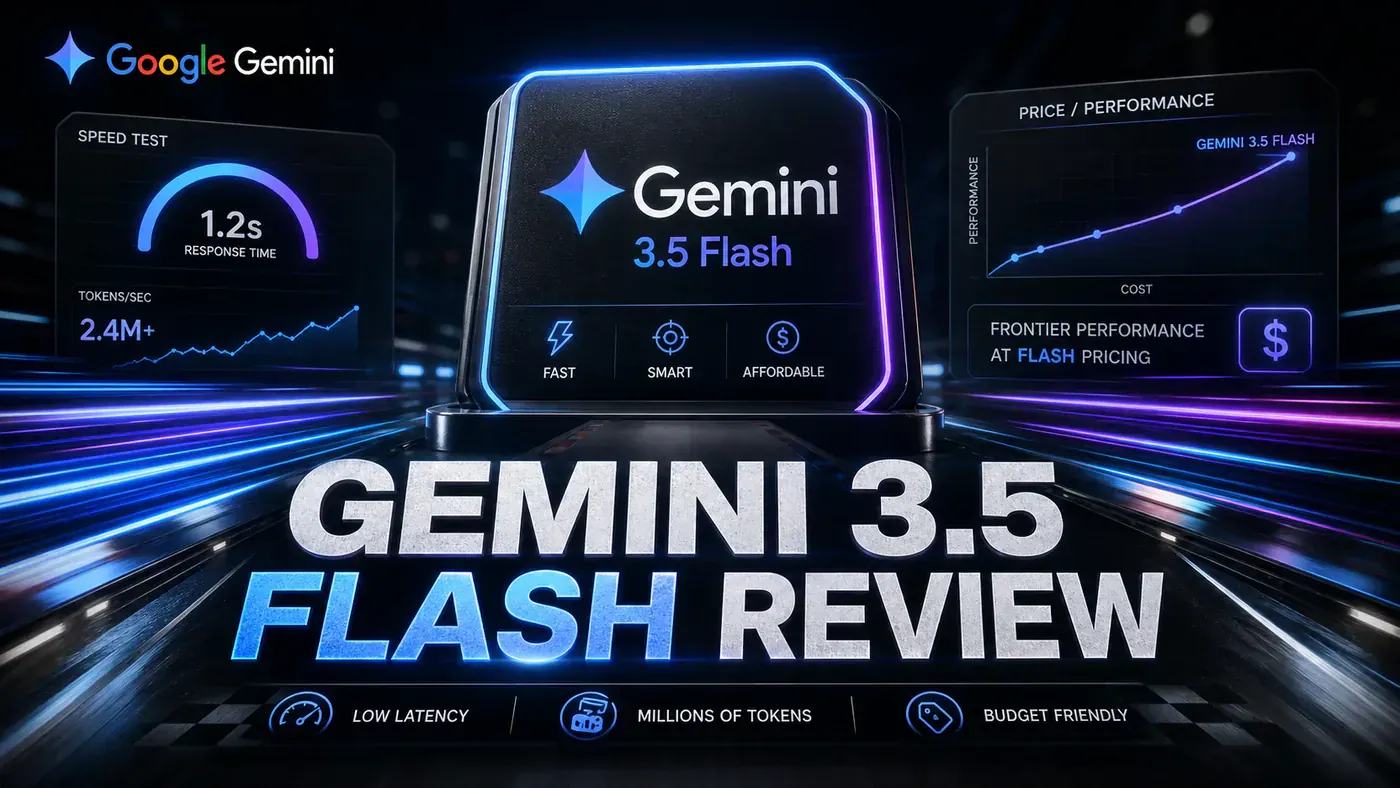
Instead, Google chief executive Sundar Pichai effectively told the audience to wait until the following month. According to reports from the event, the crowd actually groaned aloud. What did launch was Gemini 3.5 Flash - a smaller, faster, cheaper model that sits below the Pro tier in Google's hierarchy. Flash is impressive in its own right, but it is not the main event. The flagship was held back, and nobody knew exactly why.
The "Coming Soon" Tag That Broke the Internet
The leak itself was almost comically subtle. Not long after I/O, observers spotted a small tag on Google's Gemini model page that read simply: "3.5 Pro coming soon." That was it. No press release, no blog post, no stage announcement - just three words tucked into an interface that most users would scroll straight past.
But in the AI community, where every breadcrumb is analysed within minutes, that tiny tag was enough. It confirmed what many had suspected: the model was real, it was close to completion, and a public release was imminent.
Codename "Cappuccino"
Adding fuel to the fire, leaked internal builds have been circulating under the codename "Cappuccino." While Google has not confirmed this designation, multiple sources have reported seeing references to it in internal tooling and preview environments. The consensus among those tracking Google's model pipeline is that Cappuccino represents an early build or internal test version of Gemini 3.5 Pro.
All signs now point to a launch within weeks - possibly even days. Google has historically favoured quiet, mid-week drops for major model releases: a single blog post, a flurry of benchmark charts, and the model simply appearing in the interface without fanfare. Late June 2025 looks like the most probable window for the wide release.
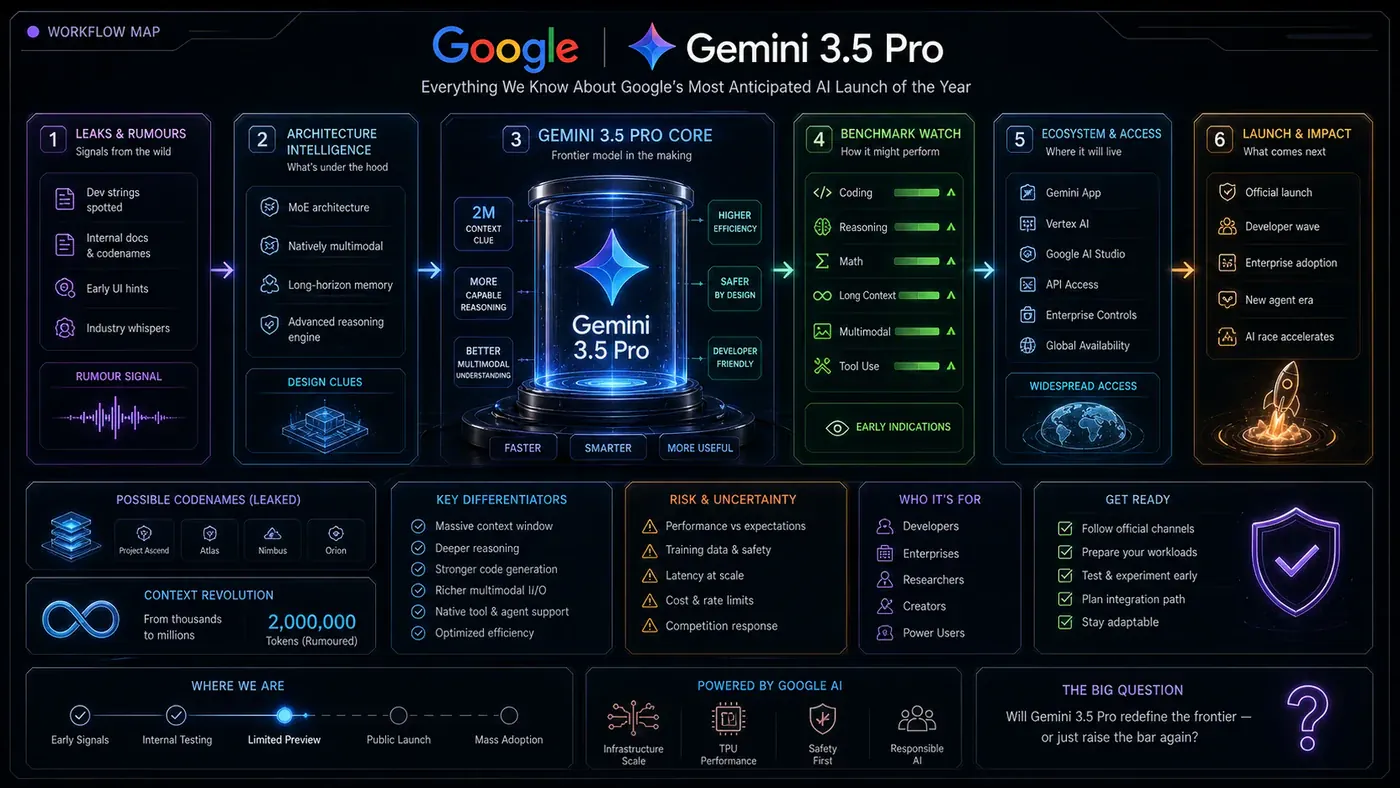
The Five Big Features Leaked So Far
Based on the clues Google has left behind and the leaks that have emerged from early testers, here is what Gemini 3.5 Pro is expected to deliver.
1. A 2 Million-Token Context Window
The headline feature is memory - enormous memory. Gemini 3.5 Pro is expected to handle approximately two million tokens in a single conversation. To put that in practical terms, this model could ingest entire novels, hundreds of documents, hours of transcribed audio, or massive codebases all at once - and retain full awareness of everything it has seen.
For comparison, most frontier models today operate with context windows in the 128,000 to 256,000-token range. Two million tokens is an order-of-magnitude leap. It transforms what is possible. Researchers could feed an entire literature review into the model and ask for synthesis across every paper simultaneously. Developers could upload an entire production codebase and request architectural improvements with full cross-file awareness. Content creators could submit complete book manuscripts for editorial feedback in one pass.
The constraint with current models is rarely intelligence. It is memory. Gemini 3.5 Pro appears designed to remove that constraint entirely.
2. Deep Think Mode
Raw processing capacity means little if a model rushes to answers without genuine reasoning. Gemini 3.5 Pro is expected to ship with a "deep think" mode - a deliberate slowdown where the model spends more compute cycles working through complex problems step by step rather than generating the fastest possible response.
This mirrors what competitors have been exploring. The idea is simple in concept but difficult in execution: give the model permission to pause, plan, and reason through difficult tasks rather than pattern-matching its way to a plausible-sounding but incorrect answer. For coding challenges, mathematical proofs, strategic analysis, and any domain where precision matters more than speed, this capability could be transformative.
The key question, of course, is whether it works. Early reports on pre-release builds have been mixed, which we will address shortly.
3. True Multimodal Reasoning
"Multimodal" has become something of a buzzword, but Gemini 3.5 Pro appears to be pushing it beyond marketing speak. The expectation is genuine cross-modal understanding - working with text, images, audio and video together in a single context, not as separate capabilities bolted onto a text model.
What this means practically: you could upload a screen recording of a software demonstration and ask the model to produce a written step-by-step guide, identify UI issues, and suggest improvements - all from the same input. You could describe a visual concept in words, provide a rough sketch, and receive a refined design proposal that integrates both inputs. You could feed the model a video presentation alongside its transcript and slide deck, then ask for analysis of where the messaging aligns and where it contradicts.
Google has historically been stronger on multimodal work than many competitors, thanks to its deep investments in vision and speech models. Gemini 3.5 Pro looks set to press that advantage aggressively.
4. Visual and Front-End Generation
This is where the leaks get particularly interesting for builders and designers. Reports suggest Gemini 3.5 Pro has made dramatic strides in generating clean, functional visual outputs from natural language descriptions.
The expected capabilities include:
- Web layout generation: Describe a landing page and receive production-ready HTML/CSS.
- Interactive components: Build small applications and widgets from a text prompt.
- Animations: Generate motion designs and transitions.
- 3D outputs: Create basic three-dimensional assets and scenes.
The workflow this enables is powerful: describe what you want, watch the model build the visual structure, then refine iteratively through conversation. For rapid prototyping, internal tools, marketing pages, and design exploration, this could compress days of work into hours.
5. Smarter Agents and Tool Connections
The final major leak concerns agents - autonomous AI systems that can take actions across multiple tools and services. Gemini 3.5 Pro is rumoured to feature tighter integrations with external tools, allowing it to execute multi-step workflows that span different applications.
There is also talk of an always-on assistant codenamed "Spark" that could handle persistent tasks across your app ecosystem. This remains firmly in the rumour category - there has been no official confirmation from Google, and the details are thin. But if accurate, it would represent Google's most aggressive move yet into the agentic AI space that companies like Anthropic, OpenAI and several well-funded startups are all racing to claim.
What This Actually Looks Like in Practice
Features are meaningless without application. Here is how these capabilities translate to real workflows.
For content creators and coaches: The two-million-token memory means you could dump an entire archive of recorded coaching calls into a single session and ask the model to extract recurring questions, identify knowledge gaps, and recommend exactly which training materials to build next. No more guessing what your audience needs - you let the model analyse every interaction simultaneously and tell you.
For strategists and planners: Feed the model a messy, fifty-page roadmap document and ask it to reason through the optimal teaching sequence. The deep think mode would evaluate dependencies between topics, identify logical progression paths, and flag areas where prerequisites are missing. The output is a curriculum that actually makes sense from day one.
For designers and developers: Describe a product page in natural language, watch the model generate a clean layout, then refine it conversationally. "Move the call-to-action above the fold." "Make the colour scheme more muted." "Add a testimonial section." Each instruction updates the output without requiring manual coding.
For documentation and training: Take a screen recording of any software demonstration and have the model convert it directly into a written guide with annotated screenshots. The multimodal capability bridges the gap between visual demonstration and textual documentation automatically.
The pattern is not about performing clever tricks. It is about identifying the slow, repetitive, cognitively heavy parts of real work - and letting the model carry that load.
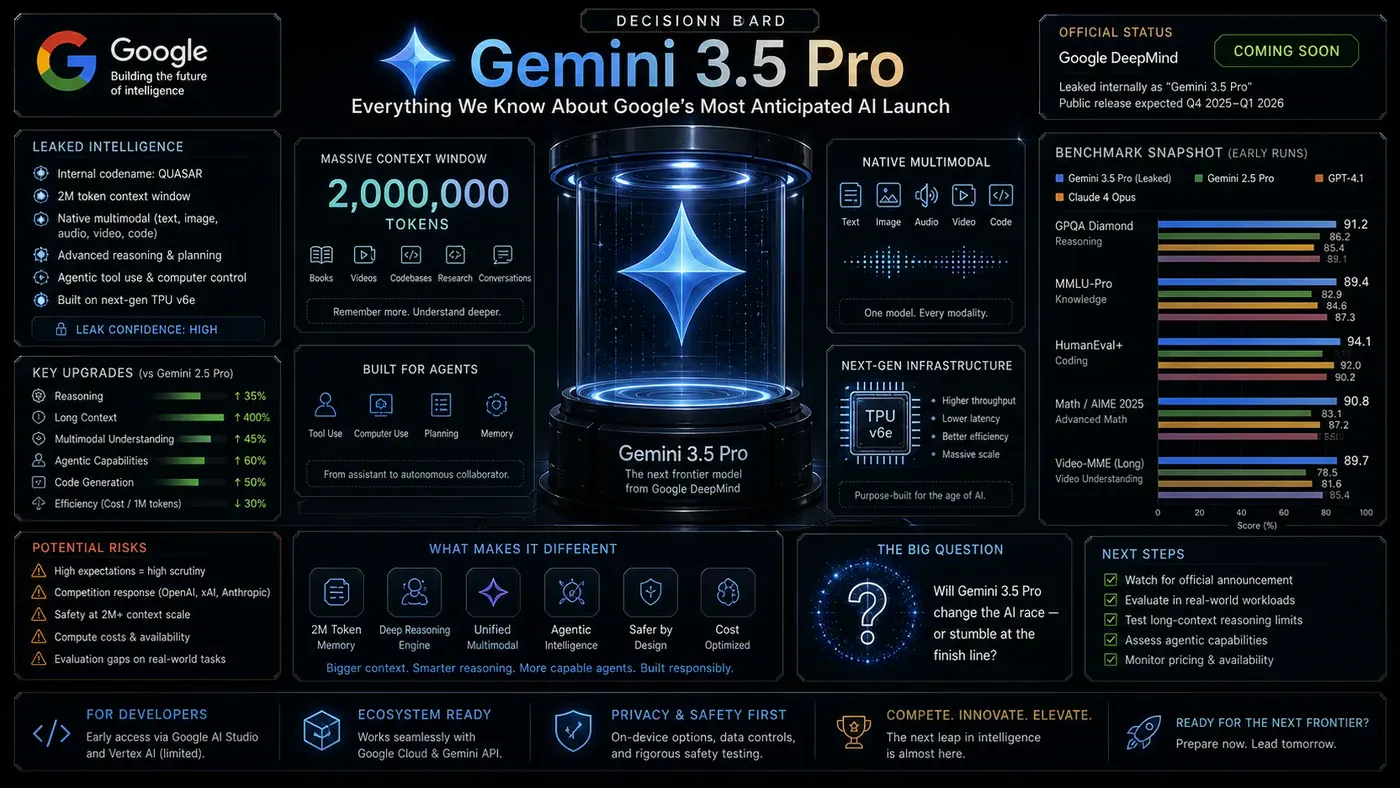
Pro vs Flash: Choosing the Right Tool
Google's current public model in this generation is Gemini 3.5 Flash, and it is already strong - strong enough, in fact, to beat last year's Pro model on several coding and agent benchmarks. Flash is optimised for speed and cost. It is the model you reach for when you need fast answers to straightforward questions.
Where Flash gives up ground is on the hardest reasoning tasks. Complex logical deduction, multi-step planning, deep synthesis across enormous inputs - that is where the larger architecture of a Pro model pays dividends.
The expected trade-off is cost. Gemini 3.5 Pro will almost certainly sit in the premium pricing tier. The practical rule is simple: use the big model for hard, heavy, cognitively demanding work, and the fast model for everything else. Reaching for the premium option when a cheaper alternative would suffice is poor strategy, regardless of how impressive the specs look.
The Competitive Landscape
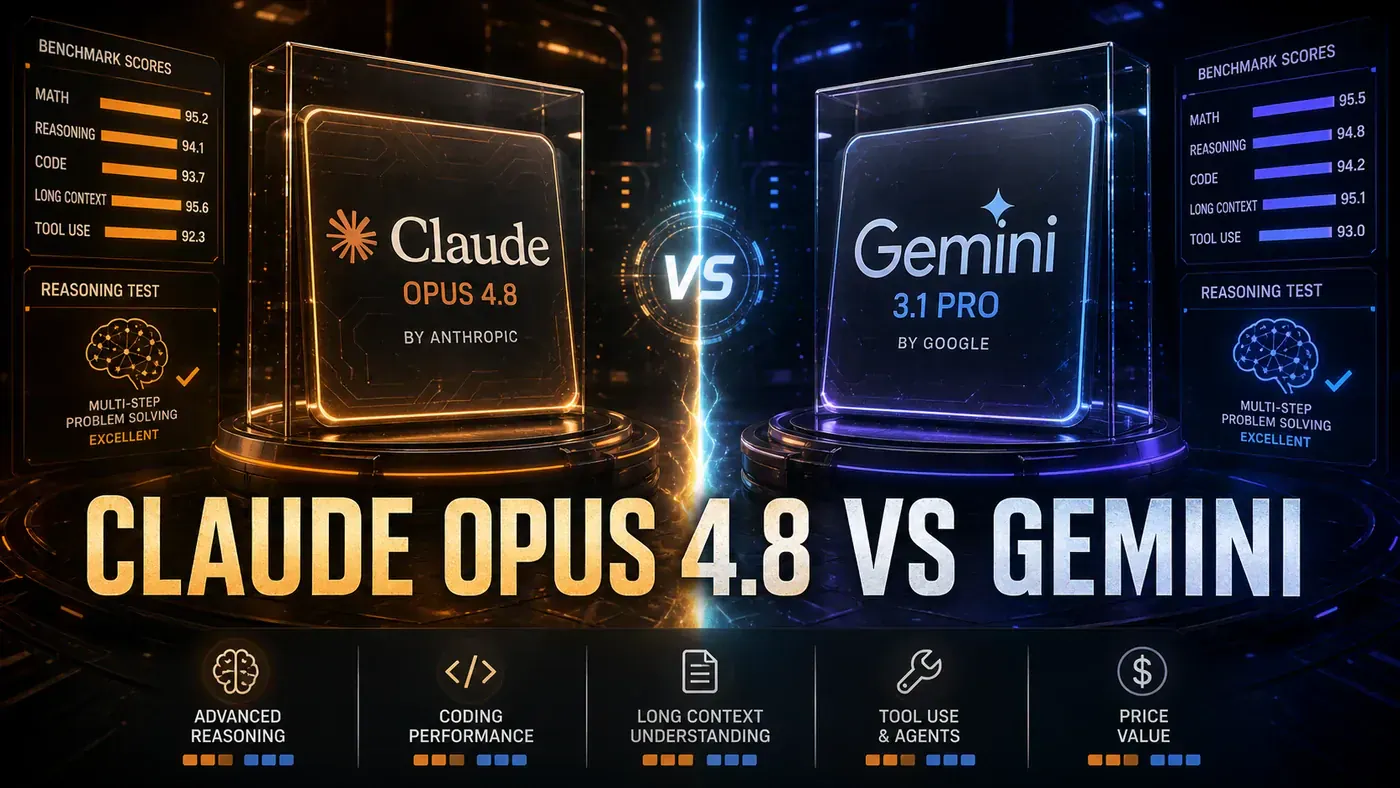
The top end of AI in mid-2025 is genuinely competitive in a way that benefits users. There is no single model that dominates every dimension. Instead, a handful of frontier systems trade punches across different capabilities - reasoning, coding, multimodal understanding, speed, cost, and context length.
When a new top-tier model from Google arrives, it does not exist in a vacuum. It forces every competitor to improve. That dynamic is the reason the tools keep getting better at such a rapid clip. For practitioners, the correct posture is not brand loyalty but results-based selection: evaluate each model on the specific work you do, choose based on performance rather than headlines, and remain willing to switch as the landscape evolves.
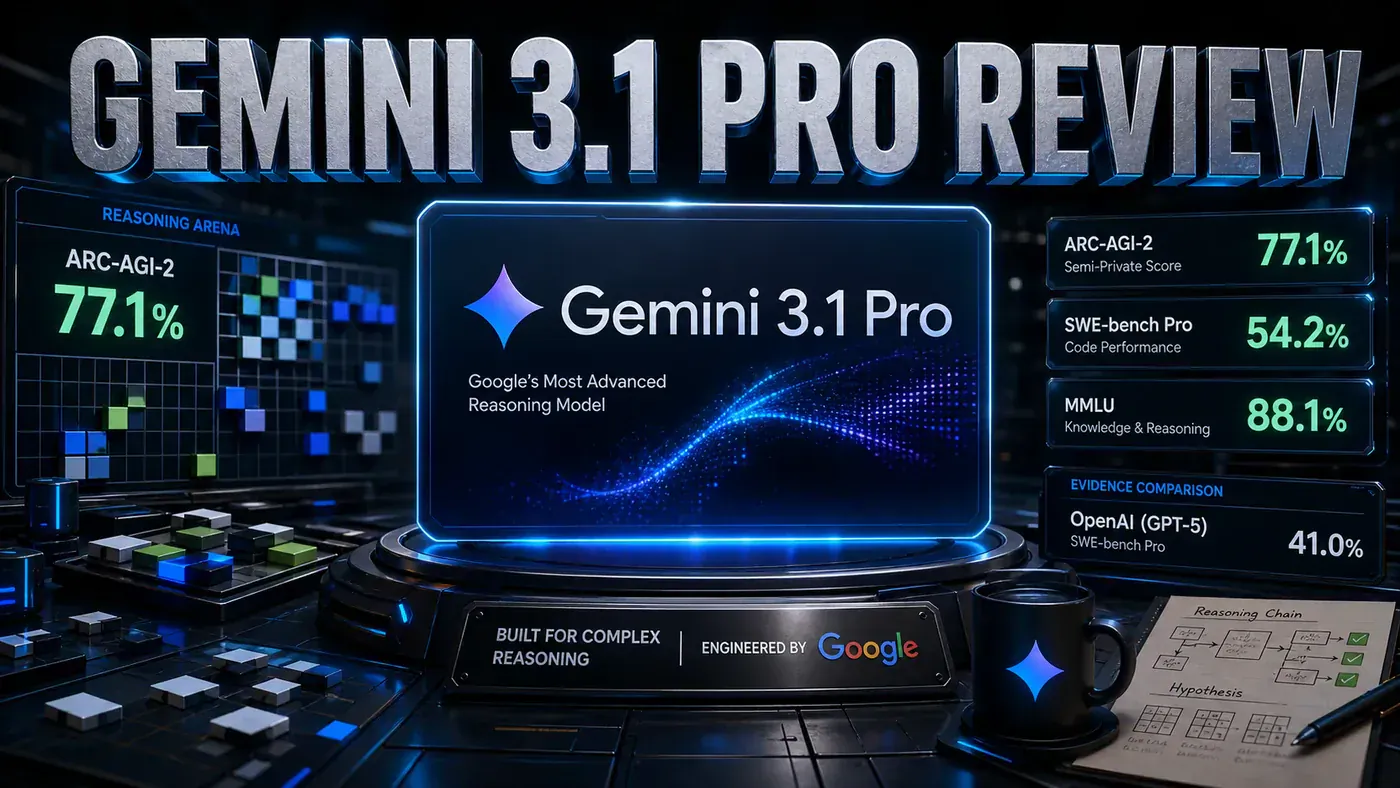
Gemini 3.5 Pro enters this environment with clear differentiators - the enormous context window, Google's multimodal strengths, and the visual generation capabilities. Whether those differentiators translate to real-world dominance depends on the quality of execution at launch.
Five Practical Tips for Launch Day
When Gemini 3.5 Pro drops, here is how to approach it intelligently.
1. Do not migrate everything on day one. Test it on one real task you already understand well. Compare the output directly against whatever you currently use. A single controlled test tells you more than a thousand benchmark charts.
2. Watch for the laziness question. Give it a genuinely complex, long-context task and observe whether it maintains depth and accuracy throughout. If it holds up, that is a strong signal. If it starts cutting corners, wait for the next update.
3. Match the model to the task. Use the Pro model for hard reasoning, enormous inputs, and complex builds. Use Flash for quick queries, drafts, and routine tasks. Premium pricing is only justified by premium results.
4. Prepare your prompts in advance. The moment the model launches, you want to run structured tests - not fumble around wondering what to type. Good prompts are portable across models, and having them ready lets you evaluate faster.
5. Ignore the noise. Leaks and hype cycles generate far more content than signal. Track a small number of trusted sources, run your own evaluations, and make decisions based on what you observe rather than what you read.
Conclusion
Gemini 3.5 Pro represents one of the most consequential AI launches of the year - not because of any single feature, but because of what the combination of features attempts to achieve. A two-million-token memory changes what is possible with long-form work. Deep think mode, if it works, raises the ceiling on reasoning quality. Stronger multimodal and visual generation capabilities bring AI deeper into creative and technical workflows. And smarter agent integrations hint at a future where AI systems do not just answer questions but complete tasks.
The risk is execution. Early builds showed warning signs that Google now has weeks to address. The question on launch day is not whether the spec sheet is impressive - it is whether the model delivers on that promise when the prompts get hard and the contexts get long.
For practitioners, the right move is preparation, not hype. Understand what the model is designed to do well. Prepare test cases that map to your actual work. Evaluate it honestly when it arrives. And remember that the biggest improvement most people can make is not switching models - it is learning to write clearer prompts, break tasks into steps, and give the model the right context to succeed. That skill transfers to every tool, now and in the future.
Helpful Resources
- AI Profit Boardroom – Community and masterclass for staying current with AI tool launches, including walkthroughs, prompt libraries and live coaching calls. *URL:* <https://www.skool.com/ai-profit-lab-7462/about>
- Google Gemini Official – Access current Gemini models and updates at <https://gemini.google.com>
- Google AI Blog – Official announcements and technical deep-dives: <https://ai.googleblog.com>
- Google DeepMind – Research publications and model details: <https://deepmind.google>