





Briefing
Most teams that try to build something with a large language model hit the same wall. The model itself is the easy part. What eats the weeks is everything around it: keeping track of prompts, feeding the model your own documents, checking whether the answers are any good, and getting the whole thing online without it falling over.
Dify (opens in a new tab) is an open-source project that bundles all of that plumbing into one platform, so you don't have to stitch it together yourself. Developers have voted with their attention. The project's GitHub repository (opens in a new tab) passed 100,000 stars in June 2025 (per Dify's own announcement (opens in a new tab)) and has kept climbing well past 136,000 since.
For an Australian business, the appeal is simple. You can build a working AI app on top of your own data without hiring a platform team to build the foundation first. Here's what's actually under the hood.
The Complete Platform
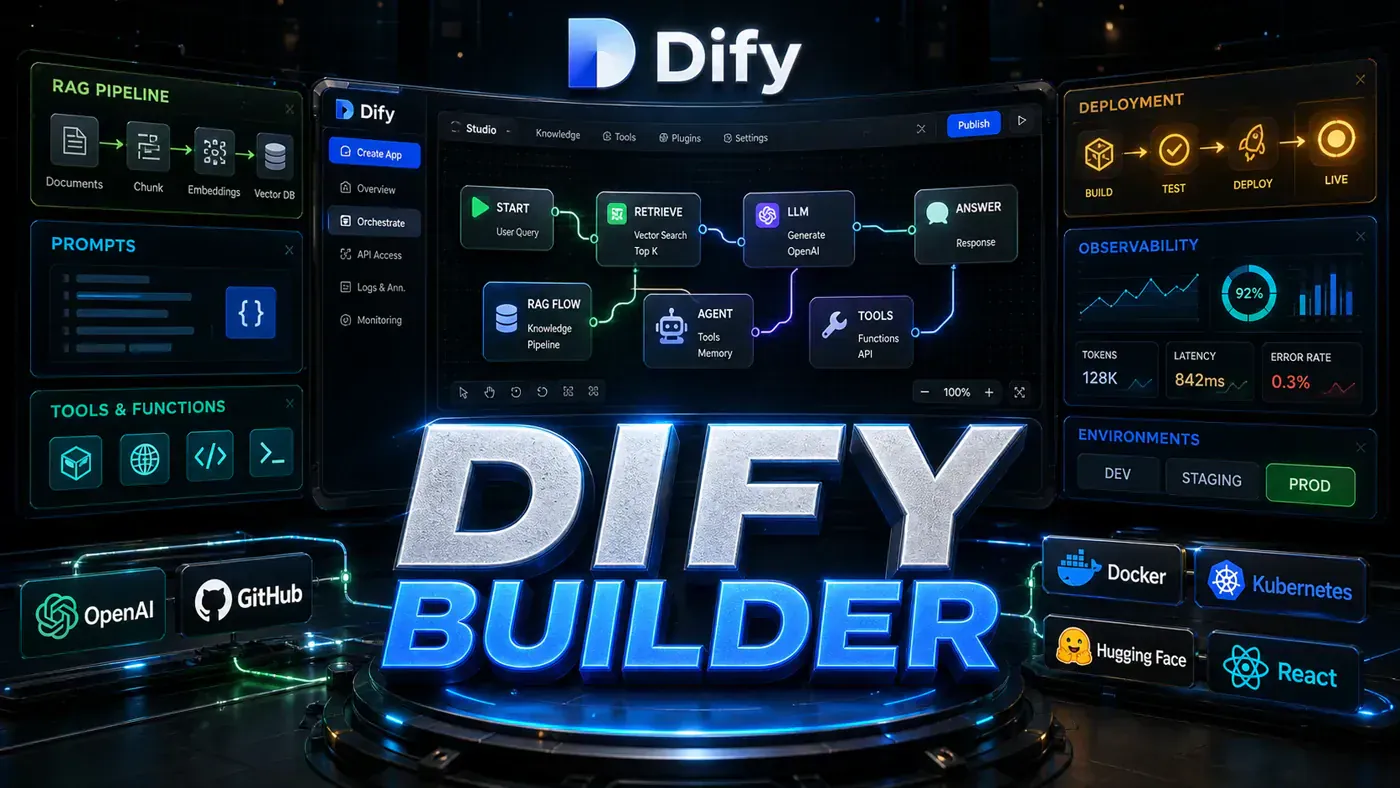
Dify bills itself as a platform for building LLM applications, not just a framework you wire into your own code (as described on its GitHub page (opens in a new tab)). The current official tagline leans further into "production-ready platform for agentic workflow development," but the practical pitch is the same: it gives you the full stack. That includes:
Orchestration: A visual workflow builder for LLM applications that need branching, looping, and conditional logic.
Prompt Management: Version-controlled prompt work with A/B testing, variable substitution, and template inheritance.
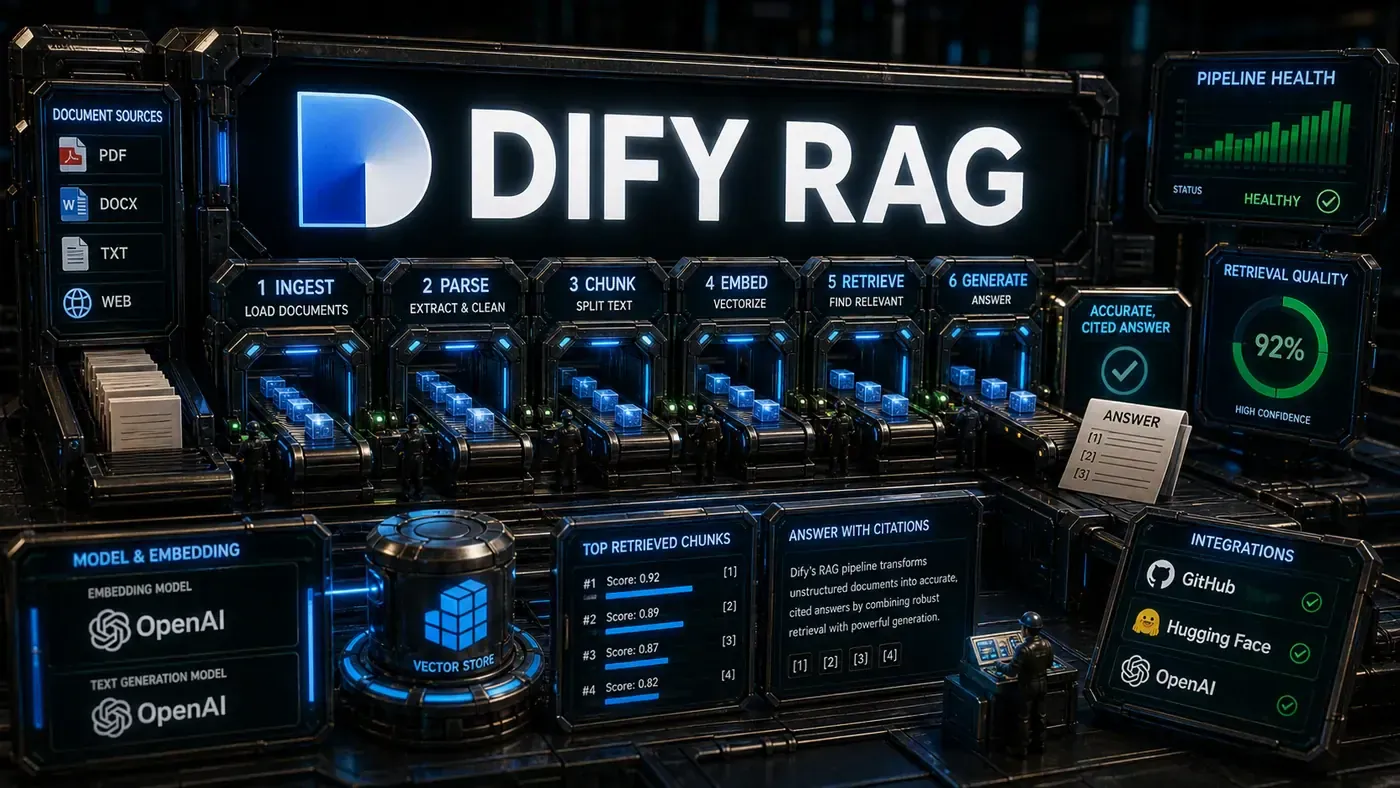
RAG Pipeline: Document ingestion, chunking, embedding, and retrieval, the whole path from your files to a usable answer.
Agent Framework: Tool-using agents with memory, planning, and multi-turn conversation support.
Evaluation: Built-in testing for measuring accuracy, relevance, and performance.
Deployment: One-click deployment as APIs, web apps, or chat widgets, with SSL, authentication, and rate limiting.
RAG Pipeline Deep Dive
The RAG (Retrieval-Augmented Generation) pipeline is where Dify does some of its heavier lifting. Documents move through several stages:
- Ingestion: Out-of-the-box support for common document formats including PDF, Word, Markdown, HTML, and structured data. (Dify markets support for 50+ formats, though official docs list roughly a dozen common ones, so treat the headline count as generous.)
- Chunking: A choice of strategies, semantic, recursive, fixed-size, and custom, with control over overlap
- Embedding: Pluggable embedding models (OpenAI, Cohere, local) with batch processing
- Retrieval: Hybrid search that combines vector similarity with keyword matching and reranking
- Generation: Context-aware prompting with citation tracking and source attribution
These capabilities are documented across Dify's RAG pipeline guidance (opens in a new tab). The pipeline also copes with the cases that trip up simpler setups: tables buried in PDFs, images with captions, documents in more than one language, and nested hierarchical structures.
By The Numbers
- 136,000+ GitHub stars, among the most-starred LLM platforms (the count crossed 100k in June 2025 and keeps moving) (Source: langgenius/dify GitHub repository (opens in a new tab))
- 50+ document formats marketed for RAG ingestion (official docs confirm around a dozen common ones) (Source: langgenius/dify GitHub repository (opens in a new tab))
- Multiple embedding providers, OpenAI, Cohere, Hugging Face, local
- Self-hosted or cloud, your choice of deployment
- Enterprise adoption, reportedly used in production at larger companies, though Dify does not publish a verified named-customer list
Architecture
Under the hood, Dify is a fairly conventional modern web app: a React-based frontend, a Python backend, and a PostgreSQL database. It scales horizontally through Docker Compose or Kubernetes (Dify documents the Docker Compose route for self-hosting (opens in a new tab)). The pieces are kept separate, which helps when you grow: the API server handles orchestration, worker processes take care of async tasks, and a message queue manages how jobs get distributed.
Who Uses Dify?
Dify says it has been picked up across a range of industries, financial services for compliance Q&A, healthcare for clinical decision support, e-commerce for product recommendations, and education for tutoring. These are the company's own framing rather than verifiable named-customer references, so read them as illustrative. The pattern they point to is real enough, though: organisations that want capable LLM applications without building the infrastructure from scratch.
That trade-off is the whole reason to look at Dify. You get visual development tools, a production-grade RAG pipeline, and deployment options that run on your own servers or in the cloud, without standing up the foundation yourself. The star count it has earned suggests plenty of developers agree that's a fair deal.
Dify: answer-first summary
Dify matters because it can change how Founders and operators plan, build, or govern an tool evaluation workflow. Dify combines visual workflow design, RAG pipelines, and model management into a complete platform for building LLM applications at scale.
The direct answer is this: do not treat the topic as a standalone trend. Treat it as a decision about inputs, outputs, review ownership, data exposure, and whether the workflow produces a result that is faster, safer, or more useful than the current process.
Dify: implementation checklist
- Define the user, job to be done, and success metric for the tool evaluation workflow.
- Collect real examples, policies, source files, customer questions, or search queries before writing prompts or choosing tools.
- Separate low-risk drafts from decisions that need approval, privacy checks, or senior review.
- Document what the AI is allowed to access, what it must not access, and who signs off before production use.
- Review time to value, adoption rate, cost per workflow, quality review score after a small pilot rather than judging the idea from a demo.
This keeps the work practical. It also gives search engines and AI answer engines a clean factual structure: what the topic is, who it helps, what to do next, and which risks matter before implementation.
Decision criteria for Dify
| Decision area | What to check | Production signal |
|---|---|---|
| Intent | Does Dify solve a real workflow problem? | The use case has a named owner and measurable outcome. |
| Data | Can the required data be used safely? | Sensitive data is classified and access is controlled. |
| Quality | Can a reviewer judge the output consistently? | Examples, rubrics, or acceptance criteria exist. |
| Scale | Can the workflow be repeated without hero effort? | The process is documented and can be handed to another team member. |
Practical example for Dify
A small business could use this article to choose one practical test. For example, a manager might take one customer-facing process, one internal document workflow, or one recurring content task and redesign only that step with AI support. The goal is not to automate the whole business at once; it is to learn where AI Tools creates reliable leverage.
The useful deliverable is a short operating note: the trigger, the source material, the prompt or tool, the review checklist, the escalation rule, and the metric. That note becomes the handover asset for staff training, SEO/GEO content, service delivery, or future agent work.
Risks and controls for Dify
The common failure pattern is moving too quickly from a promising idea into an unmanaged workflow. For Dify, the risk is not only bad output. It can also be unclear data permission, staff confusion, duplicate content, unreviewed customer advice, or a tool that quietly changes cost or capability.
- Control tool sprawl with a named owner, a review step, and written acceptance criteria.
- Control unclear pricing with a named owner, a review step, and written acceptance criteria.
- Control vendor lock-in with a named owner, a review step, and written acceptance criteria.
- Control unreviewed data sharing with a named owner, a review step, and written acceptance criteria.
Measurement plan for Dify
A useful AI or SEO initiative should leave evidence. Track time to value, adoption rate, cost per workflow, quality review score and compare the pilot against the current process. If the measure does not improve, keep the learning but avoid scaling the workflow.
For GEO readiness, the page should also answer the core question directly, define the entities involved, include implementation steps, explain tradeoffs, and link readers to the next relevant AI Kick Start service, guide, tool, or article.
Definitions and entities for Dify
For search, GEO, and staff handover, define the core entities in plain language. In this article the important entities are the workflow owner, the AI tool or model, the source material, the review process, the risk boundary, and the measurable business outcome. Clear definitions make the page easier for people to scan and easier for AI answer engines to quote accurately.
- Workflow owner: the person accountable for deciding whether Dify belongs in the business process.
- Source material: the documents, examples, policies, URLs, prompts, videos, or customer questions that ground the output.
- Review boundary: the point where a human checks accuracy, privacy, brand voice, or customer impact before the result is used.
- Success metric: the measure that proves whether the tool evaluation workflow is worth repeating.
Dify versus doing nothing
Doing nothing is also a decision. The cost may be slow manual work, weaker search visibility, inconsistent advice, duplicated effort, or staff using unmanaged AI tools without a shared process. The practical question is whether a controlled pilot can reduce that cost without creating a larger governance problem.
| Option | When it makes sense | What to watch |
|---|---|---|
| Do nothing | The workflow is rare, low value, or already reliable. | Competitors may improve speed, content depth, or service consistency first. |
| Run a small pilot | The task repeats often and has clear review criteria. | Keep scope tight and measure the result against the current process. |
| Build a production workflow | The pilot is repeatable and risk controls are documented. | Assign ownership, monitoring, training, and a rollback path. |
AI Kick Start handover package for Dify
A production handover should be concrete enough that another person can run it. For Dify, that means a short brief, a workflow map, approved prompts or tool settings, source material, a review checklist, internal links to supporting resources, and a simple measurement sheet. This is the difference between reading about AI and turning it into operational capability.
That packaging also strengthens E-E-A-T. It shows experience through implementation notes, expertise through decision criteria, authoritativeness through source-aware structure, and trust through risks, controls, and review steps. The article becomes useful even if the reader never buys a tool because it helps them make a better operational decision.