





Introduction: Why This One Belongs on the Watchlist
Anthropic's open-source Claude Code skill turns agent creation into a managed project workflow instead of a one-off prompt. The reason it matters for AI Kick Start readers is practical: this is not just another launch to admire from a distance. It changes how founders, operators, and technical teams should think about agent Systems work over the next few months.
The source transcript repeatedly centres on Claude Code, Anthropic and AI agents, with the video framing the topic as a practical workflow rather than a detached product announcement. That is the useful lens. The video is worth treating as implementation intelligence: what should be tested, what should be ignored for now, and what should become part of a repeatable operating system.
For Australian small businesses and technical teams, the right question is not "is this impressive?" The right question is "where does this reduce friction without creating a larger governance, security, or maintenance problem?"
What the Video Actually Shows
The core pattern is simple: Treat agent creation like a project scaffold, not a chat session. Use skills to package repeatable instructions, files, and launch steps. Validate scope, credentials, and handoff before trusting a live agent.
In practice, that means the update sits inside a broader shift from isolated AI prompts to managed systems. A tool, model, or method only becomes valuable when it has clear inputs, a measurable output, a review path, and a way to repeat the result next week.
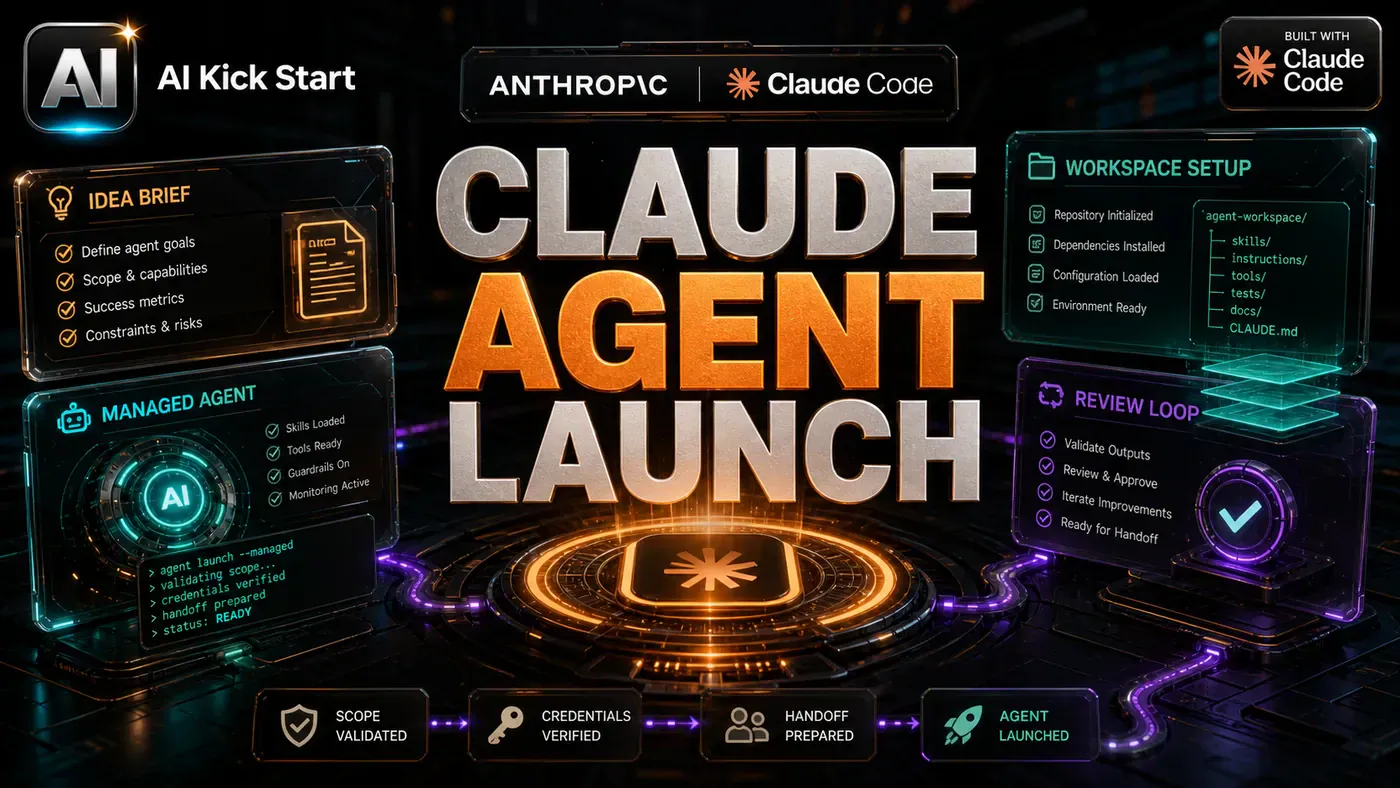
The video's most useful signal is the workflow shape. The moving parts can be summarised as:
- Idea brief
- Managed agent
- Workspace setup
- Review loop
That is the level at which teams should evaluate it. A demo can be entertaining, but a workflow must survive messy source files, staff handoff, data boundaries, and real deadlines.
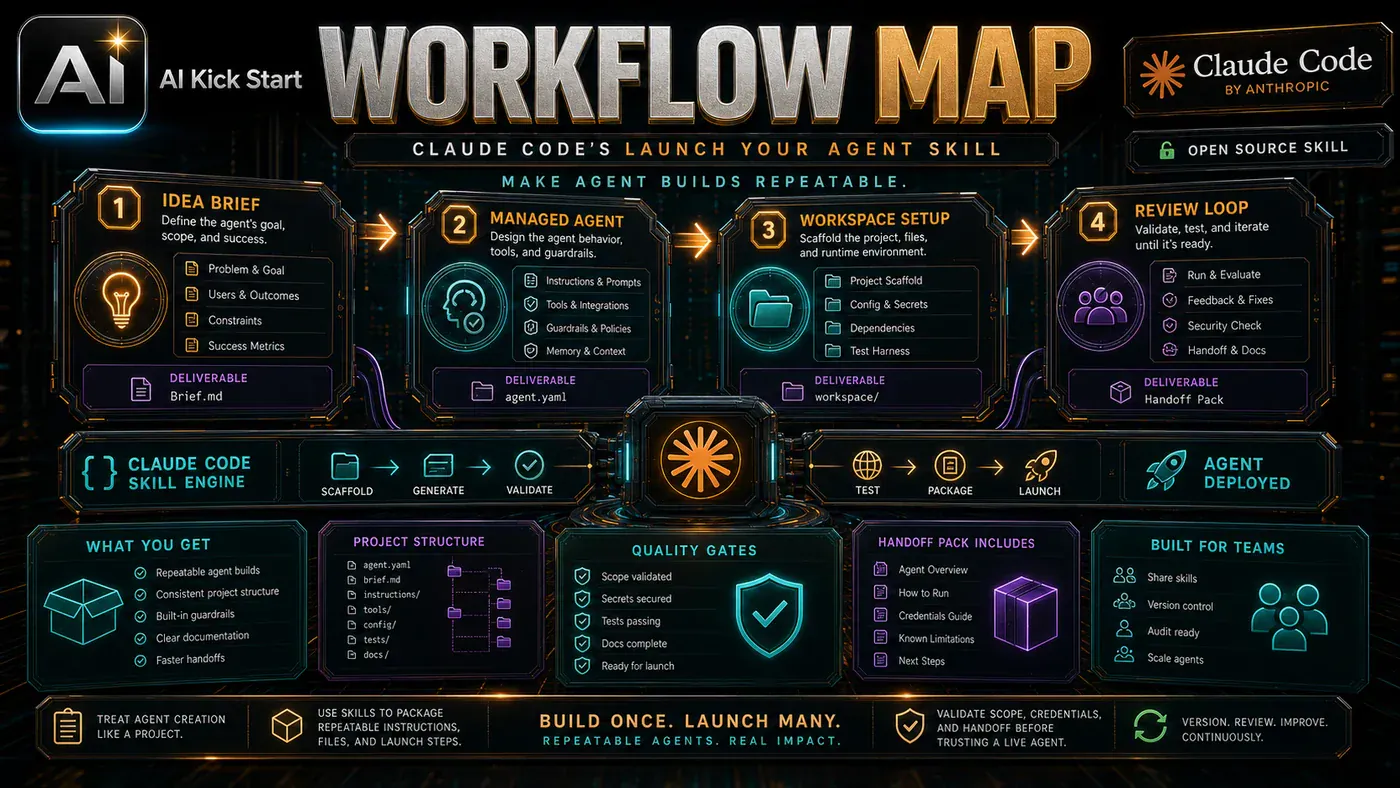
The Implementation Pattern
The first implementation lesson is to narrow the scope. Start with one narrow business process. Broad adoption is usually where AI systems fail first because nobody knows which decision the tool is allowed to make and which decision still belongs to a human.
The second lesson is to create a test harness. Keep the agent's tool permissions small. A useful harness does not have to be complicated. It can be a short brief, a fixed sample dataset, a few expected outputs, and one person responsible for judging whether the result is good enough.
The third lesson is to capture the process. Document how the agent is started, stopped, and reviewed. When the process is documented, it can become a reusable skill, checklist, prompt pack, repo pattern, or operating procedure. When it is not documented, the team is back to improvising in chat.
Research Update: What To Correct
This update adds a current-source pass rather than treating the original video summary as enough. The important corrections are the product surface, plan or pricing constraints, and what should be verified before a team depends on the workflow.
- Treat Launch Your Agent as an Anthropic reference implementation for Claude Managed Agents, not as a generic local-agent builder.
- The useful distinction is Claude Code skill, Agent Skills standard, and managed-agent deployment. They overlap, but they are not the same surface.
- The practical workflow starts with Claude Code inside the cloned repo, local credentials, a narrow v0 scope, and a grading pass before release.
Practical Setup and How-To
The useful next step is a controlled pilot with a named owner, fixed inputs, a measurable output, and a review point. Use the sequence below as the first implementation path before expanding the workflow.
- Clone the reference repo, open it in Claude Code, and run the documented
/launch-your-agentflow. - Write one v0 job definition with owner, tools, data boundaries, expected output, and definition of done.
- Grade the first result against usefulness, safety, completeness, and repeatability before adding more tools.
- Package reusable behaviour into
SKILL.md, references, scripts, and examples rather than another long prompt.
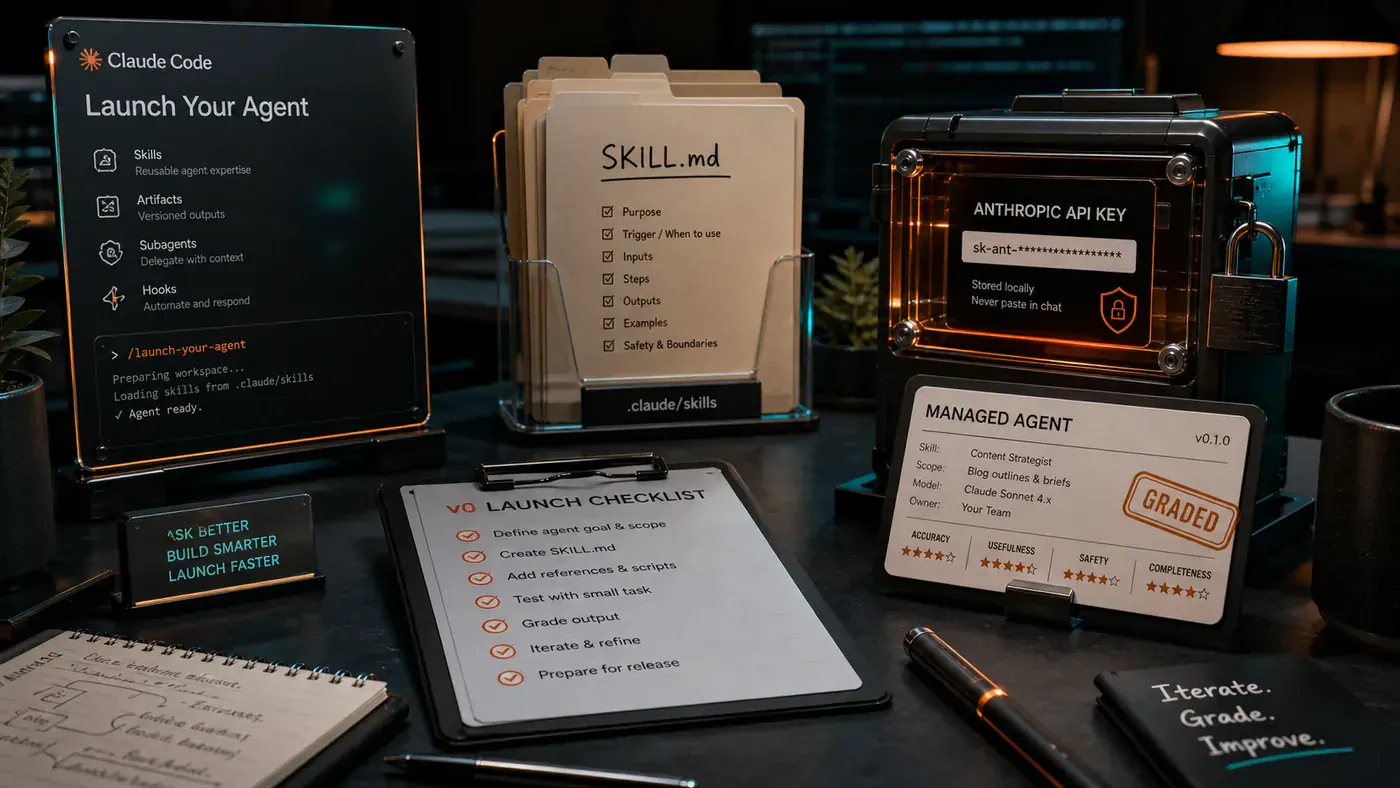
Pricing, Access, and Comparison Notes
Pricing and access should be checked at implementation time because AI products change quickly. The safer decision is to compare the tool against the job-to-be-done, not against launch hype.
- API usage is token based, so pilots need a budget cap, max-turn limit, and sample workload before broad rollout.
- Compare this against a custom Claude Code skill, a scheduled automation, and a managed agent only after the v0 task proves repeatable.
- Do not paste API keys into chat; store credentials locally according to the repo instructions and review who can run the agent.
| Decision area | What to compare |
|---|---|
| Access | Plan, preview status, region, account type, admin controls, and rate limits. |
| Cost | Subscription, credits, API tokens, retries, hardware, review time, and support burden. |
| Fit | Workflow reliability, data handling, output quality, observability, and human approval needs. |
Implementation Notes for Teams
For AI Kick Start readers, this is the production filter: keep the first rollout narrow, make the evidence visible, and do not let the tool cross a business boundary until the review model is clear.
- Keep tool permissions narrow until the agent has passed a repeatable grading run.
- Use source-controlled skills and examples so the agent can be relaunched by someone else.
- Add review gates before external messages, customer data access, or write actions.
Screenshot and Visual Guidance
The second inline image for this article should make the implementation concrete: A clean project bench with a labelled SKILL.md folder, secure API-key lockbox, v0 checklist, and a graded managed-agent card. If the team is documenting a real rollout, capture setup screens, before/after outputs, permission settings, cost meters, and review evidence rather than decorative screenshots.
Where It Fits for Real Teams
For founders, the opportunity is speed with evidence. This kind of workflow can reduce the time between idea and first useful output, but it should still produce artefacts that a customer, manager, or developer can inspect.
For operators, the value is consistency. If the same task is done slightly differently every time, AI can either make the inconsistency worse or help standardise the path. The difference is whether the workflow has rules, examples, and review checkpoints.
For technical teams, the value is leverage. A strong setup lets agents, models, or creative systems take on repeatable work while engineers keep control over architecture, security, deployment, and final judgement.
The practical fit is strongest when the task has clear source material, a known output format, and a low-cost way to verify quality. It is weaker when the task is vague, politically sensitive, legally risky, or dependent on facts that cannot be checked.
Trade-offs and Risks
The main risk is over-broad tool access. That risk can be managed, but only if it is named before the workflow becomes normal.
A second risk is unclear ownership. AI systems often look better in a screen recording than they feel inside a production workflow. The test is whether the result is repeatable when the source material changes, the operator changes, and the deadline is real.
The third risk is prompt-only agents that cannot be reproduced. This is why AI Kick Start generally recommends a staged rollout: sandbox first, internal use second, customer-facing deployment last.
The Next Sensible Test
The next sensible test is a small controlled implementation. Pick one workflow, one owner, one expected output, and one acceptance check. Run it twice. If the second run is easier than the first, the pattern is worth keeping.
Do not judge the workflow by the best possible demo. Judge it by the worst acceptable production case. Ask: what happens when the source file is incomplete, the tool is unavailable, the output is wrong, or a staff member needs to explain the result to a customer?
If those answers are clear, this belongs in the roadmap. If they are not, it belongs in the lab until the operating model catches up.
Helpful Resources
- skool.com (opens in a new tab)
- github.com (opens in a new tab)
- Anthropic Claude documentation (opens in a new tab)
- Video Source:
- Claude Code's NEW Open Source Repo Builds Effective AI Agents in MINUTES! by Duncan Rogoff | Learn Claude Code